





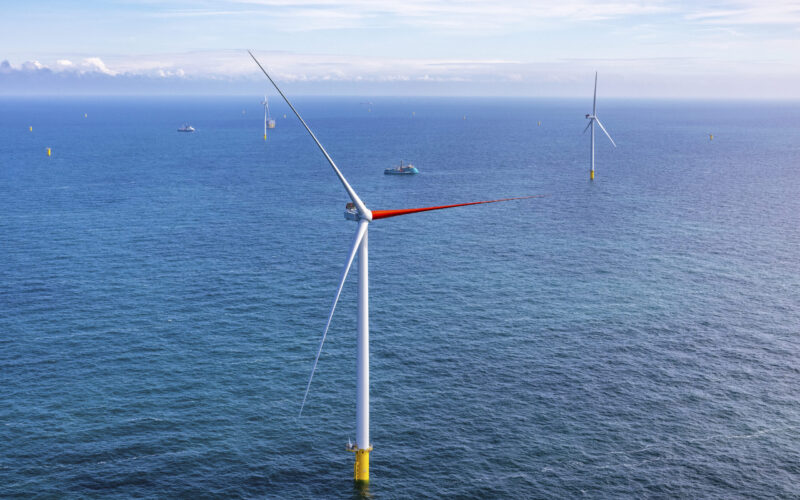
Shell plc (LSE: SHEL; NYSE: SHEL), Chubu Electric Power Co., Inc. (Tokyo: 9502) and Eneco have begun generating and marketing electricity from the 760 MW Ecowende offshore wind farm at Hollandse Kust West, approximately 53 kilometres off the Dutch coast. First power follows the project’s connection to TenneT’s offshore grid and begins the phased commercial commissioning of 52 Vestas Wind Systems A/S (Nasdaq Copenhagen: VWS) turbines. Shell Energy Europe Limited will purchase 60% of the electricity, while Next Kraftwerke will manage day-ahead, intraday, balancing and congestion-market participation. Full commercial power delivery is expected by the end of 2026, when Ecowende is projected to generate approximately 3.3 TWh annually. The milestone moves Ecowende from construction into a more consequential test of whether merchant electricity trading, grid services and nature-focused design can support offshore wind economics without a conventional generation subsidy.
Why does Ecowende’s first power matter more than a routine construction milestone?
First power confirms that the offshore turbines, inter-array cables, offshore substation and TenneT grid connection can operate together and deliver electricity to the Dutch power system. This is a more meaningful milestone than turbine installation because it begins the transition from capital expenditure to revenue generation. However, first power does not mean the complete wind farm has reached commercial operation or that every turbine is producing at full availability.
The remaining turbines must be commissioned in stages, tested under different operating conditions and integrated into the project’s control and market-management systems. Commissioning can expose faults involving turbine controls, electrical equipment, cables, transformers or communications that were not visible during installation. Ecowende must therefore convert an initial technical success into dependable production across the entire 760 MW project.
The timing is strategically important because European offshore wind economics have deteriorated since Ecowende won its development rights in 2022. Construction costs, financing rates and electricity-market uncertainty have increased, while several later auctions have struggled to attract developers. Ecowende now provides a live test of whether a project awarded during the zero-subsidy period can generate acceptable returns under current market conditions.
The financial terms remain largely undisclosed. Ecowende has not published total construction spending, expected project returns or the average price at which its electricity will be sold. Investors can therefore assess construction progress and commercial structure, but not the precise profitability of the project.
How will Shell and Next Kraftwerke convert Ecowende’s output into electricity-market revenue?
Shell Energy Europe Limited will act as the offtaker for 60% of Ecowende’s electricity production. That proportion closely matches Shell plc’s 60% ownership of the project, although the commercial offtake contract and the equity stake remain separate arrangements. The structure gives Shell plc access to a substantial renewable-electricity portfolio that can be traded, supplied to customers or combined with other energy products.
Next Kraftwerke will manage the wind farm across the day-ahead, intraday and balancing markets. This means Ecowende’s electricity will not simply be sold through one fixed long-term contract at one price. Production forecasts and market conditions will determine how power is scheduled and adjusted as wind output and customer demand change.
Day-ahead trading establishes an initial production schedule based on expected wind conditions. Intraday trading allows that schedule to be adjusted when forecasts change, while balancing services compensate for differences between expected and actual electricity supply. Strong forecasting and active trading can reduce imbalance penalties and capture additional value from periods of market volatility.
The commercial model introduces more complexity than a fixed-price power purchase agreement. Revenue can benefit from high electricity prices and valuable balancing services, but it can also be exposed to negative prices, weak demand and periods when many offshore wind farms generate simultaneously. Shell plc and Next Kraftwerke must therefore optimise the project as part of a wider electricity portfolio rather than treating each megawatt-hour as interchangeable.
The arrangement also provides Shell plc with customer-supply opportunities. Renewable electricity from Ecowende can support corporate contracts and lower-carbon energy products for industrial or commercial customers. The value will depend on whether Shell plc can secure customers willing to pay for predictable renewable supply rather than relying primarily on volatile wholesale prices.
Why are balancing and congestion services becoming essential to offshore wind economics?
Large offshore wind farms can create operational challenges when weather conditions cause several gigawatts of generation to rise or fall together. The electricity system must continuously match supply and demand, and deviations can affect frequency stability. Ecowende will participate in balancing markets, including automatic negative frequency reserve, by reducing output when the grid has excess electricity.
The ability to reduce generation has commercial value because system operators pay qualified assets for flexibility. Wind farms were historically viewed mainly as variable generators that created balancing requirements. Digital control and active market participation increasingly allow them to provide part of the flexibility required to manage renewable-heavy electricity systems.
Congestion management is also relevant in the Netherlands, where grid capacity has struggled to keep pace with renewable generation, electrification and data-centre demand. Electricity may be abundant offshore while onshore transmission constraints prevent it from reaching consumers efficiently. Next Kraftwerke’s role as congestion-service provider could help adjust Ecowende’s output when parts of the network become overloaded.
These services cannot fully protect the project against curtailment or negative prices. Reducing output means losing electricity production, and balancing-market revenue may not always compensate for the lost wholesale sale. The long-term economics will depend on how frequently congestion occurs, the prices paid for flexibility and the accuracy of Ecowende’s production forecasts.
The project’s 20 MW of turbine capacity above its 760 MW grid connection may provide a modest production advantage. The 52 Vestas turbines have a combined nominal rating of 780 MW, allowing the wind farm to use the 760 MW connection more fully when individual turbines or wind conditions produce below maximum output. The project will still be capped by its grid export limit during periods of peak generation.
Why does Ecowende matter as the Netherlands retreats from zero-subsidy offshore wind?
Ecowende was awarded through a Dutch tender that did not provide a conventional operating subsidy for each unit of electricity generated. The project’s owners were expected to recover their investment through electricity sales, power contracts and market optimisation. TenneT separately developed the offshore grid connection, meaning the project remained supported by publicly planned transmission infrastructure even without a direct generation subsidy.
That model appeared commercially credible when offshore wind costs were falling, interest rates were low and corporate demand for renewable power was expanding. The conditions later changed. Equipment, construction and financing costs increased, while lower-than-expected electricity demand and more frequent negative prices weakened expected merchant returns.
The Netherlands subsequently received no bids for a 1 GW offshore wind tender and moved toward offering substantial public support for future projects. The policy reversal shows that zero-subsidy development was not necessarily a permanent destination for the sector. Ecowende reaching first power is therefore commercially important because it represents one of the later large projects developed under the earlier market assumptions.
Successful operation would not prove that every new offshore wind project can be financed without support. Ecowende benefits from an established North Sea supply chain, a TenneT grid connection, large corporate shareholders and access to Shell plc’s trading platform. New projects in deeper water or farther offshore may face higher costs and weaker revenue visibility.
However, strong Ecowende performance could demonstrate that active trading, corporate offtake and grid services can reduce dependence on fixed subsidies. Weak returns would strengthen the argument that future European offshore wind projects require contracts for difference, capacity-style payments or other forms of revenue stabilisation.
Can Ecowende’s ecological design become a commercial advantage rather than an added cost?
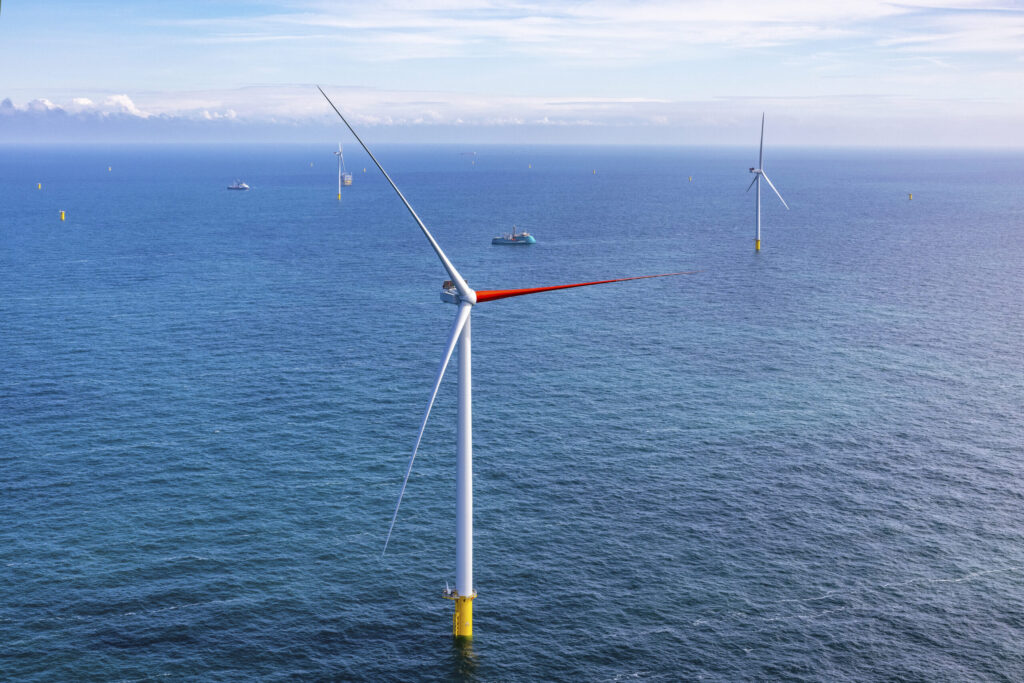
Ecowende was selected partly because of its nature-inclusive design rather than only its electricity price. The project incorporates wider turbine spacing, a dedicated bird corridor, elevated nacelles, radar monitoring and adaptive curtailment intended to reduce risks to birds and bats. Seven turbines will each use one red-painted blade to test whether stronger visual contrast reduces bird collisions.
Below the water, the project uses specially designed scour protection, fish openings in monopile foundations and habitat features intended to support marine life. Three foundations were also assigned to a lower-noise installation approach. These measures turn Ecowende into a large offshore ecological research site as well as an electricity-generating asset.
The immediate commercial effect may be higher complexity and cost. Monitoring equipment, modified foundations, curtailment rules and specialised installation methods require additional engineering and operating coordination. If turbines are stopped more frequently during bird migration, the project could also sacrifice some electricity production.
The potential benefit is faster and more durable permitting for future projects. Public opposition and environmental litigation can delay offshore wind developments for years, creating costs far greater than the price of individual ecological measures. Demonstrating that mitigation techniques work could reduce planning risk across future North Sea tenders.
Data will be as important as the physical measures. Ecowende must show which interventions reduce ecological harm and which merely create attractive project presentations. Measures that prove effective could become future permit requirements, while unsuccessful experiments may be removed from later designs.
Chubu Electric Power Co., Inc. has a particular strategic interest in this knowledge. Its 30% investment was its first direct participation in an offshore wind development, giving the Japanese utility access to construction, commissioning and biodiversity-management experience that could be applied to projects in Japan and other markets.
What does first power mean for Shell’s changing renewable-energy strategy?
Shell plc retains the largest Ecowende interest at 60%, making the project one of its more substantial operating offshore wind exposures in Europe. The company can earn returns through project ownership, electricity offtake, wholesale trading and customer supply. This integrated structure provides more potential revenue sources than a passive minority investment.
The project arrives as Shell plc applies tighter capital discipline across low-carbon businesses. The company has reduced or restructured parts of its renewable-development pipeline while prioritising businesses where it can combine physical energy assets with trading and customer relationships. Ecowende fits that preference because Shell plc is involved in ownership, offtake and market optimisation.
Even at full production, Ecowende will remain small relative to Shell plc’s group earnings and cash flow. The project will not independently determine shareholder distributions, upstream investment or liquefied natural gas strategy. Its significance lies in testing whether Shell plc can earn competitive returns from integrated power rather than simply accumulating renewable capacity.
The project will also reveal whether Shell plc’s trading capabilities create a measurable advantage over traditional utility ownership. Strong optimisation could improve revenue and reduce imbalance costs. Poor electricity prices or persistent congestion could demonstrate that even sophisticated trading cannot fully overcome weak market fundamentals.
Eneco’s 10% direct interest is smaller after it sold 30% to Chubu Electric Power Co., Inc. However, Eneco remains responsible for day-to-day offshore operations alongside Vestas Services, preserving operational involvement and access to project experience. The ownership structure spreads capital risk while keeping Dutch utility expertise inside the project.
How important is Ecowende for Vestas and the European offshore wind supply chain?
Vestas Wind Systems A/S is supplying 52 V236 turbines rated at 15 MW each and will service the wind farm under a 15-year agreement. Ecowende therefore provides both equipment revenue and a long-duration service opportunity. The service contract may become increasingly valuable as turbines age and availability depends on preventive maintenance, component replacement and digital monitoring.
The project is also an important reference for the V236 platform. Large turbines reduce the number of foundations, cables and installation operations required for a given project capacity. However, each unit becomes more consequential because a single turbine outage removes 15 MW from production.
Vestas Wind Systems A/S must demonstrate that the turbines can achieve reliable availability in North Sea conditions. Early operating problems could create warranty costs and affect customer confidence in future offshore orders. Successful performance would strengthen the platform’s credentials at a time when developers are demanding greater certainty over turbine reliability and lifecycle cost.
Van Oord has managed foundation transport and installation, inter-array cables, turbine installation and scour protection. Sif Holding supplied the monopile foundations, while TenneT delivered the offshore grid infrastructure. The project illustrates how offshore wind depends on coordinated execution across multiple contractors rather than one dominant engineering company.
The remaining commissioning phase still carries supply-chain risk. Turbine testing, cable energisation and control-system integration must proceed while weather conditions remain suitable for offshore access. A problem involving one common component could affect several turbines and delay full commercial operation beyond the year-end target.
Why has Ecowende first power had little direct impact on Shell and Vestas shares?
Shell plc American depositary shares closed at approximately $78.14 on July 6, around 1.6% above the June 29 close but approximately 9.8% below the June 8 close. The shares remained within a 52-week range of about $68.62 to $94.90. The one-month decline primarily reflects wider oil, gas and integrated-energy sentiment rather than the economics of one Dutch offshore wind farm.
Ecowende is not large enough to materially alter Shell plc’s near-term earnings outlook. Investors place much greater weight on commodity prices, liquefied natural gas volumes, upstream production, refining margins, acquisitions, debt and shareholder distributions. First power is strategically constructive but financially incremental at group level.
Vestas Wind Systems A/S closed near DKK184 on July 6, approximately 3.2% above its June 29 close and about 5.3% higher than on June 8. The shares were trading within a 52-week range of roughly DKK102.75 to DKK203. The recovery reflects broader confidence in improving wind-turbine demand and profitability, although the stock remains sensitive to warranties, pricing and offshore order execution.
For Vestas Wind Systems A/S, Ecowende contributes to an already contracted equipment and service portfolio rather than creating an entirely new order. Reaching first power reduces project-execution risk and begins the transition toward service revenue. The market is unlikely to assign a separate valuation uplift unless turbine performance materially changes expectations for the wider V236 fleet.
Chubu Electric Power Co., Inc. traded near ¥3,174 on July 6, close to the upper end of its approximately ¥1,783 to ¥3,203 52-week range. Its shares had gained strongly over the preceding month, but Ecowende represents only one component of a much larger Japanese utility and international investment portfolio. The project’s strategic learning value may exceed its immediate earnings contribution.
What operational milestones will determine whether Ecowende becomes a successful investment?
The first milestone will be completion of turbine commissioning by the end of 2026. Investors should watch whether the project reaches full commercial delivery on schedule or experiences delays involving turbines, cables or grid systems. The difference between first power and full availability can be financially meaningful.
The second milestone will be actual annual generation. Ecowende expects approximately 3.3 TWh per year, but output will depend on wind conditions, turbine availability, grid constraints and ecological curtailment. Several years of operating data will be required before the project’s normalised production profile becomes clear.
The third milestone will be market revenue quality. Shell plc and Next Kraftwerke must demonstrate that day-ahead, intraday and balancing-market optimisation can protect value during periods of high renewable production and negative electricity prices. Generation volume alone will not reveal whether the project is earning attractive returns.
The fourth milestone will be Vestas turbine reliability. Availability, maintenance requirements and major-component performance will influence operating costs and service-contract economics. A small number of extended turbine outages could materially reduce project production.
The fifth milestone will be ecological evidence. Monitoring must show whether red blades, bird corridors, radar systems, quieter installation techniques and marine habitat measures produce measurable environmental benefits. Credible data could influence future offshore wind tender design across Europe.
The final milestone will be shareholder disclosure. Shell plc, Chubu Electric Power Co., Inc. and Eneco have not published detailed Ecowende capital costs or return expectations. Greater financial transparency would help investors understand whether the project is merely operationally successful or also commercially competitive.
Key takeaways on what Ecowende first power means for Shell and offshore wind
- Ecowende has produced its first electricity and begun phased commercial commissioning after connecting to TenneT’s offshore grid.
- The 760 MW project contains 52 Vestas Wind Systems turbines and is expected to generate approximately 3.3 TWh annually.
- Full commercial power delivery remains targeted for the end of 2026, meaning construction and commissioning risks have not fully disappeared.
- Shell Energy Europe Limited will purchase 60% of production, while Next Kraftwerke manages wholesale trading, balancing and congestion services.
- Active market optimisation could improve revenue, but Ecowende remains exposed to negative prices, curtailment and Dutch grid constraints.
- The project is an important test of a zero-subsidy offshore wind model that later became difficult to replicate as costs and interest rates increased.
- Shell plc owns 60% of Ecowende, Chubu Electric Power Co., Inc. owns 30% and Eneco owns 10%.
- Ecological measures may increase project complexity but could lower permitting and environmental risks for future North Sea developments.
- Vestas Wind Systems gains an important operating reference for its 15 MW turbine and a 15-year service revenue opportunity.
- The decisive tests will be year-end commissioning, turbine availability, annual generation, market revenue and evidence that ecological innovations work.
Discover more from Business-News-Today.com
Subscribe to get the latest posts sent to your email.
