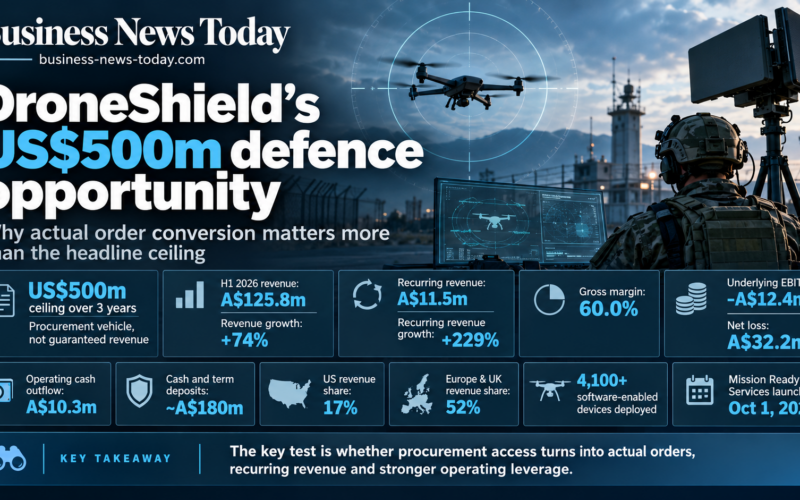
DroneShield Limited (ASX: DRO), the Australian counter-drone technology company, has secured access to a United States defence procurement programme carrying a maximum contract ceiling of US$500 million over three years. The September 30, 2026 award strengthens the company’s position in a rapidly expanding military and homeland security market, but the headline amount does not represent guaranteed revenue, a confirmed order book or an immediate addition to sales. The distinction is particularly important because DroneShield’s latest financial results reveal a company experiencing rapid revenue expansion alongside increasing operating expenditure and a transition towards more software-based recurring income.
The contract, awarded under the Joint Interagency Task Force 401 Domestic Shield initiative, uses an indefinite-delivery, indefinite-quantity structure. That arrangement establishes a procurement mechanism through which eligible purchases can be made, subject to actual requirements and subsequent orders. DroneShield has indicated that material orders awarded under the arrangement will be disclosed in accordance with applicable requirements, making future purchase commitments rather than the overall ceiling the critical measure of commercial progress.
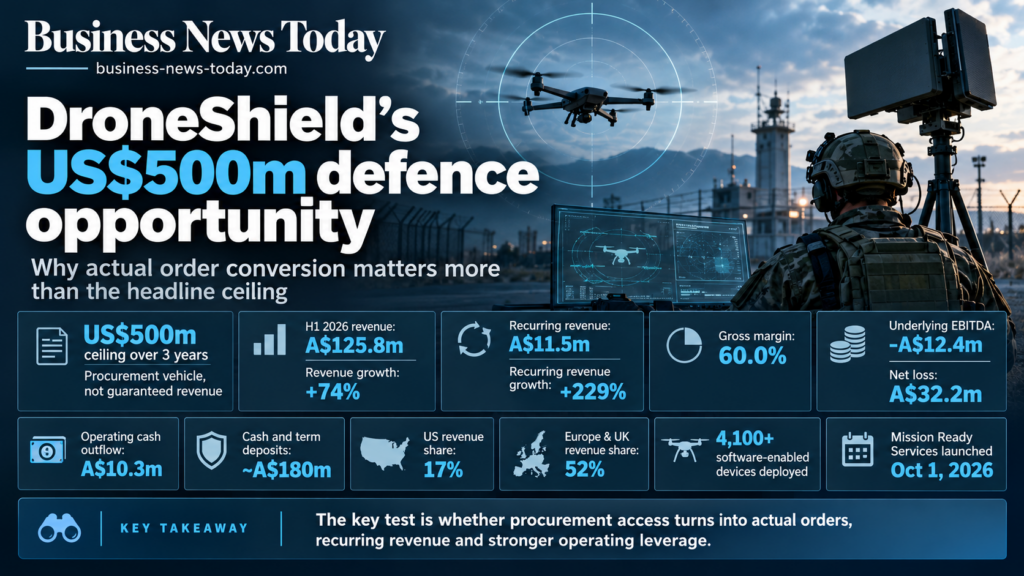
The company’s underlying financial performance provides a more useful starting point for assessing this opportunity. Revenue reached A$125.8 million in the six months ended June 30, 2026, an increase of 74% from the corresponding period, while recurring revenue grew 229% to A$11.5 million. However, gross margin declined to 60.0% from 65.3%, underlying EBITDA moved into a A$12.4 million loss, and the company recorded a statutory net loss of A$32.2 million. Those figures show that significant customer demand has already translated into sales, but profitable scaling remains a separate challenge.
How much of DroneShield’s US$500 million defence contract is actually guaranteed revenue?
The most important characteristic of the Domestic Shield agreement is its contractual structure. An indefinite-delivery, indefinite-quantity contract sets out a mechanism for ordering products or services over a specified period, with actual purchases governed by subsequent requirements and delivery orders. DroneShield’s announcement identified a maximum value of up to US$500 million over three years, establishing the potential scale of procurement accessible through the arrangement rather than confirming that amount as contracted sales.
The difference between procurement eligibility and firm customer commitments is fundamental to understanding the economic value of the award. A contract ceiling cannot automatically be recognised as revenue, nor should it be treated as equivalent to an executable order backlog. Revenue arises when the relevant accounting recognition conditions are met, while a procurement vehicle may remain available without generating anything close to its maximum permitted value.
A further distinction concerns the meaning of the three-year period. Dividing US$500 million by three produces an arithmetic average of approximately US$166.7 million annually, but that figure is not annual guidance, an announced purchasing schedule or a reasonable standalone revenue forecast. The allocation of actual orders could be uneven, concentrated in particular products or considerably below the ceiling, depending on defence requirements, available funding and procurement decisions.
This arrangement nevertheless has meaningful strategic value. DroneShield can offer its counter-drone technology through an established procurement pathway supporting military installations, defence infrastructure and other locations regarded as vulnerable to small unmanned aircraft. The company has already supplied counter-drone capabilities supporting Joint Interagency Task Force 401 requirements, including DroneSentry-X Mk2 deployments, so the new contracting mechanism builds upon an existing operational relationship rather than introducing a completely unfamiliar customer environment.
The strongest evidence of commercial success will therefore come from the size, timing and nature of subsequent purchase orders. Particularly relevant information will include whether purchases represent initial deployments, larger site-wide installations, repeat equipment orders or continuing software and support commitments. Those distinctions will establish whether the procurement framework becomes a material recurring revenue channel or remains primarily a strategically important route to future competition.
What do DroneShield’s first-half 2026 revenue, margins and cash flow reveal?
DroneShield’s first-half financial results demonstrate that the company is no longer dependent solely on the possibility of future defence contracts. Revenue increased from A$72.3 million in the first half of 2025 to A$125.8 million in the first half of 2026, reflecting a substantial expansion in commercial deliveries. The growth is particularly significant because defence procurement can involve lengthy purchasing cycles, technical evaluations and deployment requirements before demand becomes recognised sales.
However, the revenue growth did not translate into a corresponding improvement in profitability. Gross margin declined by 5.3 percentage points to 60.0%, meaning a smaller proportion of each dollar of revenue remained after the associated cost of sales. The company also reported an underlying EBITDA loss of A$12.4 million, compared with positive underlying EBITDA of A$8.0 million in the previous corresponding period, reflecting the challenge of scaling organisational capabilities while expanding commercial activity.
The statutory earnings comparison was similarly unfavourable. DroneShield recorded a net loss after tax of A$32.2 million for the first half of 2026, compared with a profit of A$2.1 million a year earlier. The results do not mean that rising defence demand has failed to benefit the business, but they demonstrate that sales growth alone is insufficient to establish sustainable profitability.
Operating cash flow provides another important measure because it captures the cash consequences of growing the business. Net operating cash outflow was A$10.3 million during the half-year, compared with an A$8.7 million outflow a year earlier. DroneShield also continued investing in property, equipment and intangible assets, indicating that the financial demands of expansion extend beyond routine operating expenditure.
The balance sheet nevertheless provides a degree of flexibility. At June 30, 2026, DroneShield reported approximately A$180 million in cash and term deposits, including deposits classified beyond cash equivalents. This represents a substantial liquidity resource relative to the operating cash outflow recorded during the first half, although future working-capital needs, investment spending and the timing of customer receipts will determine how that financial position evolves.
The company’s next financial updates will therefore need to demonstrate more than higher revenue alone. A stronger operating profile would combine sustained customer deliveries with improving cost absorption, disciplined investment and more reliable cash generation. Until those improvements become visible, the financial evidence supports a growth narrative more clearly than an established profitability narrative.
Why is DroneShield’s recurring software revenue becoming increasingly important?
One of the more consequential developments in DroneShield’s financial results is the expansion of subscription income. Revenue from subscriptions increased from A$3.5 million in the first half of 2025 to A$11.5 million in the first half of 2026, representing growth of approximately 225% using the reported financial statement figures. The company’s operational review describes recurring revenue growth of 229%, with the difference reflecting the precision and categorisation used in its disclosures. Subscription revenue accounted for approximately 9.2% of total first-half sales, up from 4.9% a year earlier.
The significance of this growth becomes clearer when the company’s product mix is examined. Hardware and shipping contributed A$109.4 million during the first half of 2026, representing approximately 87% of reported revenue. That demonstrates the continued importance of equipment deliveries, while simultaneously highlighting the opportunity to expand income generated after hardware has entered service.
DroneShield’s October 1 launch of Mission Ready Services represents a further step towards addressing that opportunity. The offering combines software updates, technical support, operator training and digital customer services under an annual renewable subscription structure. Existing software subscription customers are expected to transition to the new offering when their current subscriptions renew, potentially allowing the company to deepen relationships with customers whose equipment has already been deployed.
The company reported that more than 4,100 software-enabled devices were already deployed in the field at the time of the announcement. This installed base provides a measurable foundation for recurring-service expansion, although the number of deployed devices should not be confused with the number of paying subscriptions. Different customers may operate multiple devices, service contracts may cover different combinations of equipment, and subscription pricing may vary according to operational requirements.
The commercial opportunity is therefore broader than simply attaching a fixed annual subscription to every deployed unit. Software enhancements, technical support, training and system management could create additional service opportunities throughout the equipment lifecycle. However, the financial significance will depend on renewal rates, pricing, customer adoption and the costs associated with delivering those services.
A particularly useful future disclosure would be the proportion of deployed systems covered by paid recurring agreements. Together with subscription revenue growth and renewal data, that figure would provide a clearer indication of whether DroneShield is developing a durable software and services business or primarily generating recurring income as an extension of episodic hardware sales.
Can DroneShield convert expanding United States defence procurement into a larger revenue contribution?
The United States represented approximately 17% of DroneShield’s revenue during the first half of 2026, while Europe and the United Kingdom contributed approximately 52%. That geographic distribution demonstrates that the company’s existing revenue base remains particularly dependent on European demand, notwithstanding its expanding commercial presence in the United States. The Domestic Shield contracting arrangement creates an opportunity to increase the importance of the American market, but the scale of that transition remains dependent on future orders.
The United States counter-drone market also presents procurement characteristics that distinguish it from conventional commercial technology markets. Equipment must meet operational requirements, integrate with existing security and defence systems, and function within applicable regulatory and procurement frameworks. Establishing access to an approved procurement channel can reduce certain purchasing obstacles, but it does not eliminate competition, budget constraints or customer-specific technical requirements.
DroneShield’s position benefits from its existing relationship with Joint Interagency Task Force 401 and previous deliveries of mobile counter-drone technology. That operating history provides evidence of practical deployment rather than merely laboratory-level capability. Nevertheless, existing acceptance of one product or configuration does not automatically establish demand for every offering available through the company’s broader portfolio.
The competitive environment also deserves attention. SRC Inc. announced on October 6 that it had received a separate three-year Domestic Shield procurement contract with a US$500 million ceiling, alongside an initial US$10.24 million delivery order for radar equipment and associated services. That disclosure illustrates both the presence of competing suppliers and the distinction between the maximum value of a procurement arrangement and the value of actual orders placed under it.
The comparison is instructive because two suppliers may each have access to substantial procurement ceilings without those figures representing guaranteed programme expenditure or exclusive allocations. DroneShield’s ultimate commercial outcome will depend on the orders it secures, its ability to deliver the required systems and the economics of those deliveries. Procurement access is an important competitive qualification, but realised revenue remains the stronger indicator of market penetration.
What would stronger contract conversion mean for DroneShield’s margins and operating leverage?
DroneShield’s growth creates a potentially favourable operating leverage opportunity, but its first-half financial performance shows why that outcome cannot yet be assumed. The company expanded its workforce from 363 employees at June 30, 2025, to 535 employees at June 30, 2026, representing an increase of approximately 47%. This organisational expansion may support research, production, software development and customer delivery, but it also increases the operating cost base that future revenue must support.
Higher sales volumes could improve profitability if fixed costs are spread across a larger revenue base and product margins remain attractive. Conversely, rapid recruitment, manufacturing investment, customer support commitments and research expenditure could continue absorbing incremental gross profit. The first-half decline in gross margin underscores the importance of monitoring product mix and contract economics rather than assuming that every additional dollar of sales will have an identical profitability effect.
Defence contract structures can also influence cash generation. A large equipment delivery may require inventory purchases, manufacturing activity and other expenditure before final customer payments are received. The timing of advance payments, contractual milestones, delivery acceptance and settlement terms can therefore materially affect working capital even when reported revenue is increasing.
DroneShield’s June 2026 balance sheet included A$85.0 million of inventory and A$63.4 million of trade and other receivables. These balances illustrate the financial resources involved in supporting an expanding hardware business, although they should not independently be interpreted as evidence of poor collections or excess stock. Their future movement relative to revenue, customer receipts and confirmed orders will be an important indication of how efficiently the business is scaling.
The growing subscription business could eventually provide a useful counterbalance to the timing variability associated with hardware contracts. Recurring services may generate more predictable income, but that benefit depends on actual renewal performance and the company’s ability to deliver support efficiently. For now, the reported revenue mix indicates that equipment procurement remains the principal driver of commercial performance.
How has DroneShield’s share price responded to the latest defence announcements?
DroneShield shares closed at A$1.69 on October 7, 2026, compared with A$1.62 on September 29, immediately before the Domestic Shield announcement. That represents an increase of approximately 4.3% across the period, although the movement cannot be attributed exclusively to the contract announcement. The stock also reached a closing price of A$1.83 on October 2 before retreating during subsequent sessions.
The trading pattern suggests that the procurement development has not produced a sustained upward move through the entire period following the announcement. This observation does not establish whether the market has correctly assessed the company’s commercial prospects, particularly because short-term trading can reflect broader market conditions, changes in risk appetite and company-specific expectations. What is clear is that the contractual ceiling and the company’s current financial performance remain fundamentally different measures.
DroneShield’s share-price performance also needs to be distinguished from its operational growth. Revenue increased sharply during the first half of 2026, but operating profitability deteriorated, creating a mixed financial picture. A larger addressable procurement opportunity does not remove the need for evidence that future sales can generate adequate returns on the company’s expanding operating and capital expenditure.
The next substantive financial disclosures will provide a stronger basis for evaluating the direction of the business than short-term price movements alone. Confirmed contract orders, subscription revenue, margins and operating cash flow will help establish whether the company’s growing commercial footprint is producing the financial improvements needed to support its expansion.
Which financial and commercial milestones will determine the value of DroneShield’s US defence opportunity?
The clearest near-term milestone will be the announcement of material purchase orders under the Domestic Shield procurement arrangement. Such disclosures would allow the market to begin distinguishing the programme’s theoretical ceiling from actual committed business. Order size, product composition, delivery schedules and any associated support commitments would provide a more meaningful picture of the contract’s commercial significance than the headline ceiling alone.
The second milestone concerns the company’s recurring revenue strategy. DroneShield has demonstrated rapid subscription growth and introduced a broader annual service offering, but future results will need to establish whether that strategy materially changes the balance between hardware and recurring income. Subscription penetration, renewal performance and the contribution of services to overall profitability would provide useful measures of progress.
A third milestone is improvement in operating leverage. The company’s first-half revenue growth demonstrates substantial commercial momentum, while its EBITDA loss, lower gross margin and negative operating cash flow show that the economic benefits of scale remain incomplete. Sustained revenue growth accompanied by stabilising expenses, improving margins and stronger cash conversion would represent more convincing evidence of a successful business transition.
DroneShield therefore occupies an interesting position within the expanding counter-drone industry. It has an established revenue base, deployed technology, growing recurring subscriptions and access to a major United States defence procurement channel. At the same time, the company’s financial performance demonstrates that commercial expansion and sustainable profitability are not interchangeable.
The US$500 million contract ceiling establishes the potential size of one procurement opportunity, not the outcome that DroneShield has already achieved. The more consequential story will emerge through subsequent order announcements and financial results, where actual revenue conversion, profitability and cash generation can be measured. Those developments will determine whether the latest American defence opportunity becomes a material addition to DroneShield’s business or remains primarily an important strategic qualification.
Discover more from Business-News-Today.com
Subscribe to get the latest posts sent to your email.