

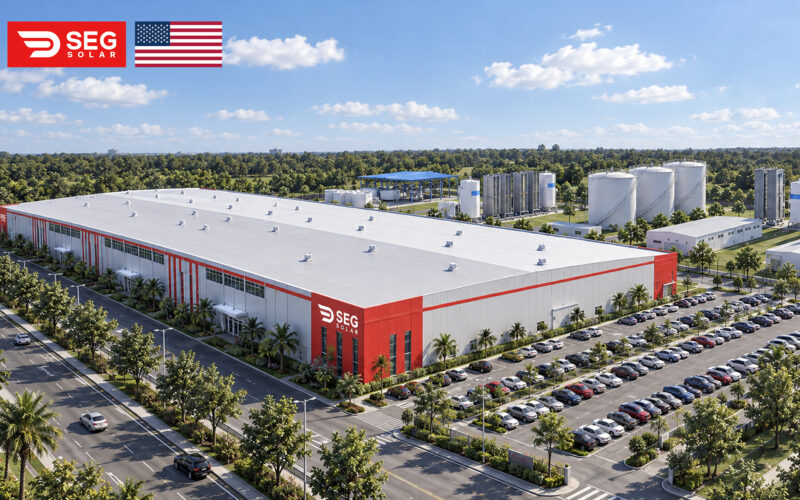
SEG Solar has signed a land agreement for a planned $950 million heterojunction solar cell manufacturing facility at its Tomball Industrial Campus in Greater Houston, Texas, advancing its strategy to integrate US solar cell and module production. Announced on October 29, 2026, the proposed plant would add 4 gigawatts of annual cell manufacturing capacity through two 2 GW phases targeted for 2028 and 2029, while creating more than 700 local jobs. The development follows the company’s expansion of domestic module manufacturing, including an operational 4 GW Tomball facility and another 4.6 GW module plant under construction. The investment would extend SEG Solar’s American manufacturing operations into a more capital-intensive segment of the photovoltaic supply chain. However, the land agreement does not establish that construction has begun or that the full investment has been financed, leaving project execution and commercial competitiveness as the central tests.
The proposed factory is designed to sit alongside SEG Solar’s existing and planned module operations, creating a manufacturing campus that brings solar cells, modules and selected supporting components closer together. The arrangement could reduce dependence on externally sourced cells, improve production coordination and offer developers greater visibility into the origin of equipment used in US solar projects. These advantages have become more commercially relevant as manufacturers and project developers navigate changing federal tax incentives, domestic-content requirements and restrictions affecting supply chains connected to prohibited foreign entities.
Jim Wood, chief executive officer of SEG Solar, described the expansion as part of the company’s effort to create a more accountable domestic supply chain. He indicated that integrating US-produced cells with locally manufactured modules would give customers clearer sourcing arrangements and greater confidence in product supply. The commercial outcome will depend on translating that strategy into reliable production volumes, competitive pricing and sustained customer demand.
How will SEG Solar’s $950 million Texas investment change its domestic manufacturing capacity and production strategy?
SEG Solar’s proposed solar cell facility represents a substantial extension of its existing American manufacturing footprint. The company already operates a 2 GW module factory in Houston and inaugurated its second US module manufacturing facility, Tomball #1, in August 2026. That newer plant has 4 GW of annual module capacity, including a 1 GW back-contact production line, and produced its first heterojunction module in September. SEG Solar announced in October that the facility had passed an Intertek factory audit and received authorisation to apply the ETL certification mark to qualifying modules.
These developments have established approximately 6 GW of annual US module nameplate capacity across the company’s first two factories. SEG Solar is also constructing Tomball #2, a separate 4.6 GW module manufacturing facility expected to begin operations in 2027. If completed as planned, that expansion would raise its total domestic module nameplate capacity to approximately 10.6 GW annually.
The planned cell factory would add a different manufacturing capability rather than another 4 GW of module assembly. Solar cells convert sunlight into electricity and are incorporated into finished photovoltaic modules, making cell production a key upstream stage in the manufacturing process. Establishing domestic capacity would allow SEG Solar to manufacture more of the components used in its Texas-assembled products.
The capacity figures also reveal an important limitation. Even if the proposed 4 GW cell plant reaches full output, it would represent only about 38% of the company’s planned 10.6 GW annual US module nameplate capacity on a simple watt-for-watt comparison. Actual requirements will depend on technology mix, manufacturing yields and production utilisation, but the figures indicate that the proposed investment would not make the entire module operation self-sufficient in domestically manufactured cells.
SEG Solar’s strategy is therefore better understood as partial upstream integration with potential for further expansion, rather than the immediate creation of a completely domestic photovoltaic supply chain. The new facility could secure an important volume of US-produced cells while leaving other production requirements dependent on additional sourcing arrangements.
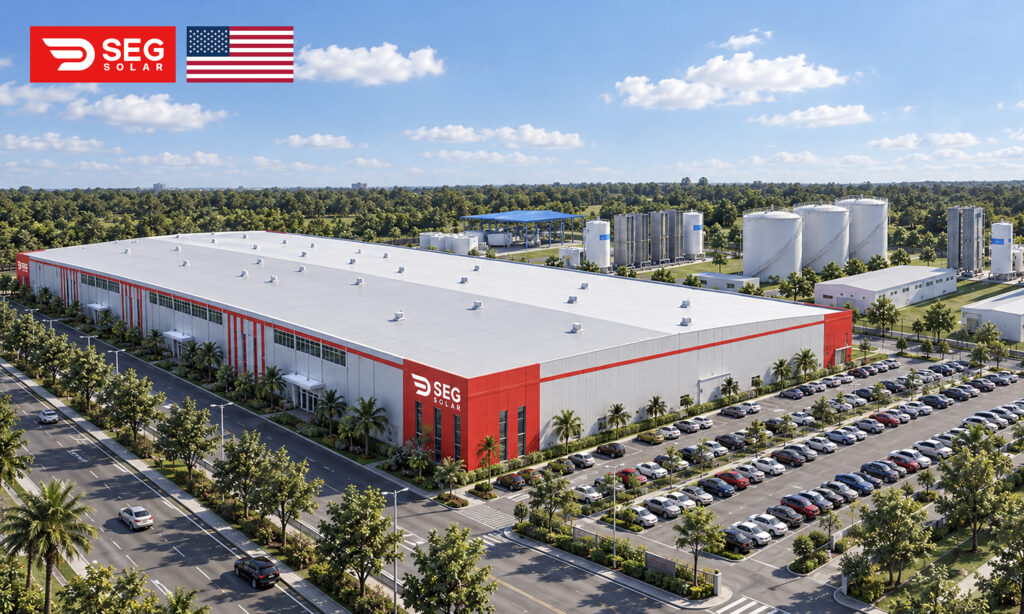
Why is the proposed 4 GW heterojunction solar cell factory strategically important for US solar manufacturing?
The United States has expanded solar module assembly more rapidly than several upstream manufacturing activities, creating an imbalance between the capacity to produce finished panels and the domestic availability of cells, wafers and other materials. This creates commercial exposure for manufacturers that assemble modules domestically but continue importing major components. Supply-chain restrictions, trade measures and changes in component pricing can affect production economics even when the final assembly process takes place in the United States.
Research published by the Clean Investment Monitor in October 2026 illustrates this imbalance. As of the third quarter of 2026, the United States had approximately 65 GW of operational solar module manufacturing capacity, including thin-film technology, compared with 20 GW of solar cell capacity and only 3 GW of wafer capacity. The study estimated that domestic cell manufacturing capacity was equivalent to approximately 41% of the solar capacity installed nationwide during 2025.
These figures indicate that upstream photovoltaic manufacturing remains less developed than module assembly. The imbalance is particularly relevant to crystalline silicon module producers that require compatible cells and wafers, since aggregate national capacity figures can include different technologies and manufacturing configurations. A new 4 GW cell factory could strengthen domestic supply, although its contribution would not materialise until production begins and commercially usable output is established.
The market opportunity also faces an evolving demand environment. The Clean Investment Monitor projects substantial US solar installations in 2026 and 2027, partly reflecting developers’ efforts to qualify for expiring federal incentives. Beyond that near-term period, deployment projections become more variable, influenced by regulatory conditions, project economics and competition from other sources of electricity generation.
For SEG Solar, this creates a timing challenge. The company is planning a major upstream manufacturing investment that would become operational after the immediate 2026 and 2027 installation cycle. Its business case must therefore remain competitive under the market conditions expected in 2028 and 2029, rather than relying solely on current demand for domestic manufacturing capacity.
Can SEG Solar’s HJT technology provide enough efficiency and performance advantages to justify its higher manufacturing investment?
The proposed Texas facility will use heterojunction technology, commonly known as HJT, which combines crystalline silicon with thin layers of amorphous silicon to improve certain photovoltaic performance characteristics. The technology is associated with high conversion efficiency potential, favourable temperature behaviour and strong bifacial performance, allowing suitable modules to capture electricity from light reaching both sides of the panel.
SEG Solar has highlighted these characteristics in connection with the HJT modules produced at Tomball #1. The company expects the technology to support higher lifetime electricity generation under appropriate operating conditions, particularly where temperature sensitivity and reflected light contribute meaningfully to system performance. These potential advantages are relevant to utility-scale developers evaluating lifetime electricity production rather than upfront module prices alone.
However, superior technical specifications do not automatically translate into a commercial advantage. HJT manufacturing economics depend on equipment investment, production throughput, material consumption, conversion efficiency, cell yields and the costs of competing technologies. Solar manufacturers must also consider whether customers are willing to pay a premium for performance improvements or whether those improvements generate sufficiently lower lifetime electricity costs to justify the equipment.
The competitive comparison includes tunnel oxide passivated contact technology, known as TOPCon, and back-contact cell designs. These technologies have also advanced in efficiency and manufacturing scale, giving customers several options for high-performance photovoltaic modules. SEG Solar’s own 4 GW Tomball #1 module facility includes a back-contact line, indicating that its product strategy is not exclusively dependent on HJT.
The planned $950 million investment will therefore need to deliver more than production capacity. Sustained competitiveness will depend on the ability to manufacture reliable HJT cells at attractive unit costs, operate production lines efficiently and secure demand for the resulting modules. A factory with advanced technology but insufficient utilisation could struggle to recover its capital expenditure.
How could US manufacturing tax credits and domestic-content rules affect the economics of SEG Solar’s Texas project?
Federal manufacturing incentives are a potentially important element of the financial environment surrounding SEG Solar’s investment. Section 45X of the US Internal Revenue Code provides an advanced manufacturing production credit for qualifying photovoltaic components produced and sold in accordance with the applicable requirements. Under the statutory framework, eligible crystalline photovoltaic cells can receive a credit calculated at four cents per direct-current watt.
At the proposed factory’s full annual nameplate capacity of 4 GW, that statutory rate equates to a theoretical gross credit calculation of $160 million for a year in which 4 GW of qualifying cells are produced and sold at the full rate. This is an illustrative calculation, not a forecast of SEG Solar’s tax-credit receipts. Actual benefits would depend on eligible production, qualifying sales, applicable tax rules, ownership and sourcing requirements, and the timing of commercial operations.
Timing is particularly relevant because the general Section 45X phaseout for applicable solar components begins with sales after December 31, 2029. Under the existing schedule, the credit falls to 75% of its original value in 2030, 50% in 2031 and 25% in 2032, before reaching zero for qualifying sales after 2032. SEG Solar’s proposed initial operating phases in 2028 and 2029 would precede that general phaseout if the schedule is achieved.
Additional restrictions complicate the calculation. Federal legislation enacted in 2025 introduced prohibited foreign entity rules and material-assistance requirements affecting eligibility for certain energy tax credits. The US Department of the Treasury and Internal Revenue Service issued further guidance in February 2026 addressing the application of these restrictions. Manufacturers must account for qualifying ownership structures and the origin of relevant materials and components, rather than assuming that locating a factory in the United States guarantees the credits.
SEG Solar has not disclosed a project-specific tax-credit forecast, and the announced $950 million investment should not be treated as reduced by any hypothetical incentive amount. Its financial model will also depend on the cost and availability of financing, construction expenditure, operating expenses and customer prices.
Domestic-content incentives create a separate potential commercial benefit for solar project developers purchasing eligible US-manufactured equipment. However, the contribution of domestic cells and modules to a project’s qualification depends on the relevant rules, product composition and applicable credit provisions. SEG Solar’s expanded manufacturing footprint could improve customers’ sourcing options, but the October announcement does not establish that every future product will automatically satisfy domestic-content requirements.
What does the planned $950 million investment reveal about the capital intensity and financing requirements of US solar cell production?
The proposed investment amounts to approximately $237.5 million per gigawatt of annual nameplate cell manufacturing capacity. Expressed another way, the announced capital expenditure equates to approximately $0.238 per watt of planned annual manufacturing capacity. This measures the scale of investment relative to factory output capability and should not be confused with the cost of producing an individual cell or the selling price of solar equipment.
A $950 million programme would require substantial spending on specialised production equipment, manufacturing infrastructure, utilities and related operational systems. HJT cell production involves multiple controlled processing stages, making equipment commissioning, process optimisation and yield management important determinants of eventual operating efficiency. The economic return would depend on how much commercially acceptable output the factory delivers relative to its installed nameplate capacity.
SEG Solar has not identified the financing structure for the project. The announcement does not specify the proportion expected to come from internal capital, debt, outside investors, customer arrangements or public-sector support. Without those details, there is insufficient evidence to assess the project’s financing cost, repayment obligations or expected investment return.
The company is also undertaking the separate expansion of its module manufacturing footprint. Its 4.6 GW Tomball #2 plant remains under construction, while the proposed HJT cell facility would introduce another major development programme on the same industrial campus. Coordinating these investments could provide infrastructure and operational advantages, but it may also increase demands on management capacity, procurement and capital planning.
A phased commissioning strategy provides some flexibility. Launching the first 2 GW of cell capacity in 2028 could allow SEG Solar to establish production performance and customer demand before the second phase planned for 2029. However, the announcement does not establish whether later expenditure is conditional on first-phase performance or whether the full financing programme has already been committed.
The next financial milestone would be a clearer disclosure of the project’s funding arrangements and construction commitments. Evidence of committed capital, equipment procurement and confirmed implementation schedules would materially strengthen confidence in the announced timetable.
How will the Texas facility connect with SEG Solar’s existing manufacturing operations and international supply chain?
SEG Solar’s proposed investment is part of a broader manufacturing strategy spanning the United States and Indonesia. The company has pursued upstream photovoltaic manufacturing through its Indonesian industrial park, including development of ingot and wafer capabilities. In December 2025, SEG Solar announced the build-out of an initial 3 GW ingot and wafer manufacturing facility in Indonesia as part of a larger 5 GW expansion plan.
The Indonesian investment was designed to support a more integrated international supply chain serving the US solar market. Its planned production capabilities could complement SEG Solar’s American operations, although sourcing arrangements would need to meet applicable trade, customs and tax-credit eligibility requirements. The October Texas announcement does not establish that every upstream input for the proposed HJT cells will originate domestically.
At Tomball, SEG Solar intends to combine cell production with module manufacturing, warehousing, research and development, testing and supporting component operations. The campus includes a planned ethylene vinyl acetate encapsulant production line and junction box manufacturing capability. Bringing these activities closer together could improve manufacturing coordination, inventory management and quality control across selected stages of module production.
The location of the cell factory adjacent to existing facilities may also provide logistical benefits. Shorter movements between cell production and module assembly could simplify material handling and potentially reduce lead times, provided the plants operate on compatible schedules and production volumes. Integration could also support better traceability between individual cells, finished modules and associated testing records.
The manufacturing footprint nevertheless remains geographically distributed. Full domestic sourcing would require additional clarity about wafers, ingots, polysilicon and other inputs used by the planned Texas cell operation. SEG Solar’s strategy can strengthen local manufacturing without necessarily eliminating reliance on international suppliers.
What economic benefits could the SEG Solar expansion bring to Tomball and the Greater Houston manufacturing economy?
SEG Solar estimates that the proposed 4 GW HJT cell facility would create more than 700 local jobs. The employment projection adds to the company’s existing industrial expansion in Greater Houston, where manufacturing investments have involved production facilities, logistics operations and supporting technical capabilities. New cell manufacturing activity could create demand for equipment maintenance, process engineering, quality assurance and industrial services.
The proposed $950 million capital investment could also generate construction and equipment-related activity during development. However, the announcement does not provide a detailed breakdown of construction employment, permanent positions, wage levels or local supplier expenditure. The projected employment figure should therefore be treated as a company estimate rather than jobs already created.
Co-location could increase the importance of Tomball as a specialised solar manufacturing centre. A campus combining cell and module production, testing, component manufacturing and research activities may support a larger concentration of technical expertise than a standalone assembly operation. Such clustering can encourage the development of specialised maintenance providers, equipment suppliers and industrial training capabilities.
The benefits will depend on project execution and the extent to which spending reaches local businesses. Factory equipment may be sourced internationally, while construction and technical services could involve suppliers from several regions. The announcement does not establish the proportion of investment expected to remain within the Texas economy.
For regional economic development, the strongest evidence would come from confirmed construction contracts, hiring commitments and the establishment of permanent manufacturing operations. The proposed employment figure is meaningful in scale, but the jobs depend on the factory proceeding through development and commissioning.
What construction milestones and commercial commitments must SEG Solar deliver before its 2028 production target?
The immediate project status is a signed land agreement for a proposed manufacturing facility. SEG Solar has not announced the commencement of construction for the new cell factory, the award of a principal construction contract or a detailed equipment installation timetable. Its targets of 2028 and 2029 refer to planned operational phases rather than confirmed commissioning dates.
The next development stages would normally involve completing site and engineering preparations, obtaining applicable approvals, securing capital commitments and finalising equipment procurement. Solar cell manufacturing lines must then undergo installation, testing, qualification and production ramp-up before reaching sustained commercial volumes. Nameplate capacity should not be treated as actual annual output during this process.
Commercial commitments will be another important indicator. Although SEG Solar has an established module manufacturing network that could consume a portion of the proposed cell production, the company has not disclosed project-specific offtake agreements, utilisation forecasts or cell production cost estimates. The absence of those figures limits visibility into the planned factory’s revenue potential and expected returns.
The wider US solar manufacturing environment introduces both opportunity and competition. Domestic cell capacity is expanding, while a substantial pipeline of additional manufacturing projects could increase competition if planned facilities reach production. At the same time, federal policy changes and uncertainty over future solar deployment could affect the pricing environment facing factories commissioned near the end of the decade.
SEG Solar has strengthened its manufacturing footprint through the commissioning of additional module capacity and the development of another Texas assembly facility. The proposed HJT cell investment would move the business further upstream, creating an opportunity to capture more value from integrated domestic manufacturing. Its credibility will be tested first by financing and construction progress, and ultimately by whether the new cells can be produced and sold competitively under the market and policy conditions prevailing in 2028 and 2029.
What are the key takeaways from SEG Solar’s $950 million Texas HJT solar cell manufacturing expansion?
- SEG Solar signed a land agreement on October 29, 2026, for a planned $950 million HJT solar cell manufacturing facility in Greater Houston.
- The proposed factory would have 4 GW of annual cell production capacity, developed through two 2 GW phases targeted for 2028 and 2029.
- SEG Solar expects the project to create more than 700 local jobs, although construction and hiring milestones remain to be confirmed.
- The company has approximately 6 GW of operational US module nameplate capacity, with another 4.6 GW facility under construction.
- The new cell plant would cover only part of SEG Solar’s planned 10.6 GW US module capacity, leaving additional sourcing requirements.
- Domestic cell production could improve supply-chain traceability and strengthen customer access to eligible US-manufactured solar equipment.
- Section 45X manufacturing tax credits could influence project economics, but actual eligibility and benefits depend on qualifying production, sales and sourcing requirements.
- The planned investment equates to approximately $237.5 million per gigawatt of annual cell manufacturing nameplate capacity.
- SEG Solar has not disclosed the project’s financing arrangements, detailed construction timetable or customer-specific offtake commitments.
- The main execution tests are committed funding, construction progress, successful commissioning and commercially competitive cell production.
Discover more from Business-News-Today.com
Subscribe to get the latest posts sent to your email.