
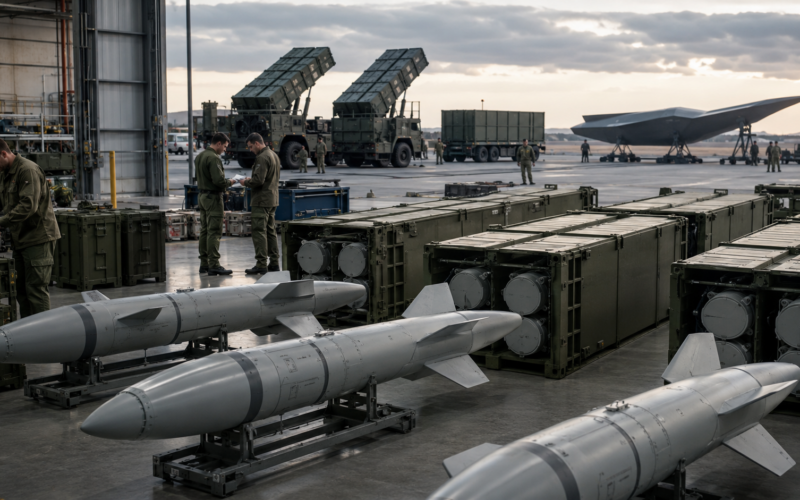
The United States Department of War (DoW) has signed new framework agreements with Anduril Industries, CoAspire, Leidos Holdings, Inc. (NYSE: LDOS), Zone 5 Technologies, and Castelion Corporation to expand American military strike capacity through lower-cost cruise missiles and hypersonic weapons. The agreements launch the Low-Cost Containerized Munitions program with Anduril Industries, CoAspire, Leidos Holdings, Inc., and Zone 5 Technologies, while a separate framework with Castelion Corporation targets scaled production of the Blackbeard hypersonic missile. The strategic relevance is immediate: Washington is trying to move beyond limited inventories of exquisite munitions toward larger, faster, and more repeatable production runs. Leidos Holdings, Inc. stock closed at USD 123.69 on May 15, 2026, leaving the company near its 52-week low despite its expanding missile-production role.
Why is the Department of War using new defence entrants to expand United States missile production capacity?
The Department of War’s latest agreements signal a procurement shift from buying only small numbers of high-end weapons toward building what defence planners increasingly describe as affordable strike mass. The Low-Cost Containerized Munitions program is structured around test missiles beginning in June 2026, followed by a path toward future firm-fixed-price production contracts. The department said the effort positions it to procure more than 10,000 low-cost cruise missiles across the participating portfolios over three years starting in 2027.
That structure matters because missile inventories have become a strategic constraint, not just a budget line. A military can own advanced aircraft, ships, drones, and command systems, but without sufficient munitions depth, those platforms risk becoming very expensive spectators. The new framework agreements suggest that the Department of War is trying to create a second industrial rhythm alongside legacy prime-contractor production: smaller defence technology companies fund development faster, accept tighter production targets, and compete for scale once testing validates performance.
The risk is that “low-cost” can become a seductive phrase in defence procurement, much like “quick fix” in enterprise software. It sounds wonderful until integration, testing, and sustainment arrive with a bill. The key test will be whether Anduril Industries, CoAspire, Leidos Holdings, Inc., and Zone 5 Technologies can deliver weapons that are not only cheaper to build, but also usable at scale across real launch platforms, command networks, and operational theatres.

How does the Low-Cost Containerized Munitions program change the economics of strike capacity?
The Low-Cost Containerized Munitions program appears designed to solve two problems at once: inventory depth and launch flexibility. Containerized missiles can potentially simplify deployment, concealment, transport, and distributed fires, giving the Joint Force more options than traditional launch architectures. If the program succeeds, the United States military could gain a larger stock of cruise missiles that can be dispersed more easily across land and potentially maritime environments.
Leidos Holdings, Inc. said it will provide an initial 3,000 Low-Cost Containerized Munitions through its framework agreement. The company also said it will expand its workforce and facilities in Huntsville, Alabama, and McEwen, Tennessee, with production expected to begin in 2027 after design, development, and testing. Leidos Holdings, Inc. said the missile draws on its AGM-190A Small Cruise Missile program and uses a modular airframe with an open systems architecture to support upgrades and mission adaptability.
For investors and defence-sector executives, the more interesting point is that the Department of War is using demand visibility as a tool of industrial policy. Firm fixed material-unit costs for 2027 through 2029 production lots are intended to give vendors enough confidence to invest in capacity before every contract dollar is formally locked in. That is a meaningful departure from the stop-start production cycles that have often made munitions manufacturing slow, costly, and fragile.
What does Leidos Holdings, Inc. gain from the Department of War missile framework?
Leidos Holdings, Inc. gains something more strategic than a single production headline. The company is being positioned deeper inside the missile and hypersonic weapons ecosystem at a time when the United States is prioritizing production capacity, not just research and development. The Low-Cost Containerized Munitions agreement adds to Leidos Holdings, Inc.’s recent visibility in hypersonics, including a separate USD 2.7 billion U.S. Army contract tied to advancing hypersonic weapons from prototype work toward full-scale production.
The stock market, however, is not yet treating the story as a clean rerating catalyst. Leidos Holdings, Inc. closed at USD 123.69 on May 15, 2026, with a market capitalization of roughly USD 15.56 billion. The company’s investor page showed a 52-week range of USD 121.53 to USD 205.77, meaning the stock is trading close to its annual low despite the new missile-production signal.
That disconnect is important. The market may be waiting for clearer evidence that these frameworks convert into durable revenue, margin expansion, and cash-flow visibility. Defence investors have seen many promising contract announcements that take time to flow through earnings. For Leidos Holdings, Inc., the upside case rests on whether missile production can become a scalable manufacturing growth lane rather than another complex government program with heavy execution risk.
Why do Anduril Industries and Castelion Corporation matter in the new United States strike-capacity model?
Anduril Industries and Castelion Corporation are central to the broader message behind the Department of War’s announcement: the United States wants non-traditional defence companies to carry more of the industrial-base burden. Anduril Industries said its agreement covers Surface-Launched Barracuda-500M, with a minimum of 1,000 all-up rounds per year and first deliveries expected in the first half of 2027. That gives the company a direct route into large-volume precision fires rather than remaining primarily associated with autonomy, sensors, and software-defined defence systems.
Castelion Corporation’s role is different but equally revealing. The Department of War said that once Castelion Corporation achieves testing and validation, it plans a two-year multi-year procurement contract for at least 500 Blackbeard missiles annually, with options to extend up to five years. The department is also seeking authorizations and appropriations to purchase more than 12,000 Blackbeard missiles over five years.
That is a striking ambition for hypersonics, a category usually associated with high cost, low production rates, and long development cycles. If Castelion Corporation can validate a lower-cost hypersonic model, the competitive pressure on larger incumbents could be significant. If it cannot, the announcement may still prove useful as a signal to the market: future strike programmes will reward speed, manufacturability, and private capital commitment as much as legacy programme pedigree.
How could this procurement strategy affect Lockheed Martin Corporation, RTX Corporation, and traditional defence primes?
The Department of War is not replacing traditional defence primes, but it is clearly trying to reduce dependence on them for every layer of strike capacity. Lockheed Martin Corporation and RTX Corporation remain deeply embedded in missiles, air defence, command systems, and platform integration. Lockheed Martin Corporation traded at USD 516.01 on May 15, 2026, while RTX Corporation traded at USD 171.18, giving both companies much larger balance-sheet and programme footprints than most of the newer entrants.
The emerging model is more likely to create a two-track defence market. Traditional primes may continue to dominate high-end systems, complex interceptors, classified integration, and long-cycle programmes. New entrants may increasingly compete for attritable weapons, containerized launch systems, autonomous munitions, software-heavy integration, and fast production ramps. The old model was built around perfection and survivability. The new one is trying to add quantity and replenishment speed. Both are needed, but they reward different companies.
There is also a capital-allocation message here. The Department of War said several vendors could reach production scale without direct department investment, suggesting that private capital is being pulled deeper into defence manufacturing risk. That could accelerate innovation, but it also raises the bar for execution. Venture-style timelines and military qualification processes are not natural roommates. One wants to sprint; the other wants to test the shoes, the track, the weather, and the runner’s family history.
What are the main execution risks behind the Department of War’s missile-production push?
The first risk is testing. The Department of War’s pathway depends on experimentation, assessment, and military utility evaluation before full production contracts can carry operational weight. If any of the systems struggle with reliability, targeting integration, range performance, safety, or platform compatibility, procurement ambitions may slow quickly. Scale without validated performance is not deterrence. It is inventory risk with a paint job.
The second risk is supply-chain resilience. Low-cost missiles still need engines, electronics, propulsion components, guidance systems, warheads, materials, and quality-controlled manufacturing lines. If too many vendors depend on narrow supplier pools, the United States may simply shift bottlenecks from prime contractors to sub-tier suppliers. That would weaken the logic of diversification.
The third risk is congressional funding. The Department of War’s plan for Blackbeard hypersonic missiles depends partly on authorizations and appropriations. In plain English, the ambition needs money, and money needs political durability. Large production numbers can be announced quickly, but they become real only when budgets, testing milestones, and acquisition approvals stay aligned over multiple fiscal years.
What does the Department of War missile push signal for the future of United States defence industrial strategy?
The biggest signal is that the United States is treating production capacity as a form of deterrence. For years, defence technology conversations often revolved around exquisite capability: range, stealth, speed, sensors, autonomy, precision, and survivability. Those attributes still matter, but the Ukraine war, Middle East conflict dynamics, and Indo-Pacific planning assumptions have all reinforced a harder lesson. A military that cannot replenish munitions at speed risks losing operational tempo even if its individual weapons are highly capable.
The new agreements also show how defence procurement is borrowing from commercial technology logic without fully becoming commercial technology. The Department of War is using framework agreements, demand signals, private investment, modular design, and faster assessment cycles to compress timelines. But the end market remains military, and the consequences of failure are much higher than a buggy app update. That means the winning companies will be those that can combine startup speed with industrial discipline.
A neutral reading suggests this is less a one-off missile announcement and more a template. If the model works, similar procurement structures could appear across drones, loitering munitions, electronic warfare, counter-drone systems, autonomous surface vessels, and space-enabled targeting networks. The strategic race is not only about who has the best weapon. It is increasingly about who can build enough credible weapons before the next crisis starts.
Key takeaways on what the Department of War missile agreements mean for defence companies, investors, and the United States military
- The Department of War is trying to shift from limited inventories of expensive missiles toward larger volumes of lower-cost strike weapons.
- The Low-Cost Containerized Munitions program gives Anduril Industries, CoAspire, Leidos Holdings, Inc., and Zone 5 Technologies a route into scaled cruise missile procurement.
- Leidos Holdings, Inc. gains a stronger missile-production narrative, but its stock remains near its 52-week low, suggesting investors want proof of revenue conversion.
- Castelion Corporation’s Blackbeard framework could challenge assumptions that hypersonic weapons must remain scarce and extremely expensive.
- Traditional defence primes such as Lockheed Martin Corporation and RTX Corporation are not displaced, but they face a more diversified competitive field.
- The Department of War’s fixed-cost framework creates incentives for private companies to invest in capacity before all long-term procurement is finalized.
- Testing, validation, supplier depth, and congressional funding remain the main risks behind the headline production targets.
- The agreements support a broader United States defence-industrial strategy built around speed, replenishment, and distributed strike capacity.
- If successful, this model could influence procurement in drones, counter-drone systems, autonomous weapons, and electronic warfare.
- The wider message is blunt: missile mass is becoming a strategic asset, not just a procurement category.
Discover more from Business-News-Today.com
Subscribe to get the latest posts sent to your email.