Union Education Minister Dharmendra Pradhan announced his resignation on July 25, 2026, after weeks of youth-led demonstrations over the NEET-UG examination paper leak escalated into one of the most serious public protests faced by Prime Minister Narendra Modi’s government during its third term.
Dharmendra Pradhan said he had sent his resignation letter to Prime Minister Narendra Modi after considering the situation at Jantar Mantar and across India. Dharmendra Pradhan said the decision was intended to protect the interests of students and prevent forces he described as anti-national from exploiting the unrest. No immediate announcement was made regarding a permanent successor in the Ministry of Education.
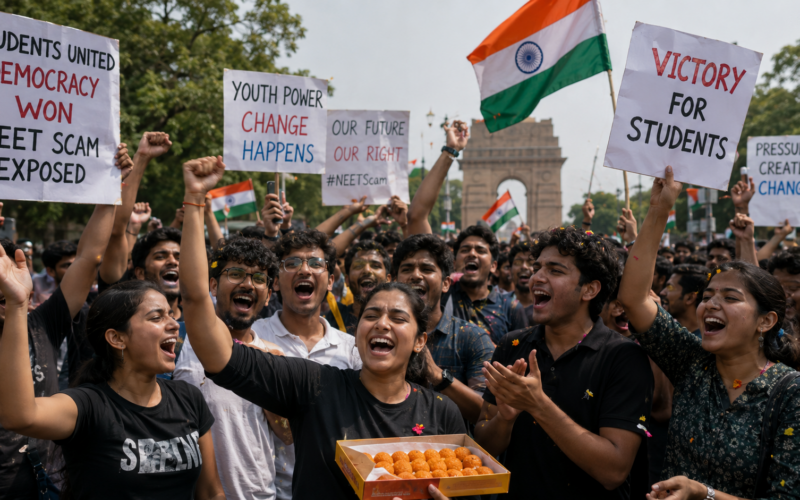
Celebrations began at Jantar Mantar in New Delhi soon after the resignation was announced. Thousands of supporters of the Cockroach Janta Party, the youth-led movement that organised the agitation, gathered at the protest site, distributed sweets, sang the national anthem and described the resignation as a victory for student mobilisation and democratic pressure.
The resignation followed more than a month of demonstrations over alleged irregularities in the National Eligibility cum Entrance Test for undergraduate medical admissions. The controversy intensified after the examination paper was leaked in May, leading to the cancellation of results and a re-examination involving approximately two million candidates.
The political pressure increased sharply after police used batons and tear gas against demonstrators attempting to march towards Parliament on July 20. Dozens of protesters were reported injured, while Delhi Police maintained that the measures were necessary to preserve law and order and prevent demonstrators from entering restricted areas.
Union Minister of Health and Family Welfare Jagat Prakash Nadda and Minister of State in the Prime Minister’s Office Jitendra Singh subsequently appeared with Cockroach Janta Party representatives at a joint press conference. Cockroach Janta Party leaders agreed to end the demonstrations after the government assured them that protesters would not face punitive action connected with the agitation.
The agreement lowered the immediate risk of further confrontation in central New Delhi, but the resignation did not close the wider examination accountability dispute. Compensation for families of students whom the movement said had died by suicide, action against officials responsible for examination failures, and demands for accountability over the police response remained central to the debate.
Why did Dharmendra Pradhan resign after weeks of NEET-UG protests across India?
Dharmendra Pradhan’s resignation followed sustained pressure over the handling of the NEET-UG 2026 examination and broader concerns about the credibility of competitive examinations administered by public bodies. Protesters argued that repeated paper leaks, cancellations and delays had placed the academic futures of millions of students at risk while imposing significant financial and psychological costs on candidates and their families.
Dharmendra Pradhan initially resisted demands to leave the Ministry of Education, while the government pursued investigations and administrative responses to the examination controversy. Prime Minister Narendra Modi later issued a personal video statement expressing concern over the paper leak and promising strict punishment for those responsible. The intervention did not immediately satisfy the protesters, who maintained that ministerial accountability was necessary alongside criminal investigations.
In his resignation statement, Dharmendra Pradhan defended his record and said he had not avoided responsibility during the crisis. Dharmendra Pradhan also suggested that people holding responsible positions had misled students and created political obstacles during the controversy. At the same time, Dharmendra Pradhan acknowledged the aspirations and legitimate expectations of India’s young people.
The resignation represented the political acceptance that administrative reforms alone were no longer sufficient to defuse the protests. The government had already moved towards tougher penalties for organised examination fraud, but the Cockroach Janta Party continued to treat Dharmendra Pradhan’s departure as the central test of whether public accountability would extend beyond lower-level officials and examination administrators.
Under India’s constitutional framework, a Union minister’s resignation is formally completed through acceptance by the President of India on the advice of the Prime Minister. The immediate announcement nevertheless removed Dharmendra Pradhan from the political centre of the crisis and allowed negotiations between the government and protest representatives to move towards de-escalation.

How did the Cockroach Janta Party turn examination anger into a national political crisis?
The Cockroach Janta Party began its organised protest at Jantar Mantar on June 20, 2026, drawing students, examination candidates, young professionals and parents concerned about alleged irregularities in national entrance and recruitment tests. The movement was led by founder Abhijeet Dipke and developed largely through social media before establishing a sustained physical presence in New Delhi.
The unusual name became a symbol of resistance after protesters embraced the cockroach as an image of survival and persistence. Supporters wore cockroach masks, carried copies of the Constitution of India and used the movement’s identity to argue that young people could not be dismissed, silenced or removed from public debate.
The initial demands focused on Dharmendra Pradhan’s resignation, compensation for affected families and action against those responsible for the alleged paper leak. The campaign later widened to include concerns about unemployment, recruitment examinations, government accountability and the economic pressures faced by young Indians preparing for highly competitive tests.
The movement gained national reach as demonstrations spread beyond Delhi. Students, youth activists and opposition supporters held protests in West Bengal, Telangana, Karnataka and Tamil Nadu, while some educational institutions witnessed class boycotts and solidarity actions.
Activist Sonam Wangchuk strengthened the movement’s visibility by supporting the protesters and undertaking a hunger strike that lasted 26 days. Sonam Wangchuk’s involvement connected the examination dispute with a wider debate over peaceful protest, institutional responsiveness and the treatment of citizens who challenge government decisions.
Opposition parties also increased pressure inside Parliament. Congress and other opposition members demanded Dharmendra Pradhan’s resignation, interrupted proceedings and argued that the government could not discuss education reform while retaining the minister responsible for the sector.
The Cockroach Janta Party’s success came from combining a clearly identifiable demand with a broader emotional issue affecting millions of households. Competitive examinations determine access to medical colleges, universities and government employment, making allegations of paper leaks particularly damaging because candidates often invest several years and substantial family resources in preparation.
What happened during the July 20 Parliament march and why did police action intensify pressure?
The political environment changed significantly on July 20 when thousands of protesters attempted to march from the Jantar Mantar area towards Parliament. Security personnel blocked the march, and confrontations followed as demonstrators sought to move through restricted areas in central New Delhi.
Police used batons and tear gas to disperse sections of the crowd. Several protesters were injured, and images of the police action circulated widely across television channels and social media platforms. The visual impact transformed the controversy from an examination governance dispute into a broader debate over the state’s handling of peaceful youth mobilisation.
Delhi Police defended the deployment by stating that security personnel were responsible for protecting Parliament, maintaining public order and preventing unauthorised movement into restricted zones. The government’s institutional position was that policing decisions were driven by security requirements rather than an attempt to suppress criticism.
Protest leaders disputed that explanation and accused police personnel of using disproportionate force. The Cockroach Janta Party demanded action against officers involved in the operation, withdrawal of cases registered against protesters and a public apology from Delhi Police and the Rapid Action Force.
The police action also encouraged more opposition leaders to publicly support the movement. Leader of the Opposition in the Lok Sabha Rahul Gandhi said the individuals responsible for injuring students should be held accountable and demanded that Prime Minister Narendra Modi apologise for the handling of the demonstrations.
Mobile internet access around the protest zone was restricted during the period of heightened tension and restored after Dharmendra Pradhan announced his resignation. More than 1,000 police personnel remained deployed near Jantar Mantar as large crowds gathered to celebrate the minister’s departure.
The escalation demonstrated how the government’s response to a protest can become as politically important as the original issue. By July 25, the examination paper leak, the ministerial accountability demand and the policing controversy had become interconnected parts of the same national dispute.
What did the Narendra Modi government concede after Dharmendra Pradhan announced his resignation?
Dharmendra Pradhan’s resignation satisfied the most visible demand made by the Cockroach Janta Party. Abhijeet Dipke described the development as the movement’s first major victory and said the result demonstrated that coordinated youth action could produce political accountability.
The Cockroach Janta Party initially stated that several demands remained pending. These included compensation of ₹1 crore for each family of students whom the movement said had died by suicide, protection for people who participated in the demonstrations and a public apology from Delhi Police and the Rapid Action Force.
The government and the Cockroach Janta Party subsequently held further discussions involving Jagat Prakash Nadda and Jitendra Singh. During a joint press conference, the government assured protest leaders that no punitive action would be taken against demonstrators, and the Cockroach Janta Party announced that it would end the agitation.
The decision to end the protests reduced the immediate possibility of further clashes at Jantar Mantar. Protest leaders encouraged supporters to leave peacefully, while authorities restored mobile internet services and began reopening areas affected by security restrictions.
The exact implementation timetable for compensation and police accountability was less clearly defined in the immediate public statements. Those issues may continue through administrative inquiries, legal proceedings or further discussions even though the organised street protest has been withdrawn.
The government’s concessions were accompanied by a separate legislative response. The Union Cabinet approved proposed amendments to the Public Examinations (Prevention of Unfair Means) Act, 2024, with provisions for stronger penalties against organised paper leak networks, examination service providers and institutions involved in malpractice.
The proposed framework includes imprisonment of up to 10 years, fines reaching ₹10 crore in serious cases and specialised procedures intended to accelerate investigations and trials. The amendment requires parliamentary approval before becoming law, and its effectiveness will depend on enforcement, investigation quality and institutional safeguards within examination bodies.
Why is Dharmendra Pradhan’s departure unusually significant for the Narendra Modi government?
Dharmendra Pradhan’s resignation is politically significant because ministerial departures under public pressure have been uncommon since Narendra Modi became Prime Minister in 2014. Dharmendra Pradhan became only the second minister to leave a Narendra Modi government mid-term amid scandal-related pressure.
The earlier prominent case involved M.J. Akbar, who resigned as Minister of State for External Affairs in October 2018 while contesting allegations of sexual harassment made during India’s MeToo movement. The rarity of such resignations has reinforced the perception that the Narendra Modi government generally prefers investigations, administrative transfers or legal processes over ministerial exits.
Dharmendra Pradhan was also not a marginal member of the Bharatiya Janata Party. Dharmendra Pradhan had served as Union Education Minister since 2021 and previously held the petroleum and natural gas, steel, and skill development portfolios. Dharmendra Pradhan remained an influential Bharatiya Janata Party figure with a strong political base in Odisha and represented Sambalpur in the Lok Sabha.
The decision therefore involved more than replacing the head of a ministry. It demonstrated that sustained street protests, parliamentary disruption and widespread youth mobilisation could overcome the government’s initial resistance to removing a senior Cabinet minister.
The resignation may also influence how opposition parties approach future accountability campaigns. Congress and other opposition groups are likely to present the outcome as evidence that coordinated pressure inside Parliament and outside government institutions can force concessions.
For the Narendra Modi government, the immediate objective is to prevent the resignation from becoming a broader narrative of institutional failure. That will require visible progress on criminal investigations, examination reforms, National Testing Agency accountability and the proposed anti-paper leak legislation.
Will tougher anti-paper leak legislation solve the deeper National Testing Agency credibility problem?
Stronger criminal penalties may deter organised paper leak networks, but legislation alone cannot restore confidence in India’s examination system. Candidates need assurance that examination papers are securely prepared, transported and stored, that digital systems are protected and that testing centres operate under consistent supervision.
The National Testing Agency faces particular scrutiny because it conducts examinations that determine access to some of India’s most competitive higher education programmes. Any compromise in examination integrity affects not only individual candidates but also the perceived legitimacy of admissions across the medical and university systems.
The government must therefore separate criminal accountability from administrative reform. Criminal investigations can identify individuals involved in leaks, while institutional reviews must examine procurement systems, information security, third-party contractors, examination centre management and internal oversight.
Faster courts and larger fines may improve deterrence, especially when paper leaks involve organised networks seeking substantial financial gain. However, enforcement will depend on evidence collection, coordination between state and central agencies, protection for whistleblowers and the capacity to trace digital and financial transactions.
The resignation of Dharmendra Pradhan provides a political answer to one demand, but it does not resolve the operational weaknesses that allowed the controversy to develop. The credibility of the next examination cycle will be more important than ministerial statements because candidates will judge reform through whether tests are conducted securely, results are delivered reliably and complaints are addressed transparently.
The appointment of the next Union Education Minister will consequently carry institutional importance. The successor will inherit an examination crisis, pending legislative changes, public distrust and demands for greater oversight of the National Testing Agency.
The government has ended an immediate confrontation with the Cockroach Janta Party. The longer test is whether the Ministry of Education can convert the political shock of Dharmendra Pradhan’s resignation into durable reform of India’s public examination system.
What are the key takeaways from Dharmendra Pradhan’s resignation and the Cockroach Janta Party protest agreement?
- Dharmendra Pradhan announced on July 25, 2026, that he had sent his resignation as Union Education Minister to Prime Minister Narendra Modi after weeks of protests over the NEET-UG paper leak and examination irregularities.
- The NEET-UG controversy involved the cancellation of results and a re-examination affecting approximately two million candidates, turning concerns about examination integrity into a major national political and institutional crisis.
- The Cockroach Janta Party began its sustained Jantar Mantar protest on June 20 and mobilised students, parents and young professionals around demands for ministerial accountability, compensation and action against examination malpractice.
- Police used batons and tear gas when protesters attempted to march towards Parliament on July 20, injuring demonstrators and intensifying public criticism of the government’s handling of the youth-led movement.
- The Cockroach Janta Party initially said compensation, withdrawal of action against protesters and a public apology from Delhi Police and the Rapid Action Force remained pending after Dharmendra Pradhan announced his resignation.
- Jagat Prakash Nadda and Jitendra Singh later joined Cockroach Janta Party representatives at a press conference where the government assured that protesters would not face punitive action, allowing the movement to end its demonstrations.
- The Union Cabinet separately approved proposed amendments to India’s anti-paper leak law, including imprisonment of up to 10 years, fines of up to ₹10 crore and faster judicial procedures for serious examination offences.
- Dharmendra Pradhan’s departure is unusually significant because senior ministerial resignations under public pressure have been rare during Narendra Modi’s tenure, making the episode an important test of political and institutional accountability.
Discover more from Business-News-Today.com
Subscribe to get the latest posts sent to your email.