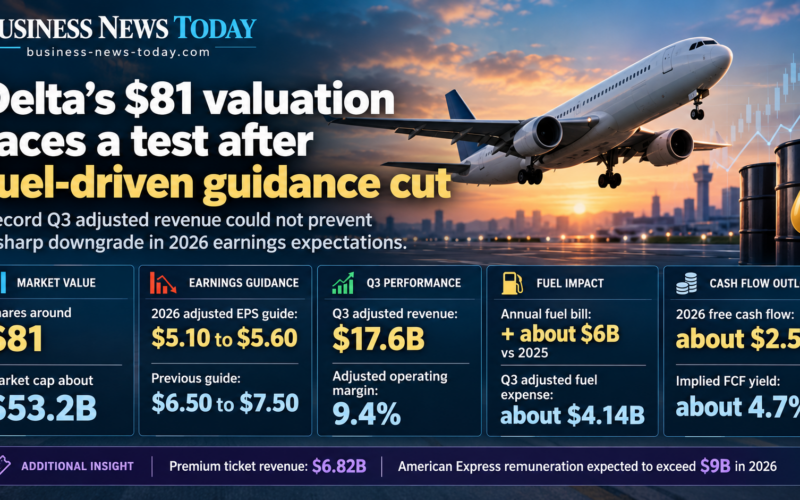
Delta Air Lines, Inc. (NYSE: DAL), the Atlanta-based international airline, was trading around $81 on October 12, 2026, after reducing its full-year adjusted earnings guidance by approximately 24% at the midpoint following an unexpectedly severe increase in aviation fuel costs. The airline now expects adjusted earnings of $5.10 to $5.60 per share, compared with its previous forecast of $6.50 to $7.50, even as third-quarter adjusted revenue reached a record $17.6 billion. Management expects its annual fuel bill to increase by approximately $6 billion compared with 2025, creating a substantial profitability challenge despite resilient passenger demand, higher ticket yields and continued growth in premium services.
At a verified October 12 intraday quotation of approximately $80.84, recorded around 12:15 p.m. Eastern Time, Delta carried an indicative equity market valuation of approximately $53.2 billion. The share price implies roughly 15.1 times the midpoint of management’s revised 2026 adjusted earnings guidance, compared with approximately 11.5 times the previous $7 earnings midpoint. That change illustrates an important distinction: Delta’s shares have not declined nearly as sharply as management’s earnings expectations, leaving investors paying a higher multiple of forecast profits despite the deterioration in the near-term outlook.
The cash-flow comparison is even more consequential. Delta now expects approximately $2.5 billion in free cash flow for 2026, down from its previous guidance of $3 billion to $4 billion, implying a prospective free cash-flow yield of roughly 4.7% at the current equity valuation. The resulting investment question is whether elevated fuel costs represent a temporary disruption that Delta’s pricing power and premium-travel franchise can eventually overcome, or a more persistent constraint on earnings, fleet investment and debt reduction. A profitable airline with strong customer demand can still represent a demanding valuation if too little of its reported earnings converts into cash available for shareholders.
Why did Delta Air Lines cut its earnings outlook despite record quarterly revenue?
Delta reported $20.2 billion in third-quarter revenue under generally accepted accounting principles, an increase of approximately 21% from the corresponding period in 2025. On an adjusted basis, which excludes items including third-party refinery sales, revenue reached $17.6 billion, up 16%, while adjusted operating income was approximately $1.7 billion. Adjusted earnings per share increased slightly to $1.72 from $1.70 a year earlier, indicating that the core business remained profitable despite substantial cost pressure. However, reported net income declined 47% to $756 million, with the difference between reported and adjusted results reflecting items including investment-related valuation movements and fuel-related adjustments.
The more revealing comparison concerns operating margins. Delta’s adjusted operating margin declined to 9.4% from 11.1% a year earlier, even though adjusted revenue increased substantially and overall passenger capacity remained broadly unchanged. Adjusted nonfuel unit costs increased 7.3%, partly reflecting higher crew and revenue-related expenses, while fuel costs rose considerably faster than passenger revenue. This combination demonstrates that stronger pricing and premium demand have helped Delta absorb inflation without fully protecting its profitability.
The earnings guidance revision is also substantial in absolute terms. The midpoint of the previous adjusted earnings outlook was $7 per share, compared with $5.35 under the revised forecast, representing a 23.6% reduction. Management now expects approximately $4.5 billion in full-year pretax profit, despite absorbing an estimated $6 billion increase in annual fuel costs. That guidance depends on demand remaining sufficiently resilient to sustain higher ticket yields and on further cost pressures staying within current assumptions.
How much of Delta’s $6 billion fuel-cost increase can higher ticket prices recover?
Aviation fuel has become the principal obstacle to stronger earnings. Delta’s adjusted third-quarter fuel expense increased 62% year over year to approximately $4.14 billion, while its average adjusted fuel price climbed 60% to $3.61 per gallon. On a reported accounting basis, aircraft fuel and related taxes increased 69% to approximately $4.35 billion, reflecting the different adjustments used in management’s operating presentation. The size of the increase explains why record revenue has not translated into a comparable expansion in operating profit.
The outlook for the December quarter suggests the pressure could persist. Delta expects an all-in fuel price of approximately $4.25 per gallon, incorporating an anticipated refinery benefit of around $0.40 per gallon and fuel market assumptions based on the forward curve as of October 2. That is materially higher than the adjusted $3.61 per gallon reported for the September quarter, although the figures apply to different periods and include estimated refinery effects. Additional fuel-price increases could therefore weaken earnings even if ticket prices continue rising.
A simplified sensitivity illustrates the scale of the risk. Delta’s September-quarter adjusted fuel expense and average adjusted fuel price imply fuel consumption of approximately 1.15 billion gallons during the period. Holding consumption constant, a sustained $0.50-per-gallon increase would represent roughly $575 million in additional quarterly pretax fuel expense before considering refinery economics, fuel hedges, changes in capacity or fare increases. This is an illustrative calculation, not a company forecast, and actual earnings sensitivity could differ materially.
Delta owns the Trainer refinery in Pennsylvania, which helps manage exposure to fuel prices and refining margins. However, refinery operations do not eliminate the airline’s exposure to global fuel markets, particularly when aviation fuel prices rise faster than the benefits available through refining activity. The company’s ultimate profitability depends on the net effect of fuel costs, refinery contributions, passenger yields and network adjustments. Sustained higher fares can provide relief, but their effectiveness will depend on how long customers remain willing to absorb additional travel costs.
Can premium travel and American Express revenue protect Delta’s profitability?
Delta’s premium customer franchise provides a meaningful distinction from airlines that rely more heavily on price-sensitive economy travel. Third-quarter premium ticket revenue increased 18% to approximately $6.82 billion, slightly exceeding main-cabin ticket revenue of approximately $6.80 billion. Main-cabin revenue also increased, advancing 12%, while domestic unit revenue rose 16% on broadly unchanged capacity. These results suggest that Delta has considerable pricing power within its customer base, even as fuel inflation places pressure on industry profitability.
The growth of loyalty-related income provides another source of resilience. Delta reported an 18% increase in total loyalty revenue during the September quarter, while remuneration from American Express grew 15%. Management expects annual remuneration associated with the American Express partnership to exceed $9 billion in 2026, supported by credit card spending, customer acquisition and broader engagement with its SkyMiles loyalty programme. That remuneration includes different commercial and loyalty-related components, meaning it should not be interpreted as $9 billion of additional profit.
These businesses matter because they allow Delta to generate revenue from customer relationships beyond the individual ticket transaction. However, loyalty partnerships are connected to travel activity, customer spending and the broader economic environment, so they cannot be considered entirely independent of airline demand. Premium travel also depends disproportionately on customers willing to pay higher fares for additional comfort, flexibility and service quality. A deterioration in corporate spending or higher-income consumer confidence could weaken a segment that has become increasingly important to Delta’s operating strategy.
The company’s October guidance nevertheless indicates continued confidence in demand. Delta expects fourth-quarter revenue to increase approximately 20% year over year, with operating margins between 7% and 9% and adjusted earnings of $1.15 to $1.65 per share. The outlook assumes relatively limited capacity growth, with available seats increasing by less than 2% and main-cabin capacity declining. That disciplined approach could improve revenue per available seat mile, although it also limits the extent to which Delta can compensate for higher costs through additional passenger volume.
Why does Delta’s 4.7% free cash-flow yield tell a different valuation story?
Delta’s earnings multiple appears considerably lower when calculated using its previous profit expectations, but the revised free cash-flow guidance introduces a less comfortable comparison. At approximately $53.2 billion in equity market capitalisation, the company’s projected $2.5 billion in 2026 free cash flow represents a yield of about 4.7%. The previous guidance midpoint of $3.5 billion would have represented a yield of approximately 6.6% at the same share price. The reduction of roughly 29% in expected cash generation is therefore at least as consequential as the decline in adjusted earnings guidance.
Cash generation has weakened despite strong revenue performance. Delta reported third-quarter operating cash flow of approximately $1.7 billion and free cash flow of $463 million, compared with $833 million in the corresponding quarter last year. For the first nine months of 2026, operating cash flow totalled approximately $5.74 billion, while the company’s adjusted free cash-flow measure reached $1.9 billion. Achieving the full-year target of $2.5 billion would therefore require approximately $600 million of additional free cash flow during the December quarter.
Free cash flow deserves particular attention because airlines require continuous investment in aircraft, maintenance facilities, airport infrastructure and technology. Delta recorded approximately $1.4 billion in gross capital expenditure during the September quarter, up from $1.1 billion a year earlier. The company also had approximately $26.7 billion in future aircraft purchase commitments at September 30, including $4.93 billion scheduled for 2027 under existing contractual arrangements. These commitments will be funded over multiple years and their timing can change, but they illustrate why airline earnings cannot be treated as fully available cash.
Delta’s free cash-flow measure is also non-GAAP and excludes or adjusts selected cash movements, including certain airport construction and strategic investment activities. It remains useful for assessing financial flexibility, but investors should distinguish it from unrestricted cash after debt repayments, dividends and every other financing commitment. An airline can report substantial accounting profit while generating relatively modest cash if aircraft investment or working-capital requirements remain elevated. That difference is central to interpreting Delta’s valuation near $81.
How strong is Delta Air Lines’ balance sheet after reducing its debt?
Delta has made measurable progress in reducing financial obligations since the pandemic, although its remaining liabilities are substantial. At September 30, the company reported $12.85 billion in debt and finance lease obligations, compared with $14.11 billion at the end of 2025. Its broader adjusted net debt measure, which incorporates additional obligations and subtracts specified cash balances, declined to $13.35 billion from $14.30 billion over the same period. Management expects to repay more than $2 billion of debt during 2026 and finish the year with gross leverage of approximately 2.2 times adjusted debt to EBITDAR.
Liquidity provides some protection against near-term financial volatility. Delta reported $6.9 billion in available liquidity at the end of September, including approximately $3.1 billion in undrawn revolving credit facilities and $3.79 billion in cash and cash equivalents. Undrawn borrowing capacity is not the same as cash already held, but it provides additional financing flexibility if operating conditions deteriorate. The company also reported approximately $9.6 billion in air traffic liability, representing an obligation to provide future travel and related services rather than conventional financial borrowing.
The combination of high capital requirements and fuel-price uncertainty makes continued deleveraging important. Although Delta has reduced its debt burden and benefited from refinancing activity, the company remains exposed to fluctuations in cash generation and aircraft financing requirements. Its long-term financial framework targets lower leverage and more durable free cash flow, but those objectives depend on continued profitability and disciplined investment. A prolonged period of elevated fuel prices could slow progress even if passenger demand remains relatively healthy.
Delta’s dividend provides another useful comparison with its cash-flow outlook. The company declared a quarterly dividend of $0.215 per share in September, equivalent to an annualised distribution of $0.86 if maintained. At the October 12 reference price, that implies a dividend yield of approximately 1.1%, which is substantially lower than the prospective 4.7% free cash-flow yield. The gap reflects the need to retain substantial financial resources for aircraft investment, debt reduction and other corporate obligations.
What fuel-price and earnings scenarios could change Delta’s stock valuation?
A more constructive scenario would involve fuel prices stabilising or declining while passenger demand remains sufficiently strong to preserve the higher fares introduced during 2026. Premium cabin revenue, American Express-related remuneration and capacity discipline could then support improving operating margins, particularly if nonfuel cost growth moderates as management expects. Lower fuel expenses would also allow a greater proportion of operating earnings to convert into cash, creating additional flexibility for debt reduction and investment. Under those conditions, the current earnings multiple could become more defensible as profitability moves toward earlier expectations.
A more cautious scenario would involve continued strong passenger demand but persistently expensive fuel. Delta could maintain higher revenue through fare increases and premium travel growth while continuing to experience pressure on margins and free cash flow. Management might respond through further capacity restraint, reduced investment flexibility or slower expansion of less profitable routes. This would preserve much of the airline’s competitive position without necessarily producing a rapid earnings recovery.
An adverse scenario would combine elevated fuel costs with weakening demand or reduced pricing power. If customers become less willing to absorb higher fares, Delta could face simultaneous pressure on passenger yields and operating expenses. Under such conditions, adjusted earnings could fall below current guidance assumptions, while lower cash generation would complicate aircraft investment and deleveraging. The company’s operating scale and loyalty franchise would remain valuable, but the price investors were willing to pay for those earnings could decline.
The valuation sensitivity is substantial. At approximately $80.84 per share, Delta trades at around 15.1 times the midpoint of revised 2026 adjusted earnings guidance, but a hypothetical recovery to $6.50 in annual adjusted earnings would reduce the implied multiple to approximately 12.4 times. A return to $7.50 would imply approximately 10.8 times earnings, while deterioration to $4.50 would increase the multiple to nearly 18 times. These are illustrative earnings scenarios rather than forecasts, and they demonstrate how the interpretation of the current share price depends on the sustainability of future profitability.
What must Delta demonstrate before its valuation becomes more convincing?
Delta’s December-quarter performance will provide an important test of whether demand and pricing can continue compensating for extraordinary fuel inflation. Management expects approximately 20% revenue growth during the quarter, alongside adjusted operating margins of 7% to 9% and earnings between $1.15 and $1.65 per share. Achieving these outcomes would demonstrate continued operating resilience, although the implications for full-year cash flow and future profitability would still require examination. The more meaningful evidence will be whether unit revenue growth consistently exceeds the combined effects of fuel inflation and nonfuel cost increases.
The outlook for 2027 will be equally important because the market needs to distinguish between a temporary disruption and a longer period of structurally elevated operating costs. Delta has indicated that more restrained industry capacity may be necessary if the fuel environment remains difficult, while management expects nonfuel unit cost growth to moderate toward low-single-digit levels. Premium travel, international routes and loyalty partnerships provide potential support, but future earnings will depend on the balance between those opportunities and the operating costs required to serve them. Aircraft delivery commitments and debt reduction will also influence how quickly stronger profits can translate into shareholder cash flow.
The stock’s October 9 trading pattern illustrates why the earnings downgrade should not be interpreted as a straightforward rejection of Delta’s business model. Shares fell to an intraday low of $79.16 following the results but recovered to close at $82.17, marginally above the previous session’s closing price. The subsequent movement toward $81 on October 12 indicates continuing uncertainty, while the share price remains above levels seen earlier in 2026. Market sentiment therefore appears divided between confidence in Delta’s premium franchise and concern about how long higher fuel costs will constrain earnings.
The central valuation argument is that Delta Air Lines remains profitable and commercially resilient, but its financial outlook has become more demanding relative to its share price. A valuation near 15 times reduced adjusted earnings is not obviously inexpensive when guided free cash flow represents less than 5% of equity market value and significant aircraft commitments remain outstanding. At the same time, strong passenger yields, growing premium revenue, loyalty income and a strengthening balance sheet provide measurable reasons why the company could recover if fuel pressures moderate. The evidence required to resolve the question is clear: Delta must demonstrate that revenue resilience can produce sustainable earnings growth, stronger cash conversion and continued debt reduction rather than merely offsetting another increase in operating costs.
Disclaimer: This article is for informational and journalistic purposes only and does not constitute investment advice, a recommendation, an offer or a solicitation to buy or sell any security. Investors should conduct their own research and consider their financial circumstances, objectives and risk tolerance before making investment decisions.
Discover more from Business-News-Today.com
Subscribe to get the latest posts sent to your email.