


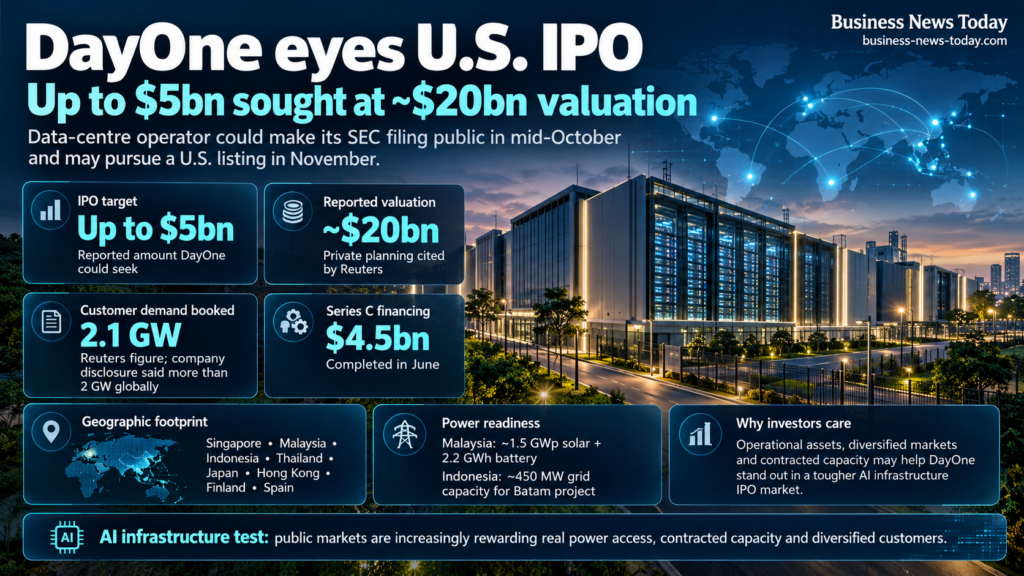
DayOne Data Centers is preparing to make its confidential U.S. Securities and Exchange Commission filing public around mid-October and could pursue a U.S. listing in November, according to Reuters, which cited three people familiar with the private planning. Reuters previously reported that DayOne could seek as much as $5 billion through the IPO at a valuation of approximately $20 billion. The sources cautioned that the timetable could still change, while DayOne declined to comment on the IPO plans.
The potential listing arrives at an important moment for the artificial-intelligence infrastructure trade. SoftBank-backed SB Energy has postponed formal marketing of its own proposed listing while addressing SEC questions and investor concerns involving valuation and customer concentration, according to Reuters’ source-based reporting. Investors are increasingly distinguishing between data-centre companies that have operational capacity and diversified contracted customers and companies whose valuations depend heavily on future sites or a small number of AI counterparties.
Why could DayOne still attempt a $20 billion IPO in a tougher market?
DayOne has attributes public-market investors increasingly prefer: operating assets, geographic diversification and substantial customer bookings. The company says it has campuses operating or under development across markets including Singapore, Malaysia, Indonesia, Thailand, Japan, Hong Kong, Finland and Spain, creating a footprint that spans both Asia-Pacific and Europe.
The company has also accumulated more than two gigawatts of bookings since its creation in 2022. DayOne’s own September disclosure said it had secured more than 2 GW globally, while Reuters put bookings around 2.1 GW. That contracted demand can make a major difference to investors evaluating whether enormous capital expenditures are likely to generate revenue once data centres become operational.
Geography provides another advantage. Data-centre operators concentrated in one region can be exposed to local power shortages, regulation or customer cycles, while DayOne can allocate development capital across several markets experiencing hyperscale demand.
The model still requires enormous financing, but a broader portfolio can provide investors with more evidence that valuation rests on an operating platform rather than a single giant development.
How important was DayOne’s $4.5 billion Series C financing before the IPO?
DayOne completed a $4.5 billion Series C financing in June led by existing investors Coatue and Hillhouse, with participation from investors including the Indonesia Investment Authority and Achi Capital Partners. The company described the financing as one of the largest private capital rounds completed in the data-centre sector.
The size matters because hyperscale data centres consume extraordinary amounts of capital before customers begin paying for computing capacity. Land acquisition, substations, transmission connections, building shells, cooling, electrical systems and specialized equipment all require investment years before a campus reaches full utilization.
DayOne’s Series C therefore provides both growth capital and a valuation reference point ahead of any IPO. Existing institutional investors accepting a higher private valuation can support public-market confidence, although IPO buyers will still determine whether the company deserves a further premium.
The capital also allowed DayOne to continue building without depending entirely on immediate access to public markets. That flexibility is valuable during a period when higher interest rates and volatility can make listings more difficult.
Why has power availability become the most important data-centre valuation metric?
AI computing equipment requires enormous quantities of continuous electricity, and in many markets power connections now represent a bigger bottleneck than land or financing. A proposed data centre with no credible power timetable may remain economically useless regardless of how strong future customer demand appears.
DayOne has been moving aggressively to secure electricity. In Malaysia, it signed arrangements covering approximately 1.5 GWp of solar capacity and 2.2 GWh of battery storage and is separately exploring as much as 1.5 GW of dedicated on-site generation with Tenaga Nasional Berhad’s generation subsidiary for a new development in Selangor.
In Indonesia, DayOne signed a long-term power purchase agreement for approximately 450 MW of grid capacity supporting its Kabil Industrial Tech Park project in Batam, with electricity scheduled to be delivered in stages.
These agreements matter to valuation because investors increasingly distinguish between “planned megawatts” and capacity that has actual power, contracts and customers attached to it.
Why is investor scrutiny increasing across AI data-centre IPO candidates?
The industry has spent several years assuming almost unlimited growth in AI compute demand. That assumption is now colliding with interest rates, debt markets and the reality that enormous facilities may take years to build.
Moody’s estimates cited by Reuters suggest AI-related capital expenditure by the six largest U.S. technology companies could reach roughly $1 trillion during 2027. Higher interest rates increase the cost of financing that infrastructure, while investors want clearer evidence that long-term contracts will generate enough cash to service debt.
Customer concentration is becoming particularly sensitive. A data-centre developer whose revenue depends heavily on one AI company can appear exceptionally valuable while that customer is expanding but becomes vulnerable if the customer delays projects, restructures contracts or encounters financing difficulties.
DayOne’s diversified geography and existing operational assets could therefore differentiate it, but investors will still want detailed information about customer concentration once the IPO registration statement becomes public.
That disclosure may ultimately matter more than the headline $20 billion valuation because it will show how much of DayOne’s bookings depend on a small number of hyperscalers.
How does DayOne compare with Switch, Vantage and other IPO candidates?
Reuters reported that Switch has filed confidentially for a U.S. IPO and could move after DayOne, while Vantage Data Centers and CyrusOne are among additional operators exploring or preparing public listings.
A wave of offerings would give investors something the data-centre sector has lacked during much of the AI boom: multiple publicly traded operators that can be compared directly on power availability, customer concentration, leverage, construction costs and returns on invested capital.
That comparison could compress valuations for weaker businesses even while rewarding companies with contracted operational capacity.
Public markets can also impose more financial discipline than private infrastructure funds. Quarterly disclosure makes it harder to hide project delays or escalating capital costs, which may ultimately separate genuine infrastructure cash flow from AI-themed development pipelines.
What would determine whether DayOne can justify a $20 billion market value?
The public filing will be decisive because it should disclose revenue, profitability, debt, customer concentration and capital commitments in far greater detail than the company currently provides.
Investors will also examine whether 2.1 GW of bookings translate into profitable long-duration contracts. A gigawatt of contracted capacity has very different value depending on the customer, pricing, operating costs and amount of construction still required.
The IPO could nevertheless become an important barometer for the entire AI infrastructure cycle. If DayOne secures a large offering near the reported valuation despite higher rates and recent project concerns elsewhere, public-market appetite for data-centre assets remains robust.
If investors demand a substantial valuation discount, the message will be equally important: AI infrastructure may still be growing rapidly, but capital is no longer willing to finance every megawatt at any price.
Discover more from Business-News-Today.com
Subscribe to get the latest posts sent to your email.