
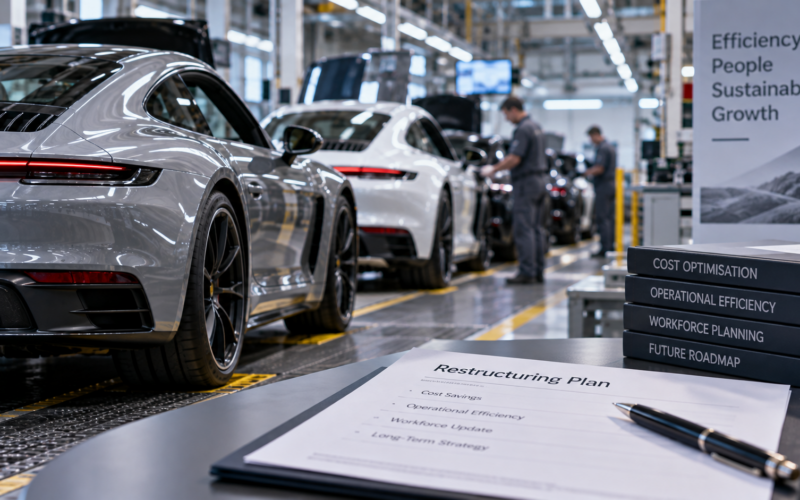
Dr. Ing. h.c. F. Porsche AG (Xetra: P911) could face another reduction of approximately 4,100 positions beyond workforce measures already agreed with employees, according to a September 19 report by German business newspaper Handelsblatt cited by Reuters. The reported proposal appears in documents connected with Volkswagen AG’s wider restructuring and is intended to address an estimated €700 million shortfall in overhead savings at the Stuttgart-based sports-car manufacturer. Porsche and Volkswagen declined to comment on the reported proposal, while Reuters noted that Volkswagen’s supervisory board can recommend further measures but cannot unilaterally impose them on Porsche.
That distinction is critical because Porsche has already negotiated a substantial workforce package with its General Works Council, IG Metall and the Südwestmetall employers’ association. In July, the company agreed to remove another 5,000 positions by 2035 largely through natural attrition, demographic effects, expanded partial-retirement programmes and voluntary termination agreements, adding to roughly 3,900 positions covered by earlier measures and more than 500 jobs affected by closures of subsidiaries. The latest reported 4,100 positions would therefore represent a new layer of restructuring rather than a restatement of cuts Porsche has already formally announced.
The report comes immediately after Volkswagen issued one of its most consequential profit warnings of recent years. Volkswagen now expects an operating return on sales of no more than 1% for 2026, compared with its previous forecast of 4% to 5.5%, and expects approximately €10 billion of special effects to weigh on operating profit during the year. Around €6 billion of those charges relate to an impairment of goodwill associated with Porsche after Volkswagen reassessed the sports-car company’s medium- and long-term earnings expectations.
How much larger could Porsche’s workforce reduction become if another 4,100 positions are approved?
Porsche’s formally agreed restructuring already represents a dramatic reduction in employment over the coming decade. The July Future Package provides for another 5,000 positions to disappear by 2035, while earlier programmes included approximately 1,900 permanent positions, around 2,000 fixed-term contracts and more than 500 positions connected with the planned discontinuation of Cellforce Group, Porsche eBike Performance and Cetitec. Taken together, Reuters described the existing programmes as roughly 9,000 job reductions, equivalent to around one-fifth of the workforce base against which the restructuring was originally assessed.
The reported 4,100 additional positions would materially increase that burden if Porsche management and employee representatives eventually agreed to implement them. On a simple cumulative basis, existing and reported measures could push the overall restructuring scope above 13,000 positions, although that figure should not be interpreted as 13,000 simultaneous layoffs from today’s workforce because the programmes cover different periods, some departures have already occurred and a large portion of the reductions are intended to happen through attrition rather than compulsory redundancy. Porsche reported 41,780 employees worldwide at the end of 2025, including 35,743 in Germany, providing a useful indication of the company’s current employment scale.
The potential extra cuts would therefore represent something more significant than another small efficiency programme. Porsche has already reduced temporary employment, begun shrinking permanent headcount, exited selected subsidiaries and negotiated changes to compensation, working practices and production conditions. Asking employees to absorb another 4,100 positions would reopen a restructuring settlement that was presented only in July as a long-term framework balancing lower personnel costs with investment and employment protection through 2035.
Why is Volkswagen pushing Porsche for another €700 million of overhead savings?
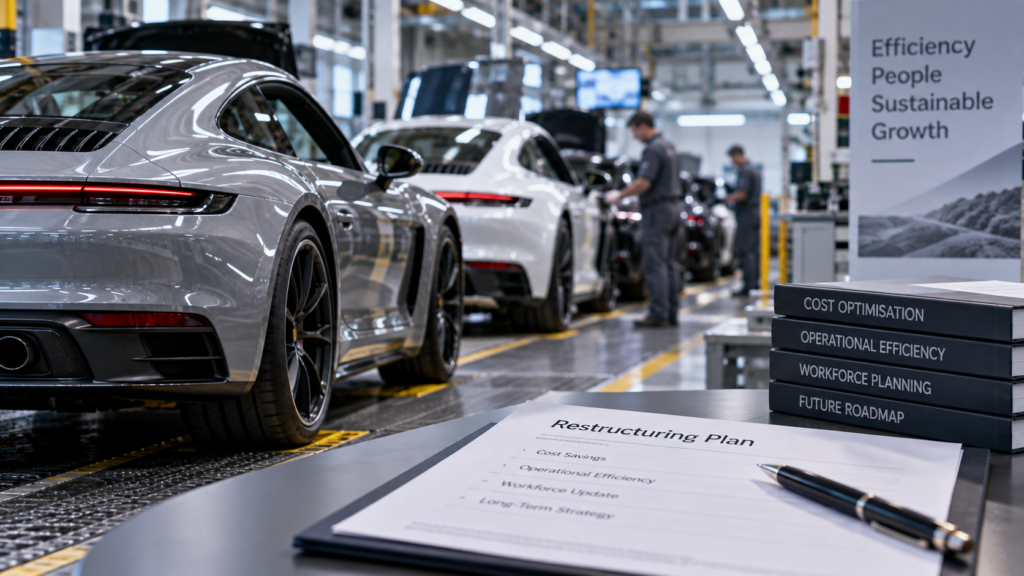
The reported €700 million gap suggests Volkswagen believes Porsche’s existing cost programme is not sufficient to support the earnings level now expected from the luxury sports-car business. According to Reuters, citing Handelsblatt, documents surrounding Volkswagen’s broader restructuring identify approximately 4,100 additional Porsche positions as one possible route toward closing that overhead shortfall. Neither Volkswagen nor Porsche has confirmed the calculation publicly, so the €700 million figure and corresponding employment proposal remain reported elements of the internal planning process rather than an announced Porsche restructuring package.
The pressure has intensified because Volkswagen has substantially downgraded what it expects Porsche to contribute financially over the medium and long term. Volkswagen said its September goodwill impairment followed updated assumptions after Porsche’s supervisory board approved revised medium- and long-term planning, with approximately €6 billion of the parent company’s latest charges directly linked to the reassessment of Porsche. Volkswagen Chief Financial Officer Arno Antlitz said broader pressures include a sharply weaker Chinese automotive market, growing competition from Asian manufacturers and a shift toward electric vehicles that can carry less attractive economics.
Porsche historically justified its place within Volkswagen partly through exceptionally strong margins. Its Group operating return on sales reached 14.1% in 2024 before collapsing to 1.1% in 2025 as restructuring expenses, changes to its electric-vehicle strategy, tariffs and weaker demand weighed heavily on results. While Porsche returned to a 7.8% margin during the first half of 2026, Volkswagen’s latest impairment indicates that the parent no longer expects the earlier level of profitability to return as quickly or as reliably as previously assumed.
Why has Porsche’s China business become such a serious workforce issue?
China has been one of the clearest sources of pressure because Porsche built considerable growth around demand from affluent Chinese customers during the luxury-car boom. That market has changed substantially as local premium and electric-vehicle manufacturers have become stronger, economic conditions have softened and foreign luxury brands have lost some of their previous pricing and technology advantages. Porsche delivered only 14,501 vehicles in China during the first half of 2026, down 32% from 21,302 in the comparable period of 2025.
The deterioration did not begin this year. Porsche’s first-half China deliveries had already fallen 28% in 2025, meaning the latest 32% decrease comes from a significantly lower base rather than simply reversing an unusually strong comparison period. Management has responded by emphasising value over volume, developing market-specific products and reducing its Chinese dealer network, but the sustained contraction means Porsche’s global cost structure was built for substantially more volume than the market is currently providing.
For employees in Germany, the connection between weaker China sales and local employment is economically important even though the jobs are thousands of kilometres from the customers being lost. Porsche’s German engineering, development, production and administrative structures expanded during years when global sales were higher, leaving management with a higher fixed-cost base when deliveries retreat. That is one reason personnel costs, production flexibility and organisational overhead have become central to the Sportwagenschmiede 35 restructuring rather than being treated as isolated human-resources issues.
How badly have Porsche’s worldwide deliveries fallen in 2026?
Porsche delivered 122,306 vehicles worldwide during the first half of 2026, a decline of approximately 16% from 146,391 a year earlier. North American deliveries fell 13%, Europe excluding Germany declined 14%, overseas and emerging markets dropped 18% and China fell 32%, while Germany was comparatively resilient with a 6% reduction. Porsche attributed the decline to a mixture of weaker markets, model-cycle effects, the end of combustion-engine 718 production and the expiration of electric and hybrid vehicle incentives in the United States.
The decline is not uniform across Porsche’s products, which complicates the restructuring decision. Deliveries of the 911 increased 19% during the first half to 30,534 vehicles, demonstrating continued strength in the company’s most recognisable sports-car franchise, while the Cayenne remained the highest-volume model with 38,141 deliveries despite a 9% decline. By contrast, Macan deliveries fell 22%, Taycan volumes declined 25%, Panamera deliveries dropped 38% and the 718 fell 73% after production of the combustion model ended in October 2025.
This mix helps explain Porsche’s emphasis on value rather than simply rebuilding volume at any price. Strong demand for high-margin 911 derivatives can support profitability even when total deliveries fall, but it cannot indefinitely absorb the fixed costs of an organisation structured around larger global sales volumes. Management is therefore attempting to preserve premium pricing and brand exclusivity while lowering the break-even point at which Porsche can produce acceptable earnings.
Why did Porsche appear to be recovering financially only weeks before the latest warning?
The timing of the reported additional job reductions is striking because Porsche’s July half-year results appeared to show meaningful progress. Revenue declined only 5.1% to €17.23 billion despite a 16.5% fall in customer deliveries, while operating profit increased 33.9% to €1.35 billion and the Group operating return on sales improved to 7.8% from 5.5%. Porsche credited cost management, pricing, product mix and its value-over-volume approach for allowing earnings to recover despite lower volumes.
At that time, Porsche reaffirmed full-year expectations for €35 billion to €36 billion of revenue and an operating return on sales between 5.5% and 7.5%. It also reported automotive net cash flow of roughly €1 billion during the first half, suggesting the turnaround programme was beginning to create visible financial benefits. Management nevertheless acknowledged that the recently negotiated Future Package would generate additional restructuring charges running into hundreds of millions of euros during the second half.
Volkswagen’s September impairment therefore changes the interpretation of those results. Porsche may have improved near-term profitability through pricing and cost action, but the parent company has now materially lowered the carrying value attached to Porsche based on weaker medium- and long-term assumptions. The issue facing Michael Leiters is no longer merely producing a better quarter; it is proving that Porsche can sustain attractive luxury-car margins in a world where China is structurally harder, electric-vehicle economics remain challenging and the United States has become more expensive because of tariffs.
How does Michael Leiters’ restructuring differ from Porsche’s previous growth model?
Michael Leiters took over as Porsche chief executive at the beginning of 2026 with an explicit mandate to overhaul a business whose profitability had fallen dramatically. His strategy has focused on making Porsche leaner, faster and more concentrated on its core sports-car business, including the planned sale of investments in Bugatti Rimac and Rimac Group and the closure of businesses that management no longer considered strategically essential. Porsche has also reduced the size of its Executive Board by integrating Car-IT into Research and Development.
The July Future Package took the strategy directly into the core German workforce. Porsche and labour representatives agreed to reduce another 5,000 jobs by 2035, lower elements of Christmas bonuses, change rules around mobile working and production breaks and introduce measures intended to raise productivity. In return, Porsche extended employment and site protection for Zuffenhausen and Weissach through 2035 and committed a cumulative €2.1 billion of investment to those locations.
That bargain is why another 4,100 positions would be especially sensitive. The Future Package was designed as a negotiated long-term framework under which employees accepted lower employment and changed conditions while management committed investment and site security. If Volkswagen now believes that package leaves a €700 million overhead gap, Porsche and its works council could face another difficult negotiation only months after completing the previous one.
Would another 4,100 jobs mean compulsory layoffs at Porsche?
There is no confirmed answer because Porsche has not announced or agreed to the reported proposal. Existing workforce programmes rely heavily on socially negotiated mechanisms including natural attrition, demographic effects, partial retirement and voluntary termination agreements, reflecting the influence of Germany’s works-council system and Porsche’s agreements with IG Metall. The July Future Package explicitly describes the 5,000 additional positions as a socially responsible reduction rather than a conventional compulsory-layoff programme.
Whether the same mechanisms could absorb another 4,100 positions would depend on timing, eligible employees, workforce demographics and negotiations with labour representatives. Adding thousands of further departures while preserving production, vehicle development and technical capability could become more difficult because the easiest voluntary and demographic reductions may already be incorporated into existing plans. Porsche would also need to avoid removing engineering and manufacturing expertise needed for the products on which its recovery depends.
The reported proposal should therefore not be translated into a near-term dismissal count. Volkswagen can recommend deeper reductions, but Reuters reported that it cannot mandate the measures at Porsche, where implementation would require decisions within Porsche’s governance structure and likely extensive consultation with labour representatives. Both companies declined to comment on the Handelsblatt report, leaving the proposed figure unconfirmed as of September 19.
What does Volkswagen’s €10 billion profit warning reveal about pressure on Porsche?
Volkswagen’s September 18 warning provides the clearest indication that Porsche’s challenges now have consequences for the entire group. Volkswagen expects special effects of approximately €10 billion to hit 2026 operating profit, with around €9 billion of those effects occurring in the second half, and has reduced its full-year operating-margin forecast to no more than 1%. The revised outlook compares with a 2.8% margin in 2025 and the previous 2026 target of 4% to 5.5%.
Approximately €6 billion of the latest charges relate to Porsche goodwill, making the sports-car company the single biggest driver of the warning. Volkswagen owns approximately 75% of Porsche AG and historically benefited enormously from Porsche’s premium margins, so a structural deterioration in the brand’s expected profitability affects group-level valuation and earnings even if Volkswagen-branded cars continue operating independently. Reuters said the warning reflects weaker Porsche assumptions alongside problems in China, tariffs and broader restructuring costs across the Volkswagen Group.
The scale of the writedown also increases pressure on Porsche management to demonstrate that the company can become materially more profitable with lower sales volumes. Its old growth model relied heavily on China, premium pricing and rising global demand, while the new model increasingly depends on cost discipline, differentiated products and accepting that some markets may remain structurally smaller. Workforce restructuring is one of the most visible consequences of that adjustment.
How did Porsche shares react before the new 4,100-job report emerged?
Porsche preferred shares closed at €45.99 in Xetra trading on September 18, down approximately 3.3% for the session after Volkswagen announced its revised outlook and large Porsche-related impairment. Reuters separately reported Porsche shares ending around 3.3% lower, while Volkswagen fell 5.6% and Porsche SE declined 4.9%, showing that investors treated the parent-company warning as a significant deterioration in expectations across the group.
The timing is important because Handelsblatt’s report of another roughly 4,100 potential positions emerged on Saturday, September 19, after European markets had closed for the week. Friday’s Porsche share decline therefore cannot be attributed to the additional reported workforce proposal. The next trading session will provide the first opportunity for investors to react to both the reported employment measures and any subsequent clarification from Porsche or Volkswagen.
Porsche shares have already been under sustained pressure as investors reassess the earnings potential once associated with one of Europe’s most profitable automotive brands. A deeper workforce plan could eventually be viewed positively if it materially lowers the break-even point, but investors will also have to consider restructuring costs, labour negotiations and whether cutting additional capacity risks weakening product development at a moment when Porsche needs successful new models.
What should Porsche employees and investors watch next?
The most immediate question is whether Porsche confirms that the approximately 4,100 positions described by Handelsblatt are genuinely under consideration and whether management agrees that a roughly €700 million overhead gap remains after the July Future Package. Because Volkswagen and Porsche declined to comment on the report, neither figure should yet be treated as a formal target. Any subsequent company statement, works-council response or negotiations would materially change the certainty surrounding the proposal.
The second milestone is Porsche’s Capital Markets Day, scheduled for October 7. Management had already promised a comprehensive explanation of its Sportwagenschmiede 35 strategy, including how it intends to improve profitability, cash flow and resilience while focusing more tightly on its core business. After Volkswagen’s impairment and the reported additional workforce proposal, investors will expect considerably more detail on the cost base, medium-term margin ambitions and the relationship between employment reductions and future investment.
The third issue is whether China stabilises. Porsche’s first-half deliveries there are already 32% lower year over year after a substantial decline in 2025, and further deterioration would make it increasingly difficult to restore historical profitability through cost savings alone. New products, a smaller dealer network and value-oriented pricing may improve economics, but Porsche must ultimately prove that its premium brand can generate sufficient demand in a market where domestic manufacturers have become much stronger.
Porsche’s workforce story has consequently moved beyond the approximately 9,000 reductions already negotiated through 2035. A further roughly 4,100 positions are now reportedly being examined as Volkswagen searches for another €700 million of overhead savings, only weeks after Porsche management and labour representatives reached what appeared to be a long-term settlement. The proposal remains unconfirmed, but its emergence immediately after a €6 billion Porsche-related impairment shows how quickly the financial pressure surrounding the sports-car company has intensified.
For employees, the central question is whether the July employment and site-protection compromise can survive another demand for savings without becoming materially harsher. For investors, Michael Leiters now needs to demonstrate that Porsche can recover premium margins with fewer vehicles, fewer employees and a more focused product portfolio while China remains weak and global trade conditions stay difficult. The October strategy presentation may therefore become one of Porsche’s most important investor events since its 2022 stock-market listing.
Discover more from Business-News-Today.com
Subscribe to get the latest posts sent to your email.