



The Commonwealth LNG Project is strategically important because it converts another long-delayed United States LNG export proposal into a financed construction project at a time when global buyers are still seeking flexible, long-term gas supply from North America. The project is being developed in Cameron Parish, Louisiana, on the west side of the Calcasieu Ship Channel near the Gulf of Mexico, and is designed as a 9.5 million tonnes per annum liquefied natural gas export facility.
Caturus LLC announced a positive final investment decision for the Commonwealth LNG Project on May 15, 2026, alongside the closing of $9.75 billion in project financing for construction. The project is part of Caturus’ wider attempt to build an integrated United States natural gas and LNG platform that links upstream gas production with liquefaction and exports.
The project matters in 2026 because it has moved past the most difficult threshold for many LNG developments: converting permitting, offtake discussions and engineering plans into a binding investment decision. Commonwealth LNG had already secured federal export authorization and regulatory approvals before reaching FID, but the May 2026 financing package changed its status from planned terminal to active construction project.
The development also matters because it is entering a crowded but still strategically important LNG market. The United States is already the world’s largest LNG exporter, and additional Gulf Coast capacity will compete with projects in Qatar, Canada, Mexico and other United States locations. Commonwealth LNG’s long-term relevance will depend on whether Caturus can deliver a lower-cost, modular, contract-supported export facility by 2030 while navigating construction, environmental and market risks.
Where is the Commonwealth LNG Project located and what is being built?
The Commonwealth LNG Project is located in Cameron Parish in southwestern Louisiana, close to the entrance of the Calcasieu Ship Channel and the Gulf of Mexico. The site gives the project access to established Gulf Coast gas infrastructure, marine export routes and a regional industrial base familiar with LNG, petrochemical and offshore energy construction.
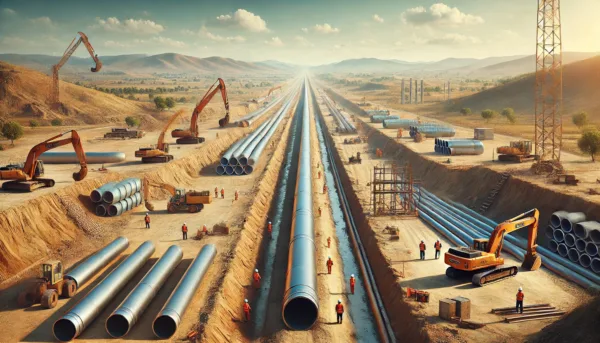
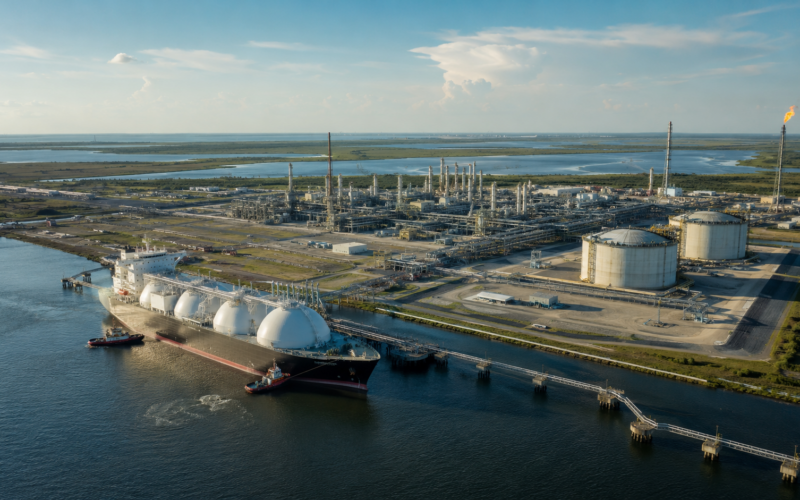
The project is designed as a liquefaction and export terminal that will receive natural gas, treat and chill it into LNG, store the LNG on site and load it onto ocean-going LNG carriers for export. The federal permitting description identifies six natural gas liquefaction trains, six LNG storage tanks, one marine berth capable of handling LNG carriers of up to 216,000 cubic metres and an approximately 3.04-mile natural gas pipeline connecting the facility with existing pipeline infrastructure in Cameron Parish.
The facility’s marketed and authorized export capacity is 9.5 million tonnes per annum. Federal project materials have also referred to six liquefaction trains with nominal capacity of 1.4 million tonnes per annum each, which creates a lower nominal train-by-train arithmetic figure. The safest way to describe the project is therefore as a 9.5Mtpa export facility with six modular liquefaction trains, while recognising that specific regulatory and technical documents may use different nominal, average or authorized capacity measures.
The Commonwealth LNG Project is also designed with a modular construction strategy. This approach is intended to move a significant portion of fabrication and equipment preparation away from the most congested field-construction environment and into more controlled fabrication settings. For LNG projects, modularisation can reduce some site execution risk, but it does not remove the need for highly disciplined transport, integration, commissioning and marine works.

Who owns and operates the Commonwealth LNG Project?
The Commonwealth LNG Project is owned by Commonwealth LNG LLC, a Caturus company. Caturus was created as an integrated natural gas and LNG platform combining Commonwealth LNG with Caturus Energy, formerly Kimmeridge Texas Gas, an upstream operator with large-scale natural gas production in Texas.
The ownership and financing structure around Caturus includes Kimmeridge, Mubadala Energy and Canada Pension Plan Investment Board, along with additional financial partners. Mubadala Energy held a 24.1% stake in the Caturus platform at the time of the May 2026 FID announcement and participated in the project financing. Canada Pension Plan Investment Board committed $1.2 billion in financing and increased its total stake in the Caturus platform to 31%, including earlier investments.
Other major financial partners include EOC Partners, funds and accounts managed by BlackRock and an Ares Infrastructure Opportunities fund. This structure gives Commonwealth LNG a broader institutional capital base than many development-stage LNG projects and helps explain how the project was able to move into construction after years of regulatory and market delays.
The operating model is also different from a traditional tolling-only LNG terminal. Caturus describes the project as part of a fully integrated “wellhead-to-water” strategy. In practical terms, that means the platform is trying to link upstream gas production, liquefaction, offtake and export revenue more directly than a standalone liquefaction facility that simply buys third-party feed gas and charges liquefaction fees.
What is the capacity of the Commonwealth LNG Project and when will it start operations?
The Commonwealth LNG Project is designed to export up to 9.5 million tonnes per annum of LNG. The United States Department of Energy’s non-free trade agreement export authorization allows Commonwealth LNG to export up to 1.21 billion cubic feet per day of natural gas as LNG, which is equivalent to 441.4 billion cubic feet per year or about 9.5 million metric tonnes per annum.
Operations are expected to commence in 2030. Caturus has said Phase 1 development is expected to generate more than $3 billion in annual export revenue once operations begin. That revenue estimate depends on commercial contracts, plant availability, feedgas supply, global LNG prices and the final operating profile of the facility.
The project’s production profile will differ from an upstream gas field because Commonwealth LNG is not producing gas from a reservoir at the terminal site. It will convert natural gas into LNG for export. Its “capacity” therefore refers to liquefaction and export capacity, not geological reserves or wellhead production.
The capacity profile will depend on the reliability of liquefaction trains, compressors, cryogenic heat exchangers, gas turbine generators, pipeline interconnections, storage tanks, loading systems and marine access. For LNG terminals, first production and first cargo are important milestones, but sustained availability and ramp-up reliability determine long-term project economics.
Which companies signed LNG offtake agreements for Commonwealth LNG?
Caturus has said long-term offtake agreements have been secured with a diversified group of global energy and industrial counterparties, including EQT, Glencore, Mercuria, PETRONAS and Aramco Trading. These agreements supported the project’s final investment decision by giving lenders and investors more confidence that future LNG volumes would have committed buyers.
The offtake structure is central to the Commonwealth LNG Project because LNG export terminals require long-term revenue visibility to support project financing. Lenders typically want evidence that enough capacity is contracted with creditworthy buyers before releasing capital for construction. In this case, the offtake counterparties include upstream-linked, trading, national energy and industrial market participants.
The inclusion of EQT is especially notable because it links the project with one of the largest natural gas producers in the United States. Glencore and Mercuria add global trading and portfolio capabilities, while PETRONAS and Aramco Trading connect the project with major international energy groups.
The offtake profile also reflects the changing shape of the LNG market. Buyers increasingly want supply diversity, destination flexibility, portfolio optionality and exposure to Henry Hub-linked United States LNG. Commonwealth LNG’s commercial success will depend on how its contracts balance long-term stability with the flexibility buyers expect in a more competitive LNG market.
What infrastructure and logistics will support the Commonwealth LNG Project?
The Commonwealth LNG Project will rely on three critical infrastructure layers: feedgas access, liquefaction and marine export capacity. Its location in Cameron Parish gives it proximity to Gulf Coast pipeline systems, existing energy infrastructure and one of the most active LNG export regions in the world.
The project includes a short pipeline connection of just over three miles to interconnect the LNG facility with existing natural gas pipelines in Cameron Parish. This feedgas link is essential because the terminal’s economic value depends on receiving sufficient gas volumes at competitive prices and with enough flexibility to match LNG train operations.
At the plant site, six liquefaction trains will process gas into LNG. The facility will also include LNG storage tanks and associated marine loading infrastructure. The ability to load LNG carriers up to 216,000 cubic metres is important because it allows the terminal to serve large modern LNG vessels and international buyers across Asia, Europe and other import markets.
The Calcasieu Ship Channel location provides direct export access, but it also places Commonwealth LNG within a busy industrial and marine corridor. That creates logistical advantages and risks. The project benefits from existing navigation and industrial expertise, but construction and operations must coexist with other LNG plants, vessels, wetlands, fisheries, storm exposure and coastal infrastructure.
Which companies won contracts for the Commonwealth LNG Project?
Technip Energies is the main engineering, procurement and construction contractor for the Commonwealth LNG Project. After the May 2026 final investment decision, Technip Energies received full notice to proceed under its major EPC contract for the 9.5Mtpa facility. This milestone moved the contractor from early works and long-lead equipment activity into full project execution.
Technip Energies had previously been authorized to order major long-lead equipment and sustain critical activities ahead of FID. This approach reduced the risk of losing time in procurement for equipment that can determine the critical path of an LNG project. Long-lead items are especially important in a global LNG construction cycle where demand for compressors, turbines, cryogenic equipment and fabrication capacity can be tight.
The project’s technology and equipment base includes six Baker Hughes mixed-refrigerant compressors powered by LM9000 gas turbines, six Honeywell main cryogenic heat exchangers and four Titan 350 gas turbine generators from Solar Turbines. These packages are central to the LNG process because compression, heat exchange and power generation determine whether gas can be reliably cooled into LNG at scale.
Baker Botts represented Commonwealth LNG on LNG sale and purchase agreements and related documentation supporting the project’s final investment decision. While legal advisory roles do not have the same physical project footprint as EPC contracts, they can be important in LNG developments because of the complexity of long-term offtake, financing, export authorization and commercial risk allocation.
The contract structure shows why LNG export terminals are contractor-intensive assets. Commonwealth LNG requires not only civil construction and process modules, but also compressors, turbines, cryogenic systems, storage, marine facilities, pipeline connections, control systems, commissioning expertise and long-term maintenance planning.
How did the Commonwealth LNG Project move through permitting and development history?
The Commonwealth LNG Project has a long development history that illustrates the difficulty of advancing new United States LNG export capacity through permitting, environmental review, market contracting and financing. Commonwealth LNG applied for federal export authorization in 2019, seeking long-term, multi-contract permission to export domestically produced LNG to free trade agreement and non-free trade agreement countries.
The Federal Energy Regulatory Commission approved the project in November 2022 under Section 3 of the Natural Gas Act. The project later faced further environmental review after a July 2024 decision by the United States Court of Appeals for the District of Columbia Circuit required additional analysis of environmental issues, including cumulative nitrogen dioxide emissions.
FERC staff issued a final supplemental environmental impact statement in May 2025 to address the court-directed analysis. Commonwealth LNG subsequently said in June 2025 that FERC had issued a final order upholding authorization for the 9.5Mtpa LNG export project.
The United States Department of Energy issued final authorization in August 2025 for Commonwealth LNG to export up to 1.21 billion cubic feet per day of natural gas as LNG to non-free trade agreement countries. This was a critical regulatory milestone because non-FTA authorization is needed to reach many of the world’s major LNG-consuming markets.
By May 2026, the project had secured long-term offtake commitments, major EPC support and a financing package large enough to support construction. The final investment decision therefore marked the convergence of regulatory, commercial, engineering and financing milestones that had been years in development.
What are the latest Commonwealth LNG Project updates in 2026?
The most important 2026 update is the May 15 final investment decision by Caturus. The company said the FID marked the start of full construction and was supported by $9.75 billion of project financing for the 9.5Mtpa export facility.
The financing package included support from Kimmeridge, Mubadala Energy and Canada Pension Plan Investment Board, as well as major financial partners including EOC Partners, funds and accounts managed by BlackRock, and an Ares Infrastructure Opportunities fund. Caturus said the transaction attracted total commitments of $21.25 billion.
Technip Energies also received full notice to proceed for the project after FID. This was an important construction milestone because it formally enabled the EPC contractor to move beyond limited early works into full execution.
A further 2026 regulatory item is the change-in-control process associated with Commonwealth LNG’s ownership and financing structure. The Department of Energy docket shows that Commonwealth LNG filed a Statement and Notice of Change in Control on June 15, 2026, followed by DOE follow-up questions on June 24 and a published Federal Register notice in July 2026 with comments due by July 29, 2026.
That does not undo the project’s FID or export authorization, but it is relevant to the project’s current regulatory file because the financing structure involves foreign economic interests and changes in ownership control. The safest way to treat it is as an implementation-stage regulatory process linked to the post-FID ownership and financing structure.
What environmental and regulatory risks affect the Commonwealth LNG Project?
The Commonwealth LNG Project remains shaped by United States federal energy regulation and environmental review. FERC approval, DOE export authorization and environmental impact analysis are all central to the project’s ability to proceed.
The project’s environmental issues include air emissions, greenhouse gas emissions, cumulative nitrogen dioxide impacts, wetlands, coastal ecosystem effects, marine traffic, fisheries, storm exposure and construction impacts in Cameron Parish. The 2024 court decision requiring additional environmental analysis showed that legal and public-interest scrutiny can materially affect LNG project timelines.
Environmental groups and community organisations have opposed or scrutinised the project at different stages, including through interventions, protests and comments in federal proceedings. That public participation does not by itself prevent construction, but it can shape regulatory conditions, legal timelines and reputational risk.
The project also sits in a coastal region exposed to hurricanes, flooding and long-term climate-related physical risks. LNG developers in Louisiana must therefore account for site elevation, storm resilience, emergency planning, marine safety and continuity of operations.
From a policy perspective, Commonwealth LNG reflects the wider debate over United States LNG exports. Supporters argue that LNG exports strengthen energy security for allies, support domestic gas production and create export revenue. Critics argue that new LNG capacity can increase greenhouse gas emissions, affect local communities and lock in fossil fuel infrastructure for decades. A durable project-page article should acknowledge both sides without turning the profile into an advocacy piece.
How does Commonwealth LNG affect Caturus’ integrated gas strategy?
Commonwealth LNG is the central export asset in Caturus’ integrated gas strategy. The platform combines Caturus Energy’s upstream gas production with the Commonwealth LNG export terminal, creating a link from natural gas production to LNG sales.
This integrated model is designed to give Caturus more control over the value chain. Instead of relying entirely on third-party feedgas purchases or functioning only as a liquefaction tolling provider, the platform can connect upstream production, supply agreements, liquefaction capacity and offtake contracts.
The model also creates different risks. Integration can support margin capture and supply control, but it exposes the platform to upstream operating performance, gas price movements, construction risk, financing requirements and long-term LNG market cycles. The economics will depend on how effectively Caturus manages the spread between feedgas costs, liquefaction costs, financing costs and LNG sale prices.
For Kimmeridge, Mubadala Energy and Canada Pension Plan Investment Board, the project provides exposure to a long-life United States gas infrastructure platform. For offtake customers, it adds another source of United States LNG supply with access to Gulf Coast infrastructure and Henry Hub-linked gas economics.
Why does the Commonwealth LNG Project matter to Louisiana and global LNG supply?
For Louisiana, the Commonwealth LNG Project adds another major energy infrastructure project to a region already central to the United States LNG export industry. The project is expected to create construction activity, operations jobs, tax revenue and demand for regional services, fabrication, marine logistics and pipeline infrastructure.
Cameron Parish is already familiar with LNG development, but that does not remove local concerns. Large energy projects can affect traffic, wetlands, fisheries, housing, emergency services and coastal communities. The project’s local impact will depend on construction management, environmental compliance, storm resilience and community engagement.
For global LNG supply, Commonwealth LNG adds another 9.5Mtpa of potential United States export capacity from 2030. That matters because LNG buyers in Europe and Asia continue to diversify supply portfolios after recent energy-security shocks, while emerging markets are weighing gas imports against price volatility and decarbonisation goals.
The project is also part of a larger wave of United States LNG capacity additions expected to reshape global supply toward the end of the decade. Commonwealth LNG will compete with projects in Texas, Louisiana, Qatar, Canada and Mexico. Its ability to secure long-term customers and financing in 2026 indicates commercial momentum, but final competitiveness will depend on execution cost, timing and contract terms.
What is the future outlook for the Commonwealth LNG Project?
The future outlook for the Commonwealth LNG Project is constructive, but execution-sensitive. The project has reached FID, secured $9.75 billion in project financing, received full EPC notice to proceed and signed long-term offtake agreements with major counterparties. Those are the milestones that many LNG proposals never reach.
The next major test is construction delivery. Technip Energies must execute the EPC programme, long-lead equipment must arrive on schedule, modular components must be integrated correctly and the site must be prepared for safe commissioning. The equipment package involving Baker Hughes compressors, Honeywell cryogenic heat exchangers and Solar Turbines generators will be central to the plant’s eventual operating reliability.
The project also must manage regulatory follow-through, including change-in-control processes and continuing compliance with FERC and DOE conditions. Federal approval does not end the regulatory burden. LNG projects remain subject to construction oversight, environmental monitoring, export authorization conditions, safety standards and operational compliance.
Commercially, Commonwealth LNG enters a market where buyers want reliable supply but also negotiate hard on flexibility and price. The project’s offtake portfolio gives it a foundation, yet future value will depend on construction cost discipline, start-up performance and the balance between contracted revenue and available merchant exposure.
If Commonwealth LNG begins operations in 2030 as planned, it will strengthen the position of Caturus as an integrated gas and LNG platform and add another major United States supply source to global LNG trade. If delays, cost increases or regulatory complications emerge, the project will become a reminder that FID is not the end of LNG project risk. It is the point at which construction, commissioning and market execution become the real test.
Discover more from Business-News-Today.com
Subscribe to get the latest posts sent to your email.