




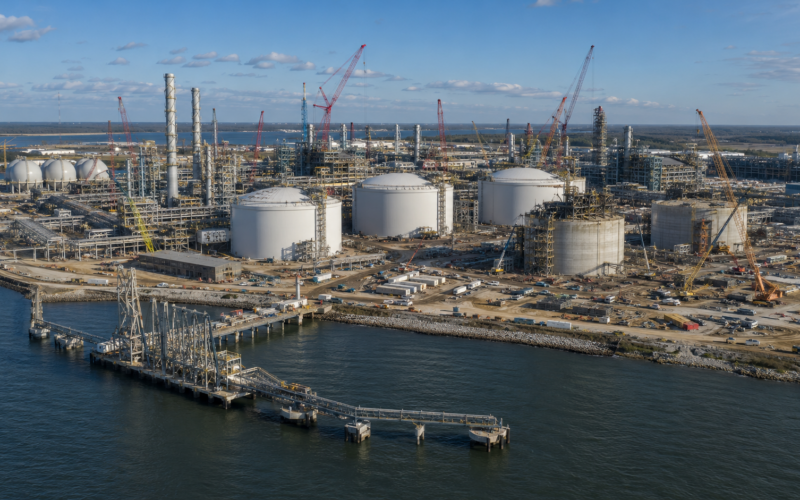
Cheniere Energy, Inc. (NYSE: LNG) has raised its 2026 adjusted EBITDA guidance to between $7.9 billion and $8.4 billion while Corpus Christi Stage 3 moves toward completion, but the underlying guidance math is more conservative than the capacity-growth narrative might suggest. The company generated $4.137 billion of adjusted EBITDA during the first six months of 2026, meaning the midpoint of its new full-year range requires only about $4.013 billion during the second half.
That would actually be about 3% below first-half adjusted EBITDA despite Cheniere having six of the seven Corpus Christi Stage 3 midscale trains operational by June 30 and expecting first LNG from Train 7 imminently. The company has also tightened its 2026 LNG production forecast upward to 53 million to 54 million tonnes.
The implication is not that Cheniere expects operations to weaken. Rather, its upgraded guidance appears to leave more room for commodity margins, timing effects and optimization revenue to normalize even as physical LNG output continues expanding.
How much EBITDA does Cheniere actually need in the second half?
Cheniere’s revised full-year adjusted EBITDA range of $7.9 billion to $8.4 billion implies second-half adjusted EBITDA of roughly $3.763 billion to $4.263 billion after subtracting the $4.137 billion already generated through June. At the $8.15 billion midpoint, the implied H2 figure is approximately $4.013 billion.
That produces an unusually tight relationship between the two halves of the year. The bottom of the guidance range would put H2 adjusted EBITDA about 9% below H1, while even the $8.4 billion upper end requires second-half EBITDA only around 3% higher.
This matters because the headline guidance increase can otherwise create the impression that Cheniere is forecasting a large earnings acceleration as additional Corpus Christi capacity enters service. Instead, much of the improvement in the full-year outlook has already been earned during a particularly strong first half.
Distributable cash flow tells much the same story
Cheniere generated $2.84 billion of distributable cash flow attributable to the company during the first six months. Its revised full-year guidance of $5.3 billion to $5.8 billion therefore implies approximately $2.46 billion to $2.96 billion during H2.
At the $5.55 billion midpoint, second-half distributable cash flow would be approximately $2.71 billion, about 4.6% below the first-half result.
That is particularly notable because Cheniere continues to deploy significant cash across growth investment, debt reduction, dividends and repurchases. During H1, it repurchased approximately 4.9 million shares for $1.1 billion, invested about $2.1 billion in growth capital and repaid roughly $253 million of long-term debt.
The cash-flow guidance therefore suggests management is not assuming that every additional tonne of LNG production translates immediately into a proportionate increase in distributable cash generation.
Why can LNG volumes rise without EBITDA accelerating at the same pace?
Volume growth is already visible. Cheniere exported 184 LNG cargoes during the second quarter, up 19% from 154 a year earlier, while exported volumes increased 22% to 672 trillion British thermal units. First-half exports reached 371 cargoes, compared with 322 in the corresponding 2025 period.
Adjusted EBITDA nevertheless depends on more than cargo count. Cheniere said its Q2 increase reflected both higher volumes and higher margins per million British thermal units of LNG delivered. Those margins can move with international gas prices, contract structures, optimization activity and the timing of cargo recognition.
That helps explain why rising production does not automatically produce sequential EBITDA growth. Corpus Christi Stage 3 increases the physical earnings base, but market-linked margins can amplify or offset the benefit in individual quarters.
How much has Cheniere already raised its 2026 expectations?
The scale of the guidance reset becomes clearer when compared with February. Cheniere initially guided to adjusted EBITDA of $6.75 billion to $7.25 billion for 2026, giving a midpoint of $7 billion. It raised that range to $7.25 billion to $7.75 billion after Q1 and then lifted it again to the current $7.9 billion to $8.4 billion following Q2.
The midpoint has therefore increased by $1.15 billion, or about 16.4%, in less than six months.
Operational execution has supported that reset. Corpus Christi Stage 3 was 98.4% complete at June 30, with Trains 1 through 6 operational and Train 7 under construction and commissioning. Stage 3 is expected to provide more than 10 million tonnes per annum of LNG production capacity when complete, while Cheniere has further growth projects under construction or in the regulatory process.
Cheniere shares were most recently around $265.43, giving the company a market capitalization of approximately $55.6 billion. The more useful question for investors now may therefore be less about whether 2026 guidance can rise again and more about what earnings level Cheniere can sustain once Stage 3 is fully operational and favorable optimization or commodity effects normalize.
The current guidance offers an interesting clue. Cheniere can deliver its midpoint without second-half adjusted EBITDA exceeding the first half at all. If Train 7 ramps smoothly and market margins remain constructive, that creates room for another upside surprise. If margins soften, the existing range already appears designed to absorb some of that pressure while the underlying LNG production platform continues to expand.
Discover more from Business-News-Today.com
Subscribe to get the latest posts sent to your email.
