


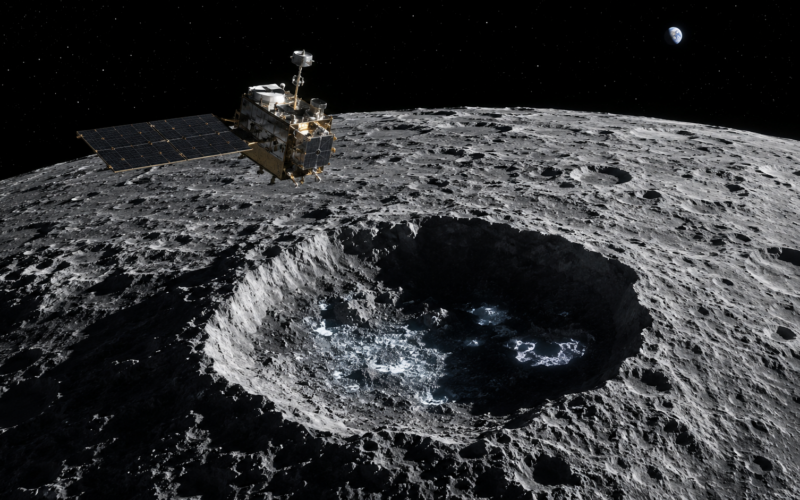
Scientists working with India’s Chandrayaan-2 mission have found strong evidence of subsurface ice in some of the Moon’s coldest and darkest craters near the lunar south pole, sharpening the strategic importance of India’s lunar programme in the global race for long-duration Moon missions.
The findings are based on data from the Chandrayaan-2 orbiter, particularly radar observations used to study permanently shadowed and doubly shadowed craters. These craters receive little to no direct sunlight and can remain cold enough to preserve water ice beneath the lunar surface for long periods. The study has identified possible subsurface ice signatures in some of these extreme environments, including craters in the lunar south polar region.
The Indian Space Research Organisation said scientists from the Physical Research Laboratory in Ahmedabad used Chandrayaan-2 data to identify possible subsurface ice in some of the coldest craters near the Moon’s south pole. The research strengthens the scientific case that the lunar south pole may contain accessible water resources that could support future human exploration, scientific bases and in-space resource use.
The discovery is important because water on the Moon is not just a scientific curiosity. Water ice can potentially support drinking water, oxygen production and rocket fuel manufacturing. That makes lunar polar ice one of the most valuable resources in the next phase of space exploration.
For India, the findings extend the relevance of Chandrayaan-2 beyond its 2019 lander setback. The Chandrayaan-2 orbiter has continued to deliver scientific value from lunar orbit, and the latest ice-related evidence builds on India’s growing credibility after the Chandrayaan-3 landing near the lunar south polar region in 2023.
Why does Chandrayaan-2’s evidence of subsurface ice matter for future Moon missions?
Chandrayaan-2’s evidence of subsurface ice matters because water is one of the most important resources for sustained human activity beyond Earth. If water ice exists in usable quantities near the lunar south pole, future missions may be able to reduce dependence on supplies launched from Earth.
The confirmed scientific development is that Chandrayaan-2 orbiter data has revealed strong evidence of ice buried beneath or within the floors of doubly shadowed craters near the lunar south pole. The institutional response from the Indian Space Research Organisation highlights the role of Indian lunar data in advancing global knowledge of the Moon’s polar resources.
The broader consequence is that lunar exploration is moving from symbolic landings toward resource assessment. Space agencies are no longer asking only whether they can reach the Moon. They are asking where water exists, how deep it is, how stable it may be and whether it can support long-duration missions.
Water ice could be processed into oxygen for breathing and hydrogen-oxygen propellant for rockets. Even if extraction remains technically difficult, the presence of water changes mission planning. Landing sites, rover routes, drilling systems and future lunar base designs may increasingly focus on polar craters and nearby illumination zones.

What are doubly shadowed lunar craters and why are they ideal traps for ice?
Doubly shadowed lunar craters are craters located inside permanently shadowed regions where the crater’s own raised rim blocks not only direct sunlight but also scattered light and thermal radiation from nearby illuminated terrain. This makes these craters among the coldest known environments on the Moon.
The confirmed study focus is on these doubly shadowed craters near the lunar poles. Their extreme darkness and low temperatures create conditions that can preserve volatile compounds, including water ice. Some of these environments can reach temperatures close to 25 Kelvin, making them natural cold traps.
The institutional significance is that missions such as Chandrayaan-2 can study these regions from orbit using instruments that do not depend on direct sunlight. Radar instruments can detect subsurface properties and help scientists identify signatures consistent with ice. This is essential because optical cameras cannot easily examine terrain that remains in deep shadow.
The broader consequence is that doubly shadowed craters could become high-priority targets for future lunar science. These craters may preserve records of comet impacts, asteroid delivery, solar wind interactions and billions of years of volatile migration across the Moon. They may also contain resources that future astronauts could use.
How did Chandrayaan-2 orbiter data help scientists detect possible ice near the Moon’s south pole?
The Chandrayaan-2 orbiter carries instruments capable of studying the lunar surface from orbit. The latest findings draw from radar-based observations that can examine surface and subsurface characteristics in permanently shadowed and doubly shadowed regions.
The confirmed instrument-linked focus is the Chandrayaan-2 orbiter’s radar observations, including data associated with the Dual Frequency Synthetic Aperture Radar. Radar can help identify features such as roughness, scattering properties and signatures that may be consistent with ice-bearing material under the surface.
The institutional value of this approach is that orbital radar can examine regions that are difficult or impossible to study with visible-light imaging. The lunar south pole includes permanently shadowed regions where sunlight does not reach directly. Without radar and thermal instruments, these regions would remain largely hidden from remote scientific investigation.
The broader consequence is that Chandrayaan-2 continues to function as a scientific platform even years after launch. The mission’s orbiter has become a long-term lunar observatory, contributing data not only for Indian missions but also for the global planetary science community.
Why does the lunar south pole matter so much to India, NASA, China and other space powers?
The lunar south pole matters because it combines scientific value, possible water resources and strategic landing-site relevance. The region contains permanently shadowed craters where ice may survive, as well as nearby areas that may receive more favourable sunlight for solar power generation.
For India, the lunar south pole is already central to national space achievement. Chandrayaan-3 made India the first country to land near the lunar south polar region in 2023. Chandrayaan-2’s latest ice-related findings reinforce the importance of India’s long-term interest in that region.
For the United States, the lunar south pole is central to the Artemis programme, which aims to return astronauts to the Moon and support sustained lunar exploration. For China and other space powers, polar resources are also increasingly relevant to future base planning and scientific ambition.
The broader consequence is that lunar polar science is becoming part of a new strategic geography. The most valuable lunar locations may be those that combine sunlight, water access, safe terrain and communications viability. Countries that understand these regions best may have an advantage in planning future missions.
How does this discovery change the legacy of Chandrayaan-2 after its 2019 lander setback?
The discovery strengthens the legacy of Chandrayaan-2 because it shows that the mission’s scientific value did not end with the Vikram lander’s failed soft-landing attempt in 2019. The Chandrayaan-2 orbiter continued operating and has delivered important lunar science data from orbit.
The confirmed development is that Chandrayaan-2 data has contributed to possible subsurface ice detection near the lunar south pole. The institutional importance is that the Indian Space Research Organisation can point to Chandrayaan-2 as a mission that continued to produce high-value science despite the lander setback.
The broader consequence is reputational. Chandrayaan-2 helped build the knowledge base that supported India’s later lunar ambitions, including Chandrayaan-3. The latest discovery adds another layer to the mission’s scientific credibility and strengthens India’s standing in planetary exploration.
For the public, the lesson is also important. Space missions are not judged only by one landing attempt. Orbiters, payloads, long-term data archives and scientific analysis can produce discoveries years after launch. Chandrayaan-2 is now part of that longer scientific story.
What does lunar water ice mean for human bases, oxygen production and rocket fuel?
Lunar water ice could support future human bases because water can potentially be used for life support, agriculture experiments, radiation shielding, oxygen generation and propellant production. The most strategically important use may be splitting water into hydrogen and oxygen, which can be used in rocket fuel systems.
The confirmed relevance of the Chandrayaan-2 finding is that subsurface ice near the lunar south pole could support future missions if it is accessible and extractable. The institutional interest from global space agencies is tied to long-duration human presence on the Moon and future missions deeper into space.
The broader consequence is that the Moon could become a resource node rather than only a destination. If water can be extracted locally, future missions may reduce the mass launched from Earth, lowering costs and increasing mission flexibility. Lunar water could support refuelling depots, surface habitats and possibly Mars mission architecture.
However, major uncertainties remain. Scientists must confirm the quantity, purity, depth and physical form of the ice. Engineers must then develop systems to extract, process and store water in extreme cold and low-gravity environments. The discovery is therefore a major scientific step, but not yet proof of immediate industrial usability.
What challenges remain before lunar ice can be confirmed and used by astronauts?
The biggest challenge is confirmation. Orbital radar can identify signatures consistent with ice, but direct measurements from landers, rovers or sample-return missions are needed to confirm composition, thickness, distribution and accessibility.
The second challenge is terrain. Permanently shadowed and doubly shadowed craters are extremely cold, dark and difficult to navigate. Robotic missions operating inside them would need power solutions, thermal protection, communication links and autonomous navigation systems.
The third challenge is extraction. Even if ice is present, it may be mixed with regolith, buried unevenly or difficult to mine. Processing lunar soil to extract water requires energy, equipment, reliability and long-term maintenance in a harsh environment.
The broader consequence is that future lunar missions will need to move from detection to ground truth. Chandrayaan-2 has helped identify promising targets. The next step for global lunar exploration is to send instruments that can drill, sample, heat, analyse and map these deposits directly.
What happens next after Chandrayaan-2’s latest lunar ice findings?
The next phase will involve further scientific analysis, comparison with other lunar datasets and possible mission planning around the most promising polar targets. Researchers will likely compare Chandrayaan-2 radar signatures with thermal maps, topographic data, crater age models and observations from other lunar orbiters.
For India, the findings may strengthen future mission planning, including more advanced lunar orbiters, landers, rovers and sample-return missions. The Indian Space Research Organisation is already positioned as a major lunar actor after Chandrayaan-3, and Chandrayaan-2’s science output gives India a stronger role in global discussions on lunar resources.
For the wider space community, the finding adds another data point in the search for lunar water. The lunar south pole is becoming a central focus for human exploration, but it remains scientifically complex. More data will be needed before space agencies can choose the safest and most resource-rich locations for future surface infrastructure.
For now, Chandrayaan-2 has delivered a major reminder: India’s lunar orbiter is still shaping the future of Moon exploration, and the coldest craters near the Moon’s south pole may hold some of the most important clues for humanity’s next steps beyond Earth.
What are the key takeaways from Chandrayaan-2’s evidence of lunar ice near the south pole?
- Chandrayaan-2 orbiter data has revealed strong evidence of possible subsurface ice near the Moon’s south pole. The findings focus on doubly shadowed craters, which are among the coldest and darkest environments on the lunar surface.
- Scientists from the Physical Research Laboratory in Ahmedabad used Chandrayaan-2 data for the analysis. The Indian Space Research Organisation highlighted the finding as an important contribution to lunar polar science.
- Doubly shadowed craters are ideal cold traps because they receive little to no direct sunlight or scattered heat. These conditions can preserve water ice beneath the lunar surface for long periods.
- Lunar water ice could support future human exploration if it is confirmed and extractable. Water can potentially be used for drinking, oxygen generation and rocket fuel production.
- The discovery strengthens the long-term scientific legacy of Chandrayaan-2. Although the 2019 lander attempt failed, the Chandrayaan-2 orbiter continues to generate valuable scientific data.
- The next step is ground confirmation through landers, rovers or sample analysis. Orbital evidence is important, but direct measurement is needed to determine the quantity, depth and usability of lunar ice.
Discover more from Business-News-Today.com
Subscribe to get the latest posts sent to your email.