


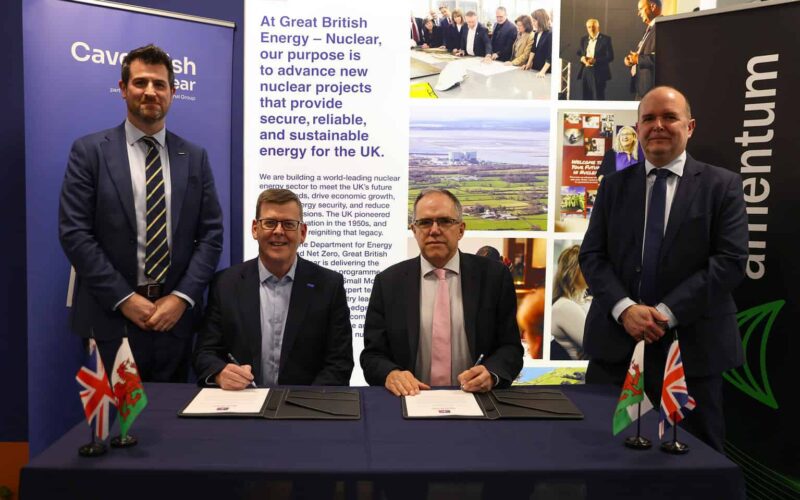
Babcock International Group (LSE: BAB), through its wholly owned nuclear engineering subsidiary Cavendish Nuclear, has secured a landmark role in a joint venture awarded a contract worth up to PS300 million by Great British Energy – Nuclear (GBE-N) to serve as Owner’s Engineer for the UK’s first small modular reactor programme at Wylfa, North Wales. The joint venture, trading as Litmus Nuclear, pairs Cavendish Nuclear with US-based defence and engineering firm Amentum and carries a contract duration of up to 14 years, reflecting the scale of the technical assurance work required before GBE-N can sanction the construction phase. The programme will deploy Rolls-Royce SMR’s 470 MWe pressurised water reactor technology, with an initial three-unit configuration targeting first power in the mid-2030s. Babcock International shares (BAB.L) have surged from a 52-week low of around 603 pence to touch an all-time high of 1,527 pence in January 2026, with the stock trading in the range of 1,366 to 1,412 pence in recent sessions, a trajectory that reflects investor confidence in the group’s nuclear and defence franchise rather than reaction to any single contract.
What does the Owner’s Engineer role at Wylfa actually mean for Cavendish Nuclear and the SMR programme?
The Owner’s Engineer designation is one of the most consequential technical roles in a large nuclear project. Litmus Nuclear sits between GBE-N as client and the broader supply chain, providing independent assurance that design, safety cases, engineering interfaces, construction methodology, and commissioning protocols meet regulatory requirements before GBE-N commits to a final investment decision currently targeted for 2029. The Owner’s Engineer does not design or build the reactor; it scrutinises everyone who does. That distinction matters because GBE-N is a state-owned entity deploying public capital, and the entire programme rationale rests on demonstrating that a UK-assembled SMR can be delivered at a lower cost and faster timeline than traditional gigawatt-scale nuclear construction. If Litmus Nuclear fails to catch design inconsistencies or regulatory shortfalls early, the cost and schedule consequences compound rapidly, as the UK’s experience with Hinkley Point C has made plain.
Cavendish Nuclear brings direct experience across the UK nuclear enterprise, spanning decommissioning work at legacy Magnox sites, engineering services at operating stations, and programme management on new build projects. Amentum, a Virginia-headquartered engineering group with around 6,000 staff in the UK, was separately appointed by Rolls-Royce SMR as its programme delivery partner across both the Wylfa project and the company’s Czech deployment with utility CEZ. That Amentum now carries roles on both sides of the client-supply chain divide, as delivery partner to Rolls-Royce SMR and as co-Owner’s Engineer for GBE-N, is a structural feature of the project worth monitoring. In orthodox project governance, Owner’s Engineer independence from the technology developer and its primary delivery partner is essential. GBE-N’s construction of the Litmus Nuclear joint venture with Amentum implies a degree of confidence that the necessary information barriers and governance protocols can be maintained, but it is a configuration that regulators and parliamentary scrutiny may examine closely.
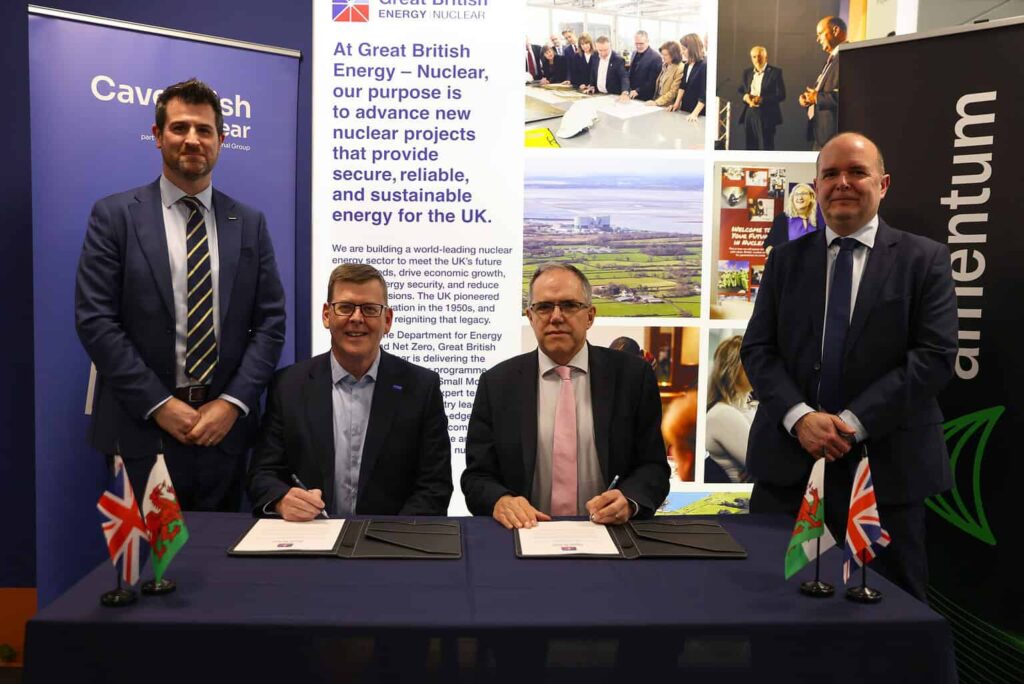
How does Wylfa fit into the UK government’s 24 GW nuclear target and broader energy security strategy?
The Wylfa SMR programme is the forward edge of the most ambitious civil nuclear expansion the UK has attempted in half a century. The government has committed more than PS2.5 billion in public funding to the initial three-unit deployment, alongside PS14.2 billion committed to Sizewell C, which reached its final investment decision in July 2025 with the government taking a 44.9% equity stake. Together with Hinkley Point C, which remains under construction in Somerset, these three projects are intended to add close to 8 GW of nuclear capacity during the 2030s, moving the UK toward a 24 GW nuclear fleet by 2050 and reducing dependence on imported gas during periods of low renewable output.
The Wylfa site itself has a long nuclear history. The original Wylfa Magnox power station operated on the island of Anglesey until 2015, and two of its reactors each produced approximately 490 MWe, making the Rolls-Royce SMR’s 470 MWe output per unit a close analogue to what the site has hosted before. Hitachi had earlier acquired the site and pursued a full-scale Advanced Boiling Water Reactor project before abandoning those plans; the UK government purchased the land from Hitachi in March 2024 for PS160 million, unlocking the SMR pathway. GBE-N has also received an Electricity Generation Licence from Ofgem, secured in March 2026, formalising its status as a licensed power generator ahead of the construction phase. Site activity is scheduled to commence in 2026, with the foundation engineering design work recently awarded to Arup alongside a consortium including LDA Design, TUV SUD Nuclear Technologies, Mace Consult, and Gleeds.
What execution risks could delay or inflate the cost of the Wylfa SMR project before the 2029 final investment decision?
The Rolls-Royce SMR design is still progressing through the UK’s Generic Design Assessment process. Step 3 of that assessment, the detailed evaluation phase, commenced in July 2024 and is planned for completion by December 2026. Any material findings arising from that process could require design modifications that ripple through the Owner’s Engineer’s assurance work and extend the timeline to a final investment decision. The programme’s self-described rationale, that factory-built modular construction can reduce on-site complexity and cost relative to bespoke large reactor projects, has yet to be validated at commercial scale. Only two SMR designs are currently operational globally: Russia’s Akademik Lomonosov floating plant and China’s HTR-PM installation in Shandong province. Neither provides a directly comparable reference case for a western regulatory environment or supply chain.
The UK’s nuclear supply chain also remains under capacity pressure. GBE-N is assembling a coalition of advisers and contractors simultaneously, including WSP and Mott MacDonald for environmental and permitting services, Skanska for earthquake protection systems, and now Litmus Nuclear as Owner’s Engineer. While this parallelised mobilisation reflects the government’s stated desire to advance the programme with pace, it also increases coordination risk at an early stage when scope boundaries are still being drawn. The construction peak is projected to support up to 3,000 jobs at Wylfa and contribute to the 8,000 long-term employment positions Rolls-Royce SMR has estimated across the UK build and maintenance programme. Those projections are contingent on the programme reaching a positive final investment decision in 2029 and maintaining construction momentum through the 2030s.
How does the Litmus Nuclear win affect Babcock International’s nuclear revenue mix and competitive position?
Babcock International’s Nuclear segment already provides engineering services across decommissioning, operational support, and new build programme management for existing UK stations. A 14-year Owner’s Engineer engagement on the UK’s first SMR programme is a structurally different revenue type: long-duration, publicly funded, and strategically visible at a policy level. For a group that reported net income of PS169.3 million and half-year revenue of approximately PS2.54 billion in its most recent reporting period, a contract with a PS300 million maximum value over 14 years is not a near-term earnings catalyst but rather a beachhead in the new build nuclear market that could generate follow-on scopes if Wylfa proceeds to construction and the fleet ambition scales to the government’s stated eight-unit potential at the site.
Babcock International’s share price rally from its 52-week low of approximately 603 pence to the all-time high of 1,527 pence reached in January 2026 reflects broader defence sector re-rating as European governments increased defence expenditure. The nuclear exposure provides a complementary long-cycle growth driver alongside Babcock’s Marine segment work on submarine support and Type 31 frigates. The average 12-month analyst price target sits at approximately 1,549 pence according to available consensus data, implying modest further upside from the current trading range but not a valuation that embeds significant new build nuclear optionality. As GBE-N’s programme progresses through design assessment and toward a final investment decision, investor attention to Babcock’s nuclear division is likely to increase.
Where does the Rolls-Royce SMR technology stand in the global small modular reactor competitive landscape?
Rolls-Royce SMR’s 470 MWe design sits at the upper end of the internationally accepted SMR size range, which the European Union defines as up to 300 MWe per unit, though the UK government classifies it as an SMR for policy and programme purposes. The design is based on proven pressurised water reactor technology and uses low-enriched uranium fuel of up to 5%, avoiding the dependency on High-Assay Low Enriched Uranium that some advanced reactor designs require and which currently only Russia produces commercially at scale. That fuel supply distinction is not a trivial consideration given the geopolitical context surrounding reactor fuel chains.
Globally, the SMR market is rapidly attracting capital and government backing. The US government announced an USD80 billion commitment to its nuclear industry in October 2025. Technology companies including Amazon, Google, and Microsoft have contracted SMR capacity for data centre power supply, creating a parallel demand signal beyond utility-scale grid applications. In Europe, the Czech Republic’s CEZ took a 20% equity stake in Rolls-Royce SMR in late 2024 and signed an Early Works Agreement for deployment at the Temelín site in July 2025. That international co-development both validates the technology pathway and creates cost-sharing opportunities in the supply chain, which is relevant to the economics of the Wylfa programme. The World Nuclear Association recorded 51 SMR designs in licensing or pre-licensing stages across 15 countries as of mid-2025, underlining that the UK’s first-mover position at Wylfa is commercially meaningful but not uncontested.
Key takeaways: what the Litmus Nuclear contract means for Babcock, Amentum, GBE-N, and the UK nuclear sector
- The PS300 million, 14-year Litmus Nuclear contract positions Cavendish Nuclear and Amentum at the centre of the UK’s first SMR programme, with independent assurance responsibilities spanning design, safety, engineering, construction, and commissioning ahead of a 2029 final investment decision.
- Babcock International (LSE: BAB) gains a long-duration new build nuclear revenue stream that complements its existing decommissioning and operational support work, and represents a strategic beachhead ahead of any fleet expansion at Wylfa beyond the initial three units.
- Amentum’s dual role as Rolls-Royce SMR’s programme delivery partner and co-Owner’s Engineer for GBE-N is an unusual structural arrangement that regulators and parliamentary oversight bodies may scrutinise for independence and conflict-of-interest management.
- The Wylfa programme’s commercial logic rests on unproven assumptions about SMR construction cost and schedule performance at scale; the Litmus Nuclear team’s ability to hold those assumptions to account will be as important as the technical assurance work itself.
- Rolls-Royce SMR’s Generic Design Assessment Step 3 is due for completion by December 2026 and represents the most proximate technical risk to the 2029 final investment decision timeline.
- The UK government’s PS2.5 billion SMR funding commitment and PS14.2 billion Sizewell C allocation together represent the largest civil nuclear programme in half a century, with Wylfa the first new build project to advance into active Owner’s Engineer engagement.
- Babcock International’s share price has more than doubled from its 52-week low, driven primarily by the defence sector re-rating, with the nuclear new build optionality not yet fully reflected in consensus analyst targets of approximately 1,549 pence.
- Wylfa’s initial three-unit configuration targets up to 1.5 GW of low-carbon output from the mid-2030s, with the site assessed as capable of hosting up to eight units, providing a long runway for supply chain and workforce development in North Wales.
- The global SMR market, with 51 designs in regulatory processes across 15 countries and major technology company procurement accelerating, validates the commercial rationale for the UK’s first-mover positioning, though it also signals that competitive pressure on cost and delivery will intensify.
- Parallel appointments across the Wylfa project, including Arup for foundation engineering, WSP and Mott MacDonald for environmental services, and Skanska for earthquake protection, indicate GBE-N is mobilising its supply chain at pace, raising coordination and scope-boundary risk during the pre-FID phase.
Discover more from Business-News-Today.com
Subscribe to get the latest posts sent to your email.
