

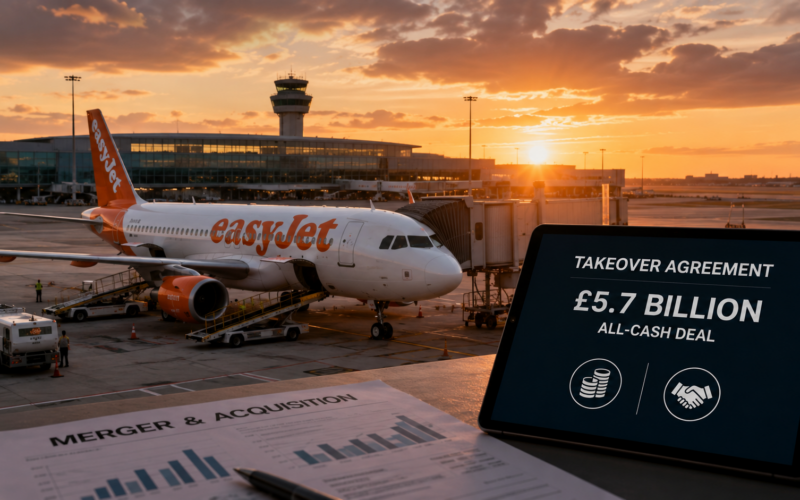
easyJet plc (LSE: EZJ) has agreed to a £5.7 billion, or approximately $7.7 billion, all-cash takeover by funds managed by Apollo Global Management (NYSE: APO), ending a months-long contest for control of one of Europe’s largest low-cost carriers and setting a Q1 2027 target for completion. The offer values each easyJet share at £7.15 in cash, with the airline’s board unanimously recommending the deal after rival US private equity bidder Castlelake pulled out of the process on the same day. Apollo has framed the price as a 54% premium to easyJet’s closing price on 27 February 2026, the last trading day before the outbreak of the current Middle East conflict, although it sits only marginally above the airline’s mid-summer market price after a bid-driven rerating. Completion still depends on shareholder, UK court, aviation licensing and competition approvals, and the transaction is structured to keep a substantial minority of easyJet’s existing register inside the private company through both an EU-compliant retention arrangement and a stub-equity alternative. The central tension for the market now is whether Apollo can extract more value from easyJet’s slot portfolio, holiday business and profit-recovery plan away from listed markets than public shareholders would have captured had the fuel shock reversed on its own.
How does Apollo Global Management’s £5.7 billion offer reset the easyJet investment case after the Iran war fuel shock?
The deal effectively closes the chapter on easyJet as a public turnaround story that had been overwhelmed by external variables. easyJet reported a H1 FY2026 headline loss before tax of £552 million for the six months to 31 March 2026, widening from a £394 million loss a year earlier, with an additional £25 million of fuel costs incurred in March once oil markets reacted to the escalation of the Middle East conflict. Second-quarter group profit before tax then fell around 70% year on year to £85 million, as spot jet fuel prices peaked near $1,800 per metric tonne in April and pushed costs onto the unhedged portion of consumption. Passenger demand held up in aggregate, with H1 revenue rising 12% to £3.95 billion and load factor improving two percentage points to 90%, but forward bookings shifted later into the departure window as travellers waited for clarity on fares and safety.
Against that backdrop, Apollo’s £7.15 offer looks less like a premium for a strong operating base and more like a premium for optionality. Management retained its medium-term ambition of more than £1 billion in pre-tax profit, but the timeline had become dependent on fuel normalisation, hedging book roll-off and disciplined capacity growth. Public shareholders were being asked to underwrite that path through further quarters of volatility. The Apollo bid converts that call-option-like payoff into a fixed cash exit at a level that is comfortably above pre-conflict trading, while transferring the execution risk to private capital.
Why did Castlelake walk away and what does the exit tell investors about the ceiling on easyJet’s private-market value?
The Castlelake withdrawal is arguably as informative as the Apollo agreement itself. Castlelake had approached the easyJet board through a sequence of proposals over May, June and July, starting with a bid around $6.64 billion that easyJet rejected in June, and moving through a $7.3 billion proposal at £6.90 a share that the board had initially indicated it was minded to recommend. Apollo entered in July with the £7.15 proposal, prompting easyJet to switch its support, and Castlelake ultimately declined to raise its bid further, telling the market on 6 August that it did not intend to make a firm offer.
The decision suggests that even a determined private equity buyer with prior conviction was not prepared to underwrite additional consideration above the Apollo level given the residual uncertainties around fuel, capacity and regulatory approval. For public shareholders, that indicates the £7.15 price sits close to the practical ceiling of what the current private-equity market was willing to bid, rather than a starting point for a further auction. It also reduces the probability of an interloper appearing during the offer period, although the possibility cannot be excluded entirely if trade buyers or strategic aviation investors reassess in the coming weeks.

What does the Haji-Ioannou family’s retained stake mean for the structure of the Apollo takeover?
European Union aviation ownership rules require that airlines holding EU operating licences remain majority-owned and effectively controlled by EU nationals. easyJet has historically satisfied that requirement through a combination of the founding Haji-Ioannou family’s shareholding and other EU-domiciled investors, and the transaction has been structured to preserve that compliance under private ownership. Contemporaneous reporting indicates that the family of founder Stelios Haji-Ioannou and other large shareholders are expected to retain a combined position of between 45% and 49% of the carrier post-completion, with an EU trust arrangement holding up to a further 5%.
Alongside that structural EU ownership feature, the offer document provides a stub-equity alternative for eligible shareholders, allowing them to roll a portion of their holdings into the acquisition vehicle rather than take cash. That gives long-standing shareholders, including the founding family, a mechanism to remain exposed to any value created under Apollo’s ownership. The arrangement is unusually explicit for a public-to-private aviation transaction and signals that Apollo does not intend to disrupt the founder relationship or the airline’s operating licence structure, both of which have real commercial value tied up in bilateral traffic rights and airport slot allocations.
How does the easyJet acquisition fit into Apollo Global Management’s existing aviation portfolio strategy?
Apollo has been building meaningful aviation exposure for several years. The firm holds positions in Sun Country Airlines, Aeroméxico and Atlas Air Worldwide, spanning US point-to-point leisure travel, a Latin American full-service network carrier and a global freight and lift services operator. easyJet extends that footprint into the largest short-haul leisure market in Europe, with 355 aircraft, more than 1,200 routes and 164 airport destinations across 38 countries. The strategic pattern is consistent: identifying carriers with clear network positioning, defensible slot or route bases, and cash generation that improves once cost inflation and capital allocation are handled outside quarterly reporting pressure.
The wider Apollo model also relies on integrated financing capability, with insurance-related balance sheet resources through Athene supporting complex, capital-intensive assets. Aircraft financing, aircraft leasing arrangements and fleet renewal decisions all sit inside that competency, which becomes relevant as easyJet works through its Airbus A320neo delivery pipeline and older A319 phase-out. Whether Apollo runs the airline as a standalone platform or eventually combines assets across its aviation portfolio is unresolved, but the deal materially enlarges Apollo’s exposure to a sector where private capital has previously moved cautiously.
What does taking easyJet private change about the airline’s ability to execute its medium-term profit ambitions?
Public ownership carried a specific set of constraints for easyJet during the fuel shock. Every quarter required disclosure of hedging positions, load factors and forward bookings at a point when the underlying demand picture was still in flux. Analyst ratings responded to short-term data, with Deutsche Bank recently maintaining a Hold rating and broker price targets ranging from around 360 pence to 715 pence, reflecting a wide dispersion in views on 2027 earnings. Under private ownership, management can lengthen its planning horizon, defer or bring forward capacity decisions without pre-committing publicly, and reshape the balance sheet to match the fuel and interest rate cycle more flexibly.
easyJet holidays is a specific point of leverage here. The holidays business grew customers 22% in H1 FY2026 and increased pre-tax profit 39% year on year to £61 million on a one-percentage-point margin improvement to 9%. It is a fundamentally different economic model from the airline, with lower capital intensity and stronger repeat customer economics. Under private ownership, Apollo can accelerate investment in that business, revisit the mix between airline and holidays revenue, and consider structural options that would be harder to justify to public shareholders focused on airline profitability quarter by quarter. The medium-term target of more than £1 billion in pre-tax profit remains the guiding number, but the pathway to it becomes an internal management decision rather than a public disclosure.
Why does easyJet’s slot portfolio at Gatwick, Milan Linate and Geneva sit at the centre of the deal’s value case?
A significant share of easyJet’s underlying value is embedded in its airport slot portfolio, particularly at capacity-constrained European hubs. easyJet’s primary bases include London Gatwick, Milan Linate, Milan Malpensa and Geneva, all of which are slot-controlled at levels that make organic entry very difficult for competitors. The airline’s presence at Rome Fiumicino and its newer Italian operations reinforce a network position that would be nearly impossible to replicate today. Private equity buyers typically place a premium on such positions because the underlying scarcity supports pricing power and terminal-value assumptions even in soft demand periods.
The slot value also frames how competition regulators are likely to view the transaction. Because Apollo does not itself operate a competing European short-haul airline, the deal is fundamentally a change of ownership rather than a change of market structure. That should reduce the antitrust review risk relative to a hypothetical merger with another operator, although national aviation regulators in the United Kingdom, France, Germany, Italy, Switzerland and other jurisdictions will still assess licence continuity and effective control. The regulatory pathway is therefore more procedural than competitive, but it is not without content.
How does the Apollo deal reshape competition among Ryanair, Wizz Air, Jet2 and IAG in the European short-haul market?
The European short-haul market has been settling into a three-way structure at the low-cost end, dominated by Ryanair, easyJet and Wizz Air, with Jet2 building strong domestic UK leisure share and IAG combining British Airways, Iberia, Aer Lingus and Vueling into a broader group offering. Apollo’s ownership of easyJet has the potential to change the pace and direction of capital allocation at the second-largest budget carrier in the region. In the near term, Ryanair benefits from having a competitor absorbed into a management transition, which may extend the current market share advantage the Irish carrier holds through fleet renewal and cost discipline. Wizz Air’s central and eastern European positioning is less directly affected, although the broader signal about private equity appetite for European aviation may spark strategic reassessment.
For Jet2, the Apollo transaction highlights that leisure-oriented UK short-haul operators can command private-market valuations of significant scale. That may attract renewed strategic interest in Jet2 itself, particularly given its stronger recent profitability, although management has consistently indicated independence. IAG’s short-haul businesses face a more nuanced impact, since Vueling competes with easyJet on Spain and Southern European routes. If Apollo increases capital investment in easyJet’s fleet or accelerates network expansion in specific markets, competitive intensity could rise for those overlapping routes over the next two years.
What are the main conditionality and regulatory risks that could still delay or reshape the easyJet takeover?
The transaction is agreed but not complete, and several distinct approval processes must run in parallel. Shareholder approval requires the requisite majority vote, and the UK courts must sanction the scheme under UK takeover procedures. Aviation regulators in the countries where easyJet holds operating licences must confirm that the change of control does not impair the airline’s licence status, particularly the majority-EU ownership requirement. Competition authorities in the United Kingdom and European Union will review the transaction, although the absence of a direct operating competitor on the acquirer side should limit the substantive antitrust question. Apollo has said it expects completion by the end of the first quarter of 2027, giving roughly six to seven months from announcement.
Practical execution risks also remain. Any deterioration in the Middle East security situation could affect fuel costs, forward bookings and consumer sentiment before completion, altering the operating context Apollo has priced into the deal. Political scrutiny of foreign private equity ownership of large European employers remains a live consideration, particularly in the UK, France and Italy, where easyJet has significant operational bases. The deal has been structured to address these concerns proactively, including through the EU ownership arrangement and continued involvement of the founding family, but political optics can move independently of contractual structure. Shareholder litigation is another possibility given the wide dispersion in analyst price targets, although the unanimous board recommendation and the two-bidder process provide meaningful defensive cover.
What has improved for easyJet plc, what remains unresolved, and what is the next measurable proof point for shareholders?
What has improved is certainty. Public shareholders now have a defined cash exit at £7.15, a 54% premium to the pre-conflict share price and a modest premium to the mid-summer market price, plus an optional stub-equity route to remain exposed to the private-ownership case. The competitive bidding process, with Castlelake and Apollo engaged over three months, provides evidence that the price reflects the highest firm proposal the market was prepared to underwrite in current conditions.
What remains unresolved is execution. Shareholder and court approvals are still to come, aviation regulators must clear the change of control, and the operating environment remains sensitive to Middle East developments, fuel prices and European travel demand. Apollo’s medium-term plan for easyJet, including how it will handle capacity, fleet renewal, the holidays business and any structural options, has not been disclosed and will not need to be until well after completion. The founding family’s retained position provides continuity but also raises questions about long-term governance and strategic direction under mixed ownership.
The next measurable proof points are procedural. Shareholders should track the publication of the scheme document, the record date for voting, the court hearings for scheme sanction and each of the aviation and competition clearances as they land through late 2026 and into Q1 2027. Confirmation from Apollo of any material change to easyJet’s operating plan, or any indication of interloper interest, would represent the more significant potential inflection points.
Key takeaways for investors tracking the easyJet plc take-private transaction
- Apollo Global Management has agreed to acquire easyJet plc for £5.7 billion, or approximately $7.7 billion, at £7.15 a share in cash, with the board unanimously recommending the offer.
- The price represents a 54% premium to the closing price on 27 February 2026, the last trading day before the current Middle East conflict began, and a smaller premium to recent market prices after bid-driven rerating.
- Castlelake withdrew from the process on 6 August after making a series of proposals culminating in a £6.90-per-share bid, indicating the practical ceiling of private-equity interest under current conditions.
- The transaction is structured to comply with EU ownership rules, with the Haji-Ioannou family and other large shareholders expected to retain a substantial minority stake, alongside a stub-equity alternative for eligible shareholders.
- Apollo already holds aviation positions in Sun Country Airlines, Aeroméxico and Atlas Air Worldwide, and easyJet extends its footprint into European short-haul leisure travel.
- Private ownership removes public reporting constraints during the fuel and demand cycle, giving management longer planning horizons on capacity, fleet, hedging and the easyJet holidays business.
- easyJet’s slot portfolio at London Gatwick, Milan Linate, Geneva and other capacity-constrained European airports remains a central pillar of the deal’s underlying value case.
- Ryanair, Wizz Air, Jet2 and IAG each face different second-order competitive implications, with private-equity appetite for European aviation now visibly re-emerging.
- Completion is targeted for the end of Q1 2027 and requires shareholder approval, UK court sanction, aviation licensing clearance and competition review across multiple jurisdictions.
- The next observable milestones for shareholders are the scheme document, the shareholder vote, the court hearings and each regulatory clearance, alongside any indication of interloper interest during the offer period.
Discover more from Business-News-Today.com
Subscribe to get the latest posts sent to your email.