



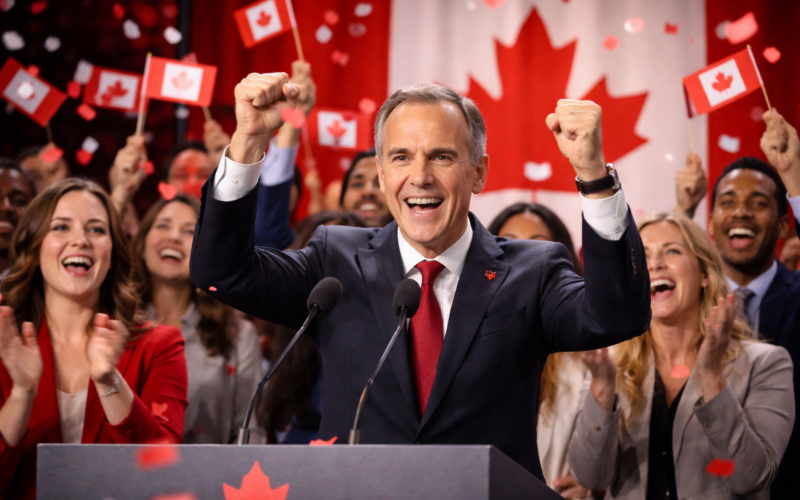
Prime Minister Mark Carney’s Liberal Party of Canada secured a majority government on April 13, 2026, following projected landslide victories in two federal byelections held in Toronto. The wins pushed the Liberals past the 172-seat threshold required for a majority in the House of Commons, ending nearly a year of minority government and giving the ruling party the legislative control it narrowly failed to achieve in the April 2025 general election.
CBC News projected that Liberal candidates won both Toronto byelections by wide margins, a result that will give the governing party full control of the House of Commons and possibly three more years in power. The projected wins came through Doly Begum in the riding of Scarborough Southwest and Danielle Martin in University-Rosedale.
Begum, a former provincial New Democratic Party Member of Provincial Parliament who left her party and Queen’s Park to contest the seat for the federal Liberals, was on pace to capture approximately 70 per cent of the vote in Scarborough Southwest, exceeding the share won by her predecessor in the 2025 general election. Martin, a physician, captured roughly 65 per cent of the vote in University-Rosedale, slightly surpassing the result recorded by the previous Liberal incumbent in that riding.
The two Toronto ridings had been vacated by former senior cabinet ministers Chrystia Freeland and Bill Blair, who had resigned from their seats. Both were considered safe Liberal seats ahead of the vote. A third byelection was simultaneously held in the Montreal-area riding of Terrebonne, Quebec, where the outcome remained undeclared at the time of publication, with a close contest between the Liberal candidate and the Bloc Québécois candidate reported throughout the night.
How did the Liberals reach majority status after a minority win in 2025?
The Liberal Party of Canada won 169 seats in the April 2025 general election, falling three seats short of the 172 required for a majority. The party formed a minority government and spent subsequent months operating without full parliamentary control.
The floor crossings that brought the Liberals to the cusp of a majority began in October 2025, when Nova Scotia Member of Parliament Chris D’Entremont left the Conservative Party for the Liberal benches. He was followed by Toronto-area Member of Parliament Michael Ma in December and Edmonton Member of Parliament Matt Jeneroux in February 2026. Lori Idlout, the lone Nunavut Member of Parliament, left the New Democratic Party of Canada for the government benches in March 2026. Marilyn Gladu, a four-term Ontario Conservative Member of Parliament, completed the sequence with her defection to the Liberals the week before the byelections.
Those five defections placed the Liberals at 171 seats as of the week before the byelections, with three vacancies remaining in the Commons. The projected victories in Scarborough Southwest and University-Rosedale lifted the seat count to 173, providing the government with a functional working majority that accounts for the role of the Speaker of the House of Commons, who votes only in the event of a tie.
House of Commons Speaker Francis Scarpaleggia, a Quebec Liberal, only votes in the case of a tie. With 172 seats, the Liberals would have had the same number of votes as the combined opposition without the Speaker’s participation, meaning a count of 173 was the effective operational majority threshold.
What did the Terrebonne byelection involve and why did it remain contested?
The byelection in Terrebonne was called after the Supreme Court of Canada annulled the result of the 2025 federal election in that riding on February 13, 2026. The court ruled that a printing error by Elections Canada on the return envelope for mail-in ballots had resulted in a vote for the Bloc Québécois candidate being returned to sender rather than being counted. The original 2025 result had awarded the seat to Liberal candidate Tatiana Auguste by a single vote following a judicial recount.
The writ for the Terrebonne byelection was issued on March 8, 2026, with the vote scheduled for April 13. Elections Canada announced procedural changes to prevent recurrence, specifying that special ballots would no longer be manually prepared by riding offices but would be centrally prepared at the Ottawa headquarters.
Bloc Québécois Leader Yves-François Blanchet campaigned in Terrebonne under the slogan “Reprenons notre place,” which translates to “Let’s take back our place,” seeking to reclaim a riding that the Bloc had previously held. The race was called extremely close throughout the night, with results expected to be delayed due to the high number of candidates on the ballot.
Why did Conservative and NDP vote shares collapse in all three ridings?
The Conservative Party’s performance deteriorated sharply in all three ridings. In Terrebonne, the Conservative candidate held approximately three per cent of the vote, compared to over 18 per cent at the 2025 federal election. The New Democratic Party vote effectively evaporated in Terrebonne as well, with its candidate receiving approximately 0.5 per cent. In Scarborough Southwest, the New Democratic Party candidate held approximately six per cent, despite the riding having previously been held provincially by a New Democrat.
The collapse of the Conservative and New Democratic Party vote in seats where those parties previously competed reflected a consolidation of opposition and centre-left support behind the Liberal candidates, consistent with patterns observed across the country during a period of heightened Canada-United States trade tensions.
What does majority government mean for Parliament and the Liberal legislative agenda?
With a majority, the Liberal Party of Canada can pass legislation without support from opposition members and without requiring tie-breaking votes from the Speaker of the House of Commons. The result sets up the Liberals to potentially hold power until the next scheduled general election in October 2029.
Former House of Commons senior parliamentary counsel Steven Chaplin noted he could find no precedent anywhere in the Commonwealth for a government assembling a majority through what he described as “bits and pieces,” and raised the possibility that the opposition could still hold up Liberal legislation unless changes are made to House rules to reset committees.
Carney stated in late March 2026 that he was not considering proroguing Parliament if he secured a majority, saying his government was focused on working with Parliament and passing legislation. He added that the government would adjust legislation where it was better informed by parliamentary discussion.
How did Conservative Leader Pierre Poilievre respond to the Liberal majority?
Conservative Leader Pierre Poilievre issued a social media statement contesting the legitimacy of the majority, stating that the Carney Liberals had not won it through a general election or through the byelections, but through what he characterised as “backroom deals with politicians who betrayed the people who voted for them.” Poilievre said he intended to remain as Conservative leader and would continue to oppose the government in Parliament and at the next election.
Although several of his former caucus members contributed to the Liberals’ majority through floor-crossing, Poilievre confirmed he would not be stepping down, stating he would continue to lead the opposition in Parliament, across the country, and through the next general election.
What was the broader political context behind the Liberal majority push?
Carney, a former governor of the Bank of Canada and governor of the Bank of England, won Canada’s general election in April 2025 fuelled by public anger over United States President Donald Trump’s annexation threats and sweeping tariff impositions. He has since moved the Liberal Party toward the centre-right.
One analyst observed that the deterioration of Canada-United States relations under the second Trump administration had convinced many Canadians, including those who do not identify as Liberal, to rally behind Carney. The same analyst noted that Carney’s speech at the World Economic Forum in Davos, Switzerland, in which he condemned economic coercion by great powers against smaller countries, helped boost his domestic support, and that he was significantly more popular at the time of the byelections than when he became Prime Minister approximately 13 months earlier.
An Ipsos poll conducted for Global News and published the day before the byelections found that 53 per cent of Canadians wanted the Liberals to win enough seats to secure a majority government, while 47 per cent were opposed.
What key takeaways summarise the outcomes of the April 13 Canadian federal byelections for Parliament and Canadian politics
- The Liberal Party of Canada reached 173 seats in the House of Commons following projected byelection wins in Scarborough Southwest and University-Rosedale, securing the first Liberal majority government since 2019.
- Five floor-crossings from opposition parties between October 2025 and April 2026, four from the Conservative Party and one from the New Democratic Party, provided the foundational seat count that made the majority achievable through the byelections.
- The Terrebonne byelection was held after the Supreme Court of Canada annulled the 2025 general election result in that riding due to a mail-in ballot processing error by Elections Canada, with the Bloc Québécois and Liberals contesting the seat in a rematch that remained undeclared at time of publication.
- Conservative Leader Pierre Poilievre rejected the legitimacy of the majority, citing floor-crossings rather than electoral outcomes as its mechanism, while confirming he would remain as party leader and lead the official opposition through the next general election.
- The Liberal majority positions the Carney government to pass legislation without opposition support and to potentially hold office until the next scheduled general election in October 2029, though formal majority status requires Elections Canada verification and gazette publication before new Members of Parliament are sworn in.
Discover more from Business-News-Today.com
Subscribe to get the latest posts sent to your email.