



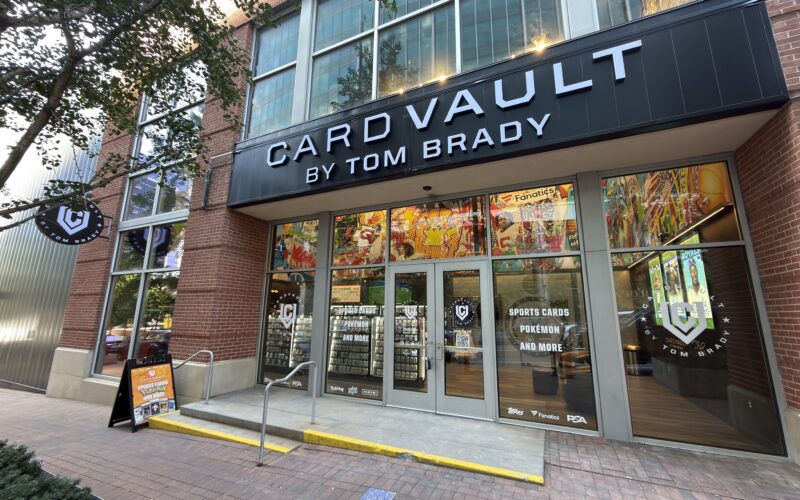
CardVault by Tom Brady is opening its 16th US retail location at 1310 Main Street in Kansas City’s Power & Light District on June 20, 2026. The private sports cards and memorabilia retailer is pairing the launch with an appearance by co-owner Tom Brady and a programme of trading, grading, live events and exclusive product activity. The expansion places CardVault inside one of Kansas City’s most heavily visited sports and entertainment zones during the FIFA World Cup 2026, when the city is hosting six matches. Strategically, the move extends a location model built around event-driven foot traffic, local team loyalty and repeat collector engagement rather than conventional mall retail. The Kansas City store will test whether CardVault can convert celebrity attention and tournament crowds into durable customer relationships after opening weekend.
Why does the Kansas City Power & Light District fit CardVault’s expansion strategy so well?
CardVault’s choice of the Power & Light District reflects a clear preference for destinations where retail demand is supported by sports, entertainment, hospitality and tourism rather than everyday shopping alone. The nine-block district includes restaurants, entertainment venues, residential buildings and event spaces that attract millions of visitors, giving the new store access to several overlapping customer groups. These include Kansas City residents, corporate visitors, tourists, concert audiences and fans travelling through the district before or after major sporting events.
The timing adds another commercial layer. CardVault will open on June 20, the same day Kansas City hosts a FIFA World Cup group-stage match between Ecuador and Curaçao. Tom Brady’s scheduled appearance at KC Live before the store begins trading at noon should create substantial opening-day awareness, while international football traffic could introduce the business to visitors who would not ordinarily search for a specialist sports card retailer.
However, opening-day crowds are not the same thing as sustainable store economics. Event districts can generate unusually high sales during major fixtures while becoming considerably quieter between events. Rent, staffing, security and inventory costs continue regardless of whether the Kansas City Chiefs are playing, a major concert is scheduled or the World Cup is bringing international fans downtown.
CardVault must therefore demonstrate that the Power & Light District can support recurring local demand after the tournament leaves town. Trade nights, product launches, grading submissions and community events will matter more to the long-term economics than the number of people who queue to see Tom Brady during the grand opening.
The location also strengthens CardVault’s relationship with The Cordish Companies. CardVault recently opened at Ballpark Village in St. Louis, another sports-oriented development connected to The Cordish Companies. A successful Kansas City store could give both companies a repeatable partnership model for entering additional entertainment districts without rebuilding the real-estate strategy from scratch in every market.

How does the Kansas City store strengthen CardVault’s hybrid retail and live commerce model?
The new store is designed to generate revenue from more than traditional product sales. CardVault will sell individual cards, sealed boxes, card packs and authenticated memorabilia while also allowing customers to buy, sell and trade collectibles. It will accept grading submissions for PSA, Beckett and SGC, creating a service relationship that can bring customers back even when they are not purchasing new inventory.
This combination is strategically important because sports cards do not behave like conventional merchandise. Their value depends on scarcity, condition, player performance, collector sentiment and authentication. A customer who purchases a card may later return to have another item graded, sell part of a collection or trade into a higher-value asset. Each transaction can begin another transaction, creating a circular retail model rather than a one-time sale.
Grading services also give CardVault access to customers who already own inventory. That reduces dependence on convincing every visitor to buy something directly from the store. A collector arriving with an ungraded card can become a service customer, a potential seller and eventually a buyer once the graded item is returned.
The physical store also connects with CardVault’s live card-breaking operation, which streams through platforms including Fanatics Live, eBay Live and Whatnot. Live breaks allow customers to purchase positions in sealed card products and watch the packs being opened in real time. The format combines shopping, entertainment, scarcity and community participation, qualities that are difficult for conventional sporting-goods retailers to reproduce.
Kansas City can therefore function as a local storefront, customer-acquisition channel, inventory source and content venue. In-store appearances, trade nights and product releases can be streamed to national audiences, while online followers can be encouraged to visit physical locations when travelling. The distinction between shop, studio and event venue becomes increasingly blurred.
The risk is that live commerce is highly dependent on platform visibility, trusted hosts and a constant pipeline of desirable inventory. Collectors can move quickly toward whichever seller offers the most compelling breaks, personalities or products. CardVault will need consistent service quality across its physical and digital channels rather than relying on the Tom Brady association to carry every customer interaction.
Why are grading, authentication and resale liquidity becoming central to sports collectibles retail?
Authentication is becoming one of the most valuable parts of the collectibles economy because customers are not merely buying objects. They are buying confidence that the item is genuine, accurately described and capable of being resold. This becomes especially important when a rare card, autographed helmet or game-used jersey is priced in the hundreds or thousands of dollars.
By working with PSA, Beckett and SGC, CardVault can position the Kansas City store as an access point to the infrastructure that supports collectible values. Grading can improve price transparency, protect cards from damage and make them easier to trade across national marketplaces. It also reduces the knowledge barrier for newer collectors who may be uncertain about submission procedures, condition standards or packaging requirements.
The buy, sell and trade model adds liquidity, which is another essential part of professionalising the category. Collectors are more willing to acquire expensive items when they believe there will be a credible route to selling or exchanging them later. A national physical network can potentially make CardVault more useful than an independent store whose inventory and customer base remain limited to one city.
There are nevertheless meaningful risks. Card values can rise rapidly when an athlete performs well and fall just as quickly after an injury, poor season or oversupply of new products. Retailers holding expensive inventory can therefore face markdown pressure that resembles fashion retail, except the catalyst might be a quarterback’s shoulder rather than a change in hemlines.
Counterfeit merchandise, altered cards, disputed autographs and grading delays can also damage customer trust. CardVault will need disciplined intake procedures, trained employees, reliable security and clear communication regarding submission timelines. As the store network expands, maintaining the same authentication and customer-service standards across every market could become more difficult.
In our view, the strongest element of CardVault’s model is not simply access to popular cards. It is the attempt to combine inventory, authentication, community and resale activity under one retail brand. If executed consistently, that infrastructure can create a more defensible customer relationship than product selection alone.
How much strategic value can Tom Brady’s name create beyond the Kansas City opening weekend?
Tom Brady gives CardVault immediate recognition in a fragmented retail category where many stores remain independently operated and locally known. His association can reduce customer-acquisition costs, attract media attention and create confidence among casual fans who may be unfamiliar with specialist card retailers. The Kansas City appearance illustrates how CardVault can use its celebrity ownership to transform a store opening into a wider entertainment event.
Brady’s reputation also fits the product. Sports cards and memorabilia derive much of their appeal from athletic achievement, cultural relevance and historical moments. A seven-time Super Bowl champion is therefore more naturally aligned with the category than a celebrity with no connection to competitive sport or collecting.
Kansas City offers particularly fertile ground for that strategy. The region has passionate support for the Kansas City Chiefs, Kansas City Royals, Sporting Kansas City and Kansas City Current. CardVault can adjust product selection around local athletes, historic moments and emerging stars rather than applying the same assortment in every city.
The presence of the Kansas City Current also creates an opportunity to expand beyond the traditional male-dominated sports memorabilia customer base. Growing attention around women’s sports can produce new collecting categories, while the FIFA World Cup provides an immediate platform for football cards and international products. A store that responds quickly to changing fan interests can create more repeat traffic than one relying mainly on vintage baseball and American football inventory.
Celebrity ownership still creates concentration risk. Brady can appear at selected openings, but he cannot serve as the daily customer experience at 16 locations. Store employees, inventory quality, grading reliability and local programming must eventually carry the brand when the cameras leave.
CardVault must also avoid becoming perceived primarily as a celebrity merchandise concept. Collectors tend to reward deep product expertise and can be sceptical of retailers that appear more interested in presentation than hobby knowledge. The most effective use of Brady’s name is therefore to open the door, while operational credibility gives customers a reason to remain inside.
What execution risks could determine whether CardVault’s sports-district expansion remains profitable?
The pace of expansion deserves attention. CardVault announced its 12th location in San Francisco in February 2026 and is now preparing to open its 16th store roughly four months later. That indicates significant rollout momentum, but it also means several locations may still be progressing through their early operating periods before management has complete evidence on customer retention and mature store profitability.
Rapid growth can create pressure on hiring, training, inventory allocation and management oversight. A rare card that performs well in Boston may not have the same demand in Kansas City, while local products can become difficult to source in sufficient volume. CardVault must balance national purchasing efficiencies with city-specific merchandising.
Inventory management could become the most important financial discipline. Sealed products may sell predictably, but rare cards and memorabilia can require substantial capital and remain unsold for extended periods. Carrying too little premium inventory weakens the destination appeal, while carrying too much exposes the company to valuation volatility and ties up cash.
Security costs are another consideration. High-value cards are portable, easily resold and difficult to trace once removed from their protective cases. Stores in busy entertainment districts must manage large crowds without making the environment feel inaccessible or overly controlled.
The key performance indicator should not be grand-opening sales. Management should focus on repeat visits, grading submissions, trade activity, local inventory acquisition, event attendance and the percentage of physical customers who later engage with CardVault’s digital channels. These measures will reveal whether Kansas City is developing into a community hub or functioning mainly as a tourist purchase point.
If the store succeeds outside major event periods, CardVault could replicate the format in other stadium-adjacent and entertainment-led developments. The Cordish Companies relationship may provide access to additional locations where sports traffic, hospitality and mixed-use real estate already coexist.
If the Kansas City operation struggles after the World Cup, the result would raise questions about whether CardVault’s expansion model is too reliant on event spikes and celebrity-led publicity. The store is therefore more than another point on a national map. It is a test of whether specialist collectibles retail can become a scalable form of experiential commerce.
What are the key takeaways from CardVault by Tom Brady’s Kansas City expansion strategy?
- The Kansas City opening advances CardVault’s strategy of locating stores inside major sports and entertainment destinations rather than relying on conventional retail centres.
- Launching during the FIFA World Cup gives the 16th store exceptional visibility, but sustainable performance will depend on local customers after tournament traffic declines.
- Buy, sell, trade and grading services can generate repeat visits and reduce CardVault’s dependence on one-time product purchases.
- The Kansas City store can operate as a retail outlet, inventory-acquisition channel, community venue and content studio for CardVault’s live-breaking business.
- Authentication partnerships with PSA, Beckett and SGC strengthen trust and improve the resale liquidity of customer-owned cards.
- Tom Brady’s involvement can lower customer-acquisition costs, although daily service and product expertise must eventually support the brand without celebrity appearances.
- Kansas City’s professional football, baseball, soccer and women’s sports ecosystem gives CardVault several locally relevant merchandising categories.
- The expansion from 12 to 16 locations within roughly four months demonstrates momentum but increases execution, staffing and inventory-management risk.
- The Cordish Companies relationship could support a broader rollout across stadium-adjacent entertainment districts if Kansas City and St. Louis perform well.
- Long-term success will be measured through repeat customers, grading submissions, trade activity and cross-channel engagement rather than opening-day crowds.
Discover more from Business-News-Today.com
Subscribe to get the latest posts sent to your email.

