





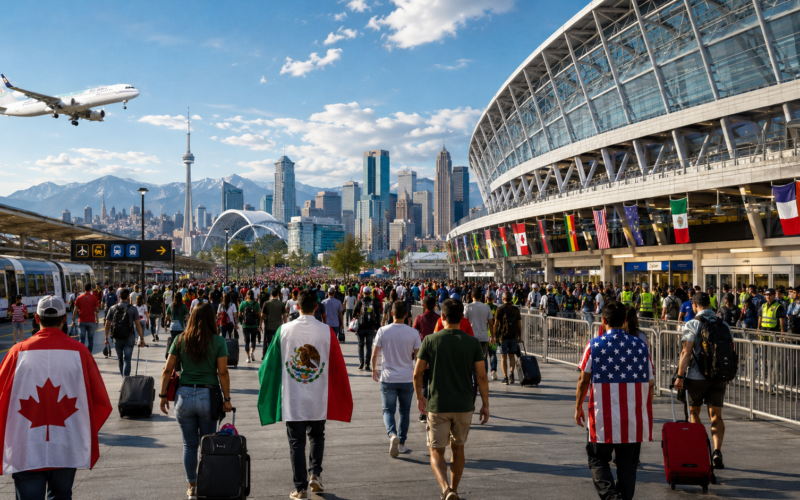
FIFA World Cup 2026 will be the most geographically ambitious men’s World Cup ever staged, spreading 104 matches across 16 host cities in the United States, Canada and Mexico and turning North America into a continent-scale football venue for more than five weeks.
The tournament is being played from June 11 to July 19, 2026, with 48 teams competing across 12 groups before a new round of 32, the round of 16, quarter-finals, semi-finals, third-place match and final. The United States will host the largest share of matches across 11 host city markets. Canada will stage matches in Toronto and Vancouver. Mexico will stage matches in Mexico City, Guadalajara and Monterrey.
The host-city structure is one of the defining features of FIFA World Cup 2026. Unlike compact tournaments where most fans can travel by train or short domestic routes, the 2026 edition stretches across major metropolitan areas, long flight corridors, different climates, different public transport systems and multiple time zones. That scale creates opportunity for tourism, hospitality, media visibility and city branding, but it also creates major operational pressure.
For fans, the host cities will determine travel plans, hotel demand, local transport decisions and matchday experience. For governments and organising bodies, the host cities will test policing, airport capacity, crowd movement, emergency services, fan zones, road management, public communication and accessibility. For businesses, the host-city map will shape spending patterns across airlines, restaurants, hotels, short-term rentals, retail and event services.
How are the 16 FIFA World Cup 2026 host cities spread across North America?
FIFA World Cup 2026 will be staged across 16 host city markets in three countries. The United States host cities are Atlanta, Boston, Dallas, Houston, Kansas City, Los Angeles, Miami, New York New Jersey, Philadelphia, San Francisco Bay Area and Seattle. Canada’s host cities are Toronto and Vancouver. Mexico’s host cities are Guadalajara, Mexico City and Monterrey.
The distribution gives the United States the largest operational role in the tournament. The United States will host the majority of fixtures, including several high-demand knockout matches and the final in New York New Jersey. Mexico will host the opening match in Mexico City, giving the tournament an immediate connection to one of football’s most historic World Cup venues. Canada will host matches in Toronto and Vancouver, giving both cities a global men’s World Cup platform.
The host-city map creates a tournament with multiple regional clusters. Western matches in Los Angeles, Seattle, San Francisco Bay Area and Vancouver will operate in Pacific time-zone environments. Central and southern host cities such as Dallas, Houston, Kansas City, Monterrey, Guadalajara and Mexico City will carry different climate and travel conditions. Eastern host cities such as New York New Jersey, Boston, Philadelphia, Atlanta, Miami and Toronto will serve major transatlantic media and travel flows.
This structure gives the tournament exceptional reach, but it also means that FIFA World Cup 2026 will not feel like one localised festival. It will function as a networked event, with each host city creating its own version of the World Cup experience.

Why does the United States carry the largest host-city responsibility at FIFA World Cup 2026?
The United States carries the largest host-city responsibility because it will stage 78 of the 104 matches across 11 host city markets. That gives the United States roughly three-quarters of the tournament’s match operations and makes it the central logistical platform for FIFA World Cup 2026.
The United States host markets are diverse in geography, climate and stadium environment. New York New Jersey will host the final, making it the centre of the tournament’s closing global audience. Dallas will host a large number of matches and one of the semi-finals. Atlanta will host the other semi-final. Miami will host the third-place match. Los Angeles, Houston, Kansas City, Philadelphia, Boston, Seattle and San Francisco Bay Area will all carry important group-stage and knockout responsibilities.
This distribution creates major public-service demands. Each United States host city will need to manage stadium access, road traffic, public transport, security perimeters, fan zones, medical readiness, hotel demand and emergency planning. Cities such as Dallas, Houston, Miami, Atlanta and Kansas City may also face heat-related planning questions because of summer conditions.
For the United States, the tournament is also a national sports-market test. Football has grown significantly in the country, but FIFA World Cup 2026 places the United States in front of a global football audience on a scale beyond domestic league or single-city events. The success of host-city operations will influence how global fans judge the country’s ability to stage large football events across multiple regions at once.
How will Mexico’s host cities connect FIFA World Cup 2026 to football history?
Mexico’s host cities give FIFA World Cup 2026 a direct link to World Cup history. Mexico City, Guadalajara and Monterrey will stage matches, with Mexico City hosting the opening match between Mexico and South Africa on June 11.
Mexico City is especially important because the venue known for previous World Cup history is associated with the 1970 and 1986 tournaments. The stadium becomes central again in 2026 as Mexico becomes the first country to host or co-host the men’s World Cup three times. That historical continuity gives the opening match a symbolic weight that few venues could match.
Guadalajara and Monterrey add regional depth. Guadalajara will host early group fixtures, including Korea Republic vs Czechia on the opening day. Monterrey will stage group-stage matches and extend the tournament’s Mexican footprint beyond the capital. Together, the three cities allow Mexico to present the tournament not only as a national football celebration but also as a multi-city public event.
Mexico’s host role also brings operational questions. Large crowds, road movement, stadium access, fan festivals, airport demand and public communication will all matter. Because Mexico City opens the tournament, its performance on the first day will shape global impressions of FIFA World Cup 2026 before the United States and Canada fully enter their own matchday rhythms.
How will Toronto and Vancouver define Canada’s role in FIFA World Cup 2026?
Toronto and Vancouver will define Canada’s role as a men’s World Cup co-host, giving the country two major urban stages for a tournament that is expected to bring substantial visitor traffic and national attention.
Toronto will host Canada’s opening match against Bosnia and Herzegovina, placing immediate pressure and visibility on the city. The match gives Canadian supporters a home-stage moment at the start of Group B. Toronto officials have expected around 300,000 visitors during the tournament, underscoring the scale of tourism, transport and accommodation planning required.
Vancouver will also play a major role through group-stage and knockout fixtures. Its position on the Pacific side of the tournament map gives FIFA World Cup 2026 a western Canadian anchor and connects naturally with United States West Coast host cities such as Seattle, Los Angeles and San Francisco Bay Area.
Canada’s role is significant because it is not only hosting matches. It is presenting itself inside the global men’s football ecosystem at a time when Canadian football has grown in visibility. The host-city experience in Toronto and Vancouver will affect how international fans view Canada’s ability to manage large football crowds, transport systems, fan zones and event safety.
The Canadian cities also face the challenge of coordinating with a three-country tournament structure. Fans and teams may move between Canada, the United States and Mexico during the tournament, making border logistics, flight connectivity and public information important parts of the wider host-city experience.
Why will travel distance be one of the biggest challenges for FIFA World Cup 2026 fans?
Travel distance will be one of the biggest challenges because FIFA World Cup 2026 is spread across a much larger geography than many previous tournaments. A supporter following one team may need to travel between cities separated by long flights, different climates and different time zones.
A fan route from Vancouver to Mexico City, Seattle to Miami, Los Angeles to Boston or Toronto to Dallas is not a simple local transfer. It requires flights, hotel changes, baggage planning, local transport arrangements and potentially border documentation. That makes the tournament more expensive and logistically demanding for travelling supporters.
The expanded 48-team format adds to the challenge. More teams mean more national fan bases, and more matches mean more possible travel combinations. During the group stage, teams will move between assigned host cities. During the knockout rounds, fans may not know their next destination until results are confirmed.
This uncertainty will affect travel behaviour. Some supporters may choose to stay in one host city and attend whichever matches are available. Others may follow a national team at higher cost. Some may wait until knockout qualification is confirmed before booking travel, creating late demand for flights and hotels.
For host cities, the challenge is to make local arrival and movement clear. Airport signs, shuttle planning, public transport information, walking routes, parking rules and multilingual communication will all influence whether fans experience the tournament as manageable or overwhelming.
How could FIFA World Cup 2026 affect hotels, airlines and local tourism economies?
FIFA World Cup 2026 could create strong short-term demand for hotels, airlines, restaurants, tourism services and local transport across host cities. International fans, domestic supporters, media workers, sponsors, officials and teams will all contribute to the visitor economy during the tournament window.
Hotels in cities hosting high-profile fixtures may see demand spikes around matchdays. Knockout matches, host-nation games and fixtures involving major teams such as Argentina, Brazil, England, France, Germany, Portugal, Spain or Mexico could create especially strong booking pressure. Short-term rental platforms may also see increased demand, although local rules will influence availability.
Airlines may benefit from intercity travel because the tournament’s geography makes flying necessary for many supporters. Routes connecting host cities could see higher demand, especially once knockout matchups become clear. However, late qualification scenarios may create uneven demand patterns, with some routes becoming expensive or difficult to book at short notice.
Restaurants, bars, retail outlets, transport operators and tourism attractions in host cities may benefit from fan footfall. The scale of benefit will depend on match allocation, visitor behaviour, hotel occupancy, fan zone locations and whether supporters stay beyond matchday.
The economic effect will not be uniform. Cities hosting more matches or late-stage fixtures are likely to see stronger activity. Cities with efficient transit, attractive tourism offerings and clear public communication may be better positioned to convert matchday attendance into broader visitor spending.
What public safety and city operations questions will host cities face during the tournament?
Host cities will face public safety and city operations questions around crowd control, stadium security, transport capacity, heat risk, emergency services, fan zones, ticketing movement and post-match dispersal. A World Cup match is not only a stadium event. It is a citywide operation.
Crowd control will be central. Fans arrive in waves, gather in public areas, move through security checkpoints and exit together after matches. Host cities must prevent congestion around stadiums, transport nodes and fan zones. Poor crowd movement can quickly become a safety issue.
Transport planning will also matter. Some host cities have stronger public transit networks than others. Cities with car-heavy transport patterns may face pressure around parking, road closures and shuttle systems. FIFA has already highlighted the need for pre-purchased parking in official materials, signalling that matchday vehicle movement will require advance planning.
Heat and weather are another concern. Matches in cities such as Dallas, Houston, Miami, Atlanta and Kansas City may require strong hydration, cooling and medical planning during summer conditions. Cities on the Pacific coast and in Canada may face different weather and crowd-management issues.
Public communication will be essential. Fans need clear information on when to arrive, what they can bring, how to reach stadiums, where to find water, how to access medical help and how to leave after the match. A successful host city will make those details easy to understand before fans reach the venue.
How will FIFA World Cup 2026 host cities shape media coverage and global perception?
FIFA World Cup 2026 host cities will shape media coverage because each city will become part of the tournament’s global identity. Broadcasts will not show only the pitch. They will show skylines, fan zones, local landmarks, streets, stadium exteriors and crowd scenes.
New York New Jersey will gain intense visibility because it hosts the final. Mexico City will dominate opening-day coverage because it stages the first match. Dallas and Atlanta will gain global exposure through the semi-finals. Miami will host the third-place match and may receive strong attention because of its international profile and football culture.
Other host cities will use group-stage and knockout fixtures to project their own identities. Seattle and Vancouver can present a Pacific Northwest tournament experience. Los Angeles and San Francisco Bay Area can connect football with global entertainment and technology audiences. Houston, Dallas and Kansas City can show large-scale United States stadium culture. Toronto can present Canada’s largest city on a global football platform.
This media exposure has value beyond tourism. Host cities often use global events to attract investment, promote civic identity, strengthen destination branding and show readiness for future major events. The World Cup gives them a global stage, but it also exposes operational weaknesses if transport, safety or crowd management perform poorly.
The perception test will therefore be two-sided. Cities can gain reputational value if they deliver smooth, safe and lively matchdays. They can also face criticism if fans experience confusion, delays, high costs or safety problems.
Why does the three-country host model matter for future mega-events?
The three-country host model matters because FIFA World Cup 2026 will test whether very large sports events can be distributed across several countries without weakening the fan experience. The format allows more cities and regions to participate, but it also creates more complex travel, governance and communication demands.
The model has clear advantages. It spreads hosting responsibilities, uses existing stadium infrastructure, increases regional participation and reduces the need for one country to build an entirely new tournament footprint. It also gives more national audiences a direct stake in the event.
The disadvantages are just as clear. Fans may face long-distance travel, high costs and uncertain routes during knockout rounds. Teams may need to manage travel and recovery across varied climates and time zones. Organisers must coordinate across different public agencies, border systems, legal frameworks and commercial environments.
If FIFA World Cup 2026 succeeds, it could strengthen the case for more distributed mega-events in the future. If it struggles, it may revive arguments that major tournaments should remain geographically compact to protect fan access and operational control.
The tournament will therefore be watched not only by football fans but also by sports administrators, city governments, tourism boards, transport planners and event organisers. The host-city model may become one of the most important legacies of FIFA World Cup 2026.
What are the key takeaways from FIFA World Cup 2026 host cities and venue planning?
- FIFA World Cup 2026 will be staged across 16 host cities in the United States, Canada and Mexico, making it the most geographically ambitious men’s World Cup ever held.
- The United States will carry the largest hosting role, staging 78 of the 104 matches across 11 host city markets, including New York New Jersey, Dallas, Atlanta, Miami and Los Angeles.
- Mexico will host matches in Mexico City, Guadalajara and Monterrey, with Mexico City staging the opening match and connecting the tournament to World Cup history from 1970 and 1986.
- Canada’s host role will be defined by Toronto and Vancouver, with Toronto staging Canada’s opening fixture and expecting large visitor volumes during the tournament period.
- Long travel distances will be a major fan challenge because supporters may need to move between cities separated by long flights, different climates, time zones and border requirements.
- Hotels, airlines, restaurants, tourism operators and local transport services may see demand spikes, especially around host-nation matches, knockout fixtures and games involving major football nations.
- Host cities will face public safety questions around crowd control, transport capacity, fan zones, heat risk, medical readiness, stadium access, parking, road closures and post-match dispersal.
- FIFA World Cup 2026 will test whether a three-country, continent-scale host model can increase reach and use existing infrastructure without making the tournament harder for fans to follow.
Discover more from Business-News-Today.com
Subscribe to get the latest posts sent to your email.

