


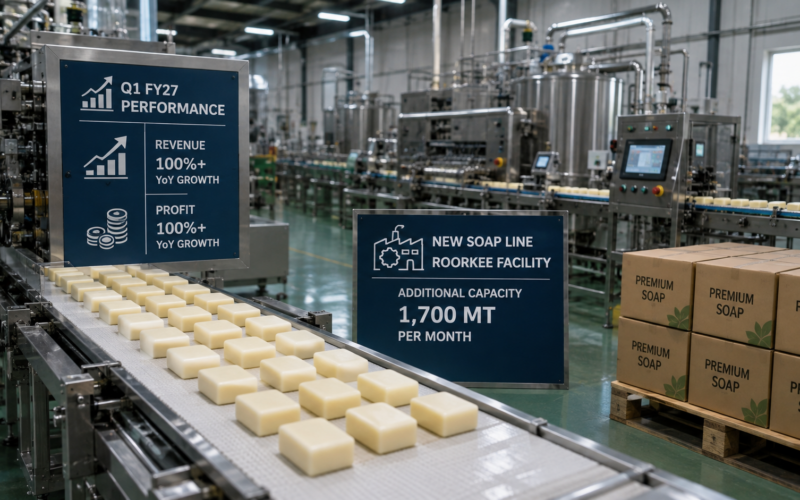
Sunrakshakk Industries India Limited (BSE: 539300) reported consolidated revenue from operations of ₹276.33 crore for Q1 FY27, up about 120.6% from ₹125.24 crore a year earlier, as the company continued scaling its FMCG and FMCG-intermediates businesses. Consolidated profit after tax increased approximately 130.7% to ₹15.04 crore from ₹6.52 crore, while EBITDA rose about 94.4% to ₹22.59 crore. The quarter also included commissioning of an additional soap-production line at the company’s Roorkee facility, adding roughly 1,700 metric tonnes of monthly capacity.
The numbers reinforce how quickly Sunrakshakk has changed from its earlier textile-focused identity into a multi-location consumer and intermediate-products manufacturer. Revenue growth remains exceptionally strong, but EBITDA margin eased to 8.18% as raw-material costs increased, compared with 10.19% in Q4 FY26 and 9.28% in the year-earlier quarter. That means the central FY27 question is no longer simply whether the company can generate rapid top-line growth, but whether scale can eventually translate into stronger and more stable operating margins.
How significant is Sunrakshakk Industries’ new Roorkee soap line?
The new line adds approximately 1,700 metric tonnes of monthly soap capacity at Roorkee and lifts the company’s aggregate FMCG and FMCG-intermediates manufacturing capacity to about 20,840 tonnes per month, according to its Q1 commentary. Annualised mechanically, the additional line alone represents roughly 20,400 tonnes of potential production capacity before allowing for utilisation, maintenance downtime or changes in product mix.
Roorkee was already a sizeable manufacturing base before the latest commissioning. Company material previously listed 3,000 tonnes per month of soap capacity, 5,760 tonnes of soap-noodle capacity and 500 tonnes of toothpaste capacity at the site. The new 1,700-tonne line therefore represents a meaningful incremental addition to the soap operation rather than a token debottlenecking project.
Sunrakshakk also operates FMCG facilities in Bhilwara and Guwahati. The Guwahati unit, which commenced commercial operations earlier in 2026, was designed for 2,160 tonnes per month of soap noodles and 1,000 tonnes of cosmetics, while Bhilwara includes detergent, home-care and edible-product capabilities. The resulting manufacturing footprint gives the company production locations across Rajasthan, Uttarakhand and Assam, substantially broadening its geographic base compared with its historical textile operations.

What is driving Sunrakshakk Industries’ 121% revenue growth?
The Q1 revenue increase reflects a combination of capacity additions, ramp-up of recently commissioned operations and a business mix that has shifted toward FMCG and FMCG intermediates. Consolidated revenue rose from ₹125.24 crore in Q1 FY26 to ₹276.33 crore in Q1 FY27, meaning the company added about ₹151 crore of quarterly revenue in twelve months.
Profit grew even faster in percentage terms, rising from ₹6.52 crore to ₹15.04 crore. However, the movement in EBITDA margin shows why absolute profit growth and margin quality need to be considered separately. Higher raw-material costs reduced the margin despite much greater production scale, indicating that procurement costs and pricing power remain important variables as the FMCG platform expands.
The latest quarter follows a major FY26 step-up. Management previously reported FY26 revenue of about ₹607.75 crore and profit after tax of ₹34.98 crore, supported by the company’s diversification and newer manufacturing assets. Q1 FY27 revenue alone was therefore equivalent to about 45% of the entire FY26 revenue base, although extrapolating one quarter directly across the year would be inappropriate because working days, customer orders and commodity costs can vary materially.
Is the company’s ₹1,000 crore FY28 revenue ambition becoming more achievable?
Management has maintained an aspiration of reaching approximately ₹1,000 crore of annual revenue by FY28. Compared with FY26 revenue of roughly ₹608 crore, reaching that level would require another increase of about ₹392 crore, or approximately 65%, over the two-year period. The Q1 FY27 run rate shows that the target is arithmetically within reach if current volumes persist, but sustainable annual revenue will depend on plant utilisation, order continuity and the commercial performance of recently added product categories.
The larger issue is whether growth can remain profitable. A company can reach ₹1,000 crore of sales while producing very different shareholder outcomes depending on margins, working-capital requirements and returns on the manufacturing assets used to support that turnover. Sunrakshakk’s Q1 margin compression therefore deserves as much attention as the headline 121% revenue growth.
Scale could eventually provide advantages through purchasing, plant utilisation and the spreading of corporate costs over a larger revenue base, but those benefits are not automatic. Consumer and intermediate-product manufacturing also exposes the business to volatile raw materials, customer concentration and competition from larger manufacturers.
What does Sunrakshakk Industries’ share-price performance suggest about sentiment?
Sunrakshakk Industries shares closed at ₹379.70 on August 21, gaining 1.81% for the session and leaving the stock only about 3.6% below its 52-week high of ₹394. The 52-week low is ₹197, indicating that the share price has already undergone a substantial rerating as the company’s FMCG transformation and earnings growth have become more visible.
The proximity to the 52-week high suggests positive sentiment, but the company remains a micro-cap stock with relatively modest trading volumes, which can amplify short-term price movements. Its operating performance is expanding much faster than it was a year ago, yet a higher market valuation also increases the importance of delivering against capacity, revenue and margin expectations.
Sunrakshakk has therefore reached an interesting stage of its transformation. The Q1 numbers show that the new manufacturing platform is capable of producing much larger revenue and profit than the legacy business, while the Roorkee addition gives management additional production capacity to pursue the next phase of growth. The harder test will be converting that capacity into durable cash earnings without allowing raw-material inflation or aggressive expansion to erode the benefits of scale.
Discover more from Business-News-Today.com
Subscribe to get the latest posts sent to your email.