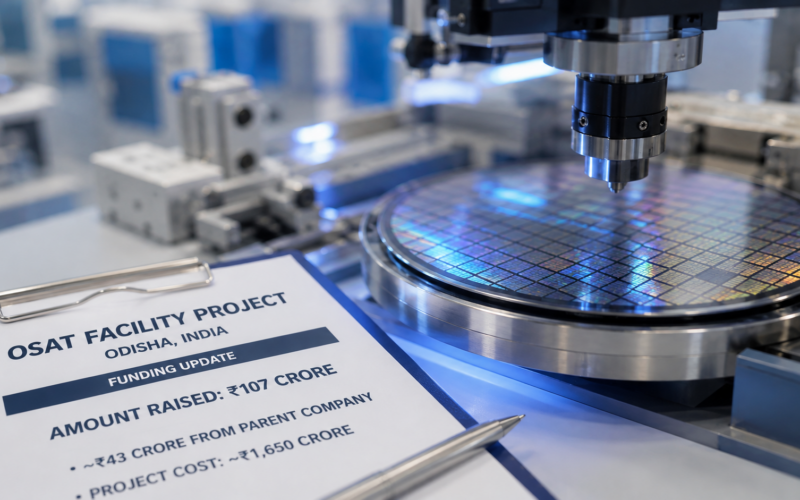
Sancode Technologies Limited (BSE: 543897) has increased its financial commitment to semiconductor manufacturing after subsidiary Sancode Semi Private Limited raised ₹107 crore through compulsorily convertible preference shares for its proposed outsourced semiconductor assembly and test facility in Odisha. Sancode Technologies subscribed for 12,647 preference shares for approximately ₹43 crore, while the subsidiary issued 31,467 shares in total and the parent is expected to retain a 95.74% fully diluted stake following the transaction. The funding is earmarked for the OSAT project, including land, technology, plant and machinery and other development expenditure.
The more important number, however, is the planned project cost rather than the latest capital injection. Sancode disclosed in February that Odisha’s High-Level Clearance Authority had granted in-principle approval for an OSAT unit in Khordha district involving approximately ₹1,650 crore of capital expenditure, subject to standard conditions and applicable statutory and regulatory approvals. The ₹107 crore raised by the subsidiary therefore represents only about 6.5% of the stated project cost, illustrating how much financing and execution work could still be required before the facility reaches production.
How much of Sancode Semi’s ₹1,650 crore OSAT project is funded so far?
The ₹107 crore preferential allotment is meaningful for a newly formed semiconductor subsidiary, but it is small relative to the planned investment. At the disclosed ₹1,650 crore project cost, the latest capital raise leaves more than ₹1,500 crore of the headline capex outside this particular funding round, although the eventual financing structure could include additional equity, debt, incentives or other sources that have not yet been fully disclosed. Sancode Technologies’ own ₹43 crore subscription represents about 2.6% of the total proposed OSAT capex.
That distinction is particularly important because Sancode Semi was incorporated only in September 2025 and reported no revenue for FY26. The capital raise therefore supports a pre-revenue manufacturing venture rather than expansion of an already cash-generating semiconductor operation, making subsequent financing rounds, technology arrangements, land development and equipment procurement central milestones. The company has identified those areas among the intended uses of the funds.
Semiconductor packaging projects are capital intensive even though they generally require less investment than leading-edge wafer fabrication plants. OSAT facilities need specialised assembly, packaging, testing, clean-room and reliability infrastructure, while successful commercialisation also depends on customer qualification and the ability to achieve high utilisation of expensive equipment. Raising the first blocks of capital is therefore necessary, but it does not by itself establish the commercial viability or completion timetable of the Odisha facility.

What exactly has Odisha approved for Sancode Semi?
Sancode Technologies’ February disclosure said the Odisha High-Level Clearance Authority had granted in-principle approval for Sancode Semi to establish the OSAT facility in Khordha district. The company put the proposed investment at approximately ₹1,650 crore and explicitly stated that the approval remains subject to standard conditions as well as applicable statutory, regulatory and other necessary clearances. The project should consequently be described as approved in principle at the state level rather than as a completed or operational semiconductor plant.
That status also differs from approval under the central India Semiconductor Mission. The Government of India said in May that 12 semiconductor manufacturing projects had been approved under the national programme with cumulative investment of around ₹1.64 lakh crore, including projects spanning fabrication, packaging, compound semiconductors and display-related technologies. Sancode’s disclosed milestone relates to Odisha’s state-level clearance, so it would be premature to assume central fiscal support unless separately confirmed.
Odisha is nevertheless attempting to build a broader electronics and advanced-manufacturing ecosystem, and OSAT is strategically relevant because packaging and testing form an essential part of the semiconductor value chain after wafer fabrication. If Sancode succeeds in moving from approval through construction and customer qualification, the project would place a relatively small listed Indian technology company inside a sector attracting unusually large public and private investment.
How does the project compare with India’s emerging semiconductor manufacturing base?
India’s semiconductor programme has moved beyond announcements in several cases. CG Semi’s Sanand OSAT facility, developed with investment exceeding ₹7,500 crore, entered commercial production in July 2026 and is expected to reach annual capacity of up to five billion semiconductor chips when fully ramped. The government has said multiple additional semiconductor plants are expected to begin production during 2026, providing Sancode with an expanding domestic ecosystem but also raising the execution benchmark for newer entrants.
The comparison also illustrates the scale difference. Sancode Semi’s ₹1,650 crore proposal is materially smaller than CG Semi’s investment, but smaller OSAT facilities can still address attractive product categories if they secure appropriate technology and customers. The commercial question is therefore not whether Sancode matches the largest projects in absolute capital expenditure, but whether it can establish a viable niche and sustain enough throughput to generate returns on the new manufacturing assets.
Execution risk remains high because semiconductor manufacturing is very different from Sancode Technologies’ historical software and technology-services business. Management must oversee a physical industrial project involving large capital commitments, specialised equipment and manufacturing qualification, making the transition substantially more demanding than adding another software service line.
Why is Sancode Technologies’ share-price rally worth treating cautiously?
Sancode Technologies shares closed at ₹534.50 on August 21, up 1.99% and at a fresh 52-week and all-time high. The stock had risen about 297% since the beginning of 2026 and roughly 377% over one year, while trading volume on August 21 was only around 2,000 shares, highlighting the limited liquidity behind the price.
Low trading volumes can make micro-cap share prices considerably more sensitive to relatively small orders, particularly when shares repeatedly approach exchange-imposed price limits. The strong rerating therefore indicates substantial market optimism around the company’s strategic direction, but the share price has advanced much faster than the semiconductor subsidiary has progressed toward operating revenue. Investors consequently have an unusually wide gap between the valuation narrative and the current stage of the underlying industrial project.
The next milestones are more concrete than the share-price momentum. Sancode needs to demonstrate how the remaining project financing will be assembled, when land and construction advance, which technology and equipment partners will support the facility and when customer qualification could begin. Until those milestones become visible, the ₹107 crore raise is best interpreted as another financing step toward a ₹1,650 crore semiconductor ambition rather than proof that the investment programme is fully funded.
Discover more from Business-News-Today.com
Subscribe to get the latest posts sent to your email.