


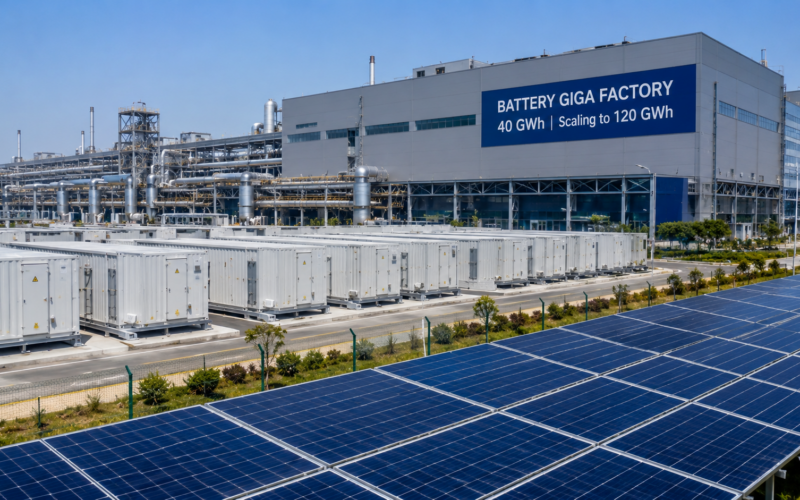
Reliance Industries Limited (NSE: RELIANCE) is moving another major component of its Jamnagar clean-energy manufacturing complex toward commercial operation, with the group targeting commissioning of 40 GWh of annual battery manufacturing capacity during 2026 before scaling the platform toward 120 GWh. The battery programme is developing alongside an integrated solar manufacturing chain that has already produced nearly 1 GW of heterojunction modules and is being expanded toward annual capacity of 20 GW.
The development marks an important transition for the Dhirubhai Ambani Green Energy Giga Complex because Reliance is gradually moving from years of construction expenditure into operating manufacturing capacity. Solar module lines are already producing, the battery factory is scheduled to commission this year and the broader new-energy platform is being connected with renewable generation in Kutch, green-hydrogen production and future green-chemicals operations.
How quickly can Reliance Industries scale Jamnagar from 40 GWh to 120 GWh of batteries?
Reliance’s current plan calls for the battery factory to start with 40 GWh of annual manufacturing capacity during 2026 and then expand toward 120 GWh. The new target is materially larger than earlier guidance, which envisaged an initial 40 GWh platform scaling toward 100 GWh, showing that the company has raised the eventual ambition for storage manufacturing as its wider energy requirements have developed.
At full 120 GWh annual capacity, the plant would theoretically be able to supply three times the energy-storage capacity of its initial 40 GWh phase. Actual output will depend on product configuration, utilisation, cell sourcing, customer demand and how quickly Reliance completes backward integration into battery materials and cells.
Reliance’s earlier strategy envisaged beginning with battery energy storage system assembly and progressively integrating backward into cell manufacturing and battery chemicals. That structure is commercially significant because importing cells and assembling containers captures less value than controlling a greater share of the battery supply chain.
The ultimate economics will therefore depend not only on how many gigawatt-hours the factory can technically produce but on how much of the battery value chain Reliance localises. Cell chemistry, manufacturing yield, energy costs and utilisation can materially influence unit economics in a sector where global prices have been falling rapidly.

Why does Reliance need such a large battery factory for its own Kutch energy buildout?
The battery factory is being designed within a much larger integrated energy system rather than as a standalone manufacturing business. Reliance is developing major renewable generation capacity in Kutch and plans eventually to deploy solar modules and battery systems at a daily installation pace of as much as 55 MWp of solar and 150 MWh of storage.
At 150 MWh of battery deployment per day, an entire year operating at that peak rate would correspond to roughly 54.75 GWh of storage installation. The calculation is illustrative rather than company guidance for annual deployment because construction will vary with weather, logistics and project phasing, but it demonstrates why a 40 GWh factory can eventually be insufficient if Reliance achieves the installation scale it is targeting.
The Kutch renewable system is intended to supply round-the-clock electricity for Reliance’s Jamnagar refining operations, the new-energy manufacturing complex, data centres and the planned green-fuels platform. Battery storage can shift some daytime solar generation into periods when solar output falls, increasing the practical value of the renewable capacity and reducing dependence on conventional electricity.
That captive demand provides Reliance with an advantage that many new battery manufacturers do not possess. Instead of relying entirely on third-party orders from the first day of production, it can potentially use its own generation and industrial projects as anchor demand while gradually building external customers.
How does Reliance’s 20 GW solar manufacturing plan connect with the battery buildout?
Reliance has already commissioned solar cell and module manufacturing lines at Jamnagar and produced nearly 1 GW of heterojunction modules. The group has also achieved Approved List of Models and Manufacturers certification for its HJT technology and intends to scale the integrated solar platform toward 20 GW of annual capacity, covering an increasingly broad chain from polysilicon through ingots, wafers, cells, modules and glass.
The pairing of solar and storage changes the economics of the manufacturing complex. Solar modules create electricity during daylight hours, while batteries make more of that electricity dispatchable, and electrolyser capacity can ultimately convert renewable power into hydrogen and green chemicals.
Reliance has separately maintained plans for a multi-gigawatt electrolyser facility, while its green-fuels strategy now includes a signed US$3 billion long-term green-ammonia agreement with Samsung C&T. The combination begins to establish commercial demand for a new-energy chain extending far beyond solar modules themselves.
The strategic ambition is unusually broad. Reliance is attempting to manufacture equipment, build renewable generation, consume electricity internally, produce green molecules and secure long-term customers for some of the resulting products. That vertical integration could lower procurement dependence, but it also makes execution considerably more complex because delays in one component can affect utilisation elsewhere.
When could Reliance Industries’ new-energy investment start affecting group earnings?
Reliance has indicated that commercial revenue from solar modules will begin during FY27 and that the battery factory will commission during 2026. That makes the current financial year potentially important because new energy begins shifting from a predominantly capital-consuming platform toward an operating business with identifiable revenue streams.
The contribution will initially remain small relative to Reliance Industries’ overall scale. The group generated Q1 FY27 gross revenue of ₹3,40,257 crore, EBITDA of ₹54,067 crore and total profit after tax of ₹23,196 crore, while quarterly capital expenditure itself reached ₹38,682 crore.
Those numbers explain why even a world-scale battery plant will take time to materially reshape consolidated earnings. Reliance already operates enormous oil-to-chemicals, digital and retail businesses, so investors are likely to focus on whether new energy eventually reaches sufficient scale and returns to become a meaningful fourth earnings engine.
The capex burden is equally relevant. Reliance spent ₹1,44,271 crore across the group in FY26, while the green-energy complex, Kutch generation, transmission and downstream green-fuels infrastructure require continuing investment. The business must eventually generate returns capable of justifying that capital intensity.
What does Reliance Industries’ share price suggest about expectations for the Jamnagar transition?
Reliance Industries shares closed at ₹1,314 on August 21, down 0.12% for the session and approximately 18.4% below the 52-week high of ₹1,611.20 reached in January. The muted daily move suggests the market is currently evaluating the new-energy buildout alongside broader factors including refining margins, retail performance, Jio growth, capital allocation and macroeconomic conditions rather than treating individual manufacturing milestones as standalone catalysts.
Q1 FY27 provided a similar mixed picture. Gross revenue and operating EBITDA reached record levels, while reported attributable profit fell against a year-earlier quarter that contained a significant exceptional gain. Reliance consequently has considerable cash-generating businesses available to support the energy transition, but new energy will still need to demonstrate its own commercial economics.
The next milestones should be increasingly measurable: commissioning of the first 40 GWh battery capacity, further solar manufacturing ramp-up, installation progress in Kutch and eventually identifiable new-energy revenue. Reliance’s Jamnagar programme is no longer simply a distant giga-factory plan. Parts of the ecosystem are operational, other major units are nearing commissioning and the company is now approaching the stage where investors can begin judging whether massive manufacturing scale translates into equally large commercial returns.
Discover more from Business-News-Today.com
Subscribe to get the latest posts sent to your email.