



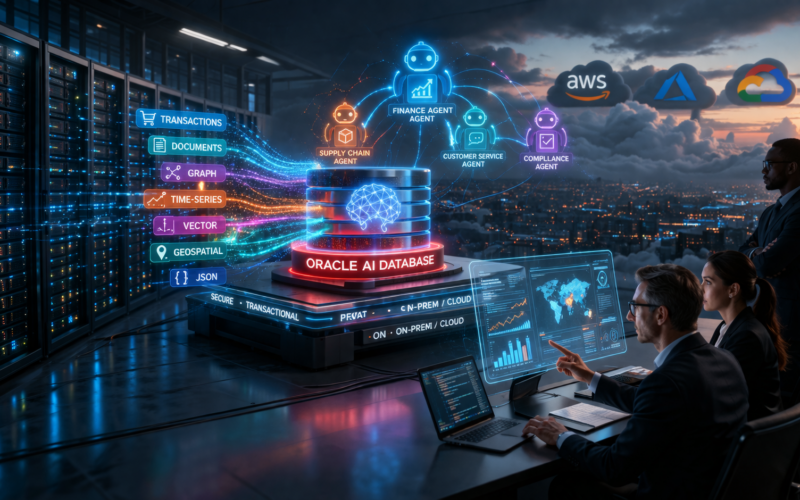
Oracle Corporation (NYSE: ORCL) unveiled a broad set of agentic AI capabilities for its Oracle AI Database platform at the Oracle AI World Tour event in London on March 24, 2026, targeting enterprise customers seeking to deploy AI agents directly against live operational data without building separate data-movement pipelines. The announcement spans a no-code private agent factory, a converged memory engine capable of handling seven data types simultaneously, a new vector database tier aimed at developers, and a container-based private AI service designed for organisations with stringent data residency requirements. Oracle is positioning the full suite as production-grade infrastructure rather than a developer preview, emphasising security architecture and transactional reliability at a moment when enterprise AI adoption is shifting from experimentation toward workloads with direct business consequences. Oracle shares were trading around USD 154 on the day of the announcement, well below their 52-week high of USD 345.72 reached in September 2025, with the stock down roughly 21.5% year to date despite a recent recovery following better-than-expected quarterly results.
Why is Oracle building agentic AI directly into its database rather than as a separate platform layer?
The core strategic argument Oracle is making with this announcement is architectural rather than promotional. Most enterprise AI deployments today involve data being extracted from operational databases, transformed, and then fed to an AI layer that sits outside the transactional system. Each handoff introduces latency, introduces synchronisation risk, and creates a security perimeter that is difficult to enforce uniformly. Oracle is arguing that by embedding agentic AI capabilities inside the database engine itself, it can eliminate those handoffs entirely, keeping data where it lives and bringing the reasoning layer to the data rather than the reverse.
This is not a new argument for Oracle, which has spent years pushing the converged database concept as an alternative to best-of-breed point solutions. What is new is the agentic framing, which gives the architectural case a concrete operational story. An AI agent querying a relational table, a graph of supplier relationships, a spatial index of delivery routes, and a vector store of product descriptions simultaneously, without any data leaving the database, is a meaningfully different proposition from an agent that issues API calls to five separate systems. The latency reduction is real, and the attack surface is smaller.
The question is whether customers and developers will accept Oracle as the coordination layer for their AI agents, given that the market has already developed strong preferences for Python-native agentic frameworks such as LangChain and LlamaIndex, and for hyperscaler-native AI services. Oracle’s answer is the Model Context Protocol integration announced as part of the Oracle Autonomous AI Database MCP Server, which allows external agent frameworks to connect to Oracle databases without custom integration code. That compatibility signal is strategically important because it reduces the either-or framing that has historically made Oracle’s ecosystem a deterrent for developer-led adoption.

What does the Oracle AI Database Private Agent Factory actually offer enterprise business analysts and domain experts?
The Oracle AI Database Private Agent Factory is described as a no-code agent builder that runs as a containerised workload in public cloud or on-premises environments, enabling business analysts and domain experts to build and deploy data-driven AI agents without writing code or sharing data with third-party AI providers. Oracle has included three pre-built specialised agents in the initial release: a Database Knowledge Agent for natural language query over structured data, a Structured Data Analysis Agent for pattern recognition and reporting tasks, and a Deep Data Research Agent for multi-step investigative workflows across large datasets.
The private deployment model is the differentiating design decision here. Enterprise organisations in regulated industries, particularly financial services, healthcare, and government, have been reluctant to adopt cloud-native AI agent services precisely because those services require data to leave a controlled environment. Oracle’s containerised approach addresses that objection directly by allowing the agent runtime to operate within the customer’s own firewall. Whether that is sufficient to unlock adoption in the most restricted environments will depend on the depth of the certification and compliance documentation Oracle produces alongside the product, not just the architectural claim.
The no-code framing is commercially sensible but carries execution risk. Business analysts who can build agents without IT involvement represent an enormous potential market, but they also represent a governance challenge. If agents built by non-technical users can query production databases with inadequate access controls, the result is data leakage risk at scale. Oracle’s answer is Oracle Deep Data Security, which implements end-user-specific access rules at the database level rather than in application code. The design intent is sound, but the practical test will be how consistently those controls propagate through agent-generated queries in complex, multi-step workflows.
How does Oracle Unified Memory Core change the architecture of enterprise AI agent deployments at scale?
Oracle Unified Memory Core is the capability that most directly targets the enterprise AI infrastructure problem as it is actually experienced in production. Current agentic AI systems frequently lose context between reasoning steps because the memory stores for different data types, vectors for semantic search, graphs for relationship traversal, time-series for operational data, are maintained in separate systems with separate synchronisation requirements. Each cross-system query adds latency and introduces the possibility of data staleness, which is particularly damaging in financial or operational contexts where decisions need to reflect the current state of a system rather than a snapshot from seconds or minutes ago.
By providing low-latency access to vector, JSON, graph, relational, text, spatial, and columnar data within a single converged engine with consistent transactional guarantees, Oracle is offering a memory substrate that agents can use without synchronisation overhead. The practical implication is that a multi-step agentic workflow, for example one that checks customer account status, cross-references it against a graph of related entities, retrieves semantically similar past cases using vector search, and then generates a recommendation, can execute entirely within a single database session rather than across multiple API calls to different systems.
The execution risk here is performance at scale. Running seven data types in a single engine under concurrent transactional load is a complex engineering problem, and Oracle’s claims about latency and throughput will need to be validated against real enterprise workloads rather than benchmarks constructed in controlled conditions. Oracle Exadata customers will have access to Exadata Powered AI Search, which Oracle describes as an accelerated AI query capability for high-volume, multi-step agentic workloads, suggesting that the full performance story may depend on Oracle’s proprietary hardware infrastructure rather than being available equally across all deployment options.
What competitive pressure does this announcement create for AWS, Microsoft Azure, Google Cloud, and specialist vector database vendors?
Oracle’s announcement lands at a moment when the enterprise AI data infrastructure market is increasingly contested. The hyperscalers, Amazon Web Services, Microsoft Azure, and Google Cloud, have each built agentic AI tooling that sits atop their existing storage and compute services, but none of them offer the converged database architecture that Oracle is promoting. Their approach tends to be compositional: a vector database service, a relational database service, a graph database service, connected through integration layers that the customer is responsible for maintaining. Oracle’s argument is that this creates exactly the data-movement and synchronisation overhead that degrades agent performance and introduces security risk.
The more immediate competitive threat is to specialist vector database vendors, including Pinecone, Weaviate, and Chroma, which have built their market position on the assumption that vector search requires a dedicated purpose-built store. Oracle’s Autonomous AI Vector Database, which combines vector search with the full Oracle database stack, directly challenges that premise for enterprise customers who already have Oracle database licenses. The ease-of-upgrade path from the developer vector tier to the full Autonomous AI Database is a particularly deliberate design choice, since it creates a natural funnel from developer experimentation to enterprise production deployment without requiring a vendor change.
For customers already on Oracle’s Exadata infrastructure, the competitive calculus is relatively straightforward: Oracle Powered AI Search offers accelerated agentic query performance without replacing existing hardware investments. For customers on hyperscaler infrastructure, the calculus is more complex, since migrating workloads to Oracle AI Database would require re-evaluating cloud-native data services that may be deeply integrated into existing applications. Oracle’s multicloud and on-premises availability is important precisely because it allows customers to add Oracle AI Database capabilities without a full platform migration, reducing the switching cost barrier that has historically made enterprise database displacement difficult.
How does Oracle Deep Data Security address the specific AI-era threat of prompt injection attacks on enterprise data?
Prompt injection is the enterprise AI security concern that most directly translates into data governance risk. In a prompt injection attack, malicious content embedded in data that an AI agent reads is used to redirect the agent’s behaviour, potentially causing it to exfiltrate data, modify records, or take actions that the legitimate end-user did not authorise. The attack vector is particularly concerning because it operates through the AI layer rather than through traditional network or application entry points, and many existing enterprise security controls are not designed to detect or prevent it.
Oracle Deep Data Security addresses this by implementing access controls at the database level rather than in application or agent code. The design principle is that if an agent, regardless of what instructions it has been given or injected with, can only access the data that the authenticated end-user is permitted to see, then the blast radius of a successful prompt injection is contained by the underlying access control layer rather than relying on the AI model to recognise and resist the attack. Oracle describes the implementation as capable of supporting sophisticated persona and function-based rules, meaning that different roles within an organisation can have different data visibility even when querying through the same AI interface.
The practical importance of centralising these controls in the database rather than in application code is that it creates a single enforcement point that is easier to audit, update, and verify. When access rules are distributed across application code, agent prompts, and API configuration, ensuring consistency across all entry points becomes a significant operational burden. Oracle’s declarative, database-native approach shifts that burden from ongoing operational management to initial configuration, which is a meaningful advantage for organisations that need to demonstrate compliance with data protection regulations.
What does ORCL’s stock position at a 53% discount to its 52-week high signal about investor sentiment toward Oracle’s AI strategy?
Oracle Corporation shares were trading around USD 154 on March 24, 2026, compared to a 52-week high of USD 345.72 reached in September 2025, representing a decline of approximately 55% from peak. The stock is down roughly 21.5% year to date, though it has recovered from lower levels following Oracle’s most recent quarterly earnings report, in which revenue grew 21.7% year over year to USD 17.19 billion and adjusted earnings per share of USD 1.79 exceeded analyst expectations of USD 1.70. Bank of America reinstated coverage with a Buy rating and a USD 200 price objective on March 24, citing accelerating AI infrastructure demand and a remaining performance obligation backlog of USD 553 billion.
The gap between Oracle’s current trading price and analyst consensus price targets, which average USD 264.47 with 34 analysts holding a Buy rating, reflects a market that is discounting execution risk and AI monetisation uncertainty rather than rejecting Oracle’s strategic positioning. The USD 553 billion RPO backlog is a significant data point because it represents contracted future revenue, not speculative pipeline, and it provides revenue visibility that most software companies cannot match at Oracle’s scale. Whether investors will re-rate the stock toward analyst targets will depend in large part on whether quarterly cloud infrastructure growth rates continue to accelerate and whether the AI database capabilities announced today translate into incremental contract wins rather than simply adding features to existing relationships.
The timing of the announcement at the Oracle AI World Tour in London, rather than at a US-centric event, is also a signal. European enterprise customers have been slower to adopt cloud AI infrastructure, partly due to data sovereignty concerns. The private deployment options in today’s announcement, including Oracle Private AI Services Container and Oracle AI Database Private Agent Factory, are directly responsive to European regulatory requirements around data residency, and the London venue choice suggests Oracle is actively targeting that conversion opportunity.
How does Oracle Vectors on Ice and Apache Iceberg support change the data lakehouse strategy for AI workloads?
Oracle Vectors on Ice is the capability that most directly addresses the enterprise data architecture reality that large organisations already maintain significant data volumes in Apache Iceberg-formatted data lakes outside of their relational databases. By enabling Oracle AI Vector Search to read vector data directly from Iceberg tables, create and maintain vector indexes over that data, and automatically update those indexes as the underlying data changes, Oracle is extending the reach of its AI database capabilities into data lake environments without requiring customers to migrate that data into Oracle-managed storage.
The competitive significance of Iceberg support extends beyond technical interoperability. Apache Iceberg has emerged as the dominant open table format for enterprise data lake storage, with support from Snowflake, Databricks, AWS, and Google Cloud. Oracle’s native support signals a pragmatic acceptance that enterprises will not consolidate all their data into Oracle-managed environments, and that Oracle’s role in AI workloads must accommodate the data where it already lives. This is a meaningful shift in positioning for a company that has historically preferred to manage data entirely within its own infrastructure stack.
Key takeaways: What Oracle’s AI database agentic suite means for enterprise data strategy, cloud vendors, and the ORCL investment case
- Oracle is repositioning its database platform as enterprise AI infrastructure, not just data storage, betting that architectural integration of AI and data will outperform the compositional multi-service approach favoured by the hyperscalers.
- The Oracle AI Database Private Agent Factory’s no-code, on-premises deployment model directly targets regulated industries where data residency requirements have blocked cloud-native AI adoption, particularly financial services, healthcare, and government.
- Oracle Unified Memory Core, with simultaneous support for seven data types in a single transactional engine, removes the cross-system synchronisation overhead that degrades multi-step agentic workflows, though performance at production scale under concurrent load remains to be validated.
- Oracle Deep Data Security’s database-native access control architecture provides a structural defence against prompt injection attacks by limiting agent data access at the source rather than relying on AI model compliance, a more auditable and regulatorily defensible approach.
- The Autonomous AI Vector Database developer tier creates a direct funnel from experimentation to enterprise production without a vendor change, putting direct competitive pressure on specialist vector database vendors such as Pinecone and Weaviate.
- MCP Server integration for Oracle Autonomous AI Database reduces the integration barrier for customers using Python-native agentic frameworks such as LangChain, addressing the developer ecosystem concern that has historically limited Oracle’s appeal outside its installed base.
- Oracle Vectors on Ice and Apache Iceberg support represent a pragmatic acknowledgment that enterprise AI workloads will span both database and data lake environments, and that Oracle must operate in open-format ecosystems rather than enforce proprietary storage.
- ORCL’s current trading price of approximately USD 154 sits roughly 55% below its September 2025 52-week high of USD 345.72, with analyst consensus at USD 264.47, suggesting that the market is pricing in execution risk rather than rejecting the strategic thesis.
- The USD 553 billion RPO backlog provides contracted revenue visibility that reduces near-term downside risk and gives Oracle time to convert its AI database announcements into incremental contract wins, which is the key catalyst for a sustained re-rating.
- The London event venue and the emphasis on private deployment options signals a deliberate push to convert European enterprise customers who have been slower to adopt cloud AI infrastructure due to data sovereignty concerns, representing a material incremental revenue opportunity.
Discover more from Business-News-Today.com
Subscribe to get the latest posts sent to your email.