Mobile air defense is moving from a specialist military capability into one of the most important investment themes in the defense sector, as drones, cruise missiles and saturation attacks force militaries to protect bases, logistics hubs, airfields and critical infrastructure more aggressively. Leidos Holdings Inc. (NYSE: LDOS) has become an early marker of that shift after receiving a $617 million U.S. Army award for additional Indirect Fire Protection Capability Increment 2 launchers, taking its IFPC Inc 2 production contract base to nearly $1.2 billion. The broader investor question is whether Leidos Holdings Inc., RTX Corporation (NYSE: RTX), Lockheed Martin Corporation (NYSE: LMT), Northrop Grumman Corporation (NYSE: NOC) and L3Harris Technologies Inc. (NYSE: LHX) are entering a longer air defense cycle rather than benefiting from isolated procurement spikes. The answer increasingly looks tied to one uncomfortable reality for defense planners: drones are cheap, but defending against them at scale is not.
Why are drones turning mobile air defense into a serious defense stock theme?
The defense stock theme around mobile air defense begins with a basic change in battlefield economics. For decades, air defense investment was mainly framed around aircraft, ballistic missiles and high-end missile threats. That has changed because unmanned aerial systems, loitering munitions and cruise missiles can now threaten high-value military sites, energy infrastructure, ports, logistics corridors and command centers at far lower cost than traditional airpower. The defender is forced to maintain constant coverage, while the attacker can probe, swarm or saturate defenses using cheaper systems.
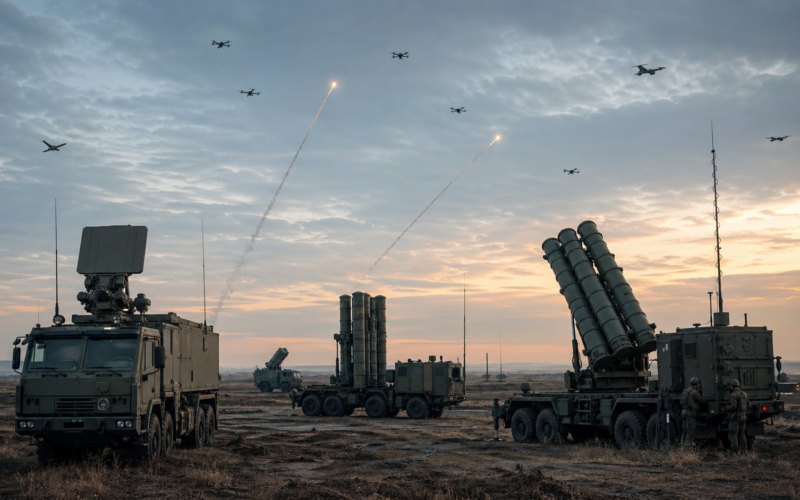
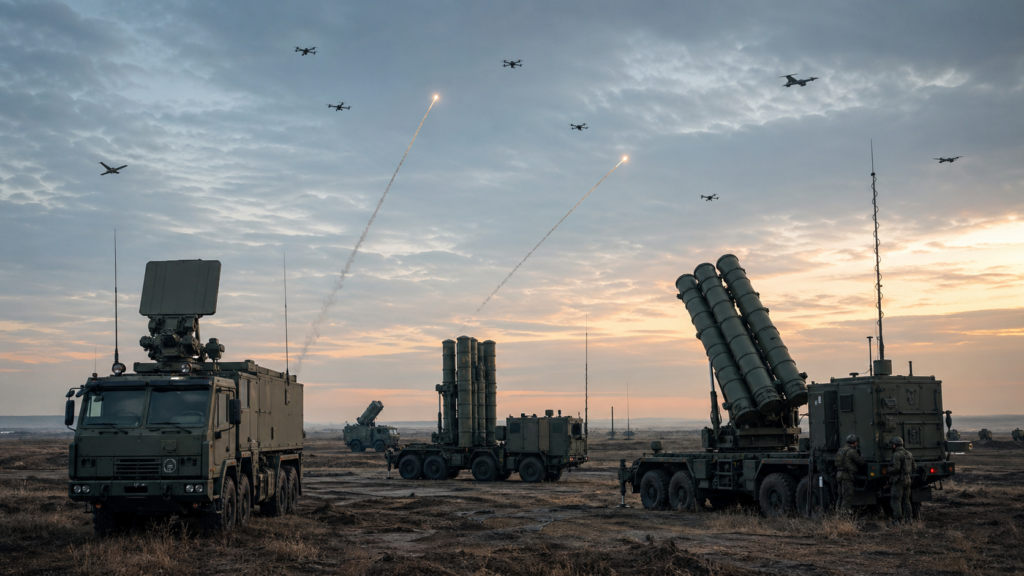
That shift is why the Leidos Holdings Inc. IFPC Inc 2 contract matters beyond the headline contract value. The U.S. Army describes IFPC Inc 2 as a mobile, ground-based air defense system designed to protect critical assets from drones, cruise missiles and other aerial threats, with interoperability across the Army’s Integrated Battle Command System and a flexible architecture built for future missions. That is exactly the type of capability militaries now need as fixed sites become more vulnerable and defensive coverage has to become more distributed.
For investors, the theme is not simply “drones are rising, therefore defense stocks rise.” That would be too lazy, and markets are not usually that generous. The more useful framing is that drones have widened the air defense addressable market. Instead of defending only strategic assets with expensive systems, militaries now need layered defenses across many more sites. That creates demand for launchers, interceptors, radars, sensors, battle management software, electronic warfare, directed energy and low-cost defeat mechanisms.
Why does Leidos Holdings Inc. sit at the center of the current mobile air defense conversation?
Leidos Holdings Inc. sits at the center of this conversation because IFPC Inc 2 gives the company a visible role in a procurement lane with long-term relevance. The latest $617 million Army award follows $356 million awarded in July and September 2025, bringing Leidos Holdings Inc.’s IFPC Inc 2 production contracts to nearly $1.2 billion. The company has more than 100 launchers committed for delivery, and the funding also supports research, development and testing ahead of future orders through 2029.
That is important because Leidos Holdings Inc. is not traditionally valued like a pure missile-defense prime. It is better known for government technology services, mission systems and defense integration work. IFPC Inc 2 gives the company a harder-edged production story in a market where investors tend to reward clear exposure to high-priority defense modernization. The company’s role in launcher production and systems integration could help it build a stronger identity in air and missile defense if execution remains strong.
However, the stock market has not yet treated the contract as a dramatic rerating event. LDOS recently traded at $146.06, with a market capitalization of about $18.67 billion and a price-to-earnings ratio of about 13.65. That valuation profile suggests investors still see Leidos Holdings Inc. as a diversified government contractor rather than a premium air defense platform story. The upside is that the IFPC Inc 2 program gives the company a clearer route to changing that perception. The risk is that backlog visibility alone does not guarantee margin expansion or valuation rerating.
How do RTX Corporation and Lockheed Martin Corporation compare in the air defense spending cycle?
RTX Corporation and Lockheed Martin Corporation remain central to the air defense conversation because both companies have deep exposure to missile defense, interceptors and integrated air and missile defense systems. RTX Corporation traded recently at $174.26, with a market capitalization of about $234.67 billion and a price-to-earnings ratio near 32.69, making it the highest-valued company in this peer group by market capitalization. That matters because RTX Corporation’s scale reflects its position across missiles, sensors, defense electronics, aerospace systems and engines, but it also means investor expectations are already substantial.
Lockheed Martin Corporation traded recently at $513.45, with a market capitalization of about $118.38 billion and a price-to-earnings ratio near 24.86. Its air defense relevance is anchored in missile defense, Patriot-related systems through its PAC-3 exposure, command-and-control integration and broader defense prime status. The company remains one of the largest defense contractors globally, and its role in missile defense makes it a natural beneficiary if governments continue to expand spending on layered air defense.
The key difference is where each company sits in the spending stack. RTX Corporation has large exposure to missile systems and missile defense demand, while Lockheed Martin Corporation has a broad defense platform and interceptor role. Leidos Holdings Inc., by contrast, is gaining visibility through the launcher and integration layer. That means the air defense spending cycle may not favor one winner. It may favor a stack of companies across hardware, effectors, sensors and software. For investors, that is both the opportunity and the complication.
Why could Northrop Grumman Corporation and L3Harris Technologies Inc. benefit from the same defense shift?
Northrop Grumman Corporation and L3Harris Technologies Inc. may not be the first names retail investors associate with mobile air defense launchers, but both companies sit near the broader architecture of modern defense networks. Northrop Grumman Corporation traded recently at $575.11, with a market capitalization of about $81.95 billion and a price-to-earnings ratio near 18.03. The company’s broader defense portfolio includes sensors, command systems, space, missile defense-adjacent capabilities and advanced military technologies, all of which become more important when air defense turns into a networked problem rather than a single-weapon problem.
L3Harris Technologies Inc. traded recently at $317.51, with a market capitalization of about $59.39 billion and a price-to-earnings ratio near 34.10. The company’s relevance comes from communications, sensors, electronic systems, space and defense technology integration. In a mobile air defense cycle, the ability to detect, communicate, classify and coordinate responses can be just as important as the launcher or interceptor. A missile battery without fast, resilient and interoperable data flows is basically an expensive sculpture with anxiety issues.
The broader point is that air defense investing should not be reduced to missile manufacturers alone. The modern layered defense market is increasingly about networks. Radars, passive sensors, battlefield management software, secure communications, artificial intelligence-assisted detection, electronic warfare and resilient command-and-control all sit inside the opportunity. That gives companies such as Northrop Grumman Corporation and L3Harris Technologies Inc. potential exposure to the same structural theme, even when the headline contracts go to launcher or interceptor suppliers.
Why is the Pentagon’s air defense problem also an industrial base problem?
The biggest constraint in the mobile air defense theme may not be demand. It may be production capacity. The Pentagon can identify the need for more launchers, interceptors, drones and counter-drone systems faster than the industrial base can always deliver them. Reuters reported that the Leidos Holdings Inc. award fits into broader Pentagon efforts to step up replenishment and readiness, which is a reminder that demand is being shaped by both future modernization and current stockpile pressure.
This matters for defense stocks because the market often celebrates contract wins before fully pricing execution risk. Scaling production of launchers, missiles, sensors and electronic systems requires supply chain depth, skilled labor, testing capacity, manufacturing discipline and working capital. Companies may win large awards but still face margin pressure if costs rise, suppliers lag or engineering changes complicate production. In defense, the headline award is the opening whistle, not the final score.
For Leidos Holdings Inc., the production test is particularly important. The company has said it delivered the first IFPC Inc 2 Initial Operational Test and Evaluation launcher two months ahead of schedule. That is a useful credibility marker, but the harder test is repeatable scaled production across more than 100 committed launchers. If Leidos Holdings Inc. proves it can deliver reliably, the market may begin to view the company differently. If production gets messy, investors may treat IFPC Inc 2 as another reminder that defense modernization is easier to fund than to execute.
Can mobile air defense become a durable investment cycle rather than a temporary geopolitical trade?
Mobile air defense has a stronger case for durability than many defense themes because the threat environment is unlikely to revert to pre-drone assumptions. Drones are becoming cheaper, more autonomous, more numerous and more tactically flexible. Cruise missile threats remain central to advanced military planning. Forward bases, logistics nodes, ships, airfields and energy infrastructure remain vulnerable. That combination creates a sustained need for layered protection.
The Pentagon’s reported push toward artificial intelligence-enabled warfare, autonomous systems and drone dominance also reinforces the other side of the equation. If militaries invest heavily in autonomous offensive capabilities, they will also need to invest in defensive systems that can detect and defeat similar threats. The Guardian reported that the Pentagon has proposed a major funding pivot toward AI-powered warfare, including autonomous drones and remotely operated vehicles across military domains. That kind of spending shift can support both drone manufacturers and counter-drone defense suppliers.
The investor risk is that the theme can become overhyped. Not every company with “air defense,” “drone,” “AI” or “autonomous” in a presentation will translate those words into profitable growth. The winners are more likely to be companies with funded programs, credible production pathways, interoperable systems and customer trust. In that sense, the Leidos Holdings Inc. IFPC Inc 2 award is useful because it is not merely a concept. It is funded, programmatic and linked to future orders through 2029.
What should investors watch next in the mobile air defense stock theme?
Investors should watch three things as this theme develops. The first is follow-on ordering. A single large contract can support a stock narrative for a few days, but a series of awards across launchers, interceptors, sensors and software can support a multi-year investment cycle. Leidos Holdings Inc.’s nearly $1.2 billion IFPC Inc 2 contract base gives investors one clear data point, but broader Army and Pentagon procurement patterns will matter more over time.
The second is margin quality. Defense contractors can grow revenue without creating much shareholder value if inflation, supplier constraints or fixed-price contract pressure squeeze profitability. This is especially relevant in production programs where costs can move faster than expected. Investors should avoid assuming that every air defense award is automatically accretive to earnings quality.
The third is interoperability. The companies best positioned in mobile air defense may not simply be those with the most famous missiles. They may be the companies whose systems can plug into broader command-and-control networks, integrate new effectors and adapt to changing threats. IFPC Inc 2 is notable because Leidos Holdings Inc. emphasizes open architecture, 360-degree coverage and interoperability with Army battle command systems. That design philosophy could become a key procurement differentiator if the Army continues prioritizing flexibility over closed, rigid systems.
Key takeaways on mobile air defense stocks, Leidos Holdings Inc. and the next defense investment cycle
- Leidos Holdings Inc.’s $617 million IFPC Inc 2 award gives LDOS direct exposure to a high-priority U.S. Army air defense production program.
- The nearly $1.2 billion IFPC Inc 2 contract base strengthens Leidos Holdings Inc.’s backlog visibility, but the stock still needs execution proof to earn a higher defense modernization premium.
- RTX Corporation and Lockheed Martin Corporation remain major beneficiaries of the broader air and missile defense cycle because of their scale, interceptor exposure and defense prime status.
- Northrop Grumman Corporation and L3Harris Technologies Inc. could benefit from the networked side of air defense, including sensors, communications, command systems and integration.
- The Pentagon’s air defense challenge is also an industrial base challenge because demand for launchers, interceptors and counter-drone systems is rising faster than simple production assumptions allow.
- The strongest defense stock opportunities may come from companies that combine funded programs, production capacity, interoperability and margin discipline.
- Drone warfare is changing the economics of defense by forcing militaries to protect more sites against cheaper and more frequent aerial threats.
- Investors should watch follow-on orders, production performance, margin quality and open architecture adoption rather than reacting only to headline contract values.
- Mobile air defense looks less like a temporary geopolitical trade and more like a durable modernization cycle, but stock selection will still matter.
- Mobile air defense is becoming a serious defense stock theme because drones and cruise missiles have expanded the number of assets militaries must protect.
Discover more from Business-News-Today.com
Subscribe to get the latest posts sent to your email.