


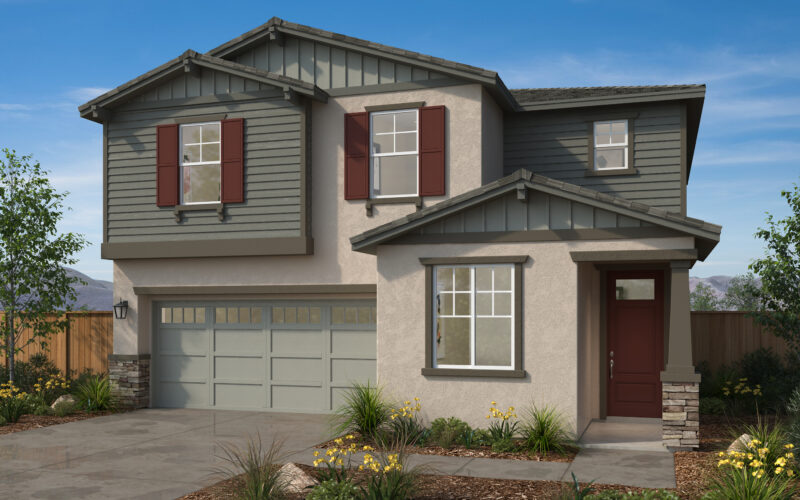
KB Home (NYSE: KBH) has opened Aurora at One Lake, a new community of two-story detached homes in Fairfield, California, with prices beginning in the $590,000s. The launch adds another selling community to the homebuilder’s expanding West Coast footprint and gives it exposure to a master-planned location near Interstate 80, the Fairfield-Vacaville Hannigan Capitol Corridor station and Travis Air Force Base. Strategically, Aurora supports KB Home’s return to a predominantly built-to-order model, under which buyers select homes and options rather than depending mainly on completed speculative inventory. The opening also comes at a difficult point in the housing cycle, with mortgage rates at 6.66%, national builder confidence remaining weak and KB Home’s latest quarterly margins substantially below the prior year. The central question is whether Aurora’s location, amenities and customization proposition can generate sufficient order volume without requiring incentives that further weaken profitability.
What does the Aurora at One Lake opening add to KB Home’s Northern California growth strategy?
Aurora at One Lake is located near the intersection of Vanden Road and One Lake Drive in Fairfield. The community includes four two-story floor plans ranging from approximately 2,125 to 2,566 square feet, with configurations offering as many as five bedrooms and three bathrooms.
The homes are positioned within the One Lake master-planned development, where residents have access to a pool, spa, clubhouse, community center, amphitheatre, parks, playgrounds, barbecue areas, trails and recreational spaces surrounding a lake. The development is also served by the Travis Unified School District.
These features allow KB Home to sell more than the structure itself. Master-planned amenities can strengthen the perceived value of a home, particularly when buyers are comparing new construction with resale properties that may offer lower headline prices but lack modern layouts, energy efficiency or shared recreational infrastructure.
The location is also intended to appeal to commuters and households connected to major North Bay employers. Access to Interstate 80 and the Capitol Corridor rail network provides links towards Sacramento and the broader San Francisco Bay Area, while Travis Air Force Base represents a substantial nearby employment centre.

The commercial significance lies in Aurora’s ability to address several buyer priorities simultaneously: space, connectivity, schools, recreation and personalization. However, every additional feature must ultimately support the sales pace. Amenities may attract site visits, but the community’s financial contribution will depend on how many visitors convert into contracts and how much pricing support KB Home must provide to secure those contracts.
Why is Aurora’s $590,000 starting price both competitive and difficult in the current housing market?
Aurora’s starting price is below KB Home’s second-quarter West Coast average selling price of $624,300. That positioning could help the community reach households seeking new construction in Northern California without moving into the higher price bands associated with several core Bay Area markets.
However, the entry price remains well above the national median price of $398,300 for a new home sold in June 2026. Geographic comparisons must be treated cautiously because Northern California land, labour, regulation and development costs differ considerably from the national market, but the gap highlights the affordability challenge facing Aurora’s target buyers.
At the July 30 average mortgage rate of 6.66%, a buyer purchasing a $590,000 home with a 20% down payment would face principal and interest payments of approximately $3,030 a month on a conventional 30-year mortgage. That calculation excludes property taxes, insurance, homeowners’ association charges and other ownership costs.
This is where product differentiation becomes important. KB Home is offering buyers the ability to personalize floor plans, exterior styles and interior finishes through its design studio. Its homes are also designed for greater energy and water efficiency and are expected to meet Energy Star certification standards.
Customization can be a competitive advantage because buyers are less likely to compare a personalized home purely on price per square foot. Energy efficiency may also reduce some ongoing utility expenses. Neither factor, however, removes the initial financing constraint created by mortgage rates and down-payment requirements.
The wider new-home market remains subdued. United States new-home sales rose 1.6% in June to an annualized rate of 628,000, but remained 5.6% below the previous year. Available inventory represented 9.3 months of supply at the prevailing sales pace, giving buyers more alternatives and increasing pressure on builders to compete through price reductions, financing assistance or upgrades.
How does Aurora support KB Home’s return to a predominantly built-to-order operating model?
KB Home reported that built-to-order homes represented 73% of its net orders during the second quarter of 2026. Aurora fits that strategy because buyers can select a floor plan, homesite and design options before construction is completed.
A built-to-order model can reduce the risk of accumulating completed homes that require aggressive discounts. It can also help KB Home align construction spending with identified customer demand and preserve the value of personalization as a differentiating feature.
The model is not risk-free. Built-to-order homes take time to construct, which means an order does not immediately become revenue. Buyers may also cancel contracts if mortgage rates rise, employment conditions change or competing builders present more attractive incentives before closing.
KB Home’s second-quarter cancellation rate improved to 12% of gross orders from 16% a year earlier. That reduction is encouraging because it suggests the backlog may be becoming more dependable. Build times also improved sequentially, according to management, which should help the company convert orders into deliveries and cash more quickly.
Aurora’s performance will therefore depend on more than its initial sales interest. The important operating measures will be the number of monthly orders per community, cancellation rates, construction cycle times and the proportion of buyers purchasing profitable design options.
A strong order pace would help validate KB Home’s decision to continue opening communities while managing land investment more conservatively. A weak pace would leave management choosing between slower absorption and additional incentives, neither of which would materially improve near-term returns.
What do KB Home’s latest results reveal about the financial risks behind the expansion?
KB Home’s second-quarter results demonstrate why new community openings matter, but also why they cannot be assessed independently from margins and capital efficiency.
Revenue declined 27% year over year to $1.11 billion as home deliveries fell 23% to 2,395. The average selling price decreased to $461,900 from $488,700. Net income dropped to $27.3 million from $107.9 million, while diluted earnings per share fell to $0.43 from $1.50.
The homebuilding operating margin contracted to 2.5% from 8.6%. Housing gross margin declined to 15.2% from 19.3%, reflecting price reductions, higher relative land costs and weaker operating leverage. These figures show that KB Home has been protecting sales volume and navigating affordability pressures at a substantial cost to profitability.
Community expansion provides a potential route back to higher deliveries because each new location creates another channel for orders. KB Home’s average community count increased 9% during the quarter, while its ending community count rose 11% to 280.
Yet community growth will only create operating leverage when incremental sales produce enough gross profit to absorb corporate and selling expenses. Opening communities without adequate absorption could instead increase carrying costs, marketing expenses and the risk that land capital remains tied up longer than expected.
There are positive regional indicators. West Coast net orders increased approximately 9% to 1,203 during the second quarter, while West Coast net order value rose about 5% to $766.9 million. The region’s backlog reached 1,618 homes valued at approximately $1.04 billion, up from 1,396 homes valued at $947.8 million a year earlier.
Aurora enters the portfolio against that comparatively supportive West Coast order backdrop. The community could help sustain regional momentum, but its pricing and incentive requirements will determine whether it contributes to the margin recovery that KB Home expects during the second half of fiscal 2026.
Can KB Home fund continued community growth while protecting its balance sheet and shareholders?
KB Home reported $1.12 billion of liquidity at the end of May, including $199.8 million in cash and $923.4 million of unused capacity under its revolving credit facility. The company also had $275 million of borrowings outstanding under that facility.
Inventories stood at $5.73 billion, while notes payable increased to $1.97 billion from $1.69 billion at the end of November 2025. The debt-to-capital ratio consequently increased to 34.1% from 30.3%.
Management reduced land and development investment during the first half of the year, spending $1.06 billion compared with $1.43 billion in the prior-year period. The number of lots owned or controlled also declined 9% to 59,106.
This combination suggests that KB Home is attempting to balance community openings with tighter land deployment. The company needs enough land to protect future growth, but excessive investment in a slow market can reduce financial flexibility and increase the risk of impairments.
Capital allocation adds another layer to the equation. KB Home repurchased $125 million of shares during the first half of fiscal 2026, including $75 million in the second quarter. The company had $775 million remaining under its share repurchase authorization at the end of May.
Share repurchases can create value when shares trade below their underlying long-term worth, but they compete with land investment, debt reduction and community development for capital. The strategic test is whether management can continue buying back shares while funding communities such as Aurora without allowing leverage or inventory exposure to rise disproportionately.
What does KB Home’s share performance indicate about investor sentiment towards the homebuilder?
KB Home shares traded at approximately $55.70 during the July 31 session, giving the company a market capitalization of about $3.49 billion. The stock was down approximately 1.2% during the session and remained nearly 11% below its June 30 closing price of $62.59.
The shares were approximately 19% below their 52-week high of $68.71 but about 27% above the 52-week low of $44.03. This positioning suggests that investors have moved beyond the most pessimistic point reached in May, although the stock has not recovered confidence associated with its previous peak.
KB Home reported book value of $61.93 per share at the end of the second quarter. The current share price therefore represents a discount of roughly 10% to reported book value. That discount can appear attractive under a successful recovery scenario, but it also reflects concerns about housing margins, land values and the timing of an earnings rebound.
Published analyst data showed a Hold consensus, with an average target price of $58.67 and a wide range between $43 and $77. The spread demonstrates how strongly valuation depends on assumptions about mortgage rates, sales incentives, gross-margin recovery and the pace at which new communities generate orders.
Aurora is unlikely to alter KB Home’s valuation by itself. Its importance is as part of a broader portfolio of openings designed to rebuild volume, improve operating leverage and restore profitability. Investors will require evidence across multiple communities before assigning a more confident valuation to that strategy.
What evidence will show whether Aurora at One Lake is delivering profitable growth for KB Home?
The first proof point will be absorption. KB Home does not need Aurora merely to attract visitors or generate reservations. It needs consistent contracts at pricing levels that cover construction, land, community infrastructure, selling expenses and the cost of buyer incentives.
The second test will be product mix. Buyers selecting larger floor plans and profitable design upgrades could raise revenue per home, but excessive customization must not delay construction or inflate costs.
The third measure will be cancellation behaviour. Aurora’s access to transport, employers, schools and amenities may support buyer commitment, but affordability remains vulnerable to mortgage-rate movements.
KB Home expects third-quarter deliveries of between 2,600 and 2,800 homes and housing revenue of $1.20 billion to $1.35 billion. Management is also targeting a housing gross margin of 16.0% to 16.6%, excluding inventory-related charges, representing an anticipated sequential improvement.
For the full year, KB Home expects to deliver between 10,500 and 11,000 homes and generate housing revenue of $4.90 billion to $5.30 billion. The company expects a full-year housing gross margin of 16.1% to 16.5%, excluding inventory-related charges.
Aurora strengthens the number of communities available to pursue those targets. What remains unresolved is whether KB Home can convert that expanded footprint into profitable volume rather than incentive-dependent sales.
The opening has therefore improved KB Home’s Northern California product reach, but the next measurable proof will come from West Coast orders, community-level absorption and consolidated gross margins. Strong demand with controlled incentives would support the strategy. Slow sales or renewed price reductions would show that community growth alone cannot overcome the affordability constraint.
What are the key takeaways from KB Home’s Aurora at One Lake community opening?
- KB Home has opened Aurora at One Lake in Fairfield, California, with prices beginning in the $590,000s.
- The community offers detached two-story homes with as many as five bedrooms and three bathrooms.
- One Lake’s amenities and access to Interstate 80, passenger rail and major employers strengthen the location proposition.
- Aurora supports KB Home’s return to a predominantly built-to-order operating model.
- The launch enters a difficult affordability environment, with the average 30-year mortgage rate at 6.66%.
- KB Home’s West Coast net orders increased during the second quarter, providing a relatively constructive regional backdrop.
- Group revenue, deliveries, earnings and gross margins remained substantially below the previous year.
- The company is expanding community count while reducing overall land investment and lot exposure.
- KB Home shares trade below reported book value, reflecting both recovery potential and continuing market caution.
- Aurora’s commercial success will be measured through absorption, incentives, cancellations and its contribution to West Coast margin recovery.
Discover more from Business-News-Today.com
Subscribe to get the latest posts sent to your email.


