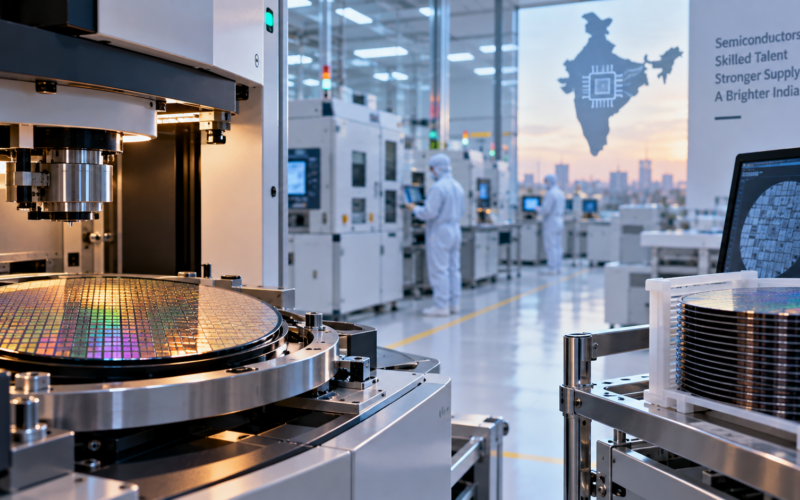
Lam Research Corporation (NASDAQ: LRCX), one of the world’s largest suppliers of wafer-fabrication equipment, plans to invest around ₹10,000 crore in India to establish its first local silicon-component manufacturing facility and expand advanced research and development operations. Times News Network reported on September 16, citing Lam Research’s announcement, that the manufacturing project will support a vertically integrated process spanning silicon-ingot production and subsequent processing for semiconductor applications serving advanced technologies and leading-edge nodes.
The project was subsequently picked up by BigInfo as a major Indian industrial development. The available disclosure identifies the investment amount and manufacturing concept but does not specify the site, land requirement, annual production capacity or commissioning date. It should therefore be described as a planned ₹10,000 crore manufacturing and R&D programme rather than a factory already under construction.
What exactly will Lam Research manufacture under its ₹10,000 crore India plan?
The project involves silicon components used inside the semiconductor manufacturing ecosystem rather than a conventional chip fabrication plant producing processors or memory devices for sale.
Lam said the facility will support a vertically integrated process beginning with silicon ingots and extending into component processing for advanced semiconductor technologies. That places the proposed operation further upstream in the chip-equipment supply chain, where specialised silicon parts are used within highly demanding wafer-processing environments.
This distinction is important because semiconductor announcements are often grouped under the broad label of “chip manufacturing” even when they occupy very different parts of the value chain. A wafer fab manufactures semiconductor devices; Lam sells the highly complex equipment used to fabricate those devices and relies on precision components capable of operating in chemically and physically extreme environments.
India’s strategic gain therefore comes from attracting another missing layer of the semiconductor ecosystem. Domestic fabs need equipment, but global equipment makers themselves need ultra-precise materials, components, gases, chemicals, metrology and manufacturing services.
Why is vertically integrated silicon production strategically important for Lam Research?
Semiconductor fabrication equipment operates at extraordinarily tight tolerances. Silicon parts used within process chambers must meet exacting standards around purity, dimensional accuracy, surface treatment and contamination.
Bringing ingot production and downstream component processing into one Indian manufacturing platform can give Lam greater control over quality, lead times and supply-chain resilience.
Lam told Times News Network that it already works with Indian suppliers across specialised materials, precision components, gases, chemicals, metrology and manufacturing services. The proposed facility could deepen those relationships by creating local demand for an even broader group of semiconductor-grade inputs.
That supplier effect may ultimately matter as much as the factory itself. A global semiconductor-equipment company placing a sophisticated manufacturing node in India creates qualification opportunities for domestic suppliers that can later serve other international semiconductor customers.
How large is ₹10,000 crore relative to Lam Research’s global business?
Lam is a very large global technology company rather than an early-stage equipment supplier. The company reported calendar 2025 revenue of $20.6 billion, employed about 19,700 people and spent approximately $2.3 billion on research and development.
Its fiscal 2026 revenue subsequently reached $23.23 billion, up sharply from $18.44 billion in fiscal 2025 as semiconductor-equipment demand strengthened.
The India investment is therefore significant without being disproportionate to Lam’s global scale. It represents a substantial long-term manufacturing commitment by a company already spending billions of dollars annually on technology development.
More importantly, the project changes the nature of Lam’s Indian presence. India has historically been important to the company for engineering talent and R&D; silicon-component manufacturing would give the country a direct role in Lam’s physical global supply chain.
How does the new factory build on Lam Research’s existing Bengaluru engineering base?
Lam already operates significant engineering functions in Bengaluru. Current company recruitment material describes India teams working across hardware, software, manufacturing engineering, supplier quality and global supply-chain functions that support Lam’s semiconductor equipment business.
Lam has also invested in semiconductor education. Its collaboration with the Indian Institute of Science and India Semiconductor Mission aims to expand access to Lam’s virtual semiconductor fabrication platform, with a longer-term objective of training as many as 60,000 engineering students in India.
The manufacturing plan therefore creates a potential loop between engineering, workforce development and local production. Indian engineers can contribute to product design and validation, while a local industrial supply chain manufactures increasingly sophisticated components.
That is much deeper participation than hosting only an offshore engineering centre.
Why does Lam’s investment matter for India’s semiconductor strategy beyond one company?
India’s semiconductor policy is increasingly moving beyond headline fab approvals toward the supporting ecosystem required to make those fabs globally competitive. Equipment, materials, chemicals, precision components and engineering capabilities determine whether domestic plants can operate reliably and expand to more advanced process technologies.
Lam is particularly important because its equipment is used in core wafer-fabrication steps including deposition, etch and cleaning. Its company material describes the group as a major global provider of the technologies used to manufacture leading-edge semiconductor devices.
A local silicon-component facility can therefore help create industrial capability serving not only Indian chipmakers but Lam’s global production system.
The opportunity also creates a demanding qualification standard for domestic suppliers. Semiconductor equipment cannot tolerate the quality variability accepted in many conventional industrial sectors, meaning suppliers that win Lam qualification can gain credibility across the global chip supply chain.
What is still missing from Lam Research’s ₹10,000 crore India announcement?
The largest missing detail is location. No state or specific industrial site was identified in the available announcement.
The second is implementation phasing. Lam said it plans further investments over several years, but there is no public breakdown showing how much of ₹10,000 crore goes into the silicon-component facility versus R&D expansion.
The third is capacity. Without annual tonnage, component volumes or factory footprint, it is not yet possible to calculate capital intensity or compare the project directly with Lam’s component operations elsewhere.
Those omissions do not reduce the strategic significance of the commitment. They simply define the project’s current stage: a major announced manufacturing and R&D plan that still requires site, capacity and commissioning details before it becomes a fully measurable construction project.
Discover more from Business-News-Today.com
Subscribe to get the latest posts sent to your email.