Reliance Industries Limited (NSE: RELIANCE), Vedanta Limited (NSE: VEDL) and Adani Enterprises Limited (NSE: ADANIENT) are reported to be among around 10 companies interested in developing rare earth processing facilities in Andhra Pradesh. The reported interest comes as India attempts to reduce dependence on China for rare earth minerals and permanent magnets used in electric vehicles, wind turbines, aerospace, electronics and defence systems. Andhra Pradesh is trying to position itself as a critical minerals hub by attracting rare earth and titanium investments worth about Rs 500 billion over the next decade. For investors, the story is not just another commodity headline, but a potential industrial-policy reset that could decide who captures value in India’s next advanced materials supply chain.
Why are Reliance Industries, Vedanta and Adani Enterprises being linked to India’s rare earth ambitions?
Reliance Industries Limited, Vedanta Limited and Adani Enterprises Limited bring three different capabilities to India’s rare earth opportunity. Reliance Industries Limited has scale, capital access and exposure to clean energy, electronics-linked infrastructure and advanced manufacturing ambitions. Vedanta Limited has mining, metals and minerals processing experience, which makes the rare earth value chain a natural adjacency if the company can manage regulatory, environmental and execution risks. Adani Enterprises Limited has a platform model across mining, infrastructure, airports, logistics and industrial development, which could fit a capital-heavy sector where land, ports, power and execution speed matter.
The reported interest also shows that India’s rare earth strategy may be moving from government policy language to corporate project formation. For years, India’s critical minerals debate has been strong on resource potential and weak on commercial-scale processing. The country has rare earth ore resources, but converting those resources into high-purity oxides, metals, alloys and magnets is where the real industrial value lies. That is also where China has built a dominant position, not merely through mining, but through refining capacity, magnet manufacturing, process know-how and supply chain control.
For the three listed groups, the opportunity is strategic rather than immediately earnings-transformative. Rare earth processing is not a quick-margin business. It needs technology partnerships, environmental clearances, feedstock security, separation capability, customer offtake and patient capital. The investor question is whether these groups are positioning early for a policy-backed supply chain that could become essential for electric mobility, renewable energy, aerospace and defence over the next decade.
Why does Andhra Pradesh matter in India’s plan to reduce China dependence in rare earth supply chains?
Andhra Pradesh matters because the state has beach sand mineral resources across identified coastal deposits and is one of the four states named for dedicated rare earth corridors. The rare earth corridor framework is designed to support mining, processing, research and manufacturing, rather than leaving India stuck at the low-value raw material stage. Andhra Pradesh’s coastal geography also gives it a logistics advantage if processing plants, ports, industrial parks and export-oriented manufacturing are aligned properly.
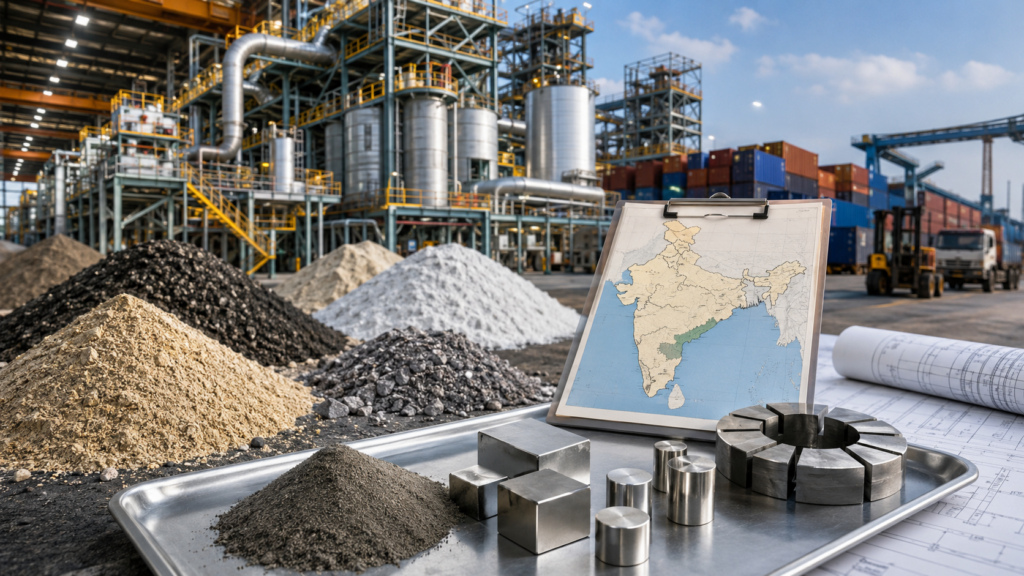
The state is aiming to attract about Rs 500 billion in rare earth and titanium investment over the next decade. That number is important because rare earth processing cannot be built as a small decorative policy pilot. It requires scale, infrastructure and long-term demand visibility. Andhra Pradesh plans to issue tenders after cabinet approval for its rare earth corridor policy, and the state is expected to offer capital-linked incentives and additional benefits for projects with investments of Rs 10 billion or more.
The broader consequence is that Andhra Pradesh is competing not just for factories, but for a place in India’s strategic materials map. If the state can move faster than other rare earth corridor states, it could attract anchor investors and technology partners early. That matters because once industrial ecosystems form around feedstock, chemical processing, magnet plants and downstream manufacturers, they become difficult to replicate. The state that gets the first credible cluster could become the default location for suppliers, customers and skilled labour.
How does the rare earth push connect to electric vehicles, defence systems and clean energy manufacturing?
Rare earth permanent magnets are essential inputs for several high-growth sectors that India wants to localise. Electric vehicle motors need high-performance magnets. Wind turbines use rare earth magnets in certain generator designs. Defence platforms, aerospace systems, electronics and industrial automation also depend on rare earth materials in different forms. This is why the rare earth story is not only about mining policy. It sits directly inside India’s ambition to build more resilient manufacturing supply chains.
The Union Cabinet approved a Rs 7,280 crore scheme in November 2025 to promote domestic manufacturing of sintered rare earth permanent magnets. The scheme aims to create 6,000 tonnes per annum of integrated domestic capacity, covering the value chain from rare earth oxides to finished magnets. That is the missing link. India can talk about electric vehicles and renewable energy capacity all day, but without magnet security, a meaningful part of the value chain remains exposed to import dependence.
The policy direction also fits India’s wider critical minerals strategy. The National Critical Mineral Mission is designed to strengthen domestic exploration, mining, beneficiation, processing, recycling and overseas resource access. In simple terms, India is trying to stop being the country that discovers minerals, exports raw materials or imports finished components at a premium. The desired shift is toward domestic value addition. That is where large companies such as Reliance Industries Limited, Vedanta Limited and Adani Enterprises Limited can matter, because rare earth processing needs both capital and execution bandwidth.
What does the stock market signal say about Reliance Industries, Vedanta and Adani Enterprises?
The market reaction should not be overread because the reported rare earth interest is still early-stage and not a confirmed project award. Reliance Industries Limited traded around Rs 1,262.60 on June 11, rising modestly on a weak market day but remaining more than 21 percent below its 52-week high of Rs 1,611.20. That suggests the stock is still being judged more by its broader energy, telecom, retail and new-energy execution than by any single critical minerals development.
Vedanta Limited traded around Rs 304.90 on June 11, up nearly 1.9 percent, with Moneycontrol’s quote data showing a 52-week range of about Rs 268.70 to Rs 795.00 on the BSE. For Vedanta Limited, rare earth interest would fit the metals and minerals narrative, but investors will also weigh leverage, commodity-cycle exposure, group restructuring questions and regulatory scrutiny. Rare earth processing could strengthen the company’s long-term strategic positioning, but it will not remove the need for capital discipline.
Adani Enterprises Limited traded around Rs 2,914.60 on June 11, down about 0.5 percent, while recent exchange data showed a 52-week range of Rs 1,753.00 to Rs 3,059.80. The stock is already close to its recent 52-week high, which means investors have been pricing in broader confidence in the company’s infrastructure and incubator model. If rare earth facilities become a serious project pipeline, Adani Enterprises Limited could frame the opportunity around infrastructure-led industrial buildout. However, the market will want confirmed tenders, capex numbers and returns before assigning meaningful value.
What execution risks could slow India’s rare earth corridor strategy despite corporate interest?
The first risk is technology. Rare earth processing is chemically complex, environmentally sensitive and harder than simply extracting ore. The challenge is not just finding rare earth resources. It is separating, refining and converting them into high-purity materials that downstream manufacturers can use. If Indian companies lack the necessary processing technology or cannot secure credible technology partners, capital alone will not solve the bottleneck.
The second risk is environmental approval and community acceptance. Beach sand minerals and rare earth processing can involve sensitive coastal zones, radiation-linked minerals such as monazite, waste handling issues and water management concerns. India cannot afford to build a critical minerals strategy that later gets stuck in litigation, local opposition or compliance disputes. Companies entering this sector will need stronger-than-usual environmental governance from day one.
The third risk is commercial viability. Rare earth supply chains are affected by global pricing, export controls, subsidies, geopolitical shocks and buyer qualification requirements. A new Indian plant cannot simply produce material and assume customers will arrive. Electric vehicle makers, wind equipment manufacturers and defence suppliers need reliability, consistency and long-term quality certification. That means offtake agreements, technology validation and downstream customer integration will be as important as the mining lease or processing site.
Why could this become a bigger strategic story than a routine metals investment cycle?
The rare earth opportunity is different from a normal metals investment cycle because it sits at the intersection of national security, industrial policy and clean technology. Iron ore, aluminium and copper are deeply cyclical. Rare earths are also cyclical, but they carry an additional strategic premium because they influence advanced manufacturing resilience. Countries are no longer looking at rare earths only through the lens of cost. They are looking at control, supply continuity and geopolitical exposure.
For India, the involvement of large industrial groups could help bridge the gap between policy intent and project execution. Government schemes can create incentives, but companies must still build plants, absorb technology, manage compliance, negotiate offtake and survive the early years of scale-up. That is why the reported interest from Reliance Industries Limited, Vedanta Limited and Adani Enterprises Limited matters. These are companies with the capital market visibility and industrial ambition to turn a state policy into a national supply chain asset if the economics work.
The opportunity also has a competitive dimension. If one group secures early access to feedstock, incentives and processing technology, it could become a preferred supplier to India’s electric vehicle, renewable energy and defence manufacturing ecosystem. That advantage may not show up in the next quarterly result, but it could matter in a decade when magnet demand is larger and supply security is more valuable. Rare earths may sound like a specialist corner of the mining world, but in strategic terms, they are becoming the small ingredient that can decide who controls the big machine.
What are the key takeaways from Reliance, Vedanta and Adani interest in Andhra Pradesh rare earth projects?
- Reliance Industries Limited, Vedanta Limited and Adani Enterprises Limited are reported to be among around 10 companies interested in developing rare earth processing facilities in Andhra Pradesh.
- Andhra Pradesh is aiming to attract about Rs 500 billion in rare earth and titanium investments over the next decade, supported by a rare earth corridor policy expected to include incentives for large projects.
- India’s rare earth strategy is focused on reducing dependence on China by building domestic capacity across mining, processing, research, magnet manufacturing and downstream industrial use.
- The Union Cabinet has already approved a Rs 7,280 crore rare earth permanent magnet manufacturing scheme designed to create 6,000 tonnes per annum of integrated domestic capacity.
- Rare earth permanent magnets are critical for electric vehicles, wind turbines, electronics, aerospace and defence systems, making the sector strategically important beyond ordinary mining and commodity cycles.
- Reliance Industries Limited could approach rare earths through its broader new-energy and advanced-manufacturing ambitions, while Vedanta Limited has metals experience and Adani Enterprises Limited has infrastructure execution capabilities.
- Investor sentiment remains company-specific, with Reliance Industries Limited trading far below its 52-week high, Vedanta Limited still shaped by metals-cycle concerns and Adani Enterprises Limited near its recent high.
- The largest execution risks include processing technology, environmental approvals, feedstock quality, commercial offtake agreements and the ability to produce high-purity materials at globally competitive cost.
- Andhra Pradesh could gain an early industrial advantage if it secures anchor investors, cabinet approval, tenders and technology partnerships before competing rare earth corridor states scale their own plans.
- The development could become a long-term supply chain story if India succeeds in moving from mineral resource ownership to rare earth oxide, metal, alloy and magnet manufacturing.
Discover more from Business-News-Today.com
Subscribe to get the latest posts sent to your email.