


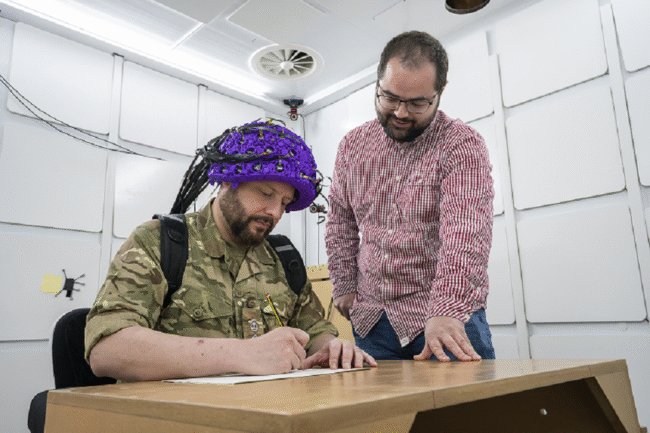
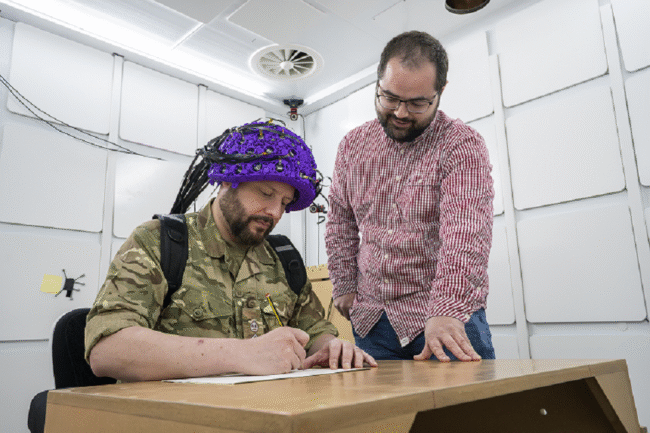
The United Kingdom’s Ministry of Defence has allocated £3.1 million toward the development of the world’s first fully mobile quantum-powered brain scanner, intended to monitor and assess the neurological effects of blast exposure in real time on military personnel. The breakthrough system, based on magnetoencephalography (MEG) technology enhanced by quantum sensors, will be capable of being deployed directly to military firing ranges, field hospitals, and rehabilitation centres—a move expected to reshape battlefield medicine and troop protection protocols.
Built by University of Nottingham spin-out Cerca Magnetics, the mobile MEG system leverages quantum precision to non-invasively measure the brain’s magnetic activity immediately after blast exposure. This real-time analysis is expected to fill a long-standing gap in military neuroscience: understanding how repeated low-level blast exposure affects brain function over time and identifying risk thresholds that conventional brain imaging technologies have failed to detect.
Why blast exposure monitoring has remained a blind spot in defence medical science
For decades, defence health systems have grappled with the challenge of detecting and quantifying mild but cumulative brain injuries sustained during weapons training and combat scenarios. While catastrophic injuries are typically diagnosed with standard tools such as CT or MRI scans, subtle disruptions to brain function—often resulting from low-level repeated shockwaves—frequently go undetected. These disturbances may disappear within 24 to 48 hours, eluding conventional scanners and leaving no permanent visible trace.
Experts in military neurology, including Lieutenant Colonel James Mitchell, Consultant Neurologist and Chief Investigator for the UK Military Blast Study at the Defence Medical Services, believe this mobile MEG scanner will enable researchers to build a time-stamped, precise account of what happens to the brain in the critical minutes and hours after a blast. He noted that the technology will be essential for tracking recovery and understanding the long-term neurological risks posed by repeated blast exposures during military careers.
The scanner’s ability to rapidly assess personnel in operational environments also allows for more informed decisions regarding return-to-duty protocols. This is crucial for mitigating long-term cognitive risks, which, if left unchecked, could accumulate into chronic neurological conditions over time.
What makes this mobile MEG scanner different from conventional brain imaging?
Unlike traditional MEG systems, which are confined to shielded hospital or university environments due to their sensitivity and size, this next-generation mobile system is engineered around optically pumped magnetometers (OPMs). These compact, quantum-enabled sensors offer enhanced precision, significantly greater portability, and reduced shielding requirements. This makes it possible to operate the scanner in rugged environments such as outdoor military ranges or on-site at field medical units.
Professor Matthew Brookes, Chair of Cerca Magnetics and a professor of physics at the University of Nottingham, has led OPM-MEG technology development for over a decade. He described the system as a major step in decentralizing advanced brain imaging. He added that the mobile unit could revolutionize diagnostics in both military and civilian settings, including sports injury clinics and community hospitals.
Professor Karen Mullinger, co-lead of the research programme from the Universities of Nottingham and Birmingham, explained that OPM-MEG’s ability to capture subtle electrical signals in the brain makes it uniquely suited to measure acute effects of blast exposure. She emphasized that this level of sensitivity allows researchers to identify the physiological impact of specific weapon types, making it possible to map brain activity changes across various exposure levels.
What are the expected outcomes for military personnel and defence policy?
The primary outcome of the project will be evidence-based decision-making protocols for evaluating the impact of blast exposure on soldiers. The data will inform exposure limits, risk profiles based on weapon type, and provide a scientific basis for developing safety policies. By tracking brain function over time and across a range of combat scenarios, the system will help the Defence Medical Services identify which personnel are most at risk of long-term neurological complications.
In practice, this could mean a more precise and equitable system for determining medical discharge eligibility, access to early interventions, or deployment readiness based on objective neurological assessments rather than subjective symptoms. Over time, this evidence could also influence how training programs are structured, reducing exposure to high-risk weapons without compromising combat readiness.
The mobile MEG scanner is expected to be operational by 31 March 2026. The system’s rollout will include integration with military rehabilitation centres and direct deployment to training zones, where it will be tested across multiple environmental conditions and personnel demographics.
How quantum defence research is creating spillover benefits for civilian healthcare
While the immediate beneficiaries of the mobile scanner are military personnel, the implications extend into broader health domains. Louise Sandher-Jones MP, Minister for Veterans and People, highlighted that quantum brain imaging could eventually help patients dealing with epilepsy, early-stage dementia, and concussion—conditions that are often difficult to diagnose without access to sophisticated imaging.
She noted that the scanner represents not just a breakthrough in military innovation but a reaffirmation of the UK government’s long-term commitment to those who serve. It also reflects the growing importance of translational defence R&D in addressing dual-use challenges, where technologies developed for national security contribute to societal well-being.
The system’s development is being supported under the UK National Quantum Technologies Programme, an initiative jointly backed by the Department for Science, Innovation and Technology (DSIT) and the Ministry of Defence. Industrial partners include Magnetic Shields Limited in the UK and QuSpin in the United States, both of which are contributing key components for the quantum sensor arrays and shielding infrastructure.
Why this scanner could influence brain health strategies far beyond the military
The potential of the mobile MEG system to become a game-changer in fields like sports medicine and public health is already generating interest from non-defence sectors. From diagnosing sport-related concussion in real time at stadiums to enabling early neurological assessments in underserved or remote regions, the portability and sensitivity of OPM-MEG make it an attractive solution for global brain health monitoring.
The scanner could also serve as a platform for future quantum health applications, including real-time tracking of neurodegenerative progression or early seizure prediction in epilepsy. For healthcare systems under pressure to deliver diagnostics with fewer resources, a mobile neuroimaging solution offers a compelling mix of cost-efficiency, flexibility, and diagnostic precision.
If successful, the UK’s investment in this project may trigger wider international interest in deploying mobile brain imaging in disaster zones, military deployments abroad, and humanitarian crises where cognitive injuries are frequent but underreported.
What are the key takeaways from the UK’s mobile quantum brain scanner project?
- The United Kingdom’s Ministry of Defence has invested £3.1 million to build the world’s first mobile magnetoencephalography brain scanner capable of measuring neurological effects of blast exposure in real time.
- The system is being developed by Cerca Magnetics in partnership with research teams from the University of Nottingham and the University of Birmingham as part of the UK Military Blast Study.
- The mobile MEG scanner uses quantum-enabled OPM-MEG technology that can operate outside traditional laboratories, allowing deployment to firing ranges, field hospitals, and rehabilitation facilities.
- The technology is designed to track subtle, short-lived brain function changes within minutes of blast exposure, addressing a long-standing gap in defence neuroscience where conventional scanners cannot capture fleeting effects.
- Researchers expect the system to generate evidence-based guidelines on safe exposure limits, return-to-duty decisions, and long-term neurological risk management for service personnel.
- The initiative is part of the National Quantum Technologies Programme supported by the Department for Science, Innovation and Technology and the Ministry of Defence.
- Scientific leaders, including Professor Matthew Brookes and Professor Karen Mullinger, believe the technology could also transform concussion research, dementia diagnostics, and epilepsy monitoring beyond military settings.
- The system is expected to be operational by 31 March 2026, with real-world testing planned across military training and medical environments.
Discover more from Business-News-Today.com
Subscribe to get the latest posts sent to your email.
