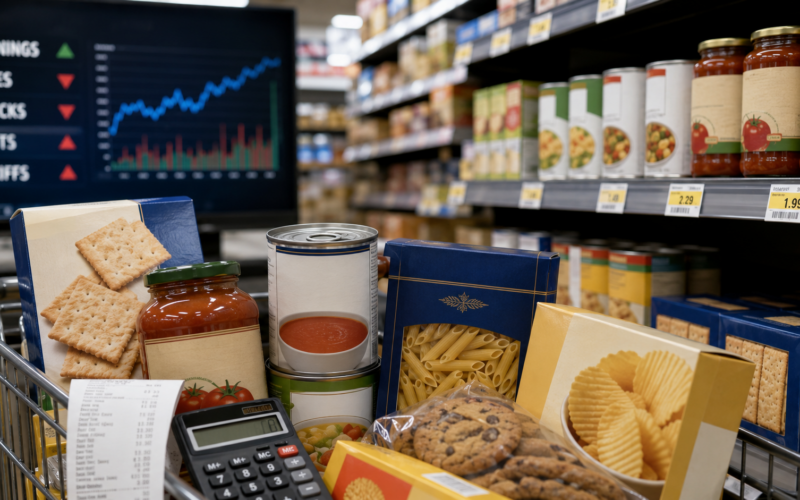
The Campbell’s Company (NASDAQ: CPB), the 155-year-old packaged-food maker behind Campbell’s soup, Goldfish, Rao’s, and Pepperidge Farm, reported third-quarter fiscal 2026 results on June 8 that narrowly beat expectations and nudged the stock up about 2.6 percent in pre-market trading to roughly $22.25. Adjusted earnings of $0.50 per share edged the $0.49 consensus, and revenue of $2.4 billion topped estimates by about $20 million even as it fell 3.2 percent year over year, while the company reaffirmed full-year adjusted earnings guidance of $2.15 to $2.25 against a $2.17 consensus. Beneath the modest beat, the quarter exposed deepening pressure, with snacks operating earnings down 32 percent, United States soup sales down 8 percent, and management warning that inflation could reach 5 to 6 percent next fiscal year if oil prices stay near $100 a barrel. The defensive appeal of a dividend-paying staple kept the reaction positive, but analysts at multiple banks cut their price targets after the report. The result matters because Campbell’s sits at the intersection of resilient at-home eating trends and a snacking business in real trouble, and this quarter showed both forces pulling at once.
Why did Campbell’s stock rise modestly on a quarter that showed sales and profits falling sharply?
The gain reflects relief that results were not worse, set against low expectations. Campbell’s beat both the earnings and revenue consensus, however narrowly, and crucially reaffirmed its full-year guidance, which reassured investors worried that deteriorating trends might force a cut. For a defensive stock, clearing a low bar and holding the outlook is often enough to spark a small bounce.
The competitive context is that the underlying numbers were genuinely soft. Adjusted earnings fell roughly 34 percent year over year, organic net sales declined on a 5 percent volume headwind, and operating earnings dropped 16 percent on tariff and inflation pressure, so the beat was relative to a reduced estimate rather than evidence of health. The market rewarded stability, not strength.
The second-order signal is the divergence between the stock’s reaction and analyst sentiment. Even as shares rose, banks including Bank of America and Barclays cut their price targets to $18 and $19 respectively, maintaining bearish ratings, which tells investors the professional community sees continued pressure ahead. A modest pop alongside target cuts reflects a market treating Campbell’s as a steady but challenged holding.
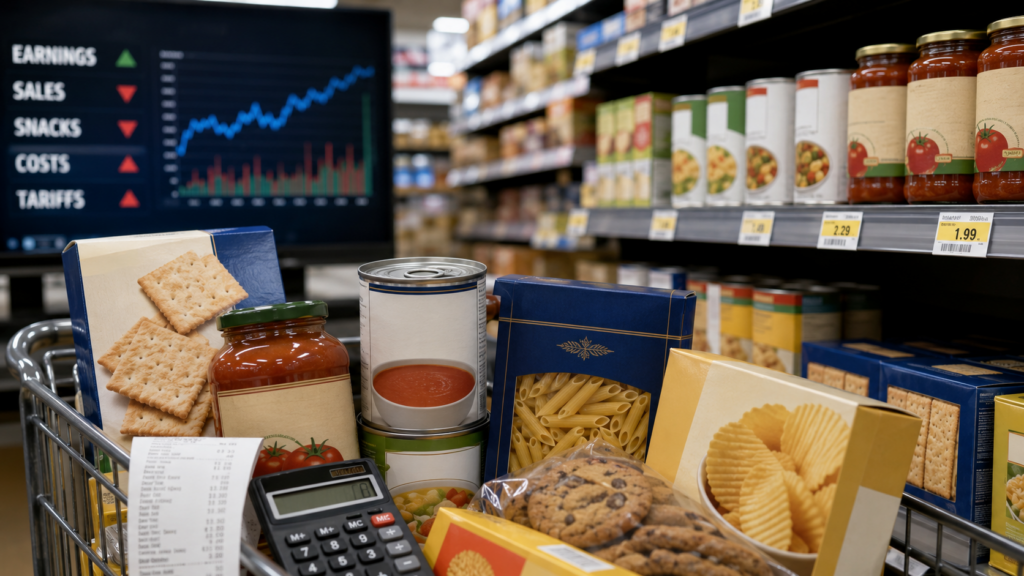
What does the 32 percent drop in snacks operating earnings reveal about Campbell’s biggest problem?
The snacks segment is the clearest weakness in the portfolio. Snacks sales fell 4 percent to $940 million while segment operating earnings collapsed 32 percent to $95 million, a far steeper profit decline than revenue, which signals deleverage as lower volumes spread fixed manufacturing and overhead costs across fewer units. Management acknowledged ongoing pressure on salty snacks specifically.
The strategic implication is that Campbell’s snacking turnaround will be slow. Executives described a multi-step response centered on SKU rationalization, simplification, and targeted innovation around brands like Goldfish, but they cautioned that these measures will take time to show results, and that near-term snacks pressure will persist. Fixing a portfolio of underperforming brands is a multi-quarter project, not a quick reset.
The risk is that snacks weakness is structural rather than cyclical. Consumers trading down, increased competition, and shifting snacking preferences are pressuring the category broadly, and if the declines reflect lasting changes in demand rather than a temporary dip, Campbell’s faces a prolonged drag on its higher-margin growth engine. The segment was supposed to be the company’s growth complement to mature soup, and right now it is the bigger problem.
How are tariffs and a potential 5 to 6 percent inflation rate threatening Campbell’s fiscal 2027 margins?
Cost inflation is the overhang management flagged most explicitly. Campbell’s warned that fiscal 2027 inflation could reach 5 to 6 percent, comprising roughly 3 percent base inflation plus an incremental 2 to 3 percent tied to elevated oil prices and supply-chain disruption, a meaningful step-up that would pressure margins across the portfolio. Tariffs and supply-chain costs already weighed on third-quarter gross profit.
The competitive implication is that Campbell’s pricing power is limited in a value-conscious environment. The company is leaning on trade investment and promotions to defend volume, which constrains its ability to fully pass through rising costs, and it is responding with $100 million in planned overhead reductions, disciplined capital spending, and aggressive working-capital management. Self-help is the lever when pricing cannot do the work.
The risk is that the inflation scenario materializes while demand stays soft. If oil remains near $100 and geopolitical disruption persists, the cost pressure compounds at exactly the time consumers are resisting price increases, squeezing margins from both directions. The 5 to 6 percent inflation warning is a conditional forecast, but it frames the central financial challenge facing the company next year.
Can Campbell’s Meals and Beverages resilience and Rao’s growth offset persistent snacks weakness?
The Meals and Beverages segment is the portfolio’s anchor of stability. Management highlighted resilient at-home cooking trends benefiting cooking soups, Rao’s, and Pacific, and expressed confidence in continued growth there, positioning the segment as the reliable counterweight to snacks. The premium Rao’s brand in particular has been a consistent growth driver aligned with the cook-at-home consumer.
The competitive context is that even Meals and Beverages faced pressure this quarter, with segment sales down 4 percent and operating earnings down 16 percent, partly reflecting a tough comparison against an unusually strong prior-year soup quarter. United States soup fell 8 percent, though management noted that on a two-year basis soup consumption declined a more modest 1.3 percent, suggesting the steep drop was largely a lapping effect rather than a collapse in demand.
The risk is that even the resilient segment cannot fully offset snacks and cost pressures. Meals and Beverages provides ballast and benefits from durable cooking trends, but it is a mature, low-growth category, and leaning on it to carry the company limits the overall growth profile. The portfolio balance Campbell’s needs, a stable soup base plus a growing snacks business, is currently missing its second engine.
What should investors weigh on Campbell’s as a defensive staple with a high dividend and falling earnings?
For Campbell’s itself, the priorities are stabilizing snacks, executing cost reductions, and protecting margins against the looming inflation step-up while sustaining Meals and Beverages momentum. The company generated $839 million in operating cash flow over nine months, supporting its dividend and capital needs, which underpins the defensive thesis even as earnings decline.
For packaged-food peers, Campbell’s quarter reflects sector-wide challenges, namely cautious consumers, snacking softness, and intensifying input-cost inflation, that pressure the entire consumer-staples group. The read-through is that even defensive food companies are not immune to the margin squeeze from tariffs and oil-linked costs, and that volume-driven deleverage is a shared risk across the category.
For investors, Campbell’s is a classic defensive income trade-off. The stock offers a dividend, steady cash flow, and the relative stability of a staple at a modest valuation near a $6.5 billion market capitalization, which appeals to income-focused buyers, but falling earnings, a troubled snacks business, and the inflation overhang explain why analysts are cutting targets and maintaining bearish ratings. The prudent stance is to weigh the dependable cash generation and dividend against a multi-year turnaround in snacks and a margin outlook clouded by costs, recognizing that Campbell’s is a defensive holding rather than a growth story.
Key takeaways on what Campbell’s third quarter results mean for the company, packaged food peers, and income investors
- Campbell’s beat narrowly on earnings and revenue and reaffirmed guidance, lifting the stock modestly despite sharp year-over-year declines.
- Adjusted earnings fell about 34 percent and revenue dropped 3.2 percent, so the beat was relative to lowered expectations.
- Snacks operating earnings collapsed 32 percent, the clearest sign of deleverage and the company’s biggest structural problem.
- Management warned of potential 5 to 6 percent inflation in fiscal 2027 if oil stays near $100, threatening margins across the portfolio.
- Campbell’s is responding with $100 million in overhead cuts, SKU rationalization, and disciplined capital spending to offset cost pressure.
- United States soup fell 8 percent, largely a lapping effect, with two-year soup consumption down a more modest 1.3 percent.
- Meals and Beverages provides stability through resilient at-home cooking trends and Rao’s, but is a mature, low-growth anchor.
- Analysts at Bank of America and Barclays cut price targets to $18 and $19 while keeping bearish ratings despite the stock’s rise.
- Strong nine-month operating cash flow of $839 million supports the dividend and underpins the defensive investment case.
- Campbell’s is a defensive income holding facing a multi-year snacks turnaround, not a growth story.
Discover more from Business-News-Today.com
Subscribe to get the latest posts sent to your email.