


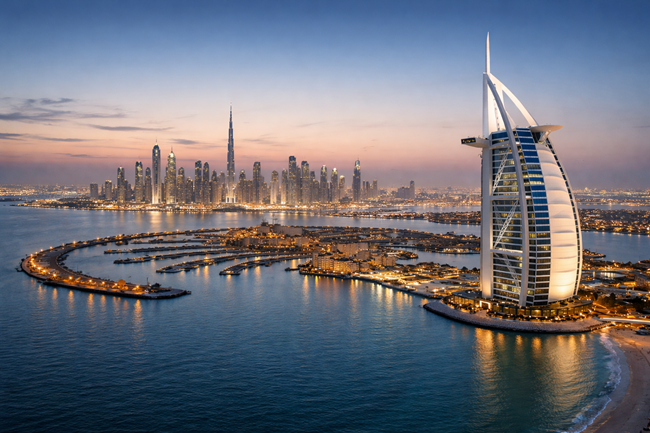
Dubai, the United Arab Emirates’ most populous city and the world’s leading international aviation and trade hub, came under sustained Iranian missile and drone attack on Saturday, February 28, 2026, and into Sunday, March 1, 2026, following a joint United States and Israeli military operation against Iran that began the same day. The strikes caused physical damage across multiple iconic locations in Dubai, including Dubai International Airport, the Palm Jumeirah residential and hospitality island, the Burj Al Arab hotel, and Jebel Ali Port, marking the first time Iranian weapons had directly struck civilian and commercial infrastructure inside Dubai.
The broader context for the attack was a joint United States and Israeli military operation against Iran designated Operation Epic Fury by the United States Department of Defense and Operation Roaring Lion by the Israeli Defence Forces. The operation killed Iranian Supreme Leader Ayatollah Ali Khamenei and struck multiple targets across Tehran, Isfahan, Qom, Karaj, and Kermanshah. Iran’s Supreme National Security Council confirmed that Iran’s armed forces had launched what it described as a crushing response, targeting United States military assets and Gulf Arab states hosting United States military installations. Dubai, as a commercial and financial hub with strong United States institutional and corporate presence, was among the targets of Iran’s retaliatory campaign.
How did Iranian missiles and drones damage Dubai International Airport and disrupt flight operations on February 28 and March 1, 2026?
Dubai International Airport, the world’s busiest international airport by passenger volume and the home base of Emirates airline, sustained confirmed physical damage after an Iranian attack struck one of its terminal concourses. Dubai Airports confirmed in a statement to CNN that a concourse sustained minor damage early on Sunday, March 1, 2026. Four airport staff sustained injuries and received prompt medical attention, Dubai Airports said. Most terminals had already been cleared of passengers as a precautionary measure when the airports were closed on Saturday, February 28, 2026.
Dramatic footage circulated on social media showing passengers evacuating through smoke-filled corridors at Dubai International Airport shortly after the incident. Eyewitnesses told CNN that ambulances rushed to the airport following the emergency. Dubai Airports confirmed the suspension of all flights from Dubai International Airport and from Dubai World Central, also known as Al Maktoum International Airport, until further notice. The Dubai Media Office advised passengers not to travel to the airport and to contact their respective airlines directly for updated information. The United States Embassy in Dubai and the United States Consulate in Dubai issued a shelter-in-place alert for all staff, urging all Americans in the United Arab Emirates to take cover.
The flight disruption figures were severe. According to FlightAware data, more than 90 percent of scheduled departures from Dubai International Airport were scrapped following the attacks. Dubai International Airport alone reported more than 700 inbound and outbound flight cancellations, according to flight tracking service FlightRadar24. Budget carrier flydubai announced the suspension of all its flights to and from Dubai until 15:00 UAE time on Sunday, March 1, 2026. Lufthansa, British Airways, Air India, and IndiGo also announced suspensions of flights to and from Dubai. Air India cancelled multiple international routes including services between Mumbai and London and between Bengaluru and several European cities, citing the evolving security situation.
Aviation consultancy BAA and Partners warned that if airspace disruptions persisted, airlines would face structurally higher operating costs, weaker aircraft utilisation, and profit margin pressure, particularly on long-haul networks reliant on Middle East transit corridors. The European Union Aviation Safety Agency issued a Conflict Zone Information Bulletin covering the Middle East and Gulf region, advising airlines against operating in the affected airspace and citing a high risk to civil aviation.
What damage did Iranian missile and drone strikes cause to Palm Jumeirah, the Burj Al Arab, and residential areas of Dubai?
In Dubai’s Palm Jumeirah area, the man-made island that serves as one of the city’s most prominent luxury hospitality and residential destinations, multiple explosions were reported throughout Saturday. The Dubai Media Office confirmed that an incident occurred in a building in the Palm Jumeirah area, resulting in a fire and four people injured. The Fairmont The Palm hotel sustained fire damage after being struck by parts of a missile that was either intercepted by UAE air defence systems or knocked off trajectory. Eyewitnesses confirmed to AFP that they heard an explosion and saw a plume of smoke rising from the Palm Jumeirah area. Witnesses across Dubai reported flames, smoke plumes, and windows shaking in multiple parts of the city.
Iranian Shahed drone debris caused a fire on one of the floors of the Burj Al Arab hotel, one of Dubai’s most internationally recognised landmarks. The fire was subsequently brought under control. Residential areas in Dubai Marina and surrounding neighbourhoods were also reported to have been struck by missiles and drone debris, causing further fires and injuries. Reports circulated of an explosion and smoke visible near the Burj Khalifa, the world’s tallest building, though Dubai authorities did not formally confirm the precise cause or origin of those explosions.
How did Iranian strikes affect Jebel Ali Port and what are the implications for Dubai’s trade and logistics operations?
A fire broke out at Jebel Ali Port on Sunday, March 1, 2026, after the facility was struck by debris from Iranian weapons. Jebel Ali Port is one of the busiest ports in the United Arab Emirates and the largest man-made harbour in the world by area, serving as the primary logistics and transhipment gateway for Dubai and the wider Gulf region. The port handles a substantial proportion of the United Arab Emirates’ import and export cargo volumes and operates as a critical node in global supply chains connecting Asia, Europe, and Africa. The full extent of damage to port infrastructure and the impact on cargo operations was not immediately confirmed by official sources.
What emergency measures did Dubai and UAE authorities implement for residents, schools, and businesses following the Iranian strikes?
The United Arab Emirates Ministry of Interior stated it was operating at its highest level of readiness and coordinating with all relevant authorities. The UAE government sent emergency alerts to residents across Dubai and Abu Dhabi advising them to remain indoors and await further official instructions. Abu Dhabi residents received separate emergency alerts instructing them to seek immediate shelter away from windows, doors, and open areas. Management in multiple Dubai residential buildings advised residents to take shelter in basements. Fitness centres across the city messaged clients to announce temporary closures.
The United Arab Emirates Ministry of Education and Ministry of Higher Education and Scientific Research announced that all public and private schools and universities nationwide would shift to distance learning from Monday, March 2, 2026, through Wednesday, March 4, 2026. Multiple corporate offices operating in Dubai advised employees to work remotely. The Burj Khalifa area was reported to have been evacuated as a precautionary measure. The BAPS Hindu Mandir in Abu Dhabi was closed following the Iranian strikes.
The Dubai government publicly warned against the circulation of unverified information, stating that old clips and images of previous fires in Dubai were being shared on social media. The Dubai Media Office urged the public and media to exercise caution and to source information solely from official channels, noting the direct impact on community security and stability.
How did the United Arab Emirates air defence systems respond to the Iranian missile and drone barrage targeting Dubai and Abu Dhabi?
The United Arab Emirates Ministry of Defence confirmed that UAE air defence systems intercepted multiple successive waves of Iranian ballistic missiles and drones throughout Saturday and into Sunday. The Ministry subsequently stated that UAE air defences in total destroyed 132 Iranian missiles and intercepted 195 Iranian drones during the barrage. Despite the scale of the interceptions, missile debris and drone fragments fell across multiple districts of both Dubai and Abu Dhabi, causing the physical damage and casualties confirmed by official sources. Shrapnel from intercepted missiles fell on residential areas of Abu Dhabi, killing one person identified as a Pakistani national. CNN staff on the ground in Dubai reported hearing blasts between calls to prayer from mosques in the city, including during Iftar, as the attacks took place during the Islamic holy month of Ramadan.
The UAE Foreign Ministry condemned Iran’s missile attacks as a violation of UAE sovereignty and reiterated the United Arab Emirates’ full and legitimate right to respond to the attacks, while also calling for restraint and a recourse to diplomatic solutions.
What does Iran’s targeting of Dubai mean for the emirate’s standing as a safe commercial and tourism hub in the Middle East?
Dubai has for decades maintained a carefully cultivated identity as a stable, secure, and commercially neutral city insulated from the conflicts that have periodically destabilised neighbouring states and regions. The city attracted 127.7 million combined passengers through Dubai International Airport and Abu Dhabi International Airport in the prior year alone, and has established itself as a leading hub for international finance, tourism, logistics, real estate, and technology. Iranian missiles and drones striking Dubai International Airport, Palm Jumeirah, the Burj Al Arab, and Jebel Ali Port represent an unprecedented direct challenge to that identity.
Dubai has historically maintained a degree of economic and diplomatic distance from regional conflicts, including serving as a significant trading partner with Iran despite international sanctions frameworks. The United Arab Emirates also signed Abraham Accords normalisation agreements with Israel in 2020. Iran’s decision to target Dubai directly with ballistic missiles and Shahed drones on February 28, 2026, represents a fundamental departure from the implicit understanding that Gulf commercial hubs would remain outside the direct line of regional military confrontation.
What do Iran’s strikes on Dubai International Airport, Palm Jumeirah, the Burj Al Arab, and Jebel Ali Port mean for Dubai’s economy, aviation sector, and regional security standing?
- Dubai International Airport, the world’s busiest international airport by passenger volume and home base of Emirates airline, sustained confirmed terminal damage and had more than 90 percent of scheduled departures cancelled; all flights from Dubai International Airport and Al Maktoum International Airport were suspended until further notice.
- Iranian ballistic missiles and Shahed drones caused fires and damage at the Palm Jumeirah area including the Fairmont The Palm hotel, the Burj Al Arab hotel, and Jebel Ali Port, with four people injured in the Palm Jumeirah incident and one person killed in Abu Dhabi from missile interception debris.
- The United Arab Emirates Ministry of Defence intercepted a total of 132 Iranian missiles and 195 drones, but falling debris and direct strikes caused confirmed damage across multiple Dubai landmarks and commercial infrastructure during the February 28 to March 1, 2026, barrage.
- Dubai’s Ministry of Education ordered all schools and universities to shift to distance learning from March 2 through March 4, 2026, while residents across Dubai received government emergency alerts advising them to remain indoors.
- The strikes represent the first direct Iranian targeting of Dubai’s civilian and commercial infrastructure, challenging the emirate’s long-established identity as a secure and neutral commercial hub in the Middle East.
Discover more from Business-News-Today.com
Subscribe to get the latest posts sent to your email.