




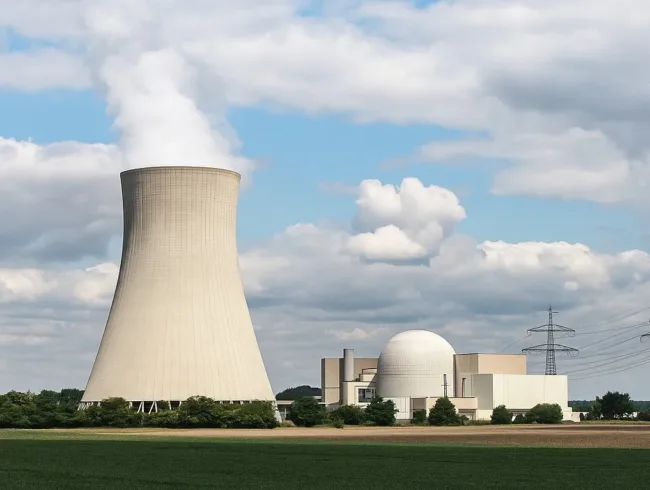
Brookfield Corporation (NYSE: BN, TSX: BN) and Brookfield Asset Management Ltd. (NYSE: BAM, TSX: BAM), alongside The Nuclear Company, have announced a partnership to form a new nuclear project development company focused on Westinghouse reactor technology in the United States. The proposed business is expected to support deployment of Westinghouse AP1000 and AP300 reactors, while also providing project management, licensing support, procurement oversight and construction execution capabilities. The announcement is strategically important because Brookfield has selected the new company as project manager for the potential restart of V.C. Summer Nuclear Units 2 and 3 in Fairfield County, South Carolina. The move places Brookfield at the center of one of the most closely watched nuclear restart opportunities in the United States at a time when power demand from data centers, electrification and industrial reshoring is reshaping energy infrastructure planning.
Why is Brookfield forming a nuclear project execution company with The Nuclear Company now?
Brookfield’s partnership with The Nuclear Company is less about announcing another nuclear ambition and more about trying to solve the least glamorous problem in the sector: execution. The United States has no shortage of nuclear policy enthusiasm, utility interest or technology roadmaps. What it has lacked is a repeatable project delivery model that can persuade investors, regulators and power buyers that new nuclear construction will not become a decades-long cost spiral.
That explains why the new company is being structured around Westinghouse reactor technology rather than around an open-ended portfolio of nuclear designs. By focusing on AP1000 and AP300 reactor deployment, Brookfield and The Nuclear Company are narrowing the construction and licensing universe. For investors, that matters because nuclear risk is rarely driven by a single variable. It comes from the interaction of regulatory review, engineering changes, supply chain gaps, labor availability, customer contracting, political oversight and financing structure.
The Nuclear Company brings field-level credibility through personnel associated with complex nuclear and energy projects, including experience tied to Vogtle Units 3 and 4. Brookfield brings capital access, infrastructure project discipline and ownership exposure to Westinghouse through its broader nuclear ecosystem. That pairing gives the new company a logical narrative, but not an automatic pass. The real test will be whether the platform can turn lessons from Vogtle and prior stalled projects into a build model that shortens schedules, reduces redesign risk and keeps counterparties aligned through construction.
How does the V.C. Summer nuclear project change the stakes for Brookfield’s U.S. energy strategy?
V.C. Summer is not just another nuclear site. It is one of the most politically and financially sensitive abandoned energy projects in the United States. Work on Units 2 and 3 was halted in 2017 after billions had already been spent, and the collapse became a warning label for nuclear construction risk. That history makes the project unusually attractive and unusually dangerous at the same time.
The attraction is obvious. Two partially constructed AP1000 units near Jenkinsville, South Carolina, give Brookfield and its partners a restart opportunity that may be more advanced than a greenfield nuclear build. Existing site work, prior licensing history, equipment availability and local institutional familiarity could reduce some development friction. Santee Cooper’s support for the new company’s role also matters because state-owned utility alignment can be critical in a project that will need regulatory, commercial and political confidence before final investment decision.
The danger is equally clear. A partially built nuclear asset is not automatically a cheaper nuclear asset. Equipment condition, design updates, licensing requirements, labor mobilization, inflation in construction materials, public trust and cost allocation will all have to be revalidated. The phrase “execution-ready” sounds encouraging, but in nuclear development, execution-ready still means years of diligence before hard capital commitments become comfortable. Brookfield’s challenge is to convince stakeholders that V.C. Summer is not a rerun of the old story, but a structurally different project with new ownership logic, improved delivery discipline and stronger end-market demand.
Why does Westinghouse reactor technology sit at the center of Brookfield’s nuclear expansion plan?
The decision to focus the new company exclusively on Westinghouse technology is strategically revealing. Brookfield is not positioning the venture as a general-purpose nuclear developer shopping across competing reactor designs. It is building an execution vehicle around a specific technology family, which could create standardization benefits if multiple projects move forward.
The AP1000 has a complicated reputation. On one hand, it remains one of the most important large reactor designs in the Western nuclear market, and Vogtle Units 3 and 4 have now demonstrated that AP1000 units can be completed and brought online in the United States. On the other hand, the same design is associated with high-profile cost overruns and schedule delays, which means any future AP1000 deployment will be judged against a demanding credibility bar.
The AP300 adds another dimension to the strategy. A smaller Westinghouse reactor could appeal to customers that need firm clean power but cannot absorb the scale, financing burden or grid integration complexity of a large reactor. However, smaller nuclear designs also carry commercialization risk because the market must still prove that modularity, repeatability and factory-style learning can offset first-of-a-kind costs. Brookfield’s bet is that a dedicated delivery company can bridge the gap between nuclear technology ownership and project execution. That is sensible in theory. The industry will care about whether it works in procurement schedules, construction sequencing and balance-sheet outcomes.
What does the Brookfield and The Nuclear Company venture signal about U.S. nuclear power demand?
The announcement lands at a moment when nuclear power is being pulled back into the center of U.S. energy strategy by three forces: data center electricity demand, industrial decarbonization and grid reliability concerns. Hyperscale artificial intelligence infrastructure has made 24-hour clean power more valuable, while utilities face growing pressure to add firm capacity without deepening emissions exposure. That is the demand-side reason nuclear has moved from policy nostalgia to infrastructure priority.
Brookfield’s nuclear push also reflects a wider market shift in which capital providers are becoming more interested in energy assets that can support long-duration demand certainty. Nuclear projects remain difficult to finance because of construction risk, but the customer universe has changed. Large technology companies, industrial buyers and utilities are increasingly willing to consider long-term offtake structures if the power is reliable, clean and scalable. That does not eliminate nuclear’s cost problem, but it may improve bankability if contracts are strong enough.
The second-order implication is that nuclear development may increasingly resemble infrastructure platform building rather than one-off utility procurement. Brookfield’s model suggests that future reactor deployment could depend on integrated ecosystems combining capital, technology ownership, project management, policy support and customer contracting. In plain English, nuclear is becoming too complicated to be left to fragmented delivery chains. That may be good news for large infrastructure investors, but it also raises the stakes for governance and accountability.
How should investors read Brookfield Corporation and Brookfield Asset Management stock sentiment after the nuclear announcement?
Brookfield Corporation shares were trading at about $45.23 on May 4, 2026, close to flat on the session, with a 52-week range cited by market data providers around $35.95 to $49.57. Brookfield Asset Management shares were trading at about $48.11, also modestly positive on the day, with a 52-week range around $42.20 to $64.10. The limited near-term price reaction suggests investors are treating the nuclear venture as strategically interesting but not yet financially decisive.
That is probably the right interpretation. Brookfield’s nuclear platform has long-term optionality, but the announcement does not yet create a bankable earnings stream. Definitive documentation is still expected in the coming months, the V.C. Summer project remains subject to due diligence and regulatory approvals, and final investment decision has not been reached. For Brookfield Corporation, the upside case is that nuclear becomes another long-duration infrastructure vertical with large capital deployment potential. For Brookfield Asset Management, the more relevant question is whether nuclear can become a scalable fee-bearing investment strategy without exposing investors to unacceptable construction risk.
Market sentiment is therefore likely to remain cautious but attentive. Investors may reward Brookfield for positioning early in a potential nuclear capex cycle, especially if Westinghouse-linked opportunities gain federal and customer support. However, nuclear development can punish optimism quickly. Any sign of cost drift, licensing friction or unclear risk-sharing at V.C. Summer would likely matter more than the headline ambition. In this sector, PowerPoint momentum does not keep the lights on. Concrete, contracts and regulatory approvals do.
What execution risks could decide whether Brookfield’s nuclear platform succeeds or stalls?
The biggest risk is not whether demand for clean firm power exists. It does. The bigger risk is whether nuclear projects can be delivered at a cost and pace that makes sense against competing energy options, including renewables, storage, gas generation with carbon management and grid upgrades. Nuclear’s value proposition is strongest when reliability, land density and emissions constraints dominate. It weakens when construction schedules stretch and interest costs compound.
V.C. Summer also carries reputational risk. Because the prior project collapse was so visible, Brookfield and The Nuclear Company will be operating under a microscope. Local communities, regulators, ratepayers, policymakers and power customers will want evidence that the restart structure protects public interests and allocates risk transparently. That means governance may matter almost as much as engineering.
There is also a supply chain question. Even with Westinghouse technology, the United States must rebuild nuclear construction depth across specialized components, skilled labor, quality assurance systems and regulatory documentation. If multiple AP1000 or AP300 opportunities emerge at once, the bottleneck may not be capital. It may be qualified people and certified suppliers. Brookfield’s platform approach can help coordinate that ecosystem, but it cannot magically recreate industrial capacity overnight.
What happens next if Brookfield’s V.C. Summer nuclear strategy gains traction?
The next meaningful milestones are definitive partnership documentation, deeper diligence at V.C. Summer, regulatory pathway clarity, offtake visibility and the economics of final investment decision. Each step will either strengthen or weaken the case that the project is truly restartable rather than merely strategically tempting. Investors should watch whether Brookfield can define who bears construction risk, who buys the power, how much of the existing asset base can be reused and how licensing issues are handled.
If Brookfield succeeds, V.C. Summer could become a template for reviving stranded or stalled nuclear assets in an era of rising power demand. It would also strengthen the case for Westinghouse as a central technology supplier in the U.S. nuclear buildout and could give Brookfield a differentiated role in clean energy infrastructure beyond renewables and transmission. That would be a meaningful strategic expansion, particularly if data center customers become long-term nuclear power buyers.
If the project stalls, the setback would reinforce investor skepticism about large nuclear construction in the United States. The industry has no shortage of ambition, but capital markets want evidence that the next generation of projects is structurally different from the last one. Brookfield’s new venture with The Nuclear Company is therefore more than a project management appointment. It is a live test of whether nuclear power can move from policy enthusiasm to repeatable infrastructure execution.
Key takeaways on Brookfield’s nuclear venture, V.C. Summer and the future of U.S. reactor development
- Brookfield’s partnership with The Nuclear Company is designed to address nuclear power’s core bottleneck, which is project execution rather than technology ambition.
- The focus on Westinghouse AP1000 and AP300 reactors suggests Brookfield wants standardization, repeatability and a tighter construction learning curve.
- V.C. Summer gives the venture a high-profile test case, but the site’s troubled history raises the credibility bar for cost control and governance.
- Santee Cooper’s support improves the project’s institutional footing, although final investment decision remains subject to due diligence, approvals and definitive agreements.
- Brookfield Corporation and Brookfield Asset Management shares showed limited immediate movement, suggesting investors see long-term optionality rather than near-term earnings impact.
- The nuclear revival is being driven by firm power demand from data centers, electrification and industrial growth, not just climate policy.
- The biggest risks remain licensing friction, equipment validation, supply chain capacity, labor availability and risk-sharing between public and private stakeholders.
- A successful V.C. Summer restart could make Brookfield a central infrastructure player in the next U.S. nuclear buildout cycle.
- A failed restart would deepen skepticism that large nuclear projects can be delivered competitively in the United States.
- The announcement is strategically important because it turns nuclear resurgence from a policy narrative into an execution challenge with named companies, assets and accountability.
Discover more from Business-News-Today.com
Subscribe to get the latest posts sent to your email.