




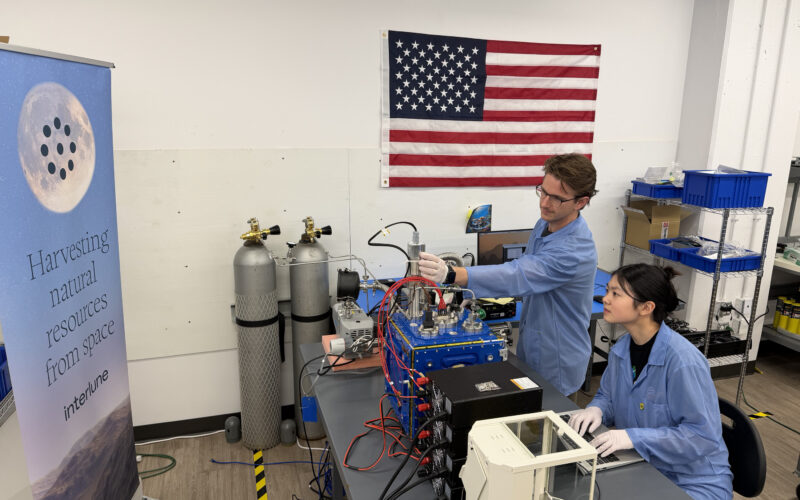
Interlune has secured a $6.9 million firm-fixed-price NASA Small Business Innovation Research Phase III contract to develop a lunar payload suite that can measure volatile gases released from heated lunar regolith. The Seattle-based space resources company said the 18-month project, backed by NASA’s Space Technology Mission Directorate Game Changing Development program, is intended to support technology development for extracting resources such as helium-3 and hydrogen from lunar soil. The payload is being designed for potential launch in 2028 on a commercial robotic lander developed under NASA’s Commercial Lunar Payload Services program. The award matters because it shifts Interlune’s lunar resource strategy from prototype validation toward flight hardware, while giving NASA a data pathway for assessing whether lunar resource extraction can support a sustainable Moon presence.
Why does Interlune’s NASA contract matter for the emerging lunar resource economy?
Interlune’s NASA contract is modest in dollar terms, but strategically significant because lunar resource development is still constrained less by demand narratives and more by basic measurement risk. Before a company can credibly claim that helium-3, hydrogen, or other volatiles can be extracted at commercial scale, it must show how much material exists in accessible regolith, how much power is required to release it, and whether robotic systems can process lunar soil under actual Moon conditions. That is precisely where this payload sits in the value chain.
The company’s planned system is intended to collect regolith, sort particles by size, extract solar wind gases through mechanical and thermal processes, and measure released gases using a mass spectrometer based on NASA’s Mass Spectrometer Observing Lunar Operations architecture. Interlune also plans to use a multispectral camera to estimate helium-3 concentrations, a capability that could become important if future lunar mining depends on identifying richer deposits before large processing systems are deployed.
The larger commercial question is whether lunar resource extraction can move beyond exploration economics. NASA’s involvement gives Interlune technical validation, but not automatic commercial success. The hard part is not simply detecting helium-3. It is building an operational chain that includes excavation, processing, storage, lunar surface logistics, launch support, and return transport to Earth. In other words, the glamorous part is Moon mining. The expensive part is everything around it.

How could helium-3 demand from quantum computing change the investment case for Moon mining?
Helium-3 has attracted interest because it is scarce on Earth and useful in several high-value applications, including quantum computing cooling systems, national security detection technologies, medical imaging, and potential fusion research. Interlune has said it has nearly $500 million in binding purchase orders for helium-3, including from the U.S. Department of Energy and quantum computing companies. Publicly disclosed agreements include a U.S. Department of Energy Isotope Program purchase for three liters of lunar-sourced helium-3 and a Maybell Quantum agreement for thousands of liters annually from 2029 to 2035.
That demand signal is important because most space resource concepts fail at the first commercial question: who pays, and why now? Helium-3 has a more plausible early market than many other lunar resources because it targets customers on Earth rather than depending entirely on a mature in-space economy. Quantum computing companies need dilution refrigeration systems that can operate near absolute zero, and helium-3 is part of that cooling infrastructure. If quantum computing scales materially, helium-3 supply constraints could become more than a niche laboratory issue.
However, this does not mean the business case is settled. The Washington Post reported in 2025 that Bluefors had entered a more than $300 million agreement with Interlune for lunar helium-3 supply, while also noting that technical and geological uncertainties remain significant. The same reporting highlighted that a U.S. Geological Survey assessment had previously classified lunar helium-3 as an inferred unrecoverable resource at that time, reflecting how early the field remains. The practical test is whether high market prices can offset the cost of extracting, processing, and returning a rare isotope from the Moon. That is a brutally demanding equation, even by space industry standards.
What does the NASA payload reveal about Interlune’s commercial strategy?
Interlune’s approach appears to be deliberately staged. The current NASA contract is not a full mining deployment. It is a measurement and technology demonstration step designed to reduce uncertainty around volatile concentrations, power requirements, regolith handling, and gas extraction. That makes sense because lunar resource economics will depend heavily on how much material must be processed to extract usable quantities of helium-3.
The payload’s design also suggests that Interlune is trying to create dual-use value for both government and commercial customers. NASA gains scientific data on lunar mineralogy, solar wind volatile concentrations, and technologies relevant to Artemis-era lunar infrastructure. Interlune gains operational data needed to refine a future harvesting system. This alignment matters because early lunar infrastructure companies will likely need government contracts, commercial purchase agreements, and strategic partnerships to survive the long gap between prototype and recurring revenue.
There is also a sequencing benefit. By using a payload that can fly on a commercial robotic lander, Interlune can avoid immediately carrying the full burden of lander development. That allows the company to focus on extraction hardware, instrumentation, and resource assessment. For an early-stage lunar resources company, outsourcing parts of the transportation stack is not just efficient. It is existentially sensible.
Could Interlune’s project support NASA’s Artemis ambitions beyond helium-3?
Although helium-3 is the headline commercial prize, NASA’s interest is broader. Long-term lunar presence requires technologies that can handle regolith, extract useful materials, support construction, manage thermal systems, and eventually reduce dependence on Earth-launched supplies. Interlune’s payload is therefore relevant not only to selling helium-3 on Earth, but also to the wider architecture of in-situ resource utilization.
The inclusion of hydrogen in the resource development effort is particularly important. Hydrogen and other volatiles could support future lunar operations if they can be accessed and processed efficiently. Even if helium-3 commercialization takes longer than investors hope, regolith handling, particle sorting, gas measurement, and thermal extraction capabilities could still have value in lunar construction, science missions, and surface infrastructure.
This is where NASA’s Game Changing Development program fits the picture. The program is designed to advance technologies that can support future exploration missions, and Interlune’s payload is being framed as a way to collect data that informs both science and resource extraction. For NASA, that reduces reliance on speculative claims. For Interlune, it creates a pathway to demonstrate technical credibility before attempting larger-scale commercial harvesting.
What are the biggest execution risks in Interlune’s lunar helium-3 roadmap?
The most immediate risk is technical validation. Measuring gases released from heated regolith on the Moon would be a significant step, but measurement does not equal commercial extraction. The company must still prove that it can process enough regolith at sufficient scale, reliability, and energy efficiency to make helium-3 recovery commercially viable.
The second risk is infrastructure dependency. Interlune’s strategy depends on commercial landers, surface operations, potentially return systems, and a broader lunar logistics ecosystem that is still developing. If lander availability slips, return transport costs remain high, or lunar surface operations prove more fragile than expected, the commercial timeline could stretch. In space business, timelines do not slip politely. They tend to bring invoices.
The third risk is market timing. Helium-3 demand from quantum computing looks strategically attractive, but the scale and timing of quantum computing deployment remain uncertain. If quantum hardware adoption accelerates, helium-3 scarcity could strengthen Interlune’s case. If commercialization is slower, the company may need to rely longer on government contracts and strategic customers rather than broad industrial demand.
Regulation is another unresolved layer. Lunar resource extraction sits inside a complicated policy environment involving national space law, international norms, commercial property rights, and responsible use of extraterrestrial resources. The United States has encouraged commercial space resource activity, but global consensus remains incomplete. For companies such as Interlune, technical execution may be only one half of the story. Policy legitimacy will matter too.
Why does this NASA award signal a broader shift in commercial space infrastructure?
The Interlune award reflects a wider shift in space commercialization. The early commercial space economy was dominated by launch, satellites, communications, and Earth observation. The next phase is moving toward infrastructure: lunar landers, surface mobility, resource assessment, power systems, construction tools, and return logistics. These markets are harder, slower, and more capital intensive, but they also define whether the Moon becomes a repeatable operating environment rather than an occasional destination.
Interlune is positioning itself inside that transition by treating lunar regolith as an industrial feedstock. That is a very different framing from classic exploration missions. The company is not only asking what the Moon can teach scientists. It is asking whether the Moon can supply scarce resources to Earth and support a permanent off-world economy.
The investment case remains high risk, but the strategic logic is becoming clearer. If space resources become commercially credible, the winners may not be only the companies that discover valuable deposits. They may be the companies that master boring but essential systems such as excavation, sorting, heating, gas measurement, storage, and logistics. In terrestrial mining, the shovel business can be as important as the ore body. On the Moon, that may be even truer.
Key takeaways on what Interlune’s NASA contract means for lunar mining, helium-3 supply, and space infrastructure
- Interlune’s $6.9 million NASA contract is small compared with conventional mining or aerospace budgets, but it is strategically important because it funds flight hardware and direct lunar measurement rather than only laboratory testing.
- The project could provide NASA and Interlune with critical data on how much energy is needed to release volatile gases from lunar regolith, a core variable in any future helium-3 harvesting model.
- Helium-3 demand from quantum computing gives Interlune a more credible early commercial market than many speculative Moon mining concepts, although demand timing remains uncertain.
- The company’s disclosed purchase agreements with the U.S. Department of Energy, Maybell Quantum, and other quantum-linked customers strengthen the demand signal but do not eliminate extraction and logistics risk.
- NASA’s involvement helps validate the technology pathway, but commercial success will depend on scalable regolith processing, lunar surface reliability, return logistics, and customer delivery execution.
- The payload’s use of a robotic arm, size sorting system, thermal extraction technologies, multispectral camera, and mass spectrometer shows that lunar mining is becoming an integrated systems problem rather than a single-machine challenge.
- The project supports Artemis-era priorities by advancing in-situ resource utilization technologies that could eventually assist lunar construction, site preparation, and surface infrastructure.
- Interlune’s strategy depends heavily on the parallel maturation of commercial lunar landers and return systems, making ecosystem timing one of the largest external risks.
- Regulatory and geopolitical questions around lunar resource extraction could become more important as commercial commitments move from prototypes to actual material recovery.
- The broader signal is that commercial space is moving beyond launch economics into resource infrastructure, where patient capital, government validation, and operational credibility will separate serious platforms from science-fiction pitch decks.
Discover more from Business-News-Today.com
Subscribe to get the latest posts sent to your email.

