




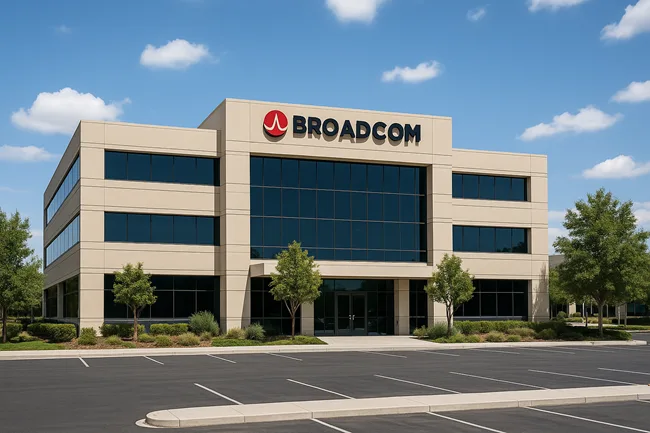
Broadcom Inc. (NASDAQ: AVGO) saw its stock edge up 1.23% to close at $306.10 on September 4, 2025, after the American semiconductor and software company reported stronger-than-expected results for the third quarter of fiscal year 2025. The momentum was driven by record AI accelerator revenues, steady growth in VMware integration, and robust guidance for the fourth quarter.
Investor optimism was further fueled by a significant beat on both GAAP and non-GAAP earnings, alongside a strong 22% year-on-year increase in consolidated revenue. Institutional sentiment appears broadly positive following Broadcom’s sustained execution in artificial intelligence (AI)-driven silicon, data infrastructure, and hybrid cloud software.
How much did Broadcom’s AI semiconductor revenue grow in Q3—and what’s the outlook for Q4?
Broadcom’s custom AI accelerator business emerged as the standout growth driver in the third quarter of fiscal 2025, underscoring how the American semiconductor and infrastructure software giant is capturing outsized demand in the artificial intelligence supply chain. President and CEO Hock Tan said that AI-related revenue surged 63% year-over-year to reach $5.2 billion, fueled by hyperscale cloud providers and enterprise customers scaling infrastructure for generative AI and large language model workloads. This figure represented nearly a third of total semiconductor sales and reflects a steep acceleration from earlier quarters when AI deployments were still in their early ramp phase.
Looking ahead, Broadcom has projected AI revenue to climb even further to $6.2 billion in the fourth quarter, which would mark the eleventh consecutive quarter of sequential growth in the segment. Such sustained momentum suggests that demand is far from peaking and instead points to a structural shift in enterprise IT spending priorities. Institutional investors have interpreted this guidance as a sign that AI hardware build-outs are transitioning from experimental pilots to scaled, recurring investment cycles—a critical inflection point for Broadcom’s long-term growth narrative.
This trajectory also underscores Broadcom’s competitive advantage in the AI infrastructure stack. Unlike traditional merchant silicon providers that sell off-the-shelf GPUs or CPUs, Broadcom specializes in custom silicon designs co-developed with leading hyperscalers. These designs allow for workload-specific optimization, faster interconnect performance, and better cost-efficiency at scale. When paired with Broadcom’s networking silicon portfolio—which provides the high-speed data movement required for AI clusters—and VMware’s virtualization software, the company is effectively offering a vertically integrated solution that combines hardware, interconnect, and software management.
Analysts tracking the sector note that this integration positions Broadcom more favorably than rivals such as Marvell Technology or Advanced Micro Devices. While both competitors have strong positions in networking chips and GPUs respectively, neither has the same level of combined exposure across AI accelerators, switching silicon, and enterprise virtualization software. This breadth of capabilities has made Broadcom a preferred partner for cloud operators seeking to reduce reliance on NVIDIA and diversify their silicon supply chains.
Institutional sentiment suggests that Broadcom’s ability to scale its custom deployments faster than peers reflects both engineering expertise and deep customer lock-in. Hyperscale clients tend to commit to long-term roadmaps with Broadcom, ensuring visibility of multi-year revenue streams. For investors, this translates into reduced earnings volatility and greater predictability compared to pure-play chipmakers exposed to cyclical demand swings.
The performance of Broadcom’s AI business is also reshaping how Wall Street views the company. Traditionally seen as a diversified chip supplier with a strong cash-flowing software arm, Broadcom is now increasingly viewed as one of the core AI infrastructure enablers alongside NVIDIA and Intel. By demonstrating consistent double-digit growth in AI revenue, Broadcom has carved out a differentiated role in what is now the fastest-growing segment of the semiconductor industry.
What are the key financial highlights from Broadcom’s Q3 FY2025 performance?
Broadcom delivered a record quarterly revenue of $15.95 billion, up 22% from the $13.07 billion reported in Q3 FY2024. On a GAAP basis, net income was $4.14 billion, compared to a loss of $1.88 billion in the same period last year. Non-GAAP net income reached $8.40 billion, a 37% jump from $6.12 billion a year earlier.
Adjusted EBITDA for the quarter was $10.70 billion, or 67% of revenue—reflecting strong operating leverage and cost discipline. Diluted GAAP earnings per share stood at $0.85, while non-GAAP diluted EPS came in at $1.69.
Cash generation remained a standout metric. Broadcom reported $7.17 billion in operating cash flow and $7.02 billion in free cash flow, representing 44% of revenue. These figures allowed the company to return $2.8 billion to shareholders through dividends, with a quarterly payout of $0.59 per share.
What is Broadcom forecasting for the fourth quarter of fiscal 2025?
Looking ahead, Broadcom issued bullish guidance for Q4 FY2025, projecting revenue of approximately $17.4 billion—a 24% year-over-year increase. The company expects adjusted EBITDA to remain consistent at 67% of revenue, suggesting continued profitability at scale.
This guidance reflects management confidence in both semiconductor and software momentum heading into the year-end quarter. Institutional watchers note that visibility into large AI orders and enterprise software renewals provides Broadcom with a relatively stable short-term forecast compared to more volatile chipmakers.
How are Broadcom’s business segments performing—semiconductors vs. infrastructure software?
Broadcom’s semiconductor solutions segment generated $9.17 billion in Q3, accounting for 57% of total revenue and marking a 26% increase from the same period last year. Growth was largely attributable to AI accelerators and networking chips deployed across data centers and enterprise infrastructure.
Meanwhile, infrastructure software—which now includes VMware—delivered $6.79 billion in revenue, up 17% year-over-year. The software segment now contributes 43% of total revenue and is expected to benefit from greater cross-sell synergies and virtualization adoption in the coming quarters.
With VMware integration progressing, Broadcom appears to be building a defensible hybrid cloud platform, which it hopes to scale through bundled enterprise licensing and channel expansion.
What does institutional sentiment suggest about Broadcom’s valuation and momentum?
Broadcom’s market capitalization stood at $1.42 trillion as of September 4, 2025, with a trading volume of over 31 million shares. The stock remains within striking distance of its 52-week high of $317.35, well above the 52-week low of $134.90, reinforcing the bullish trend.
Institutional investors appear to favor Broadcom’s consistent execution across both AI silicon and enterprise software. The 47% year-on-year increase in free cash flow, coupled with growing EBITDA margins, has reinforced Broadcom’s profile as a cash-generative large-cap tech stock with stable fundamentals.
Buy-side sentiment remains constructive, with investors encouraged by management’s ability to extract value from VMware and scale custom silicon in the face of rising competition. Sell-side firms have highlighted Broadcom’s hybrid approach—semis + software—as a differentiator that reduces cyclicality.
What risks and challenges should investors be aware of following this quarter?
Despite the strong results, Broadcom faces multiple risk factors. These include semiconductor supply chain dependencies, the success of VMware integration, and potential regulatory challenges surrounding future acquisitions. Foreign exchange volatility, customer concentration, and capital intensity in AI also remain areas to watch.
That said, Broadcom’s strategic clarity, conservative balance sheet, and high free cash flow yield continue to act as stabilizers in a turbulent tech investing environment. The firm closed the quarter with $10.72 billion in cash and equivalents and reduced its total debt compared to the previous quarter.
Is Broadcom stock (AVGO) a buy following its Q3 earnings report?
Broadcom’s fundamentals and guidance suggest that the stock may still have room to run, particularly for investors seeking exposure to AI hardware growth and enterprise infrastructure modernization. The company’s ability to generate substantial free cash flow and return capital to shareholders adds further support.
While valuation multiples are approaching historical highs, the combination of earnings growth, high-margin AI revenue, and VMware integration could justify premium pricing in the near term. For long-term investors betting on AI infrastructure and cloud convergence, Broadcom appears well-positioned to remain a core holding in the semiconductor and software space.
Discover more from Business-News-Today.com
Subscribe to get the latest posts sent to your email.


