
Oil prices climbed sharply on Wednesday, April 29, 2026, after reports emerged that United States President Donald Trump had directed his national security team to prepare for a long-running naval blockade of the Strait of Hormuz, effectively removing any near-term prospect of a negotiated end to the most severe energy supply disruption in modern history.
Brent crude, the international oil benchmark, rose approximately 3.3% to trade above $114 per barrel during Wednesday’s session, according to market data from Bloomberg. West Texas Intermediate, the United States benchmark, climbed 3.4% to trade around $103 per barrel. The latest price surge came after the Wall Street Journal reported that President Trump had told senior advisers that the blockade, which the United States Navy has enforced against Iranian ports and Iran-linked vessels since April 13, is preferable to either resuming direct military strikes on Iran or withdrawing from the conflict. On Truth Social, President Trump wrote Wednesday morning that Iran “can’t get their act together” and “don’t know how to sign a nonnuclear deal.”
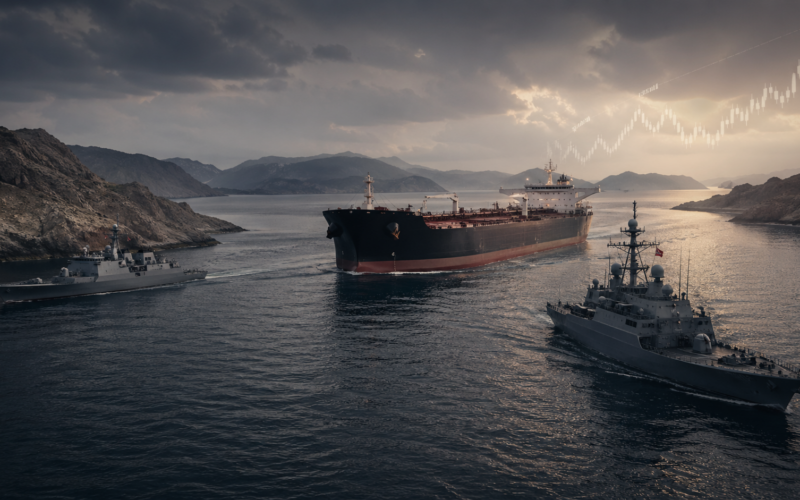
The blockade is one leg of what analysts have termed a “dual blockade” of the Strait of Hormuz, a narrow waterway between Iran and Oman through which approximately 20% of the world’s seaborne oil and liquefied natural gas normally passes. Iran’s Islamic Revolutionary Guard Corps has maintained restrictions on commercial shipping since late February 2026, when the United States and Israel launched air operations against Iran. The United States Navy’s blockade, applied specifically to vessels entering and departing Iranian ports and coastal areas, took effect on April 13 following the collapse of peace talks held in Islamabad, Pakistan. United States Central Command stated at the time that the blockade would not impede freedom of navigation for vessels transiting to and from non-Iranian ports.
What drove oil prices above $100 per barrel and what are the supply numbers?
The Strait of Hormuz crisis has produced what Goldman Sachs has described as the largest oil supply disruption in history. Goldman Sachs estimated in late April that global markets faced a shortfall of 13.7 million barrels per day during April alone, attributable primarily to the near-standstill of tanker traffic through the strait. Before the conflict began, more than 100 vessels transited the strait daily. That volume collapsed to a handful of ships per day after the Islamic Revolutionary Guard Corps issued navigation warnings and began boarding and attacking merchant vessels.
The Organisation of the Petroleum Exporting Countries recorded a production decline of 27% to 20.79 million barrels per day in March 2026. The supply shock surpassed the 6.28 million barrels per day cut recorded in May 2020 during the pandemic and exceeded production losses recorded during the 1970s oil crisis and the 1991 Gulf War, according to industry data. Total oil disruption attributable to the conflict wiped out an estimated 7.88 million barrels per day of OPEC production in March alone.
Brent crude has gained approximately 40% since the war began on February 28, 2026, when the United States and Israel launched air operations against Iran and former Supreme Leader Ayatollah Ali Khamenei was killed. West Texas Intermediate crude has risen more than 50% over the same period. The United States national average retail gasoline price reached $4.18 per gallon on Tuesday, its highest level in 2026, according to data from AAA. Iran’s parliamentary speaker Mohammad Bagher Ghalibaf warned that the blockade would make Americans “nostalgic for $4 to $5 gas.”

Why did the United Arab Emirates leave OPEC and what does it mean for global oil markets?
The oil price picture was further complicated on April 28, 2026, when the United Arab Emirates announced it would leave OPEC and the broader OPEC+ alliance effective May 1, ending nearly six decades of membership. The announcement represented the most significant structural change to OPEC since the group’s founding, removing its third-largest producer at the height of a global energy crisis.
UAE Energy Minister Suhail Al Mazrouei told CNBC that the timing was chosen to cause minimum disruption to other producers, given that all Gulf producers are currently constrained by the Hormuz crisis equally. The UAE’s Energy Ministry stated the decision followed “a comprehensive review of the UAE’s production policy and its current and future capacity” and reflected the country’s “national interest.” The UAE produced approximately 3.4 million barrels per day before the conflict began, but production fell 44% to 1.9 million barrels per day in March 2026 following the closure of the Strait of Hormuz.
The UAE’s pre-war production capacity stood at 4.85 million barrels per day, and Abu Dhabi had been producing roughly 30% below that ceiling under OPEC+ quota constraints. Following its exit, the UAE has signalled it intends to increase output gradually once freedom of navigation is restored in the Strait of Hormuz, with the state-run news agency saying Abu Dhabi would “continue to act responsibly, bringing additional production to market in a gradual and measured manner.” Rystad Energy analyst Jorge Leon said the UAE withdrawal “marks a significant shift for OPEC” and that “the longer-term implication is a structurally weaker OPEC.” The UAE was responsible for an estimated $77 billion of OPEC’s $455 billion in total oil sales in the period prior to the conflict.
What is the current status of United States-Iran negotiations over the Strait of Hormuz?
Iran proposed earlier this week that it would reopen the Strait of Hormuz to commercial shipping if the United States lifted its naval blockade and agreed to end the war, with nuclear negotiations to be deferred to a later phase of talks. White House press secretary Karoline Leavitt confirmed that President Trump and his national security team discussed Iran’s proposal. However, the proposal was not accepted. Multiple people briefed on the matter told the New York Times that President Trump told advisers he was not satisfied with Iran’s offer.
Secretary of State Marco Rubio appeared on Tuesday to reject the Iranian proposal as structured. On the Iranian side, senior adviser Ali Akbar Velayati stated that the “key to the Strait of Hormuz” remains in the Islamic Republic’s hands. Iran’s ambassador and permanent representative to the United Nations, Amir Saeid Iravani, sent a letter to the United Nations accusing the United States of breaching international law and characterising the interception of Iranian tankers as “state-sponsored piracy.” The letter stated that the United States had seized two commercial Iranian tankers, the M/T Majestic and the M/T Tifani, and removed 3.8 million barrels of oil.
President Trump on Tuesday wrote on Truth Social that Iran “informed us that they are in a ‘State of Collapse.'” He canceled plans over the weekend for special envoy Steve Witkoff and Jared Kushner to travel to Pakistan for talks with Iranian counterparts, writing that there was “too much time wasted on traveling.” Iran’s position that the United States naval blockade must be lifted before substantive negotiations can proceed stands in direct conflict with the White House’s insistence that the blockade will remain in place until a deal is finalized, leaving both parties in a strategic stalemate.
How is the Trump administration preparing for a prolonged blockade and who is involved in planning?
The White House convened a meeting at the senior level on Tuesday, April 29, to discuss contingency planning for an extended blockade. Among those in attendance were Chevron Corporation chief executive officer Mike Wirth, Treasury Secretary Scott Bessent, Vice President JD Vance, White House chief of staff Susie Wiles, and special envoys Steve Witkoff and Jared Kushner, according to Axios. A White House official told Axios the group discussed “steps we could take to continue the current blockade for months if needed and minimize impact on American consumers.”
The Trump administration has so far rejected the use of the Strategic Petroleum Reserve as a policy response to rising domestic fuel prices. President Trump acknowledged fuel prices were “a little high” for “a little while” in an earlier public statement. Capital Economics chief economist Neil Shearing noted that the blockade “risks creating new potential flashpoints,” including questions about whether the United States Navy would seize allied ships that have paid tolls to Iran or target Chinese vessels in the strait. Neil Shearing said either scenario “would represent a significant escalation.”
Meanwhile, the United States military’s war expenditure has reached approximately $25 billion since the conflict began on February 28, according to a senior Pentagon official who provided the first official cost estimate on Wednesday.
What is the broader regional and international response to the Hormuz crisis?
The Strait of Hormuz crisis has produced cascading effects across global trade, energy markets, and multilateral diplomacy. Panama reaffirmed the neutrality of the Panama Canal on Tuesday and emphasised the need to preserve stability in maritime transit routes. Panamanian Foreign Minister Javier Martinez-Acha spoke with Israeli Foreign Minister Gideon Saar, with Panama’s foreign affairs ministry saying Martinez-Acha underscored “the importance of the Panama Canal’s neutrality as a pillar of global trade.” The crisis has driven a significant surge in vessels rerouting through the Panama Canal.
Sweden warned on Tuesday of a potential jet fuel shortage caused by supply disruptions linked to the Strait of Hormuz closure. Swedish Energy Minister Ebba Busch said at a press conference that the Swedish Energy Agency had flagged the risk, and that “even if a lasting peace deal were to be in place tomorrow, it would likely still take time before oil and gas supplies are restored.” The government of Ireland announced fuel support schemes for households, businesses, farmers, and the transport sector in response to rising energy costs.
Iran has been under an internet blackout for 61 days as of April 29, according to the network monitoring organisation NetBlocks, which said Iran’s digital environment is “more tightly controlled than ever.” The new Iranian supreme leader Mojtaba Khamenei, who succeeded his father Ayatollah Ali Khamenei following the latter’s death on the first day of the conflict, has not appeared publicly since the war began and is believed to have been seriously wounded. Senior Trump administration officials have characterised the Iranian government as deeply fractured and have claimed there has been effective “regime change,” though Iran continues to function as a state and has maintained an active diplomatic posture.
Iran announced a temporary cessation of restrictions on April 17, 2026, declaring the strait open to commercial shipping for the duration of a Lebanon ceasefire. Brent crude fell more than 13% on that announcement. But Iran reimposed full restrictions on April 21 following what it characterised as ceasefire violations, and shipping traffic has not recovered to pre-war levels. President Trump stated at the time of the temporary opening that the United States naval blockade would remain in force until negotiations with Iran were complete.
What are the key takeaways from the Hormuz blockade and the global oil market crisis?
- The White House has directed the United States military to prepare for a blockade of the Strait of Hormuz lasting several months, with Brent crude trading above $114 per barrel and West Texas Intermediate near $103 per barrel on April 29, 2026.
- Goldman Sachs estimated the global oil market faced a shortfall of 13.7 million barrels per day in April 2026 due to the near-total halt in Strait of Hormuz tanker traffic, making the disruption the largest in recorded history.
- The United Arab Emirates announced on April 28 that it would leave OPEC and OPEC+ effective May 1, ending nearly 60 years of membership; the UAE’s output had fallen 44% to 1.9 million barrels per day in March due to Hormuz restrictions.
- Iran offered to reopen the Strait of Hormuz in exchange for the lifting of the United States naval blockade and an end to the war, with nuclear negotiations deferred; President Trump told advisers he was not satisfied with the proposal and Secretary of State Marco Rubio publicly rejected it.
- A senior Pentagon official disclosed on April 29 that the United States military operation against Iran has cost approximately $25 billion since the conflict began on February 28, 2026.
Discover more from Business-News-Today.com
Subscribe to get the latest posts sent to your email.