





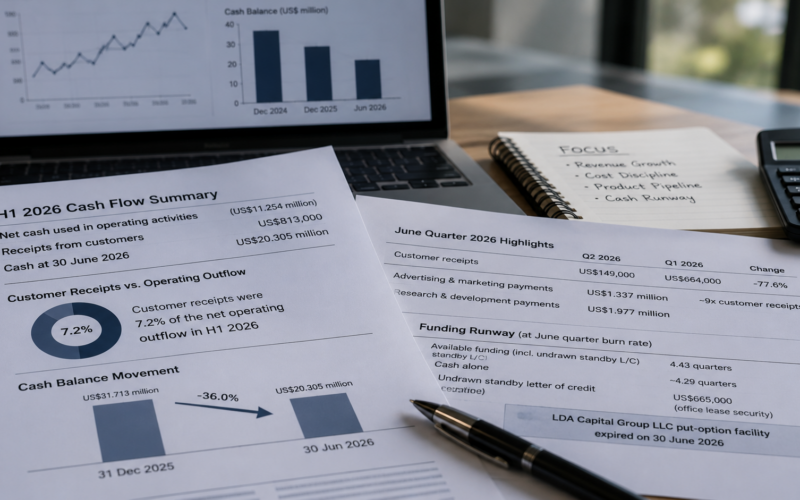
BrainChip Holdings Ltd (ASX: BRN) used US$11.254 million of cash in operating activities during the first half of 2026 while receiving US$813,000 from customers. Customer receipts were equivalent to just 7.2% of the net operating outflow, and the cash balance fell 36.0% from US$31.713 million at December 31, 2025 to US$20.305 million at June 30.
The deterioration was most visible in the June quarter. Customer receipts declined 77.6% from US$664,000 to US$149,000, which BrainChip attributed to lower development-services activity. The quarter’s advertising and marketing payments alone reached US$1.337 million, almost nine times customer receipts, while research and development payments were US$1.977 million.
BrainChip’s Appendix 4C reported 4.43 quarters of available funding at the June-quarter burn rate. The prescribed calculation included an undrawn US$665,000 standby letter of credit that secures an office lease, rather than unrestricted operating cash. Cash alone represented approximately 4.29 quarters, and the LDA Capital Group LLC put-option facility that had supported previous funding expired on June 30.
The operating case is approaching a different phase. BrainChip received the first 2,000 production AKD1500 neuromorphic processors and expected the full initial run to reach approximately 60,000 units during the third quarter. However, the revised total was 14.3% below the approximately 70,000 units anticipated in April because production yields were lower than expected.
The central tension is therefore sharper than a conventional early-stage technology story. BrainChip has enough cash to continue development and commercialisation beyond the next few quarters, but the balance sheet remains the product of equity funding rather than self-financing operations. AKD1500 shipments, licensing milestones and royalties now need to produce customer cash before the remaining runway again turns capital access into the dominant investment question.
Why did BrainChip’s customer receipts fall 77.6% after revenue rose 374% in 2025?
BrainChip’s 2025 revenue increased 374% to US$1.887 million, but the composition shows why that growth did not establish a stable quarterly base. Development-services revenue contributed US$1.822 million, or 96.6% of the annual total. Product revenue fell 68.6% to only US$64,959.
Customers that individually accounted for more than 10% of revenue contributed a combined US$1.439 million, equal to 76.3% of the annual figure. The accounts did not present the 2025 result as a broad base of recurring royalties. Instead, the growth was concentrated in product and development-services revenue from United States customers. The US$1.887 million total was also not a company record: BrainChip reported US$5.07 million of revenue in 2022.
BrainChip collected US$2.229 million from customers during 2025, but used US$15.442 million in operating activities. Gross margin was 14.1%, and the US$21.707 million operating loss was 11.5 times annual revenue. The improvement from 2024 was real, yet the business remained far from covering its research, sales and corporate cost base.
The first quarter of 2026 initially appeared to sustain better collection activity. Customer receipts rose to US$664,000, helped by deposits from new customers. The decline to US$149,000 in the June quarter demonstrates that development-services receipts remain uneven and cannot yet be treated as a recurring commercial run rate.
Across the June quarter, customer receipts equalled only 2.9% of operating cash payments and 3.1% of the net operating outflow. Related-party payments of US$223,469, comprising non-executive director fees and executive director salaries, were approximately 1.5 times customer receipts. These comparisons do not prove that individual expenditures were excessive, but they quantify how far customer-funded operations remain from the current cost structure.

How much cash runway remains now that BrainChip’s LDA Capital facility has expired?
BrainChip’s operating burn improved 10.3% from US$5.276 million in the March quarter to US$4.731 million in the June quarter. The cash balance nevertheless declined another 19.8% during the period because customer receipts remained small and financing activity produced only US$12,000 from option exercises before associated costs and lease payments in the first half.
The Appendix 4C calculation showed US$20.970 million of available funding, comprising US$20.305 million of cash and the US$665,000 standby letter of credit. Dividing that amount by the June-quarter operating outflow produced the reported 4.43-quarter figure. Excluding the lease-related standby facility produces approximately 4.29 quarters of cash coverage at an unchanged burn rate.
That distinction matters because the LDA facility is no longer available. BrainChip disclosed in its 2025 accounts that A$68 million of gross proceeds had been drawn under the arrangement since 2020. After the facility expired, an A$1 million contractual failure fee was settled through the sale of approximately 6.96 million collateral shares held by LDA Capital Group LLC.
Approximately six million collateral shares remained to be sold in an orderly process. Net proceeds were expected to be remitted to BrainChip after an 8.5% fee and any other amounts payable. That residual sale can produce some cash, but it is a finite settlement rather than a replacement financing facility.
Can BrainChip’s 60,000-unit AKD1500 production run materially change its revenue mix?
The AKD1500 is the most immediate route from evaluation activity to product revenue. BrainChip received an initial batch of 2,000 processors during the June quarter and said commercial shipments would begin in the second half of 2026. Deliveries of the remaining production run were expected to continue through the third quarter until approximately 60,000 units had been received.
That milestone should not be confused with 60,000 customer sales. BrainChip planned to allocate more than 2,000 devices to development boards, accelerator modules and application-focused reference platforms. The company had previously described orders from customers including Onsor Technologies, Parsons Corporation and Nex-Novus, but it characterised at least one of those orders as modest and did not disclose total committed units, selling prices or gross margins.
The production revision also introduces an execution question. The GlobalFoundries-manufactured 60,000-unit expectation was 10,000 units below April guidance because of lower-than-anticipated yields. BrainChip said it was analysing production data to identify the cause. The financial significance will depend on whether the yield issue raises unit costs, delays qualification or limits the number of saleable processors available for customers.
The next financial statements need to connect those technical claims to orders. Units shipped, average selling prices, inventory cost, production yield, customer concentration and product gross margin will provide a more useful measure of commercial progress than the size of the manufacturing batch by itself.
Do the EDGEAI and ASICLAND licensing agreements already support recurring revenue?
BrainChip also expanded the licensing route during 2026. Its agreement with EDGEAI included milestone-based payments for intellectual-property delivery, engineering support and technical services, alongside future royalties linked to sales of products incorporating Akida 2 technology. Delivery of register-transfer-level design assets during the June quarter satisfied an important contractual milestone.
The timing and amount of those milestone payments were not disclosed. Future royalties depend on EDGEAI completing its system-on-chip products, achieving customer adoption and generating sales. The agreement therefore creates a potential recurring-revenue pathway, but it does not justify assuming a royalty stream before the licensee enters commercial production.
The ASICLAND Co. Ltd. arrangement has a different structure. It allows the South Korean semiconductor design company to integrate Akida intellectual property into customer chip designs through separate evaluation and production licences subject to BrainChip’s approval. This broadens distribution, but ASICLAND cannot independently sublicense the technology and the agreement’s financial value was not quantified.
How much shareholder dilution was required to finance BrainChip’s 2025 cash position?
BrainChip’s ordinary share count increased from 1.972 billion at the end of 2024 to 2.253 billion at the end of 2025. That was a 14.2% increase in one year and reduced a passive shareholder’s proportional ownership by approximately 12.4%.
The 2025 increase included 200 million placement shares, 17.010 million shares issued through a share purchase plan, 40 million shares associated with the LDA arrangement, 23 million shares issued to the BrainChip Equity Plan trustee and smaller restricted-stock conversions. The placement and share purchase plan raised approximately A$37.98 million before costs, while the placement price of A$0.175 represented discounts of 10.3% to the previous close and almost 12% to recent volume-weighted prices.
Gross cash receipts from share issues reached US$30.169 million in 2025, 13.5 times the US$2.229 million collected from customers. Share-issue receipts represented approximately 93.1% of the combined inflow from share issues and customers before separately reported issue costs. That capital allowed BrainChip to finish 2025 with a stronger balance sheet, but it also shows that the subsequent cash runway was purchased mainly by shareholders.
What does BrainChip Holdings’ August share price indicate about commercial confidence?
BrainChip shares closed unchanged at A$0.135 on August 7, 2026, giving the company a quoted market capitalisation of approximately A$307.2 million. The stock gained 3.85% over the five sessions from July 31, while standard market data showed a negative 12.9% one-month return and an approximately 34.2% decline over one year.
The price was 22.9% below the A$0.175 November 2025 placement level. It also stood about 20% above its 52-week low of A$0.1125 but 50% below the A$0.27 high. That pattern indicates that investors still assign substantial option value to Akida’s technology and commercial potential, while discounting the slow conversion of partnerships into repeatable financial results.
Why has AKD1500 cash conversion become BrainChip’s decisive second-half test?
BrainChip enters the second half of 2026 with more commercial building blocks than it had a year earlier. Production silicon is available, the EDGEAI intellectual-property delivery has progressed, ASICLAND provides another route into customer chip designs and defence-related engagements continue to broaden the technology’s addressable use cases.
The financial evidence remains less mature. First-half customer receipts equalled only 7.2% of operating cash use, cash fell 36%, the previous equity facility expired and the initial AKD1500 production target was reduced because of yield performance. None of those facts invalidates the technology, but together they narrow the question investors should ask.
The next important disclosure is not another partnership count. It is a cash bridge showing how many AKD1500 units were sold, how much milestone revenue was recognised, what customers actually paid, whether product gross margin improved and how much cash remained after the December tape-out work planned for the AKD2500.
If processor shipments and licensing milestones begin producing repeatable receipts, BrainChip’s remaining runway can fund a transition toward a less equity-dependent model. If receipts stay volatile and the cost base remains near current levels, the company could approach another financing decision before commercial scale is established.
BrainChip has reached the point where manufacturing readiness and ecosystem breadth must become financial output. The next two quarters will test whether Akida is moving from an investable technology narrative to a business capable of financing more of its own development.
Discover more from Business-News-Today.com
Subscribe to get the latest posts sent to your email.



