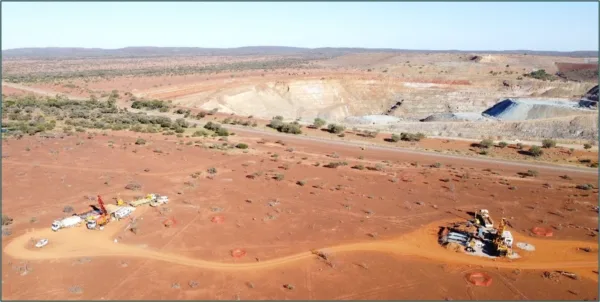


Boss Energy Limited (ASX: BOE) closed at A$1.210 on July 8, giving back part of its post-update rally but still holding above the lows reached before the company confirmed that its Honeymoon uranium operation met revised FY26 production guidance. The stock had surged from A$1.015 on June 30 to A$1.355 on July 6 before retreating across the next two sessions, showing that investors remain interested in the uranium recovery story but are not yet willing to fully re-rate the company before the next technical reset. Boss produced 1.41 million pounds of U₃O₈ during FY26 and has brought forward its new Honeymoon feasibility study and updated life-of-mine plan to the end of August. For retail investors, the story is no longer just about whether Boss Energy can produce uranium. The larger question is whether Honeymoon can prove lower-cost, durable production economics after the earlier mine-plan setback.
Why has Boss Energy pulled back after its July rebound without breaking the uranium recovery setup?
Boss Energy ended July 8 at A$1.210, down 2.02% for the session after falling 8.86% on July 7. The retreat followed a sharp rebound that had lifted BOE to A$1.355 on July 6, its highest close in the latest recovery move. Even after the pullback, the stock remained about 19% above its June 30 close of A$1.015.
The pattern suggests that the July production update created a relief rally, but not a full restoration of investor trust. Boss Energy had spent months under pressure after production downgrades, weather disruption and the withdrawal of the earlier Honeymoon feasibility assumptions. Meeting the revised FY26 production target was enough to bring buyers back, but not enough to remove the operational discount still attached to the stock.
The five-session move remains positive, with BOE up around 4.8% from the July 1 close. On a one-month basis, however, the stock is roughly flat, having closed near A$1.205 on June 9. That matters because the July rally repaired part of the late-June weakness rather than creating a clean medium-term breakout.
The 52-week context remains stark. BOE is trading within a range of roughly A$0.995 to A$4.010, meaning the shares are still about 70% below their 12-month high despite the recent operational update. That gap reflects how much confidence the market lost when the company had to reset its mine plan.
The current setup is therefore more balanced than the July 3 reaction suggested. Boss Energy has demonstrated operational improvement, but the share price is still demanding proof that Honeymoon’s next mine plan can be technically credible, financially attractive and fundable without another major shock.
What does Boss Energy own, and why is Honeymoon still the centre of the investment case?
Boss Energy owns 100% of the Honeymoon uranium operation in South Australia and a 30% interest in the Alta Mesa uranium project in South Texas. Both assets provide exposure to in-situ recovery uranium production, a mining method that differs substantially from conventional open-pit or underground uranium extraction.
In-situ recovery involves injecting solution into uranium-bearing formations, dissolving the uranium underground and pumping the solution back to surface for processing. The method can reduce surface disturbance and avoid moving large amounts of waste rock, but it depends heavily on geology, permeability, uranium continuity, fluid movement and reagent performance.
Honeymoon remains the company’s defining asset because Boss controls it fully and has built its Australian production platform around the operation. The mine’s restart placed Boss among a small group of listed uranium producers at a time when nuclear-energy sentiment has strengthened globally.
Alta Mesa provides diversification, but Boss does not operate the Texas project. Its 30% stake gives exposure to United States production and potential exploration upside, including the Alta Mesa East high-grade mineralisation announced in June. Nevertheless, the valuation debate still turns mainly on Honeymoon.
The reason is simple. Honeymoon’s earlier assumptions were challenged by real operating conditions. Boss previously found that higher-grade mineralisation was less continuous than expected, some zones did not overlap as anticipated and the earlier wellfield model could not be relied on for future production planning.
That reset changed Boss Energy from a straightforward uranium ramp-up story into a technical rehabilitation story. The company already has permitted infrastructure, uranium inventory and a producing plant. What it still needs is a revised life-of-mine plan that investors can believe.
Why did meeting revised FY26 uranium guidance matter after the earlier production downgrade?
Boss Energy produced 1.41 million pounds of U₃O₈ drummed during FY26, landing within its revised guidance range of 1.40 million to 1.45 million pounds. That was important because the company had previously cut guidance from 1.6 million pounds after heavy rainfall disrupted operations at Honeymoon.
Meeting a lowered target is not the same as outperforming the original plan. However, it does show that the operation stabilised after a difficult period. Investors had needed evidence that the company could regain control of site logistics, production infrastructure and wellfield performance after the March-quarter disruption.
The July 3 update provided several operating signals beyond the annual production number. Boss commissioned and produced from NIMCIX Column 5, brought the East Kalkaroo trunkline into operation and commissioned the first Far East Kalkaroo production wellfield. The company also said flushing time exceeded expectations and leaching performance met expectations at the first Far East Kalkaroo wellfield.
These details matter because Honeymoon’s problem has not been headline uranium demand. It has been whether the mine’s wellfields can deliver predictable solution flows, recoveries and cost performance. Infrastructure that improves flow, pumping capacity and field access is therefore directly relevant to the recovery thesis.
The market reaction was strongest because the update suggested that June operating momentum improved. A record flow for the quarter indicates that the system was beginning to perform better as new infrastructure came online.
The caution is that June improvement alone does not establish a long-term trend. One stronger month can support confidence, but it cannot replace a detailed feasibility study covering future wellfield design, capital requirements, operating costs and mine sequencing.
How could the wide-spaced wellfield design change the long-term economics at Honeymoon?
Boss Energy is developing a new Honeymoon mine plan around a wide-spaced wellfield design. The company has said the design is intended to lower capital intensity, reduce the operating cost structure and potentially bring large satellite resources into the mine plan over time.
The key idea is that wider well spacing could reduce the number of wells, pipes and associated infrastructure required to produce uranium from a broader resource base. In a successful scenario, this would allow Boss to access more material at lower upfront capital and operating cost per recoverable pound.
This is especially relevant because Boss has been evaluating lower-grade uranium mineralisation that may not have fitted neatly into the earlier development approach. A wellfield design that can make more of the resource economic would extend the mine life and improve the value of satellite deposits such as Gould’s Dam and Jason’s Deposit.
The potential upside is meaningful. If the new design supports stable recovery, lower capital intensity and larger mineable inventory, Honeymoon could move from a challenged ramp-up into a more scalable uranium production platform.
The risk is equally clear. Wider spacing must still deliver sufficient recoveries, solution control and production consistency. A design that looks attractive on paper can disappoint if underground flow paths behave differently from models or if reagent consumption rises.
The August feasibility study must therefore provide hard numbers. Investors need to see expected annual production, capital expenditure, operating cost, recovery assumptions, resource conversion, wellfield sequencing and sensitivity to uranium prices.
What milestones should BOE investors watch between July 8 and the August feasibility study?
The next confirmed operating milestone is Boss Energy’s Q4 FY26 Quarterly Activities Report on July 30. This report should provide detailed operational and financial results for the June quarter, including production, sales, inventory, cash costs, capital expenditure and liquidity.
The cost information will be particularly important. During the weather-affected March quarter, Honeymoon’s reported unit costs were elevated, with C1 cash costs and all-in sustaining costs well above the long-term levels investors want to see from a competitive in-situ recovery uranium operation.
The July 3 update confirmed production progress, but it did not provide the cost outcome for the June quarter. Investors therefore still need to know whether stronger flow rates and infrastructure commissioning reduced unit costs or merely improved volumes.
The larger milestone is the new feasibility study and updated life-of-mine plan targeted for the end of August. This document is expected to include an updated JORC mineral resource estimate for the Honeymoon deposit. Boss has decided not to proceed with the previously contemplated interim scoping study and will instead move directly to a feasibility-level outcome.
That decision can be read positively because it suggests management believes enough technical work has been completed to support a more mature plan. It also raises the stakes. If the August study disappoints, there will be less room to argue that investors should wait for another interim step.
Boss also plans to host an investor day in September. Technical members of the team are expected to explain the geological, hydrogeological and engineering work behind the feasibility study. That event could become crucial for rebuilding credibility with analysts and institutional investors.
Can Boss Energy’s liquidity position absorb another technical reset at Honeymoon?
Boss Energy entered the latest update with a stronger balance sheet than many emerging uranium producers. At the end of the March quarter, the company reported approximately A$211 million in cash and liquid assets and no debt.
That liquidity included cash, uranium inventory and strategic investments. The balance sheet gives Boss flexibility to continue the Honeymoon technical reset without immediately relying on a heavily discounted equity raising.
The company has also said that any incremental capital requirements needed to support the revised life-of-mine plan are intended to be funded organically. That statement is important because shareholders are sensitive to dilution after the stock’s steep decline from its previous highs.
However, not all liquidity is the same. Uranium inventory can be valuable, especially in a supportive commodity market, but it is not equivalent to cash until sold under favourable terms. Strategic investments can move with market conditions and may not always be easily monetised without affecting value.
The July 30 quarterly report should clarify how much cash was used or generated during the June quarter, how inventory moved and how much capital was spent on production infrastructure. A strong cash outcome would support management’s claim that Honeymoon can fund its revised path internally.
The risk is that the August feasibility study identifies larger capital needs than investors expect. A plan requiring substantial additional field development, infrastructure upgrades or longer ramp-up expenditure would test the balance sheet more severely.
Boss Energy has financial room to manoeuvre. The question is whether that room will be used to create higher-confidence production or consumed by another round of operational repair.
How does the uranium market support the Boss Energy recovery thesis?
The uranium market remains a powerful macro tailwind for Boss Energy. Nuclear power has regained strategic importance as governments focus on energy security, grid reliability and lower-emission baseload generation.
Long-term uranium demand is supported by reactor construction in Asia, reactor-life extensions in the United States and Europe, and rising power demand from data centres, electrification and industrial decarbonisation. Utilities also continue seeking secure long-term supply in a market where new mine development can take many years.
Uranium prices have remained elevated compared with historical levels, even though short-term movements can be volatile. The spot price near the mid-US$80 per pound range in early July supports the economic case for producers that can deliver reliably into the market.
This is helpful for Boss Energy because the company has production exposure through Honeymoon and Alta Mesa rather than only exploration potential. Producing or near-producing uranium companies can attract more investor attention than early-stage developers when utilities look for supply visibility.
The macro support does not remove mine-level risk. A strong uranium price can improve margins, but it cannot fix poor recoveries, excessive reagent costs or unreliable wellfield performance. Boss Energy’s challenge is operational, not thematic.
The best version of the investment case combines a strong uranium market with a repaired Honeymoon mine plan. If the August study proves that Honeymoon can produce at competitive costs, the uranium cycle could become a meaningful valuation accelerator. If the study is weak, the commodity backdrop may not be enough to protect the share price.
Is Boss Energy’s valuation still discounting too much risk after the July 8 pullback?
At A$1.210 per share, Boss Energy’s market capitalisation is roughly A$500 million. The stock is materially above the recent low near A$0.995 but still far below the 52-week high above A$4.
That valuation captures two opposing ideas. The market is assigning value to Boss as an operating uranium producer with no debt, substantial liquidity and exposure to two producing regions. At the same time, it is heavily discounting the reliability of Honeymoon’s future mine plan.
The July 8 price implies that the market is not yet convinced the July update has solved the problem. BOE remains down about 5% from its July 3 close and roughly 11% below the July 6 closing peak, even though the production update itself was positive.
This is typical of a stock where the next catalyst is technical rather than purely financial. Investors can celebrate a production target being met, but they still need a revised feasibility study before assigning higher confidence to long-term cash flows.
Formal analyst expectations remain split because the valuation depends heavily on assumptions that will be reset in August. Production volumes, unit costs, resource conversion and capital intensity could all change meaningfully once the new study is released.
The current valuation may prove conservative if Honeymoon demonstrates a credible lower-cost plan. It may also prove generous if the new study confirms that production will remain capital-intensive, technically complex or below earlier expectations.
The stock is no longer priced as if the previous high-growth uranium story is intact. It is priced as a recovery candidate where the next document could either rebuild trust or extend the discount.
Why are retail investors still debating BOE despite the production guidance being met?
Retail interest in Boss Energy remains high because the stock offers a rare combination of operating uranium exposure, a dramatic share-price collapse and visible near-term catalysts. That combination naturally attracts both recovery traders and long-term uranium bulls.
Supporters argue that Boss Energy has survived the worst phase of the Honeymoon reset. They point to the FY26 production guidance being achieved, June infrastructure milestones, the accelerated feasibility timeline and the company’s liquidity position.
Sceptics focus on the fact that the guidance was revised downward and that the earlier Honeymoon mine plan had to be withdrawn. They are less interested in whether Boss can produce uranium in the short term and more interested in whether it can produce enough uranium at attractive costs over several years.
The July 7 and July 8 pullback has reinforced both sides of the debate. Bulls can argue that the stock is still holding above the late-June lows and digesting a sharp rebound. Bears can argue that selling pressure returned quickly because the market still doubts the mine plan.
The August feasibility study is therefore becoming the central battleground. Retail investors will be looking for a simple answer to a complicated technical question: can the wide-spaced wellfield design make Honeymoon investable again?
Until that answer arrives, BOE is likely to remain volatile. The stock can move sharply on uranium sentiment, quarterly cost data, short-covering, institutional flows and any hint about the quality of the upcoming study.
Key takeaways from the Boss Energy share-price outlook before the August Honeymoon study
- Boss Energy closed at A$1.210 on July 8, down 2.02% for the session and lower than its July 6 rebound close of A$1.355.
- BOE remains about 19% above its June 30 close of A$1.015, even after two consecutive pullback sessions.
- The stock is roughly flat over one month and still about 70% below its 52-week high, showing that the market has not fully restored confidence.
- Boss Energy produced 1.41 million pounds of U₃O₈ during FY26, meeting its revised production guidance.
- The July 30 quarterly report must show whether June operating improvement also translated into better unit costs and cash performance.
- The new Honeymoon feasibility study, updated life-of-mine plan and revised JORC mineral resource estimate are targeted for the end of August.
- The investment case depends on whether the wide-spaced wellfield design can lower capital intensity, improve operating costs and bring more of Honeymoon’s satellite resources into the mine plan.
Discover more from Business-News-Today.com
Subscribe to get the latest posts sent to your email.