


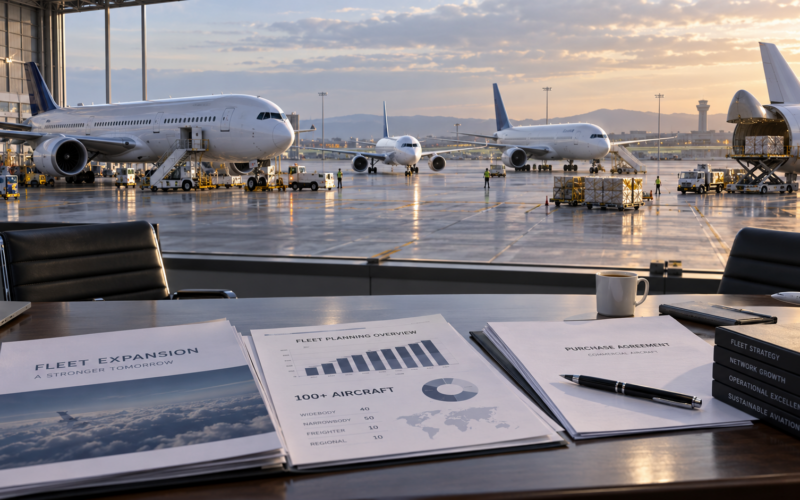
The Boeing Company (NYSE: BA) and Turkish Airlines have finalised an order covering as many as 150 Boeing 737 MAX aircraft, converting negotiations that began in 2025 into the carrier’s largest Boeing single-aisle commitment. The agreement includes a firm purchase of 100 Boeing 737-8 aircraft plus options for another 50 aircraft, with substitution rights that allow Turkish Airlines to select the larger Boeing 737-10 for part of the order.
The order gives Boeing another substantial backlog addition from a major international network carrier and follows Turkish Airlines’ earlier commitment for as many as 75 Boeing 787 Dreamliners. Turkish Airlines and its AJet unit already operate more than 200 Boeing aircraft across multiple passenger and cargo types, while the new narrowbody aircraft are intended primarily for short- and medium-haul growth from the airline’s Istanbul network.
How significant is the 150-aircraft order for Boeing?
The 100 firm aircraft provide Boeing with a meaningful addition to the 737 MAX backlog at a time when production stability and delivery execution remain crucial to the manufacturer’s financial recovery. Aircraft orders can remain in the backlog for years before generating most of their cash value, but large commitments give manufacturers visibility for production planning and strengthen relationships with airlines that can generate future service and replacement demand.
The 50 options matter differently because they are not equivalent to firm purchases. Turkish Airlines retains flexibility to exercise them as network requirements, financing conditions and fleet needs evolve. Substitution rights for the 737-10 similarly allow the carrier to adjust capacity toward a larger variant if Boeing completes the necessary certification and the aircraft matches future route economics.
Turkish Airlines’ fleet strategy is unusually ambitious. Boeing said the airline currently operates 567 passenger and cargo aircraft across its total fleet and serves 358 destinations, making additional narrowbody capacity important for feeding long-haul services through Istanbul. A larger short-haul network can therefore strengthen the economics of both the new 737 MAX aircraft and the carrier’s expanding widebody fleet.
Why has the engine issue not disappeared with the aircraft agreement?
The transaction carries an important unresolved element. Aviation Week reported that Turkish Airlines had not announced a resolution to its separate negotiations over engine maintenance for the 737 MAX fleet. CFM International, the joint venture between GE Aerospace and Safran, is the exclusive engine supplier for the MAX, meaning engine support economics can materially influence the aircraft’s lifetime operating cost even after the purchase agreement is finalised.
Earlier negotiations had reportedly become difficult enough for Turkish Airlines to consider alternatives. The fact that the aircraft agreement is now signed removes a significant uncertainty for Boeing, but it does not automatically mean every commercial issue surrounding the future fleet has been settled.
This distinction matters because airlines buy operating economics rather than airframes in isolation. Maintenance reserves, spare-engine availability, shop-visit pricing and reliability can influence the lifetime cost of a fleet over decades. Investors should therefore avoid treating the signed Boeing agreement as evidence that all related supplier negotiations have ended.
What does the order mean for Boeing’s competitive position?
Large international orders remain important in Boeing’s contest with Airbus SE for global single-aisle demand. Every major airline fleet decision can create long-term lock-in because pilot training, maintenance infrastructure, spare parts and operational procedures become increasingly efficient when an airline operates larger fleets around fewer aircraft families.
Turkish Airlines already operates both Boeing and Airbus equipment, so the new order does not create an exclusive relationship. It does, however, ensure that Boeing remains deeply embedded in the carrier’s fleet as Turkish Airlines pursues substantial network expansion.
The combination of up to 150 737 MAX aircraft and up to 75 787 Dreamliners also increases the commercial value of the account beyond a single transaction. Delivering those aircraft reliably could support decades of aftermarket and customer relationships, while execution problems would have the opposite effect because the airline is making long-term capacity decisions around promised production slots.
How did Boeing shares react to the Turkish Airlines order news?
Boeing shares closed at $199.87 on 23 September, up approximately 1.1% for the session in which the agreement was announced. The stock had closed at $197.72 a day earlier after a 1.7% decline, so the order coincided with a modest recovery rather than an outsized revaluation. A single trading session cannot establish that the Turkish Airlines transaction caused the move.
The restrained response is understandable. Boeing already holds a very large commercial backlog, so investors are increasingly focused on how efficiently that backlog is converted into certified, delivered and paid-for aircraft. Orders strengthen future demand visibility, but production rates, supplier availability, quality control and cash generation determine when that demand creates financial value.
For Boeing, this is therefore strategically useful business but not the end of the story. The firm 100-aircraft portion improves backlog quality, the additional 50 options create future upside, and the wider Turkish Airlines relationship is deepening. The next investor test is whether Boeing can translate those commitments into predictable deliveries while the outstanding engine-support discussions reach a workable commercial outcome.
Discover more from Business-News-Today.com
Subscribe to get the latest posts sent to your email.