Blue Energy, a privately held developer of prefabricated nuclear power plants based in Chevy Chase, Maryland, has secured a strategic equity investment from Constellation Technology Ventures, the corporate venture arm of Constellation Energy Corporation (Nasdaq: CEG). The transaction, announced on 16 July 2026, is described by Blue Energy as the first investment by Constellation Technology Ventures in a United States nuclear developer working on small modular reactors, and it sits alongside an earlier US$380 million funding round and a strategic partnership with GE Vernova (NYSE: GEV). The financial terms of the equity investment were not disclosed. The central tension is straightforward. Blue Energy is asking capital markets, utilities and regulators to believe that a shipyard-style manufacturing model borrowed from offshore oil and gas, combined with an existing boiling water reactor design, can finally make new nuclear plants both project-financeable and deliverable in the same execution window as a combined-cycle gas plant.
Why is Constellation Technology Ventures backing a nuclear developer that has yet to pour concrete on its first plant?
Constellation is the largest owner and operator of the United States nuclear fleet, and its venture arm has historically been used to seed technologies that could shape the company’s own generation mix rather than to chase pure financial returns. Blue Energy said Constellation Technology Ventures is investing for the first time in a small modular reactor developer, which frames the decision as a strategic signal about where the parent group sees the next wave of nuclear economics forming. Constellation itself is grappling with a demand curve dominated by hyperscale data centre load, artificial intelligence build-out and the restart of the Crane Clean Energy Center in Pennsylvania, all of which have widened the gap between planned baseload additions and required megawatts.
David Dardis, Constellation’s Senior Executive Vice President and Chief External Affairs and Growth Officer, said the investment reflects an intent to explore ways to accelerate advanced nuclear deployment and to allocate risk appropriately. That language is meaningful. The main historical failure mode for United States nuclear projects has not been reactor design; it has been cost overruns, schedule slippage and disputed risk allocation between engineering, procurement and construction contractors, utility owners and regulators. Constellation’s involvement gives Blue Energy access to the operating knowledge of a firm that already runs more than a fifth of the domestic nuclear fleet, without committing Constellation itself to a specific project offtake or capital contribution beyond the venture cheque.
How does Blue Energy’s shipyard prefabrication model try to fix the industry’s oldest cost problem?
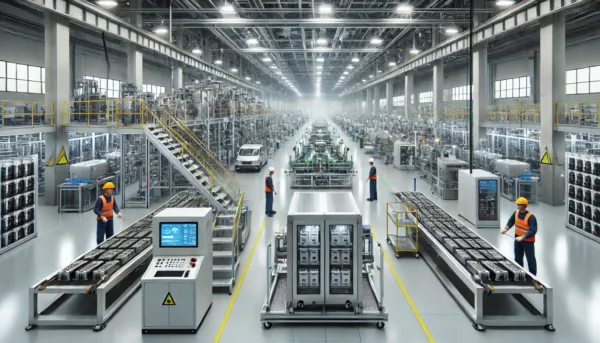
Blue Energy’s central technical claim is that new nuclear plants have been non-financeable in a project finance sense because the risk profile has never resembled that of a combined-cycle gas plant, a wind farm or a liquefied natural gas train. Cost has been driven by long stick-build cycles at nuclear sites, changing designs during construction and productivity gaps between shipyard-grade heavy fabrication and on-site nuclear construction labour. The company said its model uses large-format robotic prefabrication and modular assembly techniques borrowed from offshore oil and gas platforms and LNG projects. The design intent is to move as much construction as possible into a controlled shipyard environment where labour productivity, weld quality and inspection cycles are far more predictable than on a nuclear site, then transport completed modules to the plant location.
The proposed commercial consequence, if the manufacturing approach performs as intended, is a shift in how lenders and equity investors underwrite the project. A traditional new nuclear project has typically been financed either through regulated rate base recovery or through sovereign support, because commercial banks have not been willing to accept construction risk. If a shipyard-manufactured plant can demonstrate a defined cost, a defined delivery schedule and a defined completion test similar to an LNG train, it becomes possible in principle to structure senior debt against contracted electricity revenue. This is the outcome Blue Energy described in earlier announcements when it said the funding was intended to build what it called the world’s first project-financeable nuclear plant. The model, however, has not yet been proven on a completed reactor.
What does the BWRX-300 add to the Blue Energy pitch, and where does the reactor stand in its own licensing cycle?
Blue Energy’s chosen technology is the BWRX-300 from GE Vernova Hitachi Nuclear Energy, a roughly 300 megawatt electric boiling water reactor derived from GE Vernova’s earlier Economic Simplified Boiling Water Reactor and using components from the operating Advanced Boiling Water Reactor fleet. GE Vernova describes it as an evolutionary design that leverages existing fuel, plant simplifications and proven components. The BWRX-300 is currently under construction at Ontario Power Generation’s Darlington site in Canada, which GE Vernova has described as the first small modular reactor project under construction in the Western world. Commercial operation at Darlington is targeted by the end of 2030. In the United States, the Nuclear Regulatory Commission is reviewing Tennessee Valley Authority’s application to build the first BWRX-300 at the Clinch River site in Oak Ridge, Tennessee.
The choice matters for the Blue Energy investment case in three ways. First, using an already selected and partially built design lowers the technology risk in an equity story that would otherwise stack construction innovation on top of reactor innovation. Second, the BWRX-300 is being scaled globally through GE Vernova Hitachi’s supplier network, which reduces the risk that Blue Energy alone would need to build a component supply chain. Third, it links Blue Energy commercially to a listed reactor vendor whose own deployment cadence, in Canada, the United States, Poland and Southeast Asia, will shape how quickly Blue Energy can secure additional units on economic terms. The trade-off is that Blue Energy’s execution timelines are now partly dependent on GE Vernova Hitachi delivering component quality, licensing support and vendor guarantees on schedule.
Why the phased gas-to-nuclear strategy is central to the Texas project’s 48-month power promise
Blue Energy said it recently reached a licensing milestone with the United States Nuclear Regulatory Commission that supports what management describes as a goal of delivering reliable power in 48 months or less through a phased gas-to-nuclear approach. The company’s earlier announcement with GE Vernova detailed a multi-gigawatt configuration pairing GE Vernova gas turbines with BWRX-300 small modular reactors, a structure intended to allow gas capacity to come online first while the nuclear units follow. That sequencing is the commercial answer to a demand curve that will not wait a decade for baseload nuclear. Data centre operators, industrial customers and grid balancing authorities need firm megawatts within the current planning cycle, and the gas plus nuclear structure attempts to give them a bankable path.
Blue Energy said early site works on its first planned project in Texas could begin during 2026, with a final investment decision targeted in 2027. Neither the site nor the offtake counterparty has been publicly identified in the release. The 48 month figure is a company estimate, not an independently validated schedule, and it applies to the gas-plus-nuclear structure rather than to a standalone nuclear plant. It also assumes uninterrupted licensing progress, timely reactor deliveries from GE Vernova Hitachi Nuclear Energy and successful commercial execution on the shipyard prefabrication step, none of which has been demonstrated on a completed United States project. The Texas timeline is therefore a leading indicator investors and utilities will watch, but it is not yet a guaranteed outcome.
What does Constellation’s own share-price reset signal about the broader utility-nuclear trade?
Constellation Energy Corporation closed at approximately US$252 per share on 17 July 2026, giving the company a market capitalisation of roughly US$90 billion. The stock has fallen from a 52 week high of about US$412 and traded as low as US$228 within the past year, a decline that mirrors a broader reset in the nuclear-linked equity trade after an earlier surge tied to artificial intelligence power demand. Even so, the company has continued to attract fresh buy ratings from major sell-side houses this month and successfully cleared the recent PJM Interconnection capacity auction, an outcome that Constellation described as supportive of its earnings outlook. The company is scheduled to report its next quarterly results in early August.
That backdrop matters for reading the Blue Energy investment. Constellation’s own capital allocation priorities remain focused on maximising output from its existing nuclear fleet, restarting Crane Clean Energy Center and pursuing bilateral contracts with hyperscale customers. A venture investment in Blue Energy does not commit Constellation to buying reactors, funding construction or offtaking power from any Blue Energy project. It is more accurately read as an option on a manufacturing model that, if it works, would materially change the delivered cost of new nuclear across the industry. For Constellation shareholders, the investment does not shift the near-term earnings picture. It is however consistent with a strategy of positioning the group across multiple pathways for future generation additions rather than betting on a single new-build model.
What must Blue Energy prove before shipyard-built nuclear becomes genuinely project-financeable?
The next set of proof points is defined and measurable. Blue Energy must publicly confirm a Texas site and offtake structure, deliver the early site works during 2026 and reach a final investment decision in 2027. The company must also demonstrate credible progress on the shipyard manufacturing side, including the identification of a fabrication yard, a component supply chain and a commissioning plan that lenders can underwrite. Every one of these steps carries the risk of delay. The Nuclear Regulatory Commission’s own review timelines have historically been the binding constraint on United States nuclear projects, and the phased gas-to-nuclear licensing approach has not been tested against a completed commercial deployment.
The broader industry test is whether the shipyard-plus-project-finance model can attract senior debt on terms comparable to a liquefied natural gas train or a large offshore wind project. Achieving that would require a completion guarantee package, contingent equity commitments and a credible operator, which is precisely where a relationship with Constellation, or a similar operator, becomes commercially valuable in the future. Until Blue Energy converts the current strategic momentum into a signed engineering, procurement and construction structure with a firm cost, a firm schedule and an identifiable investment-grade offtake counterparty, the model remains an ambitious commercial thesis rather than a proven financing framework. The Constellation Technology Ventures investment strengthens the narrative. It does not close the execution gap.
What Blue Energy has strengthened, and what it must still prove
The Constellation Technology Ventures investment strengthens the credibility of Blue Energy’s commercial thesis at a stage where credibility is the scarcest resource in new nuclear. The company now combines a recognised reactor technology, a strategic partnership with a listed reactor vendor, a first-of-kind venture cheque from the largest United States nuclear operator and a defined near-term catalyst path in Texas. What remains unresolved is whether shipyard-built modular reactors can be delivered at a defined cost, on a defined schedule, on terms that a project finance lending group can underwrite. The next hard test is not a further funding announcement. It is the confirmation of the Texas site and offtake structure, followed by the 2027 final investment decision. If Blue Energy reaches those milestones with intact cost estimates and a committed engineering, procurement and construction package, the shipyard nuclear model will move from an ambitious pitch to a serious industrial proposition. If either milestone slips materially, the current momentum will need to be re-earned rather than reinforced.
Key takeaways for executives and investors evaluating the Blue Energy and Constellation deal
- Blue Energy has secured a strategic equity investment from Constellation Technology Ventures, described as the venture arm’s first investment in a United States small modular reactor developer, with financial terms not disclosed.
- The transaction complements Blue Energy’s earlier US$380 million funding round and its strategic partnership with GE Vernova on a multi-gigawatt gas-plus-nuclear configuration in the United States.
- Blue Energy’s model combines large-format shipyard-style prefabrication, inspired by offshore oil and gas and liquefied natural gas projects, with an existing reactor design in the BWRX-300 from GE Vernova Hitachi Nuclear Energy.
- The BWRX-300 is a roughly 300 megawatt electric boiling water reactor, currently under construction at Ontario Power Generation’s Darlington site in Canada and under Nuclear Regulatory Commission review for the Tennessee Valley Authority’s Clinch River site in Tennessee.
- Blue Energy said it could begin early site works on its first planned Texas project during 2026 and target a final investment decision in 2027, using a phased gas-to-nuclear structure that management estimates can deliver power in 48 months or less.
- Constellation Energy Corporation shares closed at approximately US$252 on 17 July 2026, with a market capitalisation near US$90 billion, well below the stock’s 52 week high of about US$412.
- The venture investment does not commit Constellation to offtake, construction financing or reactor procurement from Blue Energy, and its earnings impact on Constellation is not material in the near term.
- Key execution risks include shipyard manufacturing scale-up, licensing progression, supply chain readiness at GE Vernova Hitachi Nuclear Energy and the ability to attract senior project debt on terms comparable to liquefied natural gas or offshore wind.
- The next measurable proof points are a confirmed Texas site and offtake counterparty, credible progress on shipyard fabrication and a final investment decision in 2027.
- The Blue Energy pitch will be judged less on reactor technology, which is already partly derisked, and more on whether shipyard prefabrication can deliver a defined cost, a defined schedule and a completion test that lenders can accept.
Discover more from Business-News-Today.com
Subscribe to get the latest posts sent to your email.