BioQ, the biotechnology affiliate of Chinese skincare brand GUYU, has made its first appearance as a raw-material supplier at in-cosmetics Global 2026 in Paris, positioning the company as more than a finished-product beauty brand. The debut placed BioQ in front of global formulators, ingredient buyers and personal care research teams at one of the cosmetics industry’s most watched technical trade events. The company showcased three proprietary ingredients, AuroGlab, Ginsenoside CK and Biomimetic Extracellular Vesicles, in a move designed to highlight GUYU’s ability to control key active ingredients from research through production. The strategic significance is clear: Chinese skincare companies are increasingly trying to compete not only through branding and consumer marketing, but through upstream biotechnology, claims substantiation and raw-material ownership.
Why does BioQ’s in-cosmetics Global debut matter for China’s upstream beauty ingredient ambitions?
BioQ’s appearance at in-cosmetics Global matters because it shifts the GUYU story from skincare formulation to ingredient infrastructure. In a beauty market where differentiation is often flattened by fast product copying, ownership of proprietary actives can become a deeper moat than packaging, influencer campaigns or retail velocity. For GUYU, BioQ provides a way to argue that its competitive edge sits inside the formulation stack rather than merely on the shelf.
The move also reflects a broader change in how Chinese beauty companies are trying to globalise. Earlier generations of Chinese cosmetics brands often fought for recognition through price, digital commerce and domestic consumer scale. BioQ’s Paris debut suggests a more technical route, where Chinese companies seek credibility among formulators, laboratory partners and global supply-chain buyers. That is a harder path, but potentially a more durable one if the science is validated beyond company-controlled data.
For the global cosmetics industry, the signal is equally important. Ingredient innovation has long been shaped by European, Japanese, Korean and American suppliers with strong intellectual property portfolios and established regulatory familiarity. BioQ’s attempt to enter that arena shows how China’s beauty sector is becoming more vertically integrated, more research-led and more willing to contest the premium end of the personal care supply chain.

How could AuroGlab reshape the competitive debate around brightening actives and delivery systems?
AuroGlab is BioQ’s high-purity glabridin ingredient derived from Glycyrrhiza glabra, with the company claiming 99% purity through proprietary melt-crystallisation purification. The commercial logic behind the ingredient is straightforward: brightening and tone-evening products remain one of the most resilient categories in Asian skincare, and brands continue to seek actives that can be positioned as more precise, better absorbed and more technically defensible than standard botanical extracts.
The more interesting part of BioQ’s claim is not only purity, but delivery. The company says AuroGlab uses 28-nanometre encapsulation technology to improve transdermal absorption by 3.4 times, with targeted delivery intended to address melanocytes more precisely. If substantiated through independent testing and formulation performance across product types, this could give GUYU a stronger technical narrative in a category crowded with niacinamide, vitamin C derivatives, tranexamic acid, arbutin and licorice-derived compounds.
However, the commercial challenge is that skincare buyers are becoming more sceptical of dramatic efficacy language. Claims around absorption, targeted delivery and melanocyte activity must travel through regulatory review, dermatologist scrutiny and consumer trust filters. BioQ’s opportunity is to convert ingredient-level science into repeatable product performance. Its risk is that the market treats the technology as another premium active claim unless the evidence base becomes broader, more transparent and easier for formulators to evaluate.
Why is Ginsenoside CK important for anti-aging skincare and biotech-led formulation strategy?
Ginsenoside CK gives BioQ another route into premium anti-aging, but with a different strategic angle. Rather than relying solely on botanical heritage, BioQ is presenting the ingredient as a rare, highly active ginseng metabolite produced at industrial scale through an artificial intelligence-guided enzyme-screening system. The company says this process enables concentrations more than 7,000 times higher than natural sources, which frames the ingredient as a biotechnology manufacturing story rather than a conventional plant-extract story.
That distinction matters because modern cosmetic innovation increasingly sits at the intersection of natural-origin positioning and controlled biomanufacturing. Consumers still respond to familiar botanicals such as ginseng, but brands need consistency, scalability and measurable activity. If BioQ can deliver high-purity Ginsenoside CK reliably at commercial volumes, GUYU could use the ingredient to strengthen its anti-aging portfolio while also offering BioQ as a raw-material supplier to other formulation partners.
The question is whether ingredient differentiation can survive competitive benchmarking. BioQ says efficacy studies showed Ginsenoside CK engaging with 22 anti-aging targets and outperforming several benchmark actives. That kind of claim is commercially powerful, but it also invites higher scrutiny. For executives watching the sector, the real issue is not whether the ingredient sounds advanced. It is whether third-party validation, regulatory-compliant claims and long-term formulation stability can support premium pricing in markets outside China.
Can biomimetic extracellular vesicles move exosome-inspired skincare into a safer commercial lane?
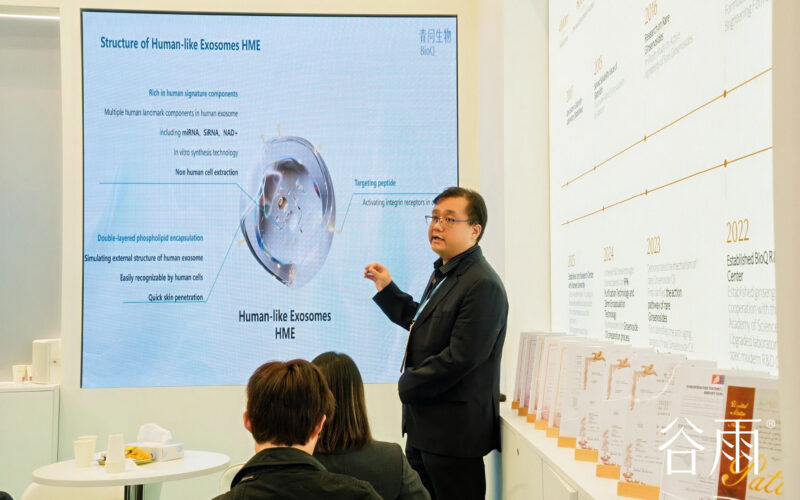
BioQ’s Biomimetic Extracellular Vesicles ingredient is the most ambitious part of the company’s Paris showcase. The ingredient is positioned as an exosome-inspired technology designed to mimic human cellular structures while avoiding some of the risks associated with natural exosomes. That positioning is smart because exosome skincare has attracted intense industry interest, but also regulatory and safety questions around sourcing, standardisation, biological activity and claims discipline.
BioQ says its Biomimetic Extracellular Vesicles use an 18.7-nanometre particle size and AI-guided functional programming, combining gene-level active ingredients such as miRNA, siRNA, NAD+ and PDRN. The company also points to laboratory data showing a reduction in senescence-associated cells within eight hours and improved ATP levels in fibroblasts after 24 hours. These are striking claims, but they should be read as early-stage ingredient substantiation rather than automatic proof of consumer-level anti-aging outcomes.
The strategic value of this technology lies in its attempt to create a more controllable alternative to natural exosome-based skincare. If BioQ can demonstrate safety, reproducibility and claim compliance, Biomimetic Extracellular Vesicles could allow GUYU to occupy a high-end cellular skincare position without depending on biologically variable human-derived or stem-cell-derived materials. The flip side is that the more sophisticated the language becomes, the higher the burden of proof. Skincare has borrowed from medicine before, sometimes elegantly and sometimes with a lab coat doing too much of the talking.
What does BioQ’s raw-material strategy reveal about the next phase of Chinese beauty competition?
BioQ’s debut suggests that the next phase of Chinese beauty competition will increasingly be fought upstream. Instead of simply competing for consumer attention, brands such as GUYU are trying to control ingredient science, patent portfolios, production systems and claims architecture. That matters because ingredient ownership can support better margins, more defensible premium positioning and faster product iteration.
This strategy also allows Chinese beauty companies to move from domestic brand-building into business-to-business influence. If BioQ can export proprietary ingredients, GUYU’s value chain expands from selling skincare products to potentially shaping what other beauty brands can formulate. That would represent a meaningful shift from consumer-facing competition to supply-chain participation, where ingredient credibility and manufacturing dependability become as important as brand recognition.
For global incumbents, the implication is not immediate displacement, but rising technical competition. Established ingredient suppliers still have advantages in regulatory familiarity, multinational customer relationships and long-standing trust. Yet BioQ’s emergence shows that Chinese companies are no longer content to sit downstream. They want to own the molecule, the delivery system, the efficacy story and the production economics. That is a much more serious form of competition than another serum launch.
What execution risks could limit BioQ’s global ingredient ambitions after its Paris showcase?
BioQ’s biggest execution risk is evidence translation. Laboratory findings, especially those generated internally or through commissioned testing, can support early positioning, but global ingredient buyers often need broader validation. They will want stability data, safety profiles, formulation compatibility, dose-response information, repeatability across skin models and claims that can survive regulatory review in different jurisdictions.
The second risk is regulatory language. Ingredients linked to cellular signalling, gene-level actives, exosome-like activity or senescence reduction can quickly drift toward drug-like territory if claims are not carefully managed. For a cosmetics ingredient supplier, the commercial sweet spot is powerful efficacy positioning without crossing into therapeutic claims that trigger more demanding oversight. BioQ will need disciplined messaging if it wants global formulators to adopt these technologies confidently.
The third risk is commercial trust. Ingredient buyers rarely switch to a new active simply because the science sounds exciting. They need supply reliability, pricing clarity, documentation quality and confidence that the supplier can support claims substantiation across markets. BioQ’s Paris debut opens the door, but converting trade-show visibility into global adoption will require patient technical selling. In beauty, the ingredient may be tiny, but the paperwork is rarely small. Lovely industry, brutal binders.
Key takeaways on what BioQ’s in-cosmetics Global debut means for China’s beauty ingredient sector
- BioQ’s debut at in-cosmetics Global signals that GUYU is positioning itself as an upstream ingredient technology player, not just a Chinese skincare brand.
- The showcase of AuroGlab, Ginsenoside CK and Biomimetic Extracellular Vesicles reflects a broader shift toward biotechnology-led skincare innovation.
- China’s beauty sector is increasingly trying to compete through proprietary actives, delivery systems and manufacturing control rather than price alone.
- AuroGlab strengthens GUYU’s positioning in brightening and tone-evening skincare, but its absorption and targeting claims will need broader validation.
- Ginsenoside CK gives BioQ a scalable anti-aging ingredient story built around biomanufacturing rather than conventional botanical extraction.
- Biomimetic Extracellular Vesicles could offer a more controlled alternative to natural exosome skincare if safety, repeatability and regulatory compliance are demonstrated.
- The strongest commercial opportunity for BioQ may be business-to-business ingredient supply, which would expand GUYU’s influence beyond consumer skincare.
- The biggest execution risk is whether BioQ can turn lab-level claims into globally accepted, independently validated and regulation-ready ingredient documentation.
- Established global ingredient suppliers are unlikely to be displaced quickly, but BioQ’s emergence shows that Chinese companies are moving deeper into the technical beauty supply chain.
- The long-term test is not whether BioQ can create attention at a trade show, but whether it can win trust from formulators, regulators and global beauty brands.
Discover more from Business-News-Today.com
Subscribe to get the latest posts sent to your email.