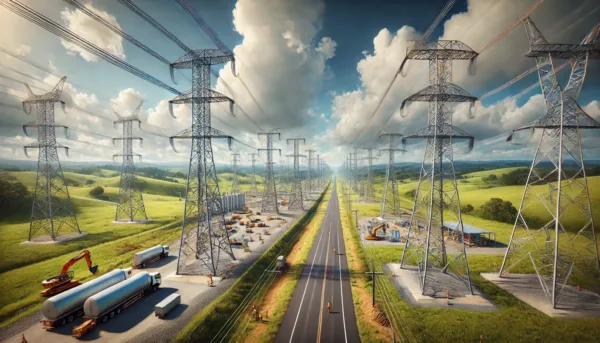



The United States Nuclear Regulatory Commission (NRC) has approved a construction permit for TerraPower’s first Natrium advanced nuclear reactor, marking the first time an advanced, commercial-scale reactor has cleared this stage of federal licensing. TerraPower, the Bellevue-based nuclear innovation company founded by Bill Gates, plans to build the facility in Kemmerer, Wyoming as Kemmerer Unit 1. The project represents a milestone for the United States nuclear sector and could become the country’s first utility-scale advanced reactor deployment. The regulatory decision also signals growing federal support for next-generation nuclear technologies aimed at meeting surging electricity demand from artificial intelligence infrastructure and industrial electrification.
TerraPower confirmed that construction activity on the reactor could begin within weeks following the Nuclear Regulatory Commission vote. The company spent several years working through the federal review process, including extensive pre-application discussions with regulators and the submission of a detailed construction permit application in March 2024.
The approval compresses what had originally been expected to be a 27-month regulatory review into roughly 18 months, reflecting both the completeness of the company’s submission and increasing political support for nuclear power development.
Why is the NRC construction permit for TerraPower’s Natrium reactor considered a major regulatory milestone?
The approval represents the first time a commercial advanced reactor design has secured a construction permit in the United States, placing TerraPower at the forefront of a global race to commercialize new nuclear technologies.
Traditional nuclear plants in the United States are typically based on large light-water reactor designs that were first developed decades ago. Advanced reactors, by contrast, are designed to offer improved safety systems, simplified construction, and greater operational flexibility. Governments and energy companies have increasingly viewed these technologies as critical tools for delivering reliable electricity while reducing carbon emissions.
For TerraPower, the permit represents validation of a long regulatory process. The company began extensive technical engagement with the Nuclear Regulatory Commission before submitting its application in 2024. The agency docketed the submission two months later, initiating a multi-year review covering safety analysis, environmental considerations, and engineering design.
The accelerated review timeline highlights how federal regulators are increasingly prioritizing advanced reactor technologies as part of broader energy policy objectives.
How does the Natrium reactor design combine nuclear generation with energy storage?
The Natrium system differs significantly from conventional nuclear plants. Instead of relying on water cooling systems, the reactor uses liquid sodium as a coolant, enabling higher operating temperatures and potentially greater efficiency.
The reactor itself is designed to produce approximately 345 megawatts of electricity under normal operating conditions. What distinguishes the system from most competing advanced reactors is the integration of a molten salt energy storage system.
This storage component allows the plant to temporarily boost output to roughly 500 megawatts during periods of peak demand while maintaining stable base generation. The design essentially transforms a traditionally inflexible nuclear plant into something closer to a hybrid between a baseload power station and a grid balancing resource.
Such flexibility is increasingly important as electricity grids integrate larger volumes of intermittent renewable energy.
By enabling rapid power ramping during demand spikes, the Natrium system could complement wind and solar generation while maintaining overall grid stability.
Could TerraPower’s Wyoming project become the first operational advanced reactor in the United States?
The Kemmerer project is being developed under the United States Department of Energy’s Advanced Reactor Demonstration Program, a public-private initiative intended to accelerate the commercialization of next-generation nuclear technologies.
Under current timelines, TerraPower expects the reactor to be completed around 2030. If achieved, it would likely become the first operational advanced reactor deployed at commercial scale in the United States.
The project carries symbolic weight for the American nuclear sector. The country has struggled to build new nuclear plants over the past two decades due to rising costs, regulatory complexity, and competition from natural gas and renewable power.
Advanced reactor developers argue that smaller designs, modular construction approaches, and new cooling technologies could significantly reduce project costs while improving operational safety.
TerraPower’s project will therefore serve as an early test case for whether these claims translate into real-world deployment success.
Why are technology companies increasingly backing advanced nuclear power projects?
The momentum behind advanced nuclear projects has been strengthened by an unlikely ally. The global technology sector.
Large technology companies are facing rapidly growing electricity demand as artificial intelligence training clusters and hyperscale data centers expand worldwide. These facilities require enormous amounts of reliable electricity and cannot rely solely on intermittent renewable energy sources.
In January 2026, TerraPower announced an agreement with Meta Platforms to develop up to eight Natrium reactors across the United States. The deal could ultimately provide approximately 2.8 gigawatts of baseload nuclear power, with peak capacity potentially rising to around 4 gigawatts when storage capabilities are used.
Meta Platforms agreed to provide funding support for the deployment of these reactors, with initial units expected to begin operation in the early 2030s.
The agreement reflects a growing trend among technology companies seeking long-term clean power contracts to support artificial intelligence infrastructure expansion.
Microsoft Corporation, Amazon.com Inc., and Alphabet Inc. have also begun exploring nuclear partnerships as part of broader clean energy procurement strategies.
How does TerraPower’s funding strategy reflect growing investor interest in advanced nuclear technologies?
Investor appetite for nuclear innovation has also strengthened as governments reconsider energy security and decarbonization priorities.
In June 2025, TerraPower raised $650 million in fresh capital, attracting new investors including NVentures, the venture capital arm of NVIDIA Corporation. Existing investors including Bill Gates and HD Hyundai also participated in the financing round.
The funding supports both the development of the Wyoming reactor and broader plans to deploy Natrium units across the United States and international markets.
The involvement of NVIDIA’s investment arm underscores the increasing intersection between artificial intelligence infrastructure and energy technology.
As machine learning workloads expand globally, the electricity demands of data centers have become one of the fastest-growing segments of energy consumption.
Advanced nuclear reactors could provide a reliable source of carbon-free electricity capable of supporting this demand growth.
What challenges could still slow the rollout of Natrium reactors in the United States?
Despite the regulatory milestone, several hurdles remain before TerraPower can scale its reactor technology.
Construction costs remain one of the largest uncertainties facing new nuclear projects. Even advanced reactors must prove that they can be built on time and within budget.
Supply chain constraints represent another potential obstacle. Nuclear projects rely on specialized materials, engineering expertise, and manufacturing capabilities that are currently limited in scale. Regulatory complexity may also remain a factor as additional reactor projects move through the licensing process.
Public acceptance of nuclear energy continues to vary across regions, particularly following decades of slow industry growth in the United States.
Finally, competition from other advanced reactor developers remains intense. Companies such as X-energy, NuScale Power, and Oklo are also pursuing regulatory approvals and demonstration projects aimed at bringing new reactor technologies to market.
The next decade will likely determine which reactor designs emerge as commercially viable.
Could TerraPower’s Natrium reactor reshape how future nuclear plants interact with power grids?
If successful, the Natrium design could change how nuclear plants operate within modern electricity systems. Traditional nuclear power plants are designed primarily for steady baseload operation and are not optimized for rapid power output changes.
The addition of integrated energy storage allows the Natrium system to adjust output more dynamically in response to grid demand. This capability could make nuclear energy more compatible with renewable power systems that rely heavily on wind and solar generation. It also creates new possibilities for nuclear plants to participate in electricity markets that reward flexible generation and peak power supply.
If TerraPower demonstrates the viability of this hybrid nuclear-storage model, other reactor developers may adopt similar approaches.
What are the key takeaways for the future of advanced nuclear power?
- TerraPower’s Natrium reactor has become the first commercial advanced nuclear design in the United States to receive a construction permit from the Nuclear Regulatory Commission.
- The Kemmerer Unit 1 project in Wyoming could become the country’s first operational advanced reactor when completed around 2030.
- The Natrium design combines a sodium-cooled fast reactor with molten salt energy storage, allowing the plant to increase electricity output during periods of peak demand.
- The project is being developed through the United States Department of Energy’s Advanced Reactor Demonstration Program, highlighting federal support for nuclear innovation.
- Technology companies such as Meta Platforms are increasingly supporting nuclear development to secure reliable electricity for artificial intelligence infrastructure.
- TerraPower’s $650 million funding round in 2025, which included NVentures, reflects growing investor interest in nuclear technologies linked to AI-driven electricity demand.
- Successful construction and operation of the Wyoming reactor could accelerate deployment of advanced nuclear plants across the United States and globally.
- Construction cost control and supply chain capacity remain key risks that could influence whether advanced reactors achieve large-scale adoption.
- Competition among reactor developers including X-energy, NuScale Power, and Oklo will shape which technologies dominate the next generation of nuclear power plants.
- If TerraPower proves its hybrid nuclear-storage model at scale, it could redefine how nuclear power integrates with renewable energy systems and future electricity grids.
Discover more from Business-News-Today.com
Subscribe to get the latest posts sent to your email.