




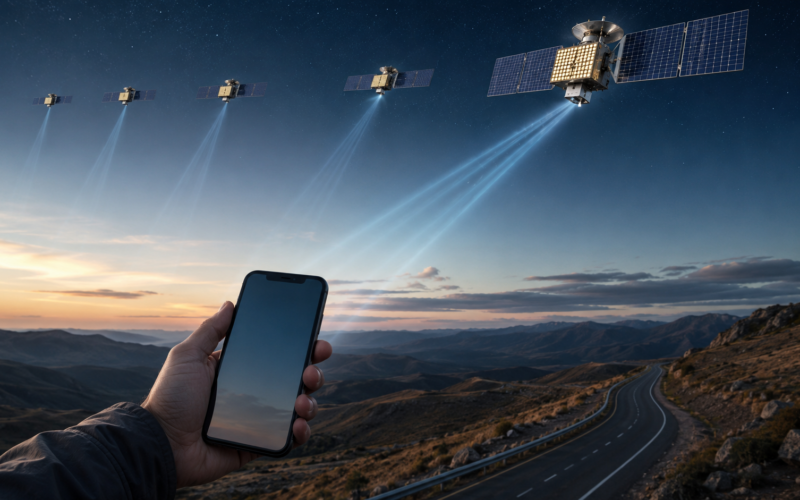
AST SpaceMobile is trying to do something no one has done at scale: beam a normal cellular signal straight from satellites to an ordinary smartphone, with no special hardware required. The Texas-based company is building a constellation of large BlueBird satellites to deliver broadband from space to phones that wander out of normal coverage, in partnership with major mobile carriers. The reason the ticker is moving right now is a stack of binary catalysts landing at once: three more BlueBird satellites are set to launch on a SpaceX Falcon 9 in mid-June, the US regulator has just cleared a far larger constellation, and the company is still recovering from losing a satellite in a launch accident. For a stock carrying a roughly US$44 billion valuation with almost no live network and tiny revenue, the next few weeks matter enormously.
What does AST SpaceMobile actually do and how is direct-to-device satellite broadband different?
AST SpaceMobile designs and operates BlueBird satellites that provide direct-to-device cellular broadband, meaning an unmodified smartphone can connect to the network when it is outside terrestrial coverage. The company partners with mobile carriers rather than competing with them, positioning its SpaceMobile service as a way to eliminate dead zones for existing subscribers and to serve government users. Founded in 2017 and headquartered in Midland, Texas, it has spent years developing the very large phased-array satellites the approach requires.
What separates this from conventional satellite internet is the absence of a dish or special terminal. Services like traditional satellite broadband need dedicated equipment, whereas AST SpaceMobile aims to make the phone already in your pocket the receiver. That is technically demanding, because reaching a low-power handset from orbit requires unusually large antennas in space, and it is the core of both the bull case and the engineering risk.
The implication for an investor is that the entire thesis rests on execution at scale. The technology has been demonstrated, and carrier partners have signed on, but the difference between a proof of concept and a continuous commercial service covering whole countries is measured in dozens of successful satellite launches. Anyone buying ASTS is betting that AST SpaceMobile can build and operate that network faster and more reliably than it has managed so far.
Why is the mid-June BlueBird satellite launch on SpaceX such a critical catalyst for ASTS?
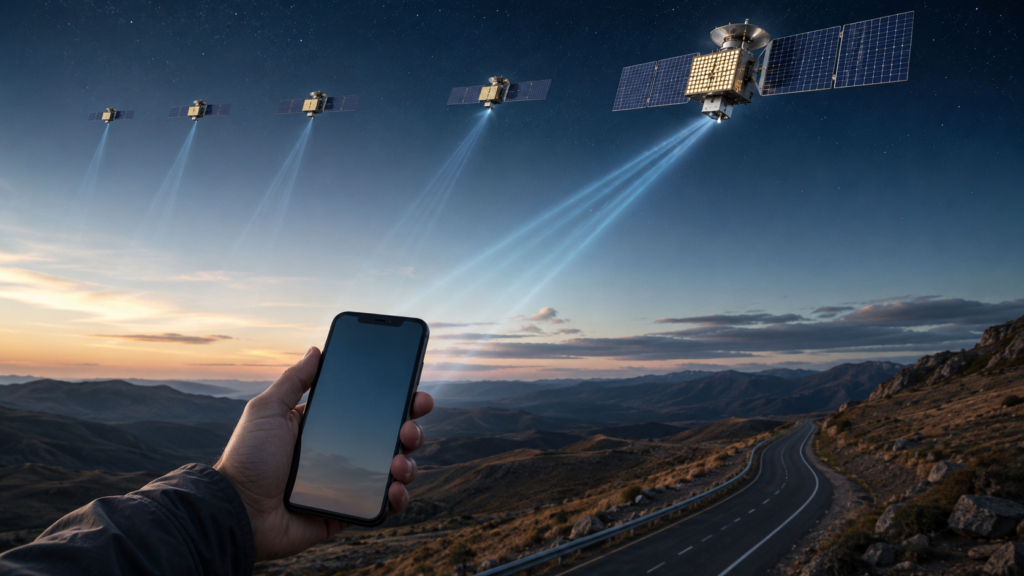
The most immediate event is the launch. AST SpaceMobile has confirmed that three more satellites, BlueBird 8, 9 and 10, are scheduled to fly on a SpaceX Falcon 9 in mid-June, and the company has said the mission will proceed as planned, which eased earlier worries about delay. Each batch of satellites is a concrete step toward a working network rather than a slide deck, which is why the market treats launch dates as hard catalysts.
The significance is in the sequence behind it. AST SpaceMobile is targeting a roughly 45-satellite operational network by the end of 2026, a threshold the company sees as enough to begin meaningful service in priority markets, and the mid-June launch is a building block toward that figure. Beyond that sits a much larger constellation. So the path from here runs launch by launch, with each successful deployment adding coverage and each failure setting the timeline back.
The risk is that launches are inherently binary and AST SpaceMobile has a mixed record on timing. A scrub, a delay, or an anomaly does not just dent sentiment, it pushes back the revenue that justifies the valuation. With the stock already pricing in a smooth build-out, the asymmetry is uncomfortable: a clean launch may be partly expected and already in the price, while a setback could hit hard. The event is a genuine catalyst, but catalysts cut both ways.
What did the FCC authorization for 248 satellites unlock for AST SpaceMobile and its carrier partners?
On 1 June 2026, AST SpaceMobile received commercial authorization from the Federal Communications Commission to deploy up to 248 satellites for direct-to-device service in the United States. This is a major regulatory milestone, because spectrum and licensing are often the hardest gate for a space-based network, and clearing it removes a structural source of uncertainty that had hung over the story.
The authorization matters most because of who it brings with it. The clearance is tied to work with Verizon, AT&T and FirstNet, giving AST SpaceMobile access to additional spectrum under the Supplemental Coverage from Space framework that lets satellite signals extend terrestrial carrier networks. Partnerships with the largest US carriers are the commercial backbone of the plan, because they provide the customer relationships and the spectrum that a standalone satellite operator would struggle to assemble alone.
The implication, and the caveat, is that authorization to deploy is not the same as a deployed network. The FCC decision gives AST SpaceMobile the legal runway for a constellation many times larger than what is in orbit today, but the company still has to build, launch and operate those satellites, and fund the enormous cost of doing so. Regulatory progress de-risks the story without shortening the long and capital-hungry road still ahead.
How damaging was the loss of BlueBird 7 in the Blue Origin launch anomaly for the timeline?
The clearest recent reminder of execution risk was the loss of a satellite. AST SpaceMobile’s first-quarter 2026 results included a net loss of about US$191 million, swollen by an asset write-off of roughly US$155 million to US$160 million after the BlueBird 7 satellite was lost following an anomaly on a Blue Origin New Glenn launch. Losing a built satellite is expensive in cash terms and worse in time, because it removes a planned piece of the constellation.
The context is that AST SpaceMobile depends on a small number of launch providers, and a problem at one of them ripples straight into its deployment schedule. Blue Origin has indicated its New Glenn rocket should return to flight before the end of 2026, which would restore capacity, and the company’s pivot to a SpaceX Falcon 9 for the mid-June mission shows it can spread launches across providers. That flexibility is a partial hedge against any single rocket grounding the programme.
The implication for the timeline is real but not fatal. The write-off dents the balance sheet and the lost satellite sets back coverage, yet AST SpaceMobile still holds a large cash position and a substantial contracted backlog to push forward. The episode is best read as confirmation that this is a high-risk deployment story where setbacks are likely, rather than as a thesis-ending event on its own.
How can AST SpaceMobile justify a US$44 billion valuation on barely any revenue today?
The valuation is the central debate. AST SpaceMobile recently carried a market capitalisation in the region of US$44 billion, a number that swings with a volatile share price, while first-quarter 2026 revenue was just US$14.7 million. Even though that figure represented explosive percentage growth from a tiny prior-year base, and full-year 2026 guidance sits at roughly US$150 million to US$200 million, the absolute revenue is a rounding error next to the valuation and the losses.
What the market is paying for is the option on a very large future market. If AST SpaceMobile builds a working global direct-to-device network, the addressable opportunity of connecting phones in every dead zone on Earth is enormous, and the carrier partnerships and FCC clearance lend that vision credibility. The company also has real financial firepower for its stage, with around US$3.5 billion in cash and more than US$1.2 billion in contracted revenue, which funds a meaningful chunk of the build.
The danger is that analyst expectations and the market price have diverged. With a small group of covering analysts holding an average rating around hold and a median target well below the current share price, the professional view implies meaningful downside if the network is not delivered on schedule. The stock prices in success, which means any combination of launch delays, weaker-than-hoped demand, or the need to raise more capital could force a sharp repricing.
What threat does SpaceX Starlink direct-to-cell pose to the AST SpaceMobile thesis?
Competition is the risk that is easiest to underestimate. SpaceX is rolling out its own direct-to-cell capability through Starlink, and it brings advantages AST SpaceMobile cannot match: it owns its launch vehicles, already operates the largest satellite constellation in history, and can deploy at a cadence no one else can rival. A direct-to-device service from Starlink targets the same basic problem of connecting phones outside terrestrial coverage.
The context softens the threat somewhat without removing it. AST SpaceMobile and Starlink take different technical and commercial paths, with AST SpaceMobile leaning on partnerships with incumbent carriers and a design aimed at broadband-grade speeds to standard phones, while the carriers themselves may prefer a partner that extends their networks rather than a rival that could disintermediate them. The market for filling dead zones may also prove large enough for more than one provider.
The implication is that AST SpaceMobile must win on execution and timing, not just vision, in a field where its largest competitor is also its main launch provider. There are also open questions about how strong consumer demand for direct-to-device service really is, since many users rarely leave coverage. A bull needs to believe both that the network gets built and that enough people and governments pay for it, with a formidable rival pushing on the same door.
Why do retail investors keep trading ASTS around every satellite launch and FCC headline?
AST SpaceMobile has become one of the defining retail trades in the space sector. The stock features heavily on trending lists, swings by double digits on launch confirmations and regulatory news, and moves alongside a wider basket of space names. The arrival of a leveraged single-stock product, the Defiance Daily Target 2X Long ASTS ETF, is a clear signal that issuers see reliable retail demand to amplify the daily moves.
The appeal is the clean narrative. A network that turns every smartphone into a satellite phone is easy to understand and easy to get excited about, and the steady drumbeat of launches, FCC decisions and carrier announcements gives traders a constant supply of catalysts to position around. Online communities track launch countdowns closely and treat each deployment as a referendum on whether the company can finally hit its targets.
The flip side is volatility driven by events rather than fundamentals. Because so much of the value depends on milestones that have not happened yet, the shares can rocket on a green light and slump on a delay, and the existence of leveraged products only sharpens those moves. With a launch due in mid-June and a long build-out ahead, there is plenty for traders to react to, but anyone holding through these catalysts should size positions for a stock that has shown it can move sharply in either direction within a single session.
Key takeaways for retail investors weighing AST SpaceMobile (NASDAQ: ASTS)
- AST SpaceMobile is building a constellation of BlueBird satellites to deliver direct-to-device cellular broadband to ordinary smartphones, in partnership with major carriers, but it has no continuous commercial network in service yet.
- The immediate catalyst is the mid-June launch of three more satellites on a SpaceX Falcon 9, a step toward a targeted roughly 45-satellite network by the end of 2026.
- The FCC authorized deployment of up to 248 satellites on 1 June 2026, tied to spectrum access with Verizon, AT&T and FirstNet, removing a major regulatory hurdle but not the build-out cost.
- Execution risk is live: the loss of BlueBird 7 in a Blue Origin launch anomaly drove a roughly US$155 million to US$160 million write-off and contributed to a US$191 million first-quarter loss.
- The valuation is the key tension, with a market capitalisation near US$44 billion against first-quarter revenue of US$14.7 million and a 2026 guide of about US$150 million to US$200 million; the average analyst target sits well below the current price.
- AST SpaceMobile holds a strong cash position of around US$3.5 billion and a contracted backlog over US$1.2 billion, but faces a serious competitive threat from SpaceX Starlink direct-to-cell and open questions about ultimate demand.
- This is a high-volatility, milestone-driven space stock where the upside vision and the launch, demand, competition and capital risks are unusually tightly linked.
Share this:
Discover more from Business-News-Today.com
Subscribe to get the latest posts sent to your email.