




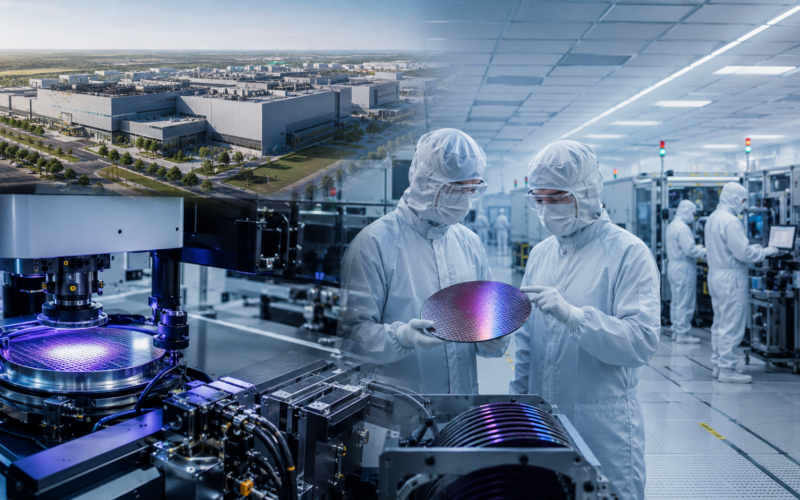
Tata Electronics and ASML Holding N.V. (NASDAQ: ASML) have signed a Memorandum of Understanding (MoU) to deploy ASML’s holistic suite of lithography tools and solutions at Tata Electronics’ upcoming 300 mm semiconductor fabrication plant in Dholera, Gujarat. The agreement, announced jointly from The Hague and Mumbai, gives India’s first commercial wafer fab access to the single most critical equipment category in chip manufacturing, supplied by the only company in the world that produces extreme ultraviolet and advanced deep ultraviolet lithography systems at scale. The Dholera fab, a roughly US$11 billion project, will manufacture chips across 28nm, 40nm, 55nm, 90nm, and 110nm process nodes for automotive, mobile, artificial intelligence, and industrial applications. For ASML, currently trading around US$1,501 on the Nasdaq with a market capitalisation of approximately US$584 billion and within striking distance of its 52-week high of US$1,603, the partnership opens a new sovereign-backed geography at a moment when its China revenue trajectory remains constrained by export controls.
What does the ASML partnership actually unlock for Tata Electronics’ Dholera fabrication plant ramp?
The MoU covers deployment of ASML’s full lithography portfolio relevant to the node range Tata Electronics has licensed from Powerchip Semiconductor Manufacturing Corporation. At 28nm and 40nm, this means access to advanced deep ultraviolet immersion systems, which are the workhorses of mature and mid-node logic and specialty foundry production globally. At 55nm, 90nm, and 110nm, the requirement shifts to dry deep ultraviolet and KrF-class scanners, where ASML competes more directly with Nikon and Canon but retains a commanding installed-base advantage in foundry environments. The “holistic” framing in the joint statement is significant. ASML increasingly sells lithography not as standalone tools but as an integrated stack that bundles scanners with computational lithography software, YieldStar metrology, and HMI e-beam inspection. For a greenfield fab attempting to hit qualified yield on a compressed timeline, that integration is not a luxury. It is the difference between hitting volume production targets and grinding through years of process variation.
The second strategic unlock is supply chain certainty. ASML’s order book and delivery lead times remain extended across most of its product lines, and equipment slots for new fabs are typically negotiated years in advance. By formalising the partnership at MoU stage with construction already progressing in Dholera, Tata Electronics is sequencing its equipment procurement ahead of the inevitable competition from other Asian and Middle Eastern fab projects that are now being announced at a rate not seen since the early 2000s. There is also the embedded service economics. Lithography is the highest-capex and highest-service-intensity equipment category in any fab, often accounting for a quarter or more of total tool spend and a meaningful share of ongoing operating costs. Locking in the supplier relationship at this stage gives Tata Electronics negotiating leverage on service contracts, spares inventory, and field engineer deployment that newer Indian fab projects will not enjoy.
Why is ASML’s commitment to India arriving at this specific geopolitical moment?
ASML is operating under a tightening web of export restrictions that has progressively narrowed its addressable market in China, historically one of its largest revenue contributors. Dutch and United States authorities have restricted sales of the most advanced extreme ultraviolet systems and, more recently, certain advanced immersion tools to Chinese customers. The company has publicly acknowledged the revenue impact, and the recent share price weakness, including a roughly 5 percent drop after the inconclusive United States-China trade summit, reflects market sensitivity to every incremental policy signal. Against that backdrop, India represents a politically aligned, capacity-additive market that does not carry the export-control overhang. For ASML’s planning horizon, a single 300 mm fab is meaningful but not yet transformational. The strategic prize is positioning for what comes after Dholera. India has announced ambitions for multiple fabs across compound semiconductors, memory, and advanced logic, and the first equipment supplier to embed itself in the ecosystem typically wins disproportionate share of subsequent projects.
The Netherlands government has also been explicit that semiconductor cooperation is now a pillar of its bilateral relationship with India, mirroring the deeper technology dialogues India has built with the United States, Japan, and Taiwan. By signing this MoU in the current quarter, ASML lands on the right side of an inter-government commitment without giving up commercial flexibility. There is a subtler defensive dimension as well. Should the Trump administration push the Dutch government toward additional restrictions on ASML’s China business, as recent reporting has suggested it may, ASML will need to show that revenue from compliant geographies, including India, is scaling fast enough to offset the contraction. A flagship customer relationship with a Tata Group entity backed by sovereign incentives is exactly the kind of optic, and substance, that helps make that case in The Hague and Washington.
How does the Tata Electronics and ASML partnership reshape the competitive landscape for Indian semiconductor manufacturing?
India currently hosts several announced semiconductor projects, but Tata Electronics’ Dholera plant is the only one targeting commercial 300 mm wafer production at scale. The other major projects, including Tata Electronics’ own assembly and test facility in Jagiroad, Assam, and Micron Technology’s ATMP facility in Sanand, focus on packaging rather than front-end wafer fabrication. CG Power’s partnership with Renesas and Stars Microelectronics, and Kaynes Semicon, are also positioned in the ATMP and OSAT segment. The ASML MoU therefore widens the strategic moat around Dholera. Front-end wafer fabrication is where the highest value-add sits in the semiconductor manufacturing stack, and lithography is the gating capability. By locking in ASML, Tata Electronics has effectively raised the entry cost for any future Indian competitor at the same node range, because every subsequent fab will need to either replicate the ASML stack at a later delivery slot or settle for second-tier lithography partners.
The competitive implications extend to global foundry economics. The mature and mid-node foundry segment, where Tata Electronics will compete, is currently dominated by Taiwan Semiconductor Manufacturing Company, United Microelectronics Corporation, GlobalFoundries, and Semiconductor Manufacturing International Corporation. Capacity additions at these nodes have lagged demand for automotive microcontrollers, power management chips, and analog devices through much of the post-pandemic period. A new entrant with a credible lithography backbone, Powerchip Semiconductor Manufacturing Corporation’s process technology, and sovereign incentives can plausibly capture a share of the supply that customers are currently desperate to diversify away from concentrated Taiwan exposure. The partnership also gives Tata Electronics credibility in customer qualification conversations with global automotive original equipment manufacturers and tier-one suppliers, where the audit checklist for fab qualification almost always begins with the lithography supplier.
What are the execution risks and timing pressures the Tata Electronics and ASML partnership cannot fully eliminate?
The first risk is talent. ASML’s industry-leading scanners require lithography engineers, process integration specialists, and field service teams who do not currently exist in India in sufficient numbers. The joint commitment to skill development addresses this directly, but the timeline from training program to production-grade engineer typically runs three to five years. Tata Electronics will need to import experienced talent from Taiwan, South Korea, the United States, and Europe in the interim, which creates compensation inflation across the Indian semiconductor labour market and raises operational expenditure assumptions in the fab’s financial model. The second risk is supply chain depth around lithography. Photoresists, photomasks, pellicles, and specialty chemicals are tightly held by a handful of mostly Japanese and Taiwanese suppliers, and the local ecosystem in India does not yet exist at the quality and volume required for a 300 mm fab. The joint statement’s reference to proactive supply chain resilience is therefore aspirational rather than immediately operational.
The third risk is yield ramp economics. Even with the best lithography stack in the world, new fabs typically run at sub-economic yields for the first eighteen to thirty months of operation. The Dholera fab will need to absorb that ramp loss against the backdrop of intense capital deployment, with the bulk of the US$11 billion investment front-loaded into construction and equipment. Sovereign incentives under the India Semiconductor Mission and Gujarat state programmes offset some of this, but the cash-flow profile remains demanding. The fourth risk is downstream demand alignment. The 28nm and 40nm nodes are well-suited to automotive and industrial applications, but they are also the segments where Chinese fabs are aggressively adding capacity under their own indigenisation push. Tata Electronics will need to demonstrate not just technical capability but also customer pipeline depth before its capacity comes online, ideally with binding offtake commitments rather than indicative interest.
What does ASML’s market positioning and recent share price action signal about its India bet?
ASML shares closed near US$1,501 in the most recent session, off the US$1,603 fifty-two-week high reached earlier this month but still within an extended uptrend that has seen the stock more than double from its 52-week low of US$683. Analyst sentiment remains constructive, with the consensus skewing toward buy and twelve-month price targets clustered around US$1,460 to US$1,660 depending on the broker. The recent pullback reflects two specific overhangs: the inconclusive United States-China trade summit and continuing uncertainty over the scope of additional export restrictions. The India MoU does not move the needle on near-term revenue, given that the Dholera fab will not be in volume production for several years, but it reinforces the geographic diversification thesis that underpins ASML’s long-term valuation. Each new sovereign-backed customer relationship reduces the company’s structural dependence on the Taiwan, South Korea, and China triad that has defined its order book for the last decade.
For ASML’s balance sheet, the partnership is also a useful data point on demand durability across the mature and mid-node DUV product range. Much of the investor focus over the last two years has centred on EUV and high-numerical-aperture EUV adoption at advanced logic and memory customers. The Dholera fab will not consume EUV tools, but it will consume meaningful quantities of immersion and dry DUV systems, alongside the metrology and computational lithography portfolio. A multi-fab India build-out, which Tata Group and the Indian government have both indicated is a directional ambition, would convert ASML’s DUV backlog visibility from quarterly speculation to multi-year planning certainty.
Key takeaways on what the Tata Electronics ASML partnership means for the company, competitors, and the global semiconductor industry
- Tata Electronics has secured the single most strategically important equipment partnership for its Dholera fab, eliminating the largest technical execution risk in the project’s critical path
- ASML’s holistic lithography stack, including computational software and metrology, materially shortens the expected yield ramp timeline for India’s first commercial 300 mm fab
- The MoU gives Tata Electronics first-mover advantage in equipment slot allocation, raising entry barriers for any future Indian fab project at comparable nodes
- For ASML (NASDAQ: ASML), India represents a politically aligned, capacity-additive geography that helps offset the structural revenue pressure from tightening China export controls
- The partnership reinforces the bilateral technology dialogue between India and the Netherlands and is consistent with India’s broader semiconductor diplomacy with the United States, Japan, and Taiwan
- Mature and mid-node foundry competitors including Taiwan Semiconductor Manufacturing Company, United Microelectronics Corporation, GlobalFoundries, and Semiconductor Manufacturing International Corporation now face a credible new entrant with sovereign backing and a top-tier lithography supplier
- Talent and specialty chemicals supply chain depth remain the binding constraints on India’s semiconductor ambition, and both will require sustained policy and private-sector investment beyond the equipment layer
- ASML’s share price near US$1,501, within 6.5 percent of its 52-week high and a market capitalisation of approximately US$584 billion, reflects investor appetite for geographic diversification stories of exactly this type
- Powerchip Semiconductor Manufacturing Corporation’s technology licensing combined with ASML’s equipment stack gives Tata Electronics a defensible technology base across five process nodes from day one
- The agreement’s significance is less about the first fab and more about positioning ASML as the default lithography supplier for the multi-fab Indian build-out that policy makers in New Delhi and Gandhinagar are now openly contemplating
Discover more from Business-News-Today.com
Subscribe to get the latest posts sent to your email.

