
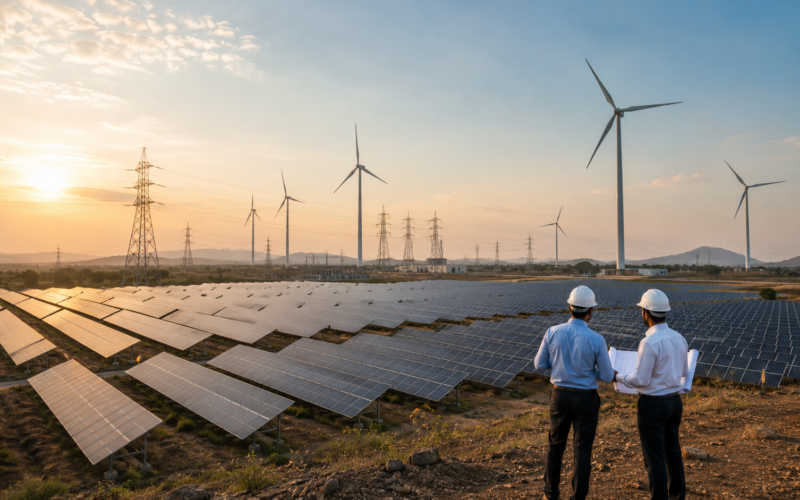
AMPIN Energy Transition has achieved financial closure on a US$195 million project financing facility for a 100 MW wind-solar hybrid project with battery energy storage in Andhra Pradesh, providing another sign that India’s renewable power market is moving beyond standalone solar and wind toward projects capable of delivering electricity when the grid actually needs it. Sumitomo Mitsui Banking Corporation and Rabobank acted as mandated lead arrangers, joint structuring banks and green loan coordinators, while the financing was structured in accordance with the Green Loan Principles and Equator Principles. The project is backed by a power purchase agreement and is intended to supply renewable electricity during peak-demand periods rather than simply generating whenever solar or wind resources are available.
The financing is commercially significant relative to the project’s 100 MW contracted capacity. Dividing the US$195 million facility by 100 MW gives an indicative financing intensity of approximately US$1.95 million per MW, although that figure should not be interpreted as the construction cost of a conventional 100 MW renewable plant because the development combines wind, solar and battery storage and because the individual component capacities have not been fully disclosed in the financing announcement. AMPIN separately states that its assured-peak renewable programme includes at least 100 MWh of battery storage for the 100 MW capacity it secured under the Solar Energy Corporation of India’s peak-power procurement.
Why is AMPIN financing a 100MW project with a $195 million facility?
Standalone utility-scale solar projects in India typically require considerably less capital per MW than the implied financing intensity associated with AMPIN’s transaction, but comparing the two directly would be misleading. This development combines multiple generation technologies with storage, grid infrastructure and contractual performance requirements intended to ensure supply during specified peak periods. The batteries add substantial upfront capital cost, while wind and solar assets may both need to be oversized relative to the contracted delivery capacity so that enough electricity is available to charge storage and satisfy the PPA.
The financing structure therefore reflects a different product. AMPIN is not simply selling renewable megawatt-hours when the sun shines or wind blows; it is developing a system designed to shape renewable output into a more dispatchable product. That distinction increasingly matters in India as midday solar generation rises and evening demand continues after photovoltaic output declines.
The participation of Sumitomo Mitsui Banking Corporation and Rabobank is also relevant because international lenders subject complex renewable projects to detailed assessments of offtaker quality, resource modelling, storage performance, construction risk and debt-service capacity. Financial closure does not guarantee successful execution, but it indicates that the project has progressed beyond an award or development concept into a financeable construction proposition.
How does battery storage change the value of AMPIN’s wind-solar project?
Wind and solar have complementary generation profiles but remain variable. Solar output is concentrated during daylight hours, while wind production can occur at different times but varies with weather conditions. Adding batteries enables part of the combined renewable output to be stored and discharged during contracted peak periods, reducing the mismatch between when renewable electricity is produced and when demand is highest.
AMPIN has said its storage strategy is aimed at serving round-the-clock and assured-peak power requirements. Its broader pipeline includes a 100 MW award under Solar Energy Corporation of India’s Hybrid VI peak-power tender, for which the company indicates at least 100 MWh of battery capacity will be deployed.
The amount of storage ultimately installed is important because 100 MWh would provide one hour of discharge at 100 MW if operated at the project’s full contracted capacity. The actual operating strategy may involve different discharge rates, multiple renewable inputs and contractual delivery windows, so the battery should not automatically be characterised as a one-hour system without final project specifications. What can be said is that storage turns the project from a generation-only asset into a power-delivery system with far greater control over timing.
Why does the PPA matter so much to the $195 million financing?
Project-finance lenders generally depend on the underlying asset’s future cash flows rather than relying primarily on the developer’s corporate balance sheet. A long-term power purchase agreement therefore provides the revenue visibility needed to assess debt repayment, particularly where the project combines technologies with different cost and operating profiles.
AMPIN’s financing announcement specifically describes the project as PPA-backed. That distinction reduces merchant-price exposure because a contractual purchaser has already committed to buy qualifying output under agreed terms, although the value of that protection depends on the tariff, contract tenure, performance obligations, counterparty strength and penalties, none of which were fully disclosed in the publicly available financing announcement.
For lenders, storage-backed renewable PPAs can also introduce additional performance questions. A solar plant may primarily need to meet generation and availability obligations, whereas dispatchable renewable projects can face requirements linked to delivery windows, minimum availability or scheduled power. Underperformance therefore can have a more direct impact on contracted revenue.
How large has AMPIN Energy Transition’s wider portfolio become?
AMPIN has built a renewable portfolio of approximately 6 GW and more than 5.5 GWh of storage, placing the Andhra Pradesh financing inside a much larger development programme rather than treating it as a single experimental project. The company has also expanded across corporate renewable procurement, utility tenders and hybrid power arrangements.
Recent corporate agreements include renewable supply arrangements for industrial customers such as Grasim Industries and Tatva Chintan Pharma Chem. That customer diversification gives AMPIN exposure to both central procurement programmes and companies attempting to reduce electricity costs and emissions through long-term renewable contracts.
The storage figure is particularly notable. A pipeline exceeding 5.5 GWh means AMPIN increasingly resembles an integrated renewable-and-flexibility platform rather than a conventional wind or solar developer. Converting that pipeline into operating assets will require significant financing beyond the latest US$195 million facility, making lender appetite an important constraint on the speed of expansion.
Why could this financing matter for India’s wider power market?
India’s renewable build-out has reached a stage where simply adding more daytime solar capacity cannot solve every power-system problem. Grid operators must manage evening peaks, renewable forecasting errors, transmission constraints and the need for firm capacity when weather conditions reduce output. Storage-backed hybrid projects directly address some of those challenges by shifting renewable electricity across hours and combining different resource profiles.
The financing also demonstrates that international banks are willing to fund such structures at meaningful scale when the contracts and risk allocation are acceptable. That matters because India’s transition toward firm and dispatchable renewable energy will require substantial private debt alongside equity from developers.
Financing terms have not been publicly disclosed, including interest rate, maturity, debt-service coverage requirements or sponsor equity contribution. Those figures would determine how attractive the transaction is for AMPIN itself. Nevertheless, securing US$195 million for a 100 MW contracted project shows that the market is beginning to finance storage-backed renewables as infrastructure rather than treating them primarily as pilot technology.
What should determine whether AMPIN’s Andhra Pradesh project succeeds?
The first operational test will be whether construction remains on budget while wind, solar and battery components are integrated into one dispatchable system. Storage procurement, battery degradation, grid connection and generation-resource assumptions all affect the economics, while the project must satisfy the obligations embedded in its PPA once commercial operations begin.
The second test will be utilisation. A storage system creates the greatest value when it can consistently shift low-cost renewable electricity into higher-value demand periods without excessive degradation or curtailment. If AMPIN demonstrates that the project can meet contracted peak requirements reliably, it could strengthen the financing case for similar hybrid developments across its 5.5 GWh storage pipeline.
The US$195 million financial close is therefore more than another green loan announcement. It marks a transition from intermittent renewable generation toward bank-financed renewable capacity that is increasingly being judged on when it can supply electricity, not simply how many megawatt-hours it can produce during favourable weather.
Discover more from Business-News-Today.com
Subscribe to get the latest posts sent to your email.