

Generac Holdings Inc. (NYSE: GNRC) has signed a long-term supply agreement with Amazon.com Inc. (NASDAQ: AMZN) covering backup power generators for Amazon data centres, with initial deliveries expected to total approximately $2.4 billion during 2027 and 2028. The scale of the arrangement triggered a dramatic market response, with Generac shares surging more than 40% in after-hours trading after the September 16 disclosure.
The transaction could ultimately become considerably larger. Generac issued an Amazon subsidiary warrants covering as many as 1,693,745 Generac shares at an exercise price of $200.9266 per share, with most of those shares vesting according to aggregate payments Generac receives from Amazon for backup generators. The vesting schedule extends up to $8 billion of Amazon purchases, revealing a potential commercial relationship far larger than the initial $2.4 billion commitment.
Why does Amazon need billions of dollars of backup generators for its data centres?
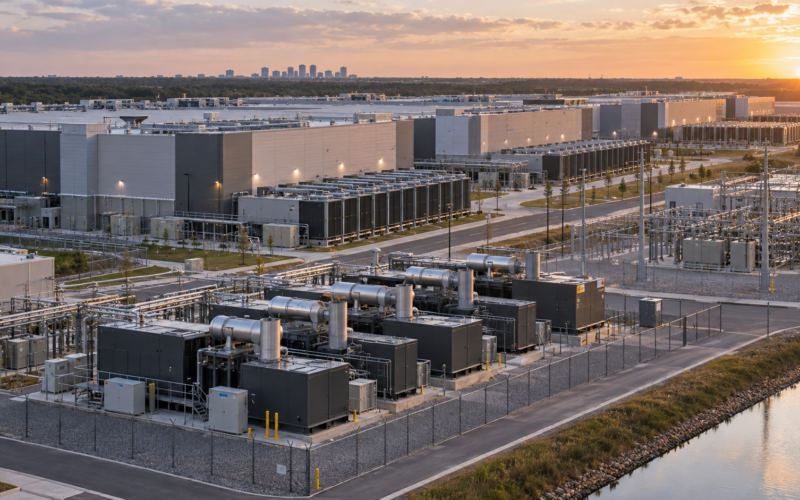
Modern cloud and artificial-intelligence data centres require extraordinary levels of electrical reliability. A hyperscale facility cannot simply shut down when the local electricity grid suffers an outage because the underlying infrastructure supports enterprise workloads, artificial-intelligence applications and customer services that may operate continuously across global markets.
Backup generation therefore sits behind the more visible parts of the AI investment boom. Nvidia processors, custom accelerators and networking equipment receive much of the attention, but every data-centre campus also needs grid connections, substations, cooling systems, batteries and emergency power capable of maintaining operations when the normal electricity supply fails.
Amazon is one of the world’s largest cloud infrastructure operators through Amazon Web Services, meaning its physical computing footprint translates directly into demand for electricity and power-management equipment. The Generac agreement indicates that Amazon is moving beyond transactional procurement and locking in substantial future backup-power capacity.
That kind of long-term commitment can become strategically valuable when suppliers face manufacturing constraints. Reserving equipment years before a data centre opens reduces the risk that electrical infrastructure becomes the component delaying a multi-billion-dollar computing project.
How significant is the Amazon contract relative to Generac’s existing business?
The contract is enormous relative to Generac’s current scale. Generac generated second-quarter 2026 sales of $1.17 billion, meaning the $2.4 billion of Amazon deliveries planned across 2027 and 2028 is equivalent to more than two entire quarters of the company’s present overall revenue.
The business mix has already been changing quickly. Commercial and Industrial segment external sales increased approximately 29% year over year in the second quarter to $556 million, compared with $431 million a year earlier. Generac also said its backlog for products serving data centres had reached approximately $1.6 billion by late July, excluding committed volume from a second hyperscale customer with which terms were still being negotiated.
Generac historically built its identity around residential and commercial backup generators, businesses driven partly by storms, grid reliability and household demand. Hyperscale data centres offer something different: larger individual orders, longer production visibility and potentially much higher equipment requirements per customer.
The Amazon agreement therefore creates a possible structural change in investor perception. Generac can increasingly be analysed not only as a backup-generator manufacturer but as part of the physical infrastructure layer supporting cloud computing and artificial intelligence.
Why did Amazon receive warrants to buy almost 1.7 million Generac shares?
The warrant creates an incentive structure linking Amazon’s commercial purchases with potential equity ownership. Of the 1.69 million warrant shares, 307,954 vested immediately. Most of the remainder will vest in tranches as Generac receives increasing amounts of qualifying payments from Amazon and its affiliates for backup-power equipment.
The arrangement means Amazon gains greater equity participation if it becomes a much larger Generac customer. At the maximum level, Reuters estimated the warrant would represent close to 3% of Generac’s outstanding stock, although the final ownership depends on vesting and exercise conditions.
Amazon has used comparable supplier arrangements before. Equity incentives can help secure strategically important products while aligning a supplier’s growth with Amazon’s own procurement volumes.
For Generac shareholders, however, there is a trade-off. A sufficiently large Amazon relationship could dramatically increase revenue and factory utilisation, but warrant exercise creates dilution. Investors therefore need to compare the incremental earnings generated by Amazon purchases against the additional shares that could eventually be issued.
At the scale contemplated by the agreement, the commercial opportunity appears far more important than the dilution alone, which helps explain the immediate share-price reaction.
Can Generac manufacture enough large generators to serve hyperscale customers?
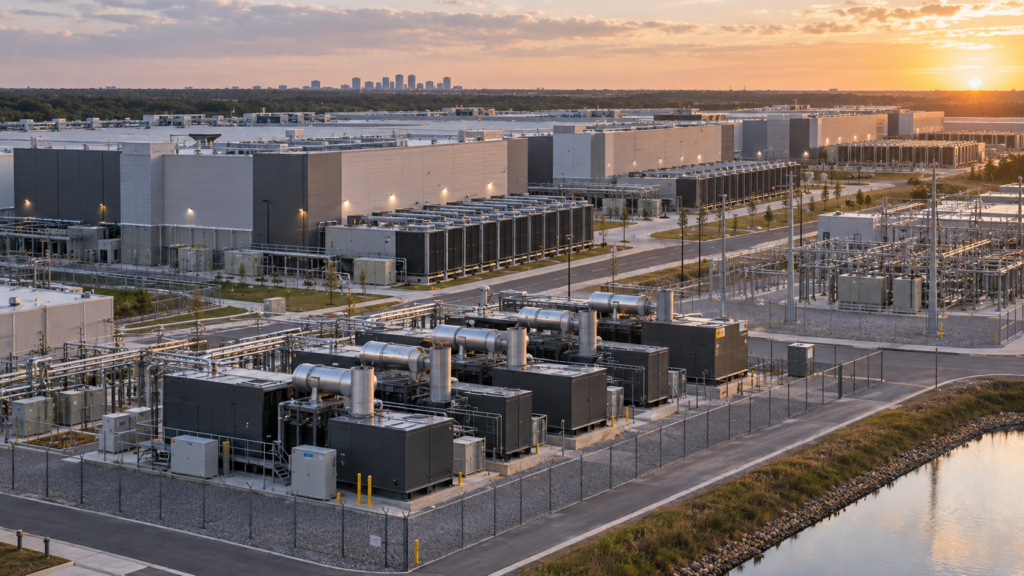
Capacity is becoming one of the decisive questions. Generac acquired a facility in Belvidere, Illinois, during 2026 to expand large-megawatt generator packaging capacity and has been investing in production infrastructure as its data-centre pipeline grows.
These systems are more demanding than conventional residential generators. Hyperscale campuses require large units, significant packaging and integration work, stringent reliability standards and the ability to deliver substantial equipment volumes on predictable schedules.
Generac’s second-quarter free cash flow was $63 million compared with $14 million a year earlier, while companywide sales increased 11%. The rapid growth of Commercial and Industrial operations consequently provides both opportunity and a capital-allocation challenge because Generac must expand manufacturing before all future revenue is realised.
That makes execution almost as important as demand. A large backlog is financially valuable only if products can be manufactured and delivered at acceptable margins without excessive working-capital requirements.
What does the Amazon deal tell us about the economics of the AI boom beyond semiconductor stocks?
The most interesting implication is the breadth of the spending cycle. Artificial intelligence is generating demand well outside processors and servers, reaching companies involved in power generation, electrical equipment, cooling, construction and fuel infrastructure.
Backup generators are a particularly revealing example because they do not make AI models faster. Their value lies in protecting the enormous capital already installed inside data centres.
When a hyperscaler spends billions on servers, the economic cost of an outage increases. That makes reliability infrastructure proportionally more valuable and may support higher spending on redundant power systems.
Generac therefore represents a second-order AI beneficiary. Its exposure depends less on which AI model wins and more on whether hyperscalers continue constructing large facilities with stringent uptime requirements.
Why did Generac shares jump so dramatically after the filing?
Generac shares rose more than 40% in after-hours trading after the agreement became public, reflecting a sudden reassessment of future revenue visibility. The market had already recognised data centres as an emerging business for Generac, but the disclosure identified Amazon as a customer and quantified a $2.4 billion near-term commitment with a pathway toward as much as $8 billion of purchases.
That is materially different from a generic announcement about AI-related opportunity. Investors now have contractual numbers, delivery windows and equity terms against which to model future sales.
The reaction also raises expectations significantly. Generac must now demonstrate that large hyperscale volumes produce attractive margins and that concentration around customers such as Amazon does not create excessive bargaining dependence.
The next milestones will be capacity expansion, the pace of Amazon deliveries during 2027 and 2028, additional hyperscale customers and evidence that the Commercial and Industrial segment can convert backlog growth into sustainable free cash flow.
Generac has already been pulled into the AI infrastructure trade. The Amazon contract now gives investors enough scale to test whether that narrative becomes an enduring earnings transformation.
Discover more from Business-News-Today.com
Subscribe to get the latest posts sent to your email.