
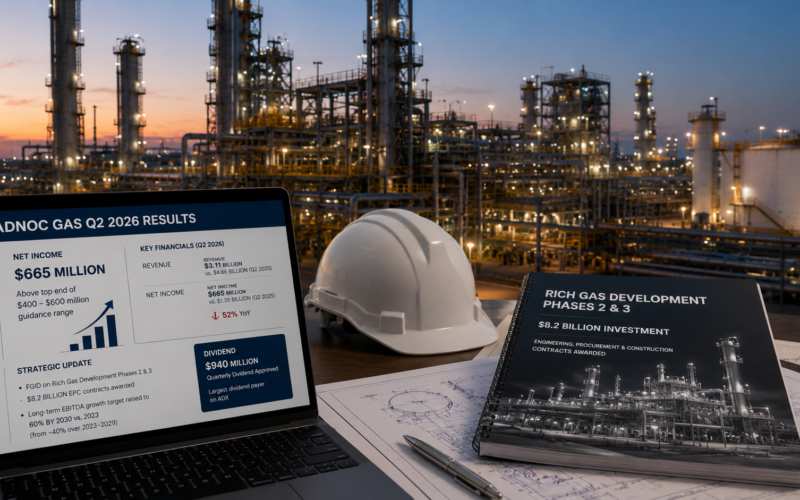
ADNOC Gas plc (ADX: ADNOCGAS) reported second-quarter 2026 net income of $665 million, above the top end of the $400 to $600 million guidance range it had communicated in May, even as reported profit fell roughly 52 per cent from the $1.39 billion delivered a year earlier and revenue eased to $3.11 billion from $4.66 billion. Alongside the results, the Abu Dhabi-listed gas processor took Final Investment Decisions on Phases 2 and 3 of its Rich Gas Development project, awarding $8.2 billion of engineering, procurement and construction contracts to Wison Engineering and Tecnimont, and raised its long-term EBITDA growth ambition to 60 per cent by 2030 versus 2023, up from the earlier target of more than 40 per cent over 2023 to 2029. The board also approved a quarterly dividend of $940 million, keeping ADNOC Gas the largest dividend payer on the Abu Dhabi Securities Exchange. The central tension is that a very steep year-on-year profit compression from Strait of Hormuz disruption and April security incidents at the Habshan gas processing complex sits directly alongside one of the most decisive capital allocation moments in the company’s short public history, and the market now has to weigh a bruised trailing print against a materially larger forward growth base.
How does ADNOC Gas’s $665 million net income sit against the 52 per cent year-on-year decline in the second quarter of 2026?
The headline profit collapse is real, but the shape of it is important for anyone modelling ADNOC Gas from here. Reported net income of $665 million compares with about $1.39 billion in Q2 2025, a decline of approximately 52 per cent, while revenue of $3.11 billion is roughly a third lower than the $4.66 billion booked a year earlier. Management’s own guidance range, set in May after the Habshan security incidents on 3 and 8 April and the disruption to maritime traffic through the Strait of Hormuz, was $400 to $600 million. On that measure the result is a clean beat, delivered $65 million above the top of the range and about $115 million above the midpoint.
The beat was driven, according to the company, by resilient margins in the domestic gas business, which supplies approximately 60 per cent of the United Arab Emirates’ sales gas needs. Export liftings were the swing factor on the way down, with the Strait of Hormuz disruption limiting product movements in the quarter. Fatema Al Nuaimi, Chief Executive Officer of ADNOC Gas, framed the outcome as a demonstration of the durability of the domestic franchise and the discipline of execution during a period of exceptional external shock. For investors, the take-home is that even in the worst combination of circumstances that ADNOC Gas has faced as a listed company, the domestic gas business held the profit line inside a range management had already lowered, rather than blowing through it.

Why does the Rich Gas Development final investment decision matter for the 2030 growth story of ADNOC Gas?
The strategic centrepiece of the Q2 update is the FID and $8.2 billion of EPC contract awards for Phases 2 and 3 of the Rich Gas Development project. Wison Engineering has been awarded a $3.9 billion contract for Phase 2, which will add a new natural gas processing train at the Habshan facility, expanding processing capacity and operational flexibility to support the UAE’s downstream and petrochemical growth. Tecnimont has been awarded $4.3 billion for Phase 3, which will add a new natural gas liquids fractionation train at Ruwais, increasing the recovery of higher-value liquids from rich natural gas for export.
Together with the roughly $5 billion of investment already committed to Phase 1, announced in June 2025, total capital committed to the Rich Gas Development programme now sits at approximately $13.2 billion. That is the direct enabler of the upgraded 2030 target: ADNOC Gas now aims for 60 per cent EBITDA growth by 2030 versus 2023, based on a Brent crude oil price assumption of $70 per barrel, replacing the earlier target of more than 40 per cent over the 2023 to 2029 window. Management also disclosed that ADNOC Gas now expects to invest approximately $28 billion between 2026 and 2030 to deliver on that ambition. The scope of the upgrade is meaningful because it is anchored in already-awarded EPC contracts and processing volumes tied to a defined feedstock plan, rather than a purely aspirational multi-year outlook.
How do the $8.2 billion EPC awards to Wison Engineering and Tecnimont shape Habshan and Ruwais capacity for the rest of the decade?
The two contract awards divide the growth story cleanly by asset. Phase 2 at Habshan is a throughput expansion play, adding fresh processing capacity into the same integrated complex that was struck by two security-related incidents on 3 and 8 April 2026. Phase 3 at Ruwais is a value uplift play, increasing the recovery of natural gas liquids from rich gas streams and lifting the share of higher-value exportable products in the overall sales mix.
The strategic implication is that ADNOC Gas is not simply rebuilding capacity that was interrupted earlier this year, but expanding it while simultaneously enriching the product slate. Combined with continued investment across the ADNOC value chain, including the recently announced Bab Gas Cap and Umm Shaif Gas Cap developments, the company expects additional feedstock to flow into the ADNOC Gas value chain over the medium term. The Rich Gas Development programme is designed to convert those extra feedstock volumes into incremental processing throughput, LNG exports and NGL sales, rather than absorbing them into existing headroom. That is the mechanism through which the $28 billion capex plan is intended to translate into the upgraded 2030 EBITDA growth target.
What does the accelerated Habshan recovery mean for the ADNOC Gas earnings floor from here?
Habshan is central to any near-term earnings picture and the recovery track has moved ahead of schedule. In May, following the April incidents, ADNOC Gas said it had already restored 60 per cent of the complex’s processing capacity and was working toward 80 per cent restoration by the end of 2026, with full capacity restored in 2027. In its Q2 update the company said gas supply had already been restored to 85 per cent, surpassing the year-end target set in May, and described its technical assessment of the impact as concluded.
That matters for two reasons. First, it removes some of the tail risk around the operational base for the rest of 2026, because the biggest single-asset shock in the recent trailing period has been resolved faster than the market was told to expect three months ago. Second, it reinforces the credibility of the guidance framework, since the company has now beaten a lowered Q2 net income range and simultaneously delivered ahead of a stated operational milestone. Any residual downside in the second half is more likely to come from external maritime and pricing conditions than from the state of Habshan itself.
How does the third-quarter and full-year 2026 guidance frame the Hormuz recovery scenario for ADNOC Gas?
Management set Q3 2026 net income guidance in a range of $600 to $800 million, on the assumption that maritime routes through the Strait of Hormuz continue to be disrupted. That assumption is deliberately cautious. Looking further ahead, if maritime operations are fully restored by the fourth quarter of 2026 and pricing realisations normalise, ADNOC Gas expects full-year 2026 net income to range from $3.5 billion to $4.0 billion, unchanged from the range communicated with the Q1 update in May.
Mapping the disclosed pieces against that full-year range gives a rough sense of what the Q4 recovery needs to look like. Q1 2026 net income was around $1.08 billion, Q2 was $665 million and the Q3 midpoint is $700 million. That points to a fourth-quarter run-rate somewhere in the $1.05 billion to $1.55 billion band to hit the guidance range, which would require both liftings recovery and price normalisation to broadly land as management is assuming. It is a scenario with visible upside if the maritime picture clears earlier, and equally visible downside if either the Strait of Hormuz disruption or product pricing lingers into the fourth quarter.
Why does the $940 million quarterly dividend keep ADNOC Gas central to the Abu Dhabi income story?
The board approved a quarterly dividend of $940 million, payable in September 2026, which the company said keeps it aligned with its commitment to deliver annual dividend growth of 5 per cent through 2030. ADNOC Gas remains the largest dividend payer on the ADX, a distinction that matters both for domestic retail participation and for institutional yield mandates focused on the Gulf.
The distribution has not been trimmed to accommodate the Q2 profit hit or the large EPC award. That is a deliberate signal about the layering of the capital plan: the $28 billion 2026 to 2030 investment programme is expected to be funded from operating cash flow generated across the gas value chain, rather than from a re-cut of the dividend baseline. For income-focused shareholders, the practical takeaway is that the progressive dividend policy has held through a period of operational shock and a step-up in growth commitments, which is arguably a more useful stress test than any prior quarter since the 2023 IPO.
What role do MERAM Ruwais LNG and Estidama play in the wider $28 billion capex programme at ADNOC Gas?
Rich Gas Development is one of four megaprojects that together frame the growth build for ADNOC Gas. The other three are Ruwais LNG, Maximizing Ethane Recovery and Monetization (MERAM), and Estidama. The company said MERAM is expected to be delivered in 2027, while Ruwais LNG and Estidama are both progressing as planned. Collectively, the four programmes are expected to generate about $13.4 billion of In-Country Value, reinforcing the company’s role in the UAE’s industrial development and economic diversification agenda.
Ruwais LNG will more than double capacity for global LNG sales from the Arabian Gulf coast plant that ADNOC is constructing, and remains one of the largest medium-term catalysts for ADNOC Gas’s export profile. MERAM feeds into a higher recovery yield of ethane, a critical petrochemical feedstock, and links directly into the domestic downstream growth story. Estidama, while less discussed in the current update, sits inside the wider portfolio of long-life growth projects that underpin the 60 per cent EBITDA growth target for 2030. ADNOC Gas is also scaling artificial intelligence and robotics across its assets, including aerial drones, four-legged inspection robots and tank-climbing crawlers, which the company said have the potential to cut certain inspection costs by up to 75 per cent and complete inspections up to 15 times faster.
What are the main execution and market risks that could still unwind the ADNOC Gas 2030 thesis?
The upgraded plan is anchored to a Brent oil price assumption of $70 per barrel, so a durable move below that level would put pressure on the EBITDA growth ratio without necessarily changing the operational trajectory. The Q3 and full-year 2026 guidance is explicitly conditional on the shape of the Strait of Hormuz disruption and on pricing realisations normalising, and neither of those assumptions is inside management’s control.
Execution risk on the Rich Gas Development also stretches across two large EPC contractors, Wison Engineering and Tecnimont, working across Habshan and Ruwais with construction and commissioning timelines running well into the second half of the decade. Habshan itself carries a residual security overhang, given that the April 2026 incidents demonstrated the physical exposure of a single complex central to both domestic supply and export volumes. Finally, the sheer scale of the $28 billion 2026 to 2030 capex programme means that any slippage in cash generation, whether from lower Brent, softer liftings or a slower Hormuz recovery, could tighten the balance between growth investment and the progressive dividend policy the market has now been trained to expect.
What has improved for ADNOC Gas, what remains unresolved, and what is the next measurable proof point for the market?
What has improved is the sanctioned growth base. The $8.2 billion of EPC awards for Rich Gas Development Phases 2 and 3, the upgrade of the 2030 EBITDA growth target to 60 per cent versus 2023, the accelerated 85 per cent recovery at Habshan, and the maintained $940 million quarterly dividend all point in the same direction. What remains unresolved is the shape of the second-half operational environment, specifically whether the Strait of Hormuz disruption continues to constrain liftings deep into Q3 and whether pricing realisations recover in time to deliver full-year 2026 net income inside the $3.5 billion to $4.0 billion guidance range. The next clear proof point is the Q3 2026 result and updated Hormuz commentary, where the $600 to $800 million guidance range will be measured against actual liftings and pricing outcomes and where any refinement of the full-year range will materially shift the market’s implied Q4 run-rate.
What should investors track as ADNOC Gas executes its $28 billion capex plan toward the 60 per cent EBITDA growth target?
- ADNOC Gas plc (ADX: ADNOCGAS) reported Q2 2026 net income of $665 million, above the guided $400 to $600 million range but down about 52 per cent from $1.39 billion a year earlier, on revenue of $3.11 billion versus $4.66 billion.
- The board approved a $940 million quarterly dividend payable in September 2026, keeping ADNOC Gas the largest dividend payer on the Abu Dhabi Securities Exchange and reaffirming annual dividend growth of 5 per cent through 2030.
- ADNOC Gas took Final Investment Decisions on Phases 2 and 3 of the Rich Gas Development project, awarding $8.2 billion of EPC contracts, split $3.9 billion to Wison Engineering for a new Habshan processing train and $4.3 billion to Tecnimont for a new NGL fractionation train at Ruwais.
- Total investment in the Rich Gas Development project now stands at approximately $13.2 billion, including the roughly $5 billion committed to Phase 1 in June 2025.
- The 2030 EBITDA growth ambition has been upgraded to 60 per cent versus 2023, replacing the earlier target of more than 40 per cent over 2023 to 2029, based on a Brent crude oil price assumption of $70 per barrel.
- ADNOC Gas now expects to invest approximately $28 billion between 2026 and 2030 across four megaprojects, Ruwais LNG, MERAM, Rich Gas Development and Estidama, which together are expected to generate about $13.4 billion of In-Country Value.
- Habshan recovery has accelerated to 85 per cent gas supply, surpassing the year-end 2026 target set in May, with management describing its technical assessment of the April incidents as concluded.
- Q3 2026 net income guidance is set at $600 to $800 million assuming continued disruption to maritime routes through the Strait of Hormuz, while full-year 2026 guidance of $3.5 billion to $4.0 billion assumes maritime operations are fully restored by Q4 and pricing normalises.
- The main upside is faster-than-expected Hormuz clearance and stronger Q4 realisations that would drive the full-year outcome toward the upper end of the range, while the main downside is a lingering maritime disruption, softer Brent versus the $70 assumption, or slippage across the RGD, Ruwais LNG or MERAM execution paths.
- The next measurable proof point is the Q3 2026 result and the updated commentary on Strait of Hormuz liftings, Brent realisations and Habshan operating rate, which will define the implied Q4 run-rate needed to land inside the $3.5 billion to $4.0 billion full-year net income range.
Discover more from Business-News-Today.com
Subscribe to get the latest posts sent to your email.