



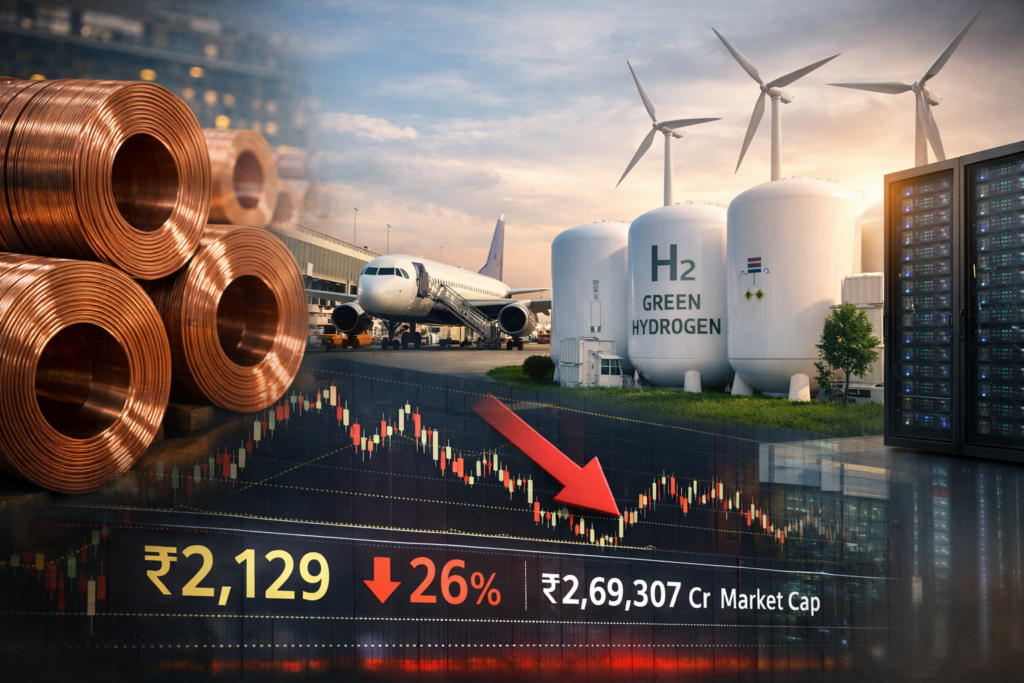
Adani Enterprises Limited has spent the better part of three decades building businesses that India did not yet know it needed, then spinning them off into independent listed companies. The flagship is now doing it again, this time in copper, data centres, airports, and green hydrogen. At ₹2,129 on the NSE as of April 13, 2026, the stock sits roughly 26% below its 52-week high of ₹2,612 and carries a market capitalisation of approximately ₹2,69,307 crore. The gap between where ADANIENT trades and where the sum of its parts is heading is the core of the investment debate right now.
What exactly does Adani Enterprises do and why is it structured differently from most Indian conglomerates?
Adani Enterprises Limited (AEL) is best described as a business incubator with a public listing. The model is not common in India at this scale. AEL takes a capital-intensive sector, builds the asset base inside the holding company, and then demerges the business into a separately listed entity once it reaches operational maturity. This cycle has already produced Adani Ports, Adani Green Energy, Adani Total Gas, and Adani Wilmar, among others.
The current portfolio of incubating businesses is larger than any previous cycle. The active build-out spans Adani Airport Holdings (nine airports including the freshly opened Navi Mumbai International Airport), Kutch Copper (a 500,000 tonne per annum copper smelter complex at Mundra in Gujarat), Adani New Industries Limited (green hydrogen and solar module manufacturing), AdaniConneX (hyperscale data centres in a joint venture with EdgeConneX), and a roads and expressway division with seven operational projects and seven more under construction.
Incubating businesses now account for over 70% of AEL’s EBITDA, up from 60% a year earlier. That figure is important context. The share price reflects the holding company and its governance overhang. The EBITDA reflects an infrastructure portfolio that is, by most internal metrics, performing ahead of where the stock implies.
What exactly does Adani Enterprises do and why is it structured differently from most Indian conglomerates?
The Navi Mumbai International Airport was inaugurated on December 25, 2025, and ranks among India’s largest greenfield airports. For shareholders who had watched this project slip its deadlines for two years, the inauguration was meaningful. The airport was initially targeted for December 2024 and went through multiple clearance delays before reaching commercial readiness.
The airport is designed to serve as the primary capacity relief valve for the congested Chhatrapati Shivaji Maharaj International Airport in Mumbai. By FY28, Adani anticipates its airport division’s EBITDA will triple from current levels. The non-aero revenues are where the growth leverage sits. The group has launched the first phase of city-side development across 114 acres at its airports in Mumbai, Ahmedabad, Jaipur, Lucknow, and Guwahati, concentrating on the fast-growing non-aero segment.
For retail investors, the airport angle matters because Adani Airport Holdings is among the subsidiaries flagged for a future independent listing. Subsidiaries likely to be listed include the airport, metals, roads, and data centre businesses, potentially between 2027 and 2031. Each listing event would, in theory, crystallise value that is currently locked inside AEL’s consolidated balance sheet. The airport opening was not just an operational milestone. It moved the listing timeline forward.
How does the Kutch Copper smelter commissioning change the investment case for ADANIENT in FY27?
The copper story is emerging as the most immediate earnings catalyst for AEL in calendar year 2026. On April 10, the head of Adani Enterprises’ metals business stated the company is ready to commission the Kutch Copper smelter within four weeks, describing it as the world’s largest smelter for copper and other metals. Trial operations had already commenced a month earlier, with the first copper anode batch produced.
The Kutch Copper facility is a 500,000 tonne per annum smelter in Gujarat. India currently imports a large share of its refined copper requirements, which means a domestic smelter of this scale positions AEL to capture import substitution economics while also serving the energy transition build-out at home. Copper demand in India is expected to grow significantly as EV infrastructure, power grids, and data centre cooling systems expand.
Adani Enterprises’ Kutch Copper and Caravel Minerals signed a strategic MoU in November 2025 to explore investment and offtake opportunities for Caravel’s copper project in Western Australia, targeting a 2026 Final Investment Decision. That tie-up signals AEL is not just building downstream smelting capacity at Mundra. It is also securing upstream concentrate supply from a friendly jurisdiction at a time when global copper supply chains are being reassessed.
Investors who bought ADANIENT expecting a metals revenue contribution in FY26 waited longer than anticipated. That contribution is now imminent. The FY27 profit and loss statement will likely look materially different from FY26 once Kutch Copper reaches anything close to nameplate capacity.
What does the ₹100 billion data centre and AI infrastructure commitment mean for AEL’s long-term valuation?
In February 2026, Adani announced plans to invest ₹100 billion to develop renewable-energy-powered, hyperscale AI-ready data centres by 2035. The commitment was described as one of the world’s largest integrated energy-compute pledges, positioning India as what Adani described as a sovereign compute platform. The scale is consistent with the group’s stated ambition to make India a global participant in the Intelligence Revolution, rather than merely a consumer of foreign cloud infrastructure.
AdaniConneX, the existing 50:50 joint venture with EdgeConneX, already operates hyperscale facilities in Chennai, Navi Mumbai, Noida, Visakhapatnam, Hyderabad, and Kolkata. The data centre infrastructure is powered by renewable energy and is designed to provide direct and indirect employment to 20,000 people.
For the AEL share price, data centres represent the longest-dated option embedded in the current valuation. The capital deployed is substantial and returns will take years to flow through the income statement. But the sector tailwinds are undeniable. India’s cloud and AI compute demand is accelerating, international hyperscalers are competing for Indian data centre capacity, and AEL’s renewable energy supply chain is a structural advantage over diesel-backed alternatives. The data centre business is, by the group’s own roadmap, a future IPO candidate. That optionality is not yet priced into the stock at current levels.
Why has the ADANIENT share price underperformed despite strong operational momentum across its subsidiaries?
The disconnect between AEL’s operational newsflow and its share price performance traces directly to governance overhang and institutional sentiment, not to the underlying businesses. The US Department of Justice’s indictment of Gautam Adani and other Adani Group executives in November 2024, alleging involvement in a bribery scheme related to solar energy contracts, created the single largest overhang on Adani Group stocks. While AEL denied all charges and US courts are yet to rule on the merits, international institutional investors who were rebuilding positions after the Hindenburg Research short-seller report of 2023 reversed course, triggering sustained FII selling across all Adani Group stocks throughout FY26.
In January 2026, Adani Group shares fell roughly 10%, incurring a loss of approximately $12.5 billion in market value, following a US SEC request to an Indian court to issue email summons to the defendants in the bribery case. That sell-off came even as the group’s operational assets continued to deliver. The market is, in effect, applying a discount to the governance risk that is entirely separate from project execution.
The US reciprocal tariff at 26% announced on April 2, 2026 also impacted Adani New Industries’ green hydrogen export economics. Green hydrogen was a central pillar of the bull case for AEL over the next decade. A tariff that raises the cost of Indian hydrogen exports to US buyers forces a reassessment of the demand side of that business, even if the domestic market remains insulated.
How are retail investors and traders on Indian forums currently reading the ADANIENT thesis?
ADANIENT generates active discussion across Indian retail platforms including ValuePickr, Moneycontrol’s community boards, and the Indian trading communities on X and Telegram. The consensus in the retail community right now is broadly polarised. Longer-horizon investors point to the asset-accumulation model, the imminent copper revenue contribution, and the subsidiary listing roadmap as reasons to accumulate at current levels. Short-term traders are more cautious, watching the ₹2,100 to ₹2,200 band as a near-term pivot.
On April 13, ADANIENT outperformed its diversified sector peers by 0.79%, delivering a 1.57% gain while the broader Nifty fell 1.45%. The stock has recorded gains over two consecutive sessions, accumulating a 4.2% return during that period.
Derivatives market data shows significant call option activity at the ₹2,100 and ₹2,200 strike prices expiring April 28, 2026, with 6,475 and 5,523 contracts traded respectively. Open interest at these strikes suggests traders are positioning for a moderate move toward ₹2,200 by expiry. The derivatives activity is consistent with short-term tactical positioning rather than long-term conviction buying, which is typical of a stock carrying unresolved headline risk.
The Indian retail investor base for ADANIENT tends to split along time horizon lines. Those with a 12 to 24 month view are focused on Q4 FY26 results, Kutch Copper revenue recognition, and any update on the DOJ case. Those with a 3 to 5 year view are watching the subsidiary IPO pipeline, the data centre buildout, and whether ANIL’s green hydrogen economics can survive the tariff environment.
What does the Q4 FY26 results season mean for ADANIENT and what are the key numbers to watch?
Adani Enterprises Q4 FY26 results are expected in May 2026. Analysts project revenue of ₹28,000 to ₹32,000 crore and PAT of ₹700 to ₹900 crore for the quarter, with EBITDA margin estimated at 10 to 12%.
The quarterly number itself is less important than the management commentary around three forward-looking items. First, whether Kutch Copper revenue is recognised in Q4 or deferred to Q1 FY27. Second, the FY27 EBITDA guidance for the airport division following Navi Mumbai’s inauguration. Third, any update on the DOJ case timeline and whether the group expects to restore FII access to institutional capital during FY27. FY27 guidance commentary is widely viewed as the most critical post-results catalyst.
Q3 FY26 results showed consolidated revenue of ₹26,080 crore and net profit of ₹587 crore, with EBITDA at ₹2,840 crore. That was below analyst estimates, with airport EBITDA mix weaker than expected. The market sold off on those numbers. A Q4 beat driven by copper revenue and stronger airport throughput would need to be accompanied by credible FY27 guidance to hold any post-results rally.
Key takeaways: What retail investors watching ADANIENT need to know right now
- ADANIENT trades at approximately ₹2,129 as of April 13, 2026, roughly 26% below its 52-week high of ₹2,612 and about 21% above its 52-week low of ₹1,753. The market cap stands at around ₹2,69,307 crore.
- The Kutch Copper smelter at Mundra is the most immediate earnings catalyst. Commissioning was announced as weeks away as of April 10. Full commercial operations at this facility would represent the first material copper revenue contribution in AEL’s income statement, with FY27 likely the first full year of contribution.
- Navi Mumbai International Airport opened in December 2025 after multiple delays, clearing the single largest execution overhang in the airport portfolio. The next milestone is non-aero revenue ramp and the path to the airport division’s FY28 EBITDA tripling target.
- The DOJ bribery case remains the dominant headwind. Until there is either a resolution or a credible timeline to dismissal, institutional buying is likely to remain subdued. Retail accumulation has partially filled that gap but is insufficient to drive a sustained re-rating.
- AEL’s subsidiary listing roadmap spanning airports, metals, roads, and data centres is the core of the long-term bull case. These listings are currently projected between 2027 and 2031 and each would unlock value embedded in the holding structure that the current share price does not fully reflect.
- The ₹100 billion AI data centre commitment and the $66 billion Maharashtra infrastructure plan announced at Davos in January 2026 establish the group’s ambition scale. Near-term cash conversion from these initiatives is limited, but they define the asset base that future listed entities will sit on.
- The primary risks are governance uncertainty around the DOJ case, group-level leverage exposure from the Adani Group’s consolidated net debt, ESG-driven institutional selling tied to coal trading activities within IRM, and green hydrogen export economics impacted by US tariffs. Investors should size their position in line with their tolerance for sustained headline risk, independent of the operational merit of the underlying assets.
Discover more from Business-News-Today.com
Subscribe to get the latest posts sent to your email.