



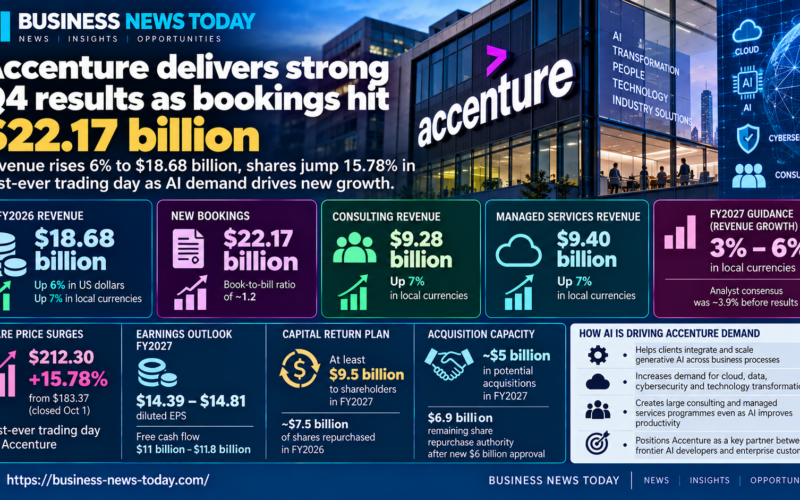
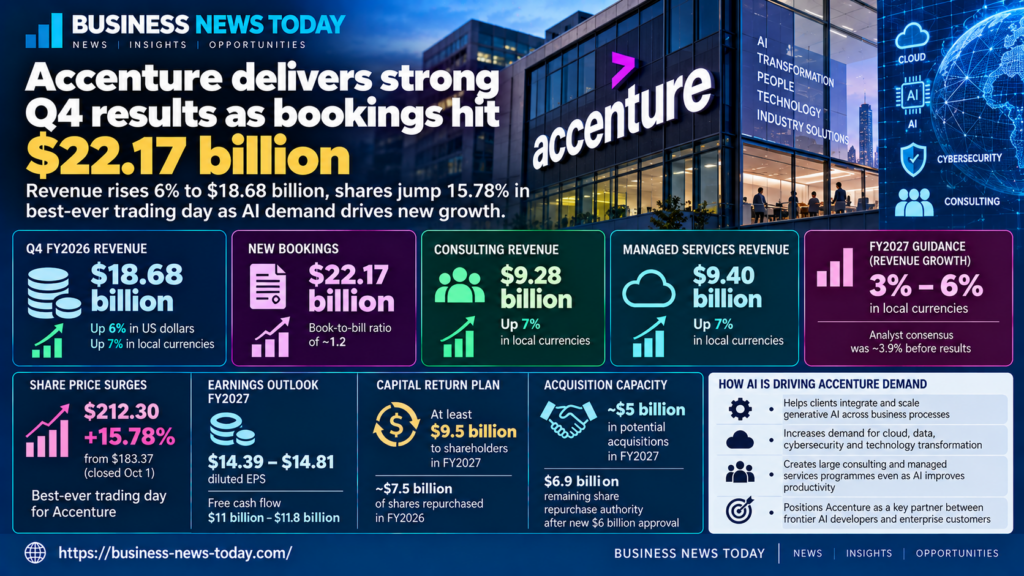
Accenture plc (NYSE: ACN), the global consulting and information technology services group, has delivered one of the clearest counterarguments yet to fears that generative artificial intelligence will rapidly undermine the economics of large IT services companies. Fourth-quarter fiscal 2026 revenue reached $18.68bn, up 6% in US dollars and 7% in local currencies, exceeding the high end of Accenture’s previous guidance range, while new bookings increased to $22.17bn.
The market response was unusually strong for a company of Accenture’s scale. Shares closed October 1 at $212.30, up 15.78% from $183.37, after trading as high as $227.63 during the session. Reuters described the rally as Accenture’s best-ever trading day, while Cognizant Technology Solutions Corporation, International Business Machines Corporation, Infosys Limited and Wipro Limited also rose as investors reassessed whether artificial intelligence is destroying IT services demand or creating another large technology-transformation cycle.
Accenture expects fiscal 2027 revenue to increase between 3% and 6% in local currencies, compared with an analyst consensus around 3.9% before the announcement. Diluted earnings per share are forecast between $14.39 and $14.81, while free cash flow is expected to reach $11bn to $11.8bn. Management also plans to return at least $9.5bn of cash to shareholders during the fiscal year.
Why did Accenture stock jump so sharply after the fiscal 2026 results?
The rally appears to reflect a major change in expectations rather than spectacular headline growth. Accenture entered the earnings report after a prolonged decline driven partly by concern that artificial intelligence could automate software development, business-process work and consulting activities that historically required large teams of billable professionals.
Against that backdrop, even moderate growth becomes powerful if investors had been pricing in structural deterioration. Accenture’s fourth-quarter consulting revenue increased 7% in local currency to $9.28bn, while managed services revenue also grew 7% to $9.40bn. Bookings reached $22.17bn, giving the quarter a book-to-bill ratio of approximately 1.2 and indicating that customers continued signing new work at a pace above recognised quarterly revenue.
The result does not prove artificial intelligence poses no threat to the traditional services model. Accenture acknowledged that pricing has fallen in some areas as customers expect to share in productivity benefits created by AI. That pressure means the company may need to complete projects with fewer labour hours while maintaining enough pricing power to capture part of the productivity gain itself.
The more encouraging interpretation is that artificial intelligence simultaneously creates demand. Large corporations need assistance reorganising data, integrating models with existing systems, changing business processes, securing AI applications and training employees. Those programmes can generate enormous consulting and managed-services requirements even as automation reduces the labour required for individual tasks.
How much of Accenture’s growth is coming from consulting rather than acquisitions?
Fiscal 2026 revenue reached approximately $74.2bn, up about 5% in local currencies, while adjusted operating margin improved to 15.8%. Adjusted earnings per share rose 8% to $13.97. That performance provides Accenture with substantial resources for acquisitions and shareholder returns while it restructures its capabilities around artificial intelligence, cybersecurity and cloud transformation.
Management is not relying entirely on organic growth. Chief Executive Officer Julie Sweet said Accenture could deploy approximately another $5bn on acquisitions during fiscal 2027 based on opportunities currently visible to the company. Accenture has repeatedly used acquisitions to acquire specialised engineering, cybersecurity, cloud and industry knowledge faster than building every capability internally.
That strategy introduces an important analytical question when interpreting the 3%-6% fiscal 2027 growth forecast. Acquisition-led revenue can expand the top line immediately, but shareholders ultimately need acquired companies to generate returns above their purchase price and integration cost. The quality of growth therefore depends on organic demand, margins and cash conversion as much as headline revenue.
Accenture enters fiscal 2027 with considerable financial flexibility. The company repurchased or redeemed approximately $7.5bn of shares during fiscal 2026 and increased its remaining repurchase authority to roughly $6.9bn after the board approved another $6bn authorisation.
Why could AI increase Accenture demand even while reducing billable hours?
Traditional IT services economics often linked revenue to the number of professionals deployed and the hours they charged. Generative AI challenges that model because a programmer, consultant or analyst can potentially complete some tasks faster.
Clients naturally want part of those productivity savings. That creates pressure on time-and-materials pricing and can force providers to shift toward fixed-price or outcome-based arrangements where the service company captures more of the benefit if it completes work efficiently.
Accenture can benefit if it manages that transition correctly. When AI allows the company to deliver a project using fewer resources, fixed-price contracts can produce higher labour productivity even if the customer pays less than under the old model. The danger arises if competitive bidding transfers nearly all productivity gains to the customer.
There is another side to the equation. Enterprises cannot simply purchase a language model and declare themselves transformed. Models must be connected to corporate systems, governed, secured and redesigned around actual workflows. Accenture’s enormous installed customer base gives it access to companies confronting precisely those problems.
The September partnership with Anthropic also illustrates how Accenture is trying to position itself between frontier-model developers and enterprise buyers rather than competing directly with foundation-model companies. That role could become increasingly valuable as customers avoid dependence on a single AI platform.
Can Accenture maintain margins while spending billions on AI capabilities?
Accenture expects fiscal 2027 operating margin between 15.9% and 16.1%, representing modest expansion from fiscal 2026. Free cash flow of $11bn to $11.8bn would remain substantial even after investment in employees, acquisitions and new technology.
Margin stability will be an important test because revenue growth alone cannot answer whether artificial intelligence is economically beneficial. If Accenture needs to cut prices substantially and spend heavily on training, models and acquisitions simply to preserve revenue, returns could weaken even while sales grow.
The early evidence is more constructive. Fiscal 2026 adjusted operating margin improved by 20 basis points to 15.8%, while adjusted earnings per share grew faster than revenue. Accenture also expects operating cash flow of $11.9bn to $12.7bn in fiscal 2027.
The strongest version of the AI investment case therefore does not require artificial intelligence to create extraordinary top-line acceleration. If Accenture can grow in the mid-single digits while using AI to improve employee productivity and protect margins, earnings and cash flow can still compound attractively.
What should investors watch after Accenture’s record share-price rally?
The October 14 Investor Day becomes considerably more important after the market’s rapid reassessment. Investors will want greater detail on AI revenue, productivity, pricing models and how much of fiscal 2027 growth depends on acquisitions.
Bookings will remain a useful leading indicator. A sustained book-to-bill ratio above one would suggest customers continue expanding commitments even as economic uncertainty and high borrowing costs affect technology budgets.
Accenture will also need to demonstrate that large AI engagements progress from pilots into production systems. Many corporations have spent the past two years experimenting with generative AI without achieving enterprise-wide financial returns.
The October 1 rally effectively removed some of the pessimism embedded in Accenture’s valuation. That means the burden now shifts back toward execution. Artificial intelligence does not need to destroy consulting for the earlier bearish thesis to be wrong, but Accenture does need to prove it can capture enough of the efficiency gains to prevent the technology from simply making its existing work cheaper.
Discover more from Business-News-Today.com
Subscribe to get the latest posts sent to your email.