

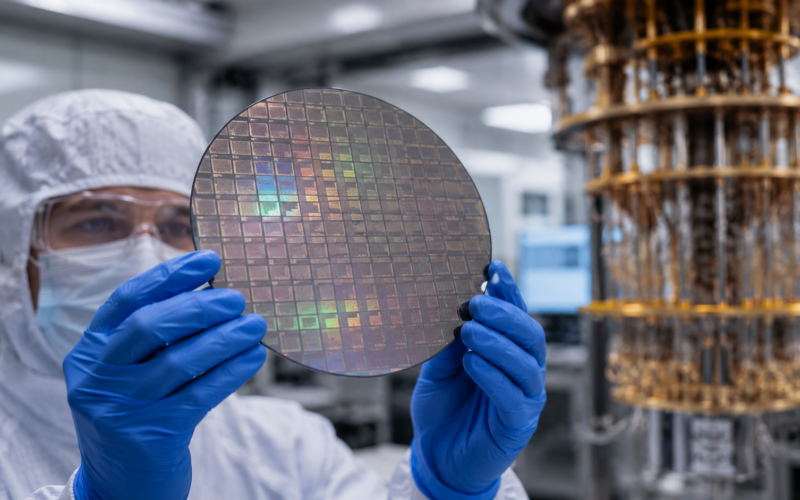
International Business Machines Corporation (NYSE: IBM) has signed a definitive agreement to acquire HRL Laboratories, LLC, the Malibu-based research institution jointly owned by The Boeing Company and General Motors Company, adding a second qubit technology to a quantum programme that has so far been built almost entirely on superconducting circuits. Financial terms were not disclosed, and IBM said the transaction remains subject to customary closing conditions and regulatory approvals, with completion anticipated by the end of the third quarter of 2026. The announcement landed on July 23, one day after IBM reported second-quarter results that missed consensus revenue and cut full-year constant currency revenue growth guidance to a range of four to five percent from above five percent, and on the same session in which the stock set a 52-week low of $199.19. The strategic logic is coherent: silicon-spin qubits share a fabrication base with the superconducting devices IBM already builds, and both can be routed through Anderon, the standalone 300-millimetre quantum wafer foundry IBM announced in May. The unresolved question is whether a company whose core software and infrastructure guidance has just been reset can keep funding a decade-long quantum build-out at the pace its roadmap now assumes.
Why does IBM’s agreement to acquire HRL Laboratories arrive one day after the stock touched a 52-week low?
The sequencing is awkward but not accidental. IBM pre-announced selected preliminary second-quarter figures on July 14, disclosing revenue of $17.2 billion against a consensus closer to $17.9 billion and operating earnings of $2.93 per share against roughly $3.01. The market reaction was severe, with the shares falling more than 25 percent in a single session, the steepest one-day decline in the stock’s modern trading history. Full results on July 22 confirmed the shape of the quarter: revenue of $17.16 billion, up one percent; GAAP diluted earnings from continuing operations of $2.27, down two percent; Software revenue of $7.76 billion, up five percent; Consulting flat at $5.33 billion; and Infrastructure down seven percent to $3.84 billion, with IBM Z revenue falling 42 percent while Distributed Infrastructure rose 37 percent.
Chairman and chief executive officer Arvind Krishna attributed the shortfall to late-quarter client reprioritisation, with buyers pulling forward purchases of servers, storage and memory ahead of expected price increases and pushing software decisions to the right. Management said several deals that slipped from the second quarter closed in the opening weeks of the third. That is a timing argument, and it is the argument the second half will test.
Against that backdrop, an undisclosed-value research acquisition does not move the near-term model at all. It does, however, tell shareholders where management intends to keep spending while the reported numbers are under pressure, which is itself the most useful information in the announcement.
What does HRL Laboratories actually bring to IBM beyond its silicon-spin qubit engineering team?
HRL Laboratories traces to the research organisation Howard Hughes established in 1948, and it was reorganised as a limited liability company in December 1997 after General Motors Company sold the Hughes aerospace and defence operations to Raytheon. Boeing acquired an interest in 2000; Raytheon exited its stake in 2007. The Malibu site is where Theodore Maiman demonstrated the first working laser in 1960, and the organisation has since published more than 1,100 patents across microelectronics, photonics, materials science and autonomy.
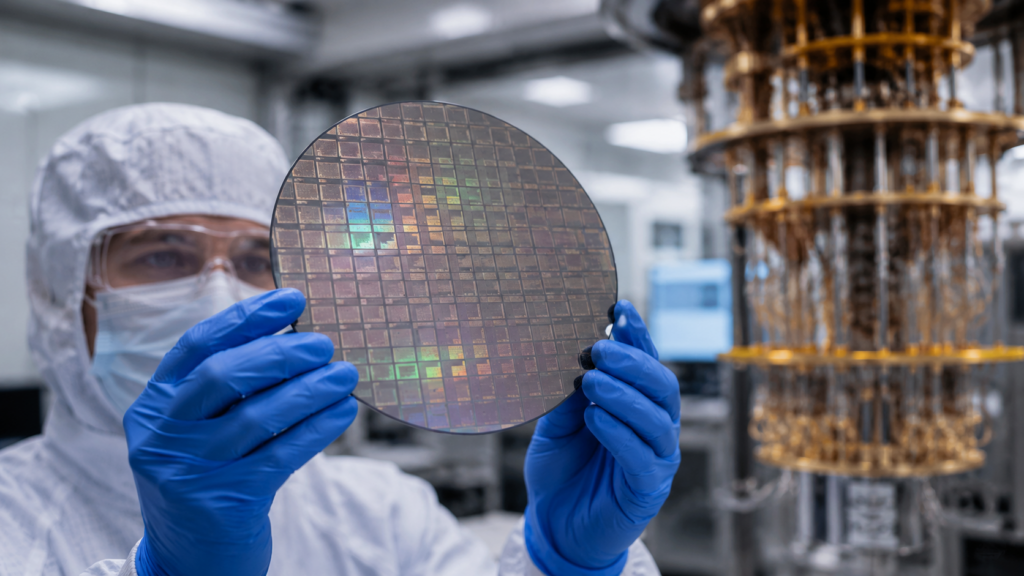
The qubit team is the headline asset. Jay Gambetta, IBM’s Director of Research and an IBM Fellow, told Reuters the group is the strongest spin qubit team in the world, and IBM’s own framing is that HRL Laboratories brings silicon-based spin qubit platforms plus surrounding infrastructure in cryogenics, control electronics, qubit interconnects and packaging. That surrounding layer matters more than it sounds. Interconnect and packaging capability is where superconducting roadmaps have historically stalled, and it transfers across modalities.
Beyond computing, IBM identified quantum sensing as an industrialisation target, citing ultra-precise sensors for life sciences, navigation, defence and scientific applications, alongside novel quantum materials with potential read-across into semiconductors. HRL Laboratories also carries decades of advanced sensor, high-speed communications and advanced manufacturing work for commercial and United States government customers. Rob Vasquez, President and Chief Executive Officer at HRL Laboratories, described the combination as delivering technology solutions for both commercial and government buyers, which points to a federal revenue channel IBM has been building separately.
How would silicon-spin qubits change IBM’s roadmap toward Quantum Starling and Blue Jay?
IBM’s published roadmap is unchanged by this deal. The company continues to target IBM Quantum Starling in 2029, described as capable of 20,000 times more operations than current systems and 100 million quantum operations, followed in the mid-2030s by Blue Jay at a projected one billion quantum operations. Jay Gambetta referenced 2033 for Blue Jay in his Reuters interview, and he framed the spin qubit rationale in terms of physical footprint: electron spin devices are considerably smaller than superconducting equivalents, and that size advantage begins to bind once systems reach Blue Jay scale.
This is the analytically important point. IBM is not hedging its superconducting bet in the near term; Starling remains the 2029 deliverable. It is buying optionality for the machine after the one it has not yet built. Jay Gambetta’s own formulation was that the future will be spins, or superconducting, or a combination of the two, which is an explicit acknowledgement that the modality question is not settled inside IBM Research.
Alphabet Inc.’s Google broadened its own quantum portfolio to include neutral-atom technology earlier in 2026. Two of the largest superconducting programmes in the industry adding a second modality within months of each other is a signal about confidence intervals on scaling, not a coincidence.
Why does the Anderon quantum wafer foundry make HRL Laboratories worth more to IBM than to Boeing and General Motors?
This is where the deal stops being a talent acquisition. In May 2026, IBM and the United States Department of Commerce announced a Letter of Intent to establish Anderon, headquartered in Albany, New York, as a standalone IBM company operating a 300-millimetre quantum wafer foundry. The structure involves a proposed $1 billion CHIPS incentive alongside $1 billion in cash from IBM, plus contributions of intellectual property, assets and workforce, and it formed part of a broader Department of Commerce package distributing just over $2 billion across nine quantum companies.
Anderon’s initial scope covers superconducting qubit and supporting electronics wafers, with stated plans to expand into other quantum modalities. IBM said the HRL Laboratories transaction creates an opportunity to partner more closely with Anderon, including potential development of spin qubit manufacturing processes. IBM also indicated that HRL Laboratories chips will be produced at its New York facility going forward.
For Boeing and General Motors, HRL Laboratories was a research asset with no route to volume manufacturing. For IBM, the same team feeds a foundry that already exists on paper and has government co-funding behind it. That is a genuine valuation asymmetry, and it is the cleanest explanation for why two industrial owners would part with an institution they have held for decades while retaining partnership access to its output. Both Boeing and General Motors will continue to partner with IBM on quantum applications and advanced technology development following the transaction.
How does IBM’s HRL Laboratories agreement compare with IonQ’s $1.8 billion deal for SkyWater Technology?
The comparison is instructive because the two transactions run in opposite directions toward the same conclusion. In January 2026, IonQ, Inc. agreed to acquire SkyWater Technology, Inc. for $35.00 per share in cash and stock, implying equity value of approximately $1.8 billion, explicitly to internalise fabrication. IonQ bought the fab and now needs to fill it. IBM already has the fab in formation and has bought a design team to give it a second product line.
Both deals rest on the same premise: fabrication capacity, not laboratory physics alone, has become the constraint on commercial quantum roadmaps. Renting capacity from academic or third-party fabs does not support a schedule with named systems attached to specific years. The strategic difference is balance-sheet position. IonQ funded its foundry with a mix of cash and its own equity at elevated multiples. IBM is funding its equivalent through cash, government incentives and an undisclosed research purchase inside a business generating $4.8 billion of first-half free cash flow.
Can IBM fund a $10 billion quantum programme while its software growth guidance is being cut?
IBM disclosed in a Form 8-K filing in late May, and confirmed publicly on June 2, plans to invest more than $10 billion in quantum computing over five years, spanning research and development, capital expenditure, manufacturing scaling, ecosystem partnerships and mergers and acquisitions. The HRL Laboratories agreement sits inside that envelope.
The funding capacity is real but not unconstrained. IBM ended the second quarter with $8.2 billion in cash, restricted cash and marketable securities against total debt of $62.0 billion, and it had invested $10.5 billion in acquisitions year to date before this transaction. Second-quarter operating cash flow was $2.6 billion, up $0.9 billion, while free cash flow of $2.5 billion was down $0.3 billion year over year. Management reaffirmed that full-year free cash flow should increase by about $1 billion, and the board declared a quarterly dividend of $1.69 per share, extending a payment record that runs to 1916.
Set against that, IBM has signed more than $1.1 billion in cumulative quantum contracts since 2017, operates more than 90 deployed systems and counts more than 340 organisations in the IBM Quantum Network. Those are respectable ecosystem metrics for a pre-commercial technology, and they are small relative to a $10 billion forward commitment. The commercial question is not whether IBM can afford the spend; it is whether a business now guiding to four to five percent constant currency growth can carry a long-cycle research programme without shareholders demanding that capital be redirected toward the segments that are missing.
What does the sale signal about Boeing and General Motors and the future of corporate research labs?
Neither seller has disclosed proceeds, and neither has framed the transaction as a retreat from quantum technology. Both retain partnership access to the work through IBM. What the deal does illustrate is the difficulty of holding a broad-spectrum research institution inside an industrial parent whose capital priorities lie elsewhere. Corporate research at this scale increasingly concentrates where a manufacturing and commercialisation path already exists, and that is now a computing platform question rather than an aerospace or automotive one.
For Boeing and General Motors, retaining application-layer access while divesting the institution converts a fixed research cost into a partnership. Whether that trade preserves the same depth of access over time depends on contract terms neither party has disclosed.
How did IBM shares behave across the Q2 results, the 52-week low and the HRL Laboratories announcement?
On July 23, the session in which the HRL Laboratories agreement was announced, IBM shares set a 52-week low of $199.19 and closed at $206.65 within a day range of $199.19 to $207.55. On July 24, the shares traded up approximately 3.6 percent, reaching an intraday high of $216.10 and last trading near $214.16 on volume of roughly 10.5 million shares. The 52-week range now runs from $199.19 to $332.46, the high having been set on June 2, 2026. Market capitalisation sits near $200 billion on approximately 942 million shares outstanding, with a trailing dividend yield around 3.3 percent.
The share-price recovery on July 24 coincided with the HRL Laboratories announcement and the completion of the earnings cycle, though attributing the move to either factor specifically would overstate what the data supports. Over the past month the stock is down roughly 19 percent, and it has underperformed the broader market materially year to date.
Analyst positioning has re-rated sharply and remains dispersed. Morgan Stanley cut its price target to $190 from $293 with an equal weight rating on July 23. HSBC moved to Reduce with a target of $191. Oppenheimer downgraded to Perform. Argus reduced its target to $280 from $360 while retaining Buy, and Bank of America Securities cut to $280 from $330, also retaining Buy. Evercore ISI reiterated Outperform at $310. UBS held its $236 target while lowering its 2026 revenue growth forecast to 3.6 percent from 5.5 percent. Consensus twelve-month targets aggregate near $249, with a range spanning roughly $175 to $350, which is an unusually wide band for a company of this size and indicates genuine disagreement about whether the second-quarter shortfall is timing or trend.
What still stands between the HRL Laboratories agreement and measurable value for IBM shareholders?
Three things, in order of proximity. First, closing. The transaction is subject to customary conditions and regulatory approvals, and IBM has guided to completion by the end of the third quarter of 2026. Because HRL Laboratories serves United States government customers and holds defence-relevant technology, the review scope may extend beyond ordinary competition clearance, though no specific regulatory concern has been identified publicly.
Second, integration. Relocating chip production to IBM’s New York facility and folding a Malibu-based institution with its own seven-decade research culture into IBM Research is a retention problem before it is a technical one. The value being acquired is substantially the team.
Third, and furthest out, physics. Below-threshold error correction at the logical qubit counts Starling requires has not been demonstrated by IBM or anyone else. Silicon-spin qubits offer a smaller footprint but have their own uniformity and control challenges at scale. Capital and manufacturing capacity reduce schedule risk; they do not retire the underlying scientific risk.
What should investors track between the HRL Laboratories signing and IBM’s next quantum proof points?
- IBM has signed a definitive agreement to acquire HRL Laboratories, LLC from The Boeing Company and General Motors Company, adding silicon-spin qubits as a second hardware modality alongside superconducting circuits; financial terms were not disclosed.
- Completion is anticipated by the end of the third quarter of 2026, subject to customary closing conditions and regulatory approvals, making that the first measurable checkpoint.
- The strategic value concentrates in the interaction with Anderon, the 300-millimetre quantum wafer foundry IBM announced in May 2026 in Albany, New York, backed by a proposed $1 billion CHIPS incentive and $1 billion of IBM cash; HRL Laboratories chips are to be produced at IBM’s New York facility.
- Jay Gambetta has framed the spin qubit footprint advantage as mattering from Blue Jay onward rather than for Starling, which means this transaction is optionality for the 2030s, not acceleration of the 2029 deliverable.
- IBM’s published roadmap is unchanged: Starling in 2029 at 100 million quantum operations, Blue Jay in the mid-2030s at one billion operations, with Jay Gambetta referencing 2033 in interview.
- The timing is uncomfortable rather than contradictory: IBM cut full-year constant currency revenue growth guidance to four to five percent from above five percent, reported Q2 revenue of $17.16 billion with IBM Z down 42 percent, and set a 52-week low of $199.19 on the day the deal was announced.
- Funding capacity exists but is not open-ended: $8.2 billion in cash against $62.0 billion of total debt, $10.5 billion of acquisitions year to date, first-half free cash flow of $4.8 billion flat year over year, and reaffirmed guidance for full-year free cash flow growth of about $1 billion.
- The quantum business remains pre-commercial at scale, with more than $1.1 billion in cumulative contracts since 2017, more than 90 deployed systems and more than 340 IBM Quantum Network members, against a stated forward commitment of more than $10 billion over five years.
- The competitive read-across is that fabrication has become the binding constraint: IonQ, Inc. agreed in January 2026 to acquire SkyWater Technology, Inc. for approximately $1.8 billion, and Alphabet Inc.’s Google added neutral-atom technology to its own portfolio earlier in 2026.
- Analyst dispersion is the cleanest measure of the open question, with targets ranging from roughly $175 to $350 and Morgan Stanley cutting to $190 while Evercore ISI holds $310; the thesis strengthens if the slipped software deals close and second-half revenue reaccelerates toward the guided range, and weakens if Q3 shows the mainframe and software softness was structural rather than a budget-timing shift.
Share this:
Discover more from Business-News-Today.com
Subscribe to get the latest posts sent to your email.