


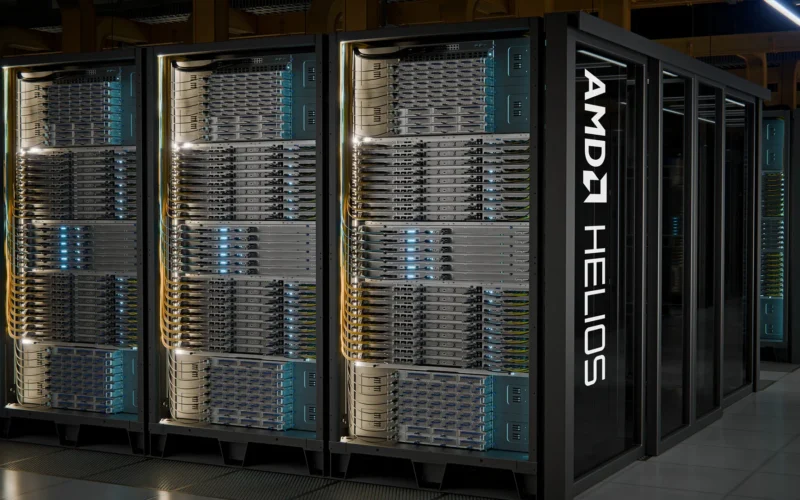
Advanced Micro Devices, Inc. (NASDAQ: AMD) has unveiled the Helios rack-scale AI reference design at Advancing AI 2026, bringing 72 Instinct MI455X graphics processing units, sixth-generation EPYC “Venice” processors and Pensando networking into a single open-standards architecture. The platform is designed for frontier model training, large-scale inference and sovereign artificial intelligence deployments, with partner-built volume systems expected during the second half of 2026. Its strategic importance lies in AMD attempting to provide a complete infrastructure blueprint rather than competing only at the accelerator level. That shift is reinforced by Anthropic’s commitment to deploy up to two gigawatts of MI450 Series capacity and AMD’s planned strategic investment of up to $5 billion in the artificial intelligence company. AMD shares traded near $543.81 on July 23, down approximately 1.5% during the session but still up about 9.7% over five trading days and 4.6% over one month, leaving the stock roughly 7% below its 52-week high.
Why does AMD Helios represent a strategic shift from selling chips to designing complete AI infrastructure?
Helios changes the competitive unit in which AMD is trying to win. The company is no longer asking customers to compare one Instinct accelerator with one competing graphics processing unit. It is asking hyperscalers, artificial intelligence developers and sovereign computing operators to evaluate an integrated rack that combines computing, memory, networking, power distribution, liquid cooling, security and software management.
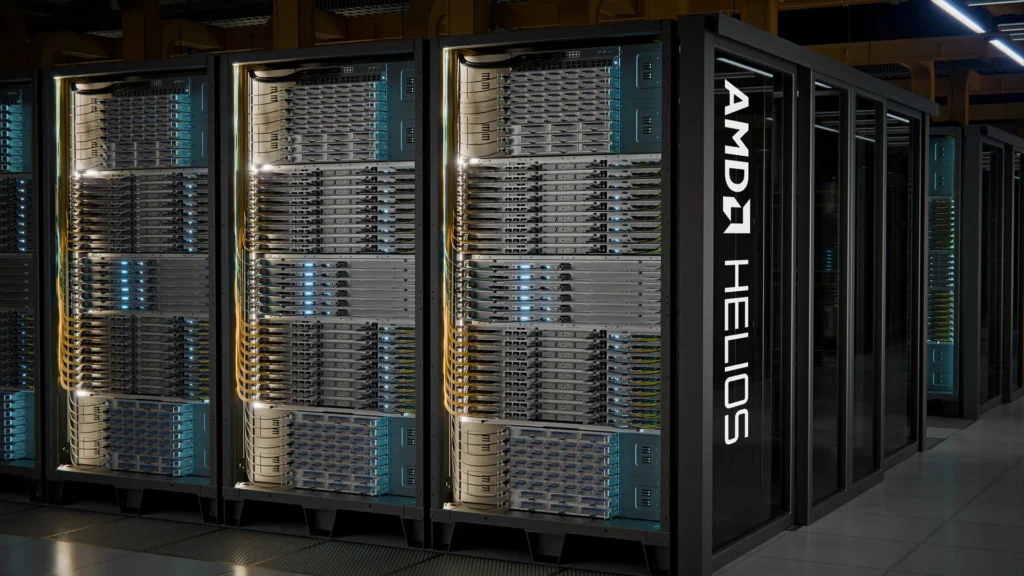
A complete Helios rack is designed around 72 AMD Instinct MI455X accelerators, with the company stating that the architecture can provide 31 terabytes of high-bandwidth memory. Each MI455X is expected to offer as much as 432 gigabytes of HBM4 memory and 19.6 terabytes per second of memory bandwidth. The rack also incorporates EPYC “Venice” processors with the Zen 6 architecture, Pensando Vulcano network interface controllers and Pensando Salina data processing units.
The inclusion of networking and data processing is strategically important because large artificial intelligence systems increasingly depend on data movement rather than raw processor performance alone. A powerful accelerator can still produce disappointing economics when memory access, interconnect bandwidth or cluster utilisation becomes the bottleneck. By combining these components within a reference architecture, AMD is attempting to improve system-level performance while reducing the engineering burden placed on server manufacturers and cloud operators.
Helios is nevertheless a reference design rather than a finished product sold directly by AMD. Original equipment manufacturers and original design manufacturers will use the blueprint to create their own branded systems. This model reduces the manufacturing and inventory burden on AMD, but it also introduces execution dependencies across partners responsible for integrating, validating and supporting the final equipment.
The approach therefore gives AMD broader influence over system architecture without requiring the company to become a full-scale server manufacturer. It is a capital-efficient strategy when the partner ecosystem works smoothly. It becomes a potential weakness when integration delays, component shortages or inconsistent partner execution prevent customers from receiving identical performance across different Helios-based systems.
Can open rack standards weaken Nvidia’s software and systems advantage in hyperscale AI deployments?
The most important differentiator in Helios may not be the processor specification. It may be the decision to build the architecture around open industry standards, including the Open Compute Project Open Rack Wide format, Ultra Accelerator Link and technologies developed through the Ultra Ethernet Consortium.
AMD is effectively arguing that hyperscalers should not need to accept a tightly controlled proprietary architecture to obtain rack-scale artificial intelligence performance. Open interfaces could allow cloud providers and server manufacturers to replace components, work with multiple suppliers and retain greater negotiating leverage over long investment cycles. That flexibility becomes more valuable when individual artificial intelligence data centres require billions of dollars of equipment and consume power measured in hundreds of megawatts.
Nvidia Corporation retains substantial advantages. Its CUDA software ecosystem, networking portfolio, developer familiarity and installed base make Nvidia systems easier to adopt for many organisations. The Vera Rubin platform also combines processors, networking, storage and software within a coordinated architecture, meaning AMD is challenging a competitor that already thinks at the data centre level rather than merely at the chip level.
AMD’s open strategy must therefore achieve two goals at the same time. It must provide customers with meaningful architectural choice while preventing that openness from producing fragmented configurations and inconsistent performance. Customers may value avoiding vendor concentration, but they will not exchange operational predictability for theoretical flexibility.
The contest will be decided partly by software. ROCm has become more capable and now supports widely used frameworks and inference tools, but compatibility is only the opening requirement. AMD must demonstrate that production workloads can be deployed, optimised, monitored and upgraded without creating labour costs that erase any hardware savings.
This explains why Helios includes fleet management, observability and workload lifecycle capabilities rather than relying solely on accelerator benchmarks. The competitive question is moving from whether an individual chip can run a model to whether thousands of chips can remain productive, stable and economically useful across several years.
How do Anthropic, Microsoft, Meta and OpenAI strengthen the commercial credibility of AMD’s MI450 roadmap?
AMD has spent several years demonstrating that its accelerators can compete technically. The more difficult task has been proving that major artificial intelligence customers are prepared to place large, long-duration infrastructure commitments around the company’s roadmap.
Anthropic’s planned deployment provides unusually strong commercial validation. The artificial intelligence developer intends to deploy up to two gigawatts of MI450 Series accelerators in Helios systems, with the first gigawatt expected to begin deployment during the first half of 2027. Anthropic already uses MI355X accelerators, reducing the risk that the agreement represents a completely untested customer relationship.
The two companies also plan to work together on software optimisation. Claude models will be used to improve workloads running on Instinct accelerators and support further ROCm development, while AMD intends to use Claude more widely within its engineering and product development organisation. This arrangement gives AMD access to a demanding real-world software environment rather than relying exclusively on internal testing.
The planned equity investment of up to $5 billion adds another layer. It can help secure a major customer and align the companies around long-term deployment milestones. However, it also creates questions about how much demand is independently generated and how much is supported by strategic financing from the supplier.
Circular financing has become a broader feature of the artificial intelligence infrastructure market. Chip companies, cloud providers and model developers increasingly invest in one another while signing large purchasing or capacity agreements. These structures can accelerate adoption, but they complicate the interpretation of backlog quality, customer concentration and ultimate cash returns.
AMD has also secured large-scale commitments involving Microsoft Corporation, Meta Platforms, Inc., OpenAI and Oracle Corporation. The combined relationships indicate that MI450 and Helios are no longer speculative products looking for an initial customer. They are becoming part of the infrastructure planning of organisations with some of the industry’s largest computing requirements.
The commercial challenge now moves from customer acquisition to fulfilment. AMD must manufacture enough accelerators, secure sufficient HBM4 memory, coordinate server partners and ensure that customers can bring clusters online within scheduled windows. A gigawatt commitment is impressive, but revenue is recognised when hardware is delivered and accepted, not when the press release receives enthusiastic applause.
What financial and supply chain risks could prevent AMD from converting demand into durable margins?
AMD enters this product cycle with considerably stronger financial momentum than it had during earlier attempts to expand in data centre accelerators. First-quarter 2026 revenue reached approximately $10.3 billion, increasing 38% from a year earlier. Data Center segment revenue rose 57% to $5.8 billion, making the business the company’s largest growth engine.
The company also reported a non-GAAP gross margin of 55% and guided for second-quarter revenue of approximately $11.2 billion, plus or minus $300 million. The midpoint would represent annual growth of about 46%, while the projected non-GAAP gross margin of 56% suggests management expects product mix and operating leverage to remain favourable.
Helios could support further margin improvement because a complete platform increases the value associated with each accelerator deployment. AMD can participate across processors, accelerators, networking and software rather than capturing revenue from a single component. A broader content opportunity also makes customer relationships more difficult to displace once a cluster enters production.
However, a systems strategy creates additional exposure to supply constraints. Helios depends on HBM4 memory, advanced semiconductor packaging, high-speed networking, liquid cooling equipment, power systems and partner manufacturing capacity. A shortage in any one component can delay an entire rack even when the graphics processing units themselves are ready.
AMD also remains dependent on external semiconductor manufacturing. Demand visibility may be improving, but the company must reserve manufacturing capacity well before customer deployments become final. Ordering too little risks delivery delays and lost market share. Ordering too much exposes the company to inventory and margin pressure if artificial intelligence infrastructure spending slows.
The planned Anthropic investment adds a capital allocation question. A strategic investment can secure demand and improve product development, but shareholders will expect transparency on investment timing, milestone conditions and the relationship between capital committed and revenue ultimately received. Investors are unlikely to object to spending that builds a durable platform, but they will become less patient if strategic investments begin substituting for independent customer demand.
Why is AMD stock holding near its 52-week high despite the scale of execution risk?
AMD shares have risen sharply as investors have revised their expectations for the company’s artificial intelligence opportunity. At approximately $543.81 during the July 23 session, the stock remained about 7% below its 52-week high of $584.73 and far above its 52-week low of $149.22.
The five-session gain of roughly 9.7% shows that the market has responded positively to the recent Microsoft and Anthropic developments. The one-month increase of approximately 4.6% is more restrained because the stock has experienced considerable volatility, including a late-June move to a record high followed by a pullback.
The July 23 decline does not necessarily indicate rejection of Helios. The stock had already climbed strongly ahead of the event, creating room for profit-taking when product specifications became public. Broader weakness in technology stocks and concerns about the scale of artificial intelligence capital expenditure also affected investor sentiment during the session.
The more important issue is that AMD is now valued as a company expected to capture a significant share of artificial intelligence infrastructure spending. This leaves less tolerance for product delays, software shortcomings or customer deployment slippage. Strong demand announcements can support the valuation, but quarterly revenue, gross margin and cash flow must eventually verify the scale of that demand.
Second-quarter results scheduled for August 4 will therefore be important. Investors will look for evidence that Instinct revenue, EPYC demand and data centre margins are progressing fast enough to justify expectations surrounding Helios. Commentary about manufacturing capacity, MI450 production and customer deployment timing may carry as much weight as the reported quarter.
Institutional sentiment appears constructive but increasingly dependent on execution. Investors are no longer debating whether AMD can participate in artificial intelligence infrastructure. They are debating how much market share the company can win, how profitable that share will be and whether its open ecosystem can produce customer loyalty comparable with Nvidia’s software-led model.
What should cloud operators and semiconductor rivals watch as Helios deployments begin in late 2026?
The first operational test will be whether AMD and its partners deliver Helios-based systems at volume during the second half of 2026. Limited demonstration racks will not be enough. Customers need repeatable manufacturing, predictable installation schedules and stable performance across large clusters.
Software adoption will be the second test. ROCm must support production workloads without forcing customers to maintain large teams dedicated to compatibility and optimisation. Anthropic’s engineering collaboration could accelerate improvements, but those gains must benefit the broader ecosystem rather than remain concentrated around a small group of strategic customers.
The third test will be data centre economics. Customers will evaluate the acquisition price, power consumption, cooling requirements, tokens produced per dollar and the operational cost of running the cluster. Helios does not need to defeat Nvidia Corporation across every benchmark. It needs to offer an attractive total cost of ownership for workloads that matter to large buyers.
The platform also creates opportunities for server manufacturers, networking suppliers, memory producers and cooling specialists. An open architecture can distribute more value across the supply chain, particularly when customers demand locally assembled systems for sovereign artificial intelligence programmes. Tata Consultancy Services Limited’s work around Helios in India illustrates how the platform could be adapted for regional infrastructure requirements.
Nvidia Corporation is unlikely to respond primarily through price cuts. Its stronger defence is continued system integration, faster product cycles and deeper software functionality. The competitive pressure may therefore increase the pace at which both companies release new architectures, forcing data centre operators to balance performance gains against the risk of equipment becoming outdated more quickly.
Helios does not by itself overturn the artificial intelligence accelerator market. It does establish that AMD wants to compete for the architecture, software and economics of the entire artificial intelligence data centre. Success would create a credible second infrastructure platform and improve customer negotiating power. Failure would show that open hardware standards cannot easily overcome the gravitational pull of a dominant software ecosystem.
Key takeaways on what AMD Helios means for AMD, Nvidia and AI infrastructure
- Helios moves AMD beyond individual accelerator sales and into rack-scale artificial intelligence architecture.
- The reference design combines 72 MI455X accelerators with EPYC Venice processors, Pensando networking, HBM4 memory and liquid-cooled infrastructure.
- Open Compute Project, Ultra Accelerator Link and Ultra Ethernet standards could give hyperscalers greater component choice and reduce dependence on proprietary systems.
- Nvidia Corporation retains a substantial advantage through CUDA, installed infrastructure, networking integration and developer familiarity.
- Anthropic’s commitment of up to two gigawatts provides significant demand validation ahead of the MI450 production ramp.
- AMD’s investment of up to $5 billion in Anthropic aligns the companies but raises questions about strategic financing and demand quality.
- First-quarter Data Center revenue growth of 57% provides a stronger financial foundation for the Helios expansion.
- Manufacturing capacity, HBM4 availability, advanced packaging and partner execution remain the most immediate deployment risks.
- AMD stock sentiment is constructive, but a valuation near the 52-week high leaves limited tolerance for delays or weak margins.
- Second-quarter results on August 4 should provide the next major test of whether customer commitments are converting into revenue and cash flow.
Share this:
Discover more from Business-News-Today.com
Subscribe to get the latest posts sent to your email.