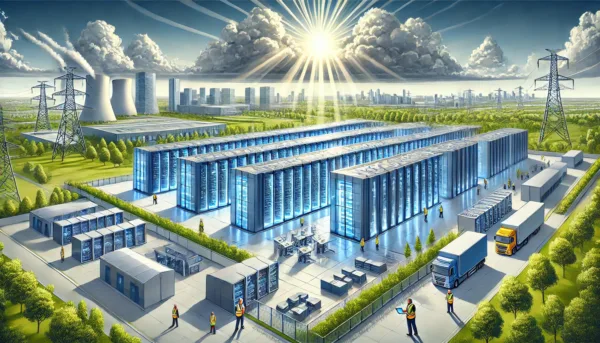


IREN Limited (NASDAQ: IREN) shares closed 19.8% higher at US$40.27 on July 20, 2026, after the data-centre operator announced US$2.8 billion of new multiyear artificial-intelligence cloud contracts. The agreements prompted IREN to raise its year-end AI Cloud annualised run-rate revenue target from US$3.7 billion to more than US$4 billion, with approximately 85% of the revised target now covered by signed contracts. Customer prepayments are expected to fund around 45% of the associated graphics-processing-unit capital expenditure, reducing part of the company’s immediate financing requirement. The central investment question is whether IREN can deliver hundreds of megawatts of computing capacity on schedule and convert contracted run-rate targets into recognised revenue, margins and free cash flow.
Why did IREN shares jump almost 20% despite remaining sharply below their June level?
IREN closed at US$40.27 on July 20 after trading as high as US$41.07, compared with US$33.62 during the previous session. Approximately 83.3 million shares changed hands, highlighting the scale of renewed market attention around the contract announcement.
The rally improved short-term performance without reversing the preceding correction. IREN shares were approximately 3.3% above their July 13 close of US$38.98 but remained around 29.2% below the June 22 closing price of US$56.87. The published 52-week range extends from US$14.72 to US$76.87, leaving the stock about 47.6% below its high but approximately 174% above its low.
Based on the 357.4 million ordinary shares reported as outstanding at April 30, the July 20 closing price implied an approximate equity value of US$14.4 billion. The actual current figure may differ because IREN has continued using equity-linked financing and maintains facilities that could increase the share count.
The market reaction appears to reflect three elements. IREN increased its AI Cloud revenue ambition, demonstrated that demand extends beyond one or two anchor customers and reduced part of the funding risk through contractual prepayments. However, the share price remains volatile because the valuation increasingly depends on infrastructure that is still being built, commissioned and accepted by customers.
What does IREN currently operate as it moves away from its Bitcoin-mining origins?
IREN describes itself as a vertically integrated AI Cloud provider that secures grid-connected power, develops land, constructs data centres and operates graphics-processing-unit clusters for artificial-intelligence training and inference. Its infrastructure portfolio spans North America, with additional European and Asia-Pacific development opportunities under consideration.
The company is transitioning from Bitcoin mining towards higher-value artificial-intelligence computing, but the financial statements show that this shift is not yet complete. During the March quarter, Bitcoin mining generated US$111.2 million of revenue, while AI Cloud Services contributed US$33.6 million. Total quarterly revenue was US$144.8 million.
Bitcoin mining therefore accounted for more than three-quarters of reported quarterly revenue, even though most of IREN’s valuation narrative now centres on artificial intelligence. The company has been decommissioning some application-specific integrated circuit mining hardware and converting existing power and data-centre infrastructure to graphics-processing-unit workloads.
That transition creates both an advantage and a temporary earnings problem. Existing sites, power connections and operational expertise allow IREN to deploy AI infrastructure more quickly than a developer beginning with undeveloped land. However, removing Bitcoin-mining equipment before replacement GPU capacity begins billing can depress revenue and earnings during the conversion period.
IREN reported a March-quarter net loss of US$247.8 million and adjusted EBITDA of US$59.5 million. The loss included US$140.4 million of mainly non-cash impairment charges associated with the decommissioning of mining equipment, along with losses related to financial instruments.
How valuable are the US$2.8 billion AI contracts compared with recognised revenue?
The new contracts involve leading artificial-intelligence developers using both bare-metal infrastructure and managed cloud services. IREN said its customer base now includes Microsoft Corporation, NVIDIA Corporation, Perplexity AI, Figure AI, Together AI, Fluidstack, Fireworks AI, Fal AI and Hume AI, alongside another unnamed developer. The company reported a weighted average contract term of approximately four years across its portfolio.
The breadth of that list is strategically important. IREN’s earlier growth case was heavily associated with a US$9.7 billion agreement with Microsoft Corporation and a US$3.4 billion five-year contract with NVIDIA Corporation. The latest agreements add customer diversification and indicate that demand extends across hyperscalers, model developers, robotics companies and artificial-intelligence application providers.
However, the US$4 billion target is annualised run-rate revenue rather than generally accepted accounting principles revenue guidance. IREN calculates the figure using expected hourly GPU pricing, planned commissioned capacity and a full year of assumed availability. Revenue will begin only after relevant infrastructure and GPUs are delivered, commissioned, tested and accepted by customers.
This creates a timing distinction that investors should not overlook. A contract can improve future revenue visibility without immediately appearing in the income statement. Delayed power delivery, construction problems, unavailable GPUs, cooling-system issues or slower customer acceptance could shift revenue into later periods.
The 85% contracted figure is nevertheless meaningful because it reduces uncertainty over demand for the planned capacity. The next analytical question is no longer primarily whether IREN can locate customers. It is whether the company can fulfil its commitments at costs that produce attractive returns after power, hardware, financing, staffing and depreciation.
Can customer prepayments materially reduce IREN’s enormous capital requirements?
IREN said customer prepayments under contracts executed since June 1 are expected to cover approximately 45% of the estimated GPU capital expenditure associated with those deployments. This improves the economics because customers are helping fund hardware before services are delivered.
Prepayments can reduce the amount of equity, convertible debt or equipment financing required from IREN. They may also indicate strong customer commitment because clients are providing capital before capacity becomes operational. Yet the payments are not equivalent to profit. They create obligations to deliver the contracted infrastructure and services, and part of the cash may ultimately appear as deferred revenue until performance requirements are satisfied.
IREN held approximately US$7.6 billion in cash and cash equivalents at June 30, compared with US$2.21 billion at March 31. The increase provides substantial liquidity for graphics-processing units, data centres, acquisitions and working capital.
The cash position was supported by financing rather than operating cash flow alone. IREN carried approximately US$3.69 billion of convertible notes on its March balance sheet and completed a further US$3 billion convertible senior-notes offering in May.
The capital requirement is correspondingly large. IREN had agreed to purchase approximately US$3.5 billion of graphics-processing units and related equipment from Dell Technologies for delivery during the second half of 2026. Goldman Sachs Bank USA and JPMorgan Chase Bank had also committed to underwrite approximately US$3.6 billion of delayed-draw financing connected with the Microsoft deployment, subject to specified conditions.
IREN does not currently appear constrained by an absence of liquidity. The more important question is whether contracted revenue and customer prepayments can support the cost of infrastructure without requiring repeated financing on increasingly complex terms.
Can IREN deliver 480 megawatts in 2026 and 1.2 gigawatts during 2027?
IREN is targeting approximately 480 megawatts of AI Cloud capacity by the end of 2026, compared with around three megawatts of self-built capacity a year earlier. The company has said operational capacity is fully contracted and that the Horizon 1 through Horizon 4 data centres remain scheduled for delivery by year-end.
The 2027 target increases to approximately 1.2 gigawatts. Planned projects include additional capacity at Childress in Texas, the first phase of Sweetwater and other air-cooled and liquid-cooled deployments. IREN also refers to a longer-term five-gigawatt secured-power portfolio.
These figures demonstrate the scale of management’s ambition, but power secured for future development is not equivalent to completed revenue-generating capacity. Each project must progress through permitting, financing, construction, grid connection, hardware delivery, testing and customer acceptance.
IREN’s vertically integrated model gives it greater control over several of these steps than a cloud operator dependent entirely on third-party data centres. It also concentrates development risk inside the company. Construction delays or budget overruns could affect several customer commitments simultaneously.
The company has proposed acquiring Mirantis, Inc. to strengthen cloud orchestration, enterprise support and GPU-cluster management. It has also agreed to acquire Ingenostrum, S.L., trading as Nostrum Group, which would add approximately 490 megawatts of power capacity in Spain. Both transactions were announced as subject to closing conditions and should not be treated as completed operating assets until IREN confirms completion.
How should investors assess dilution from convertible debt and potential new shares?
IREN has used a combination of ordinary shares, convertible notes, capped-call transactions and equipment financing to support its expansion. The company had approximately 258.1 million ordinary shares outstanding at June 30, 2025, compared with 341.5 million at March 31, 2026 and 357.4 million by April 30.
Part of that increase resulted from an at-the-market programme and a registered direct offering associated with refinancing earlier convertible notes. IREN filed a new prospectus in March allowing up to US$6 billion of ordinary shares to be sold through its at-the-market facility, although the existence of the facility does not mean that the entire amount will necessarily be issued.
The company also granted NVIDIA Corporation a five-year right to purchase up to 30 million ordinary shares at an exercise price of US$70 per share, subject to relevant conditions. Exercise could provide IREN with as much as US$2.1 billion of additional capital but would also increase the share count.
Convertible notes do not create automatic dilution at issuance. Their ultimate effect depends on conversion prices, future share prices, settlement methods and capped-call protections. However, they increase the complexity of evaluating per-share value because successful execution and a higher stock price may make conversion more likely.
The commercial test is whether each new dollar raised produces infrastructure and contracted cash flow worth more than its financing cost and dilution. Rising revenue targets are valuable only when they translate into growing value per share rather than growth funded by an ever-expanding capital base.
What evidence would strengthen or weaken the IREN artificial-intelligence thesis next?
The strongest evidence would be on-time completion of the 480-megawatt 2026 programme, followed by successful customer acceptance and recognised AI Cloud revenue. Investors should watch the rate at which contracted annualised run-rate revenue becomes reported quarterly revenue and operating cash flow.
Margin disclosure will become increasingly important as the AI Cloud business scales. GPU revenue can appear enormous, but hardware depreciation, electricity, networking, software support and financing costs can absorb a significant portion of the economics. IREN will need to show that its vertically integrated model delivers attractive returns after all these expenses.
The thesis would strengthen if customer prepayments continue covering a meaningful share of capital expenditure, the customer base becomes less concentrated and financing needs decline relative to contracted revenue. Completion and successful integration of Mirantis could also improve the managed-cloud proposition, while the proposed Nostrum acquisition could support European expansion.
The thesis would weaken if data-centre delivery slips, customer acceptance is delayed, GPU pricing declines or infrastructure costs exceed current assumptions. Additional large equity issuances, rising convertible obligations or weak cash conversion could also reduce the per-share benefit of operational growth.
IREN’s July 20 announcement represents genuine commercial progress. The company has added US$2.8 billion of contracts, expanded its customer roster and obtained prepayment structures that reduce part of the capital burden. However, investors are still valuing a transformation whose largest revenue streams remain ahead rather than behind it.
The next revaluation will depend on delivery. IREN must demonstrate that contracted demand can become functioning data-cententre capacity, recognised revenue, durable margins and free cash flow without allowing financing complexity to consume the economic upside.
Key takeaways from IREN’s US$2.8 billion AI cloud contract announcement
- IREN shares closed 19.8% higher at US$40.27 after the company announced US$2.8 billion of new AI Cloud contracts.
- The year-end AI Cloud annualised run-rate revenue target increased from US$3.7 billion to more than US$4 billion.
- Approximately 85% of the target is covered by signed contracts, with a weighted average contract term of about four years.
- Recent customer prepayments are expected to cover approximately 45% of the associated GPU capital expenditure.
- IREN held approximately US$7.6 billion in cash at June 30 but has also raised billions of dollars through convertible debt and equity-linked financing.
- The company is targeting 480 megawatts of AI Cloud capacity during 2026 and approximately 1.2 gigawatts in 2027.
- The decisive proof points are infrastructure delivery, customer acceptance, recognised revenue, margins and free-cash-flow conversion.
Share this:
Discover more from Business-News-Today.com
Subscribe to get the latest posts sent to your email.