




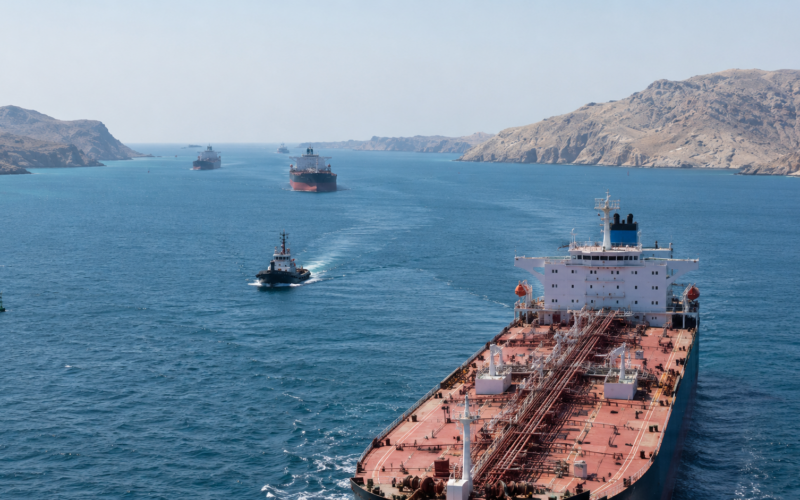
Iran’s renewed declaration that the Strait of Hormuz is closed has opened a dangerous new phase in its confrontation with the United States, even as Washington insists that the strategic waterway remains open to lawful commercial traffic. The conflicting positions followed attacks on July 11 and July 12, 2026, involving Iranian forces, United States military strikes and a Cyprus-flagged container ship that was disabled in the strait.
The escalation has already reached global markets. Brent crude climbed more than 3% to approximately $78.35 a barrel in early trading on July 13, while United States West Texas Intermediate crude advanced to about $73.62. Ship-tracking data showed only six vessels passing through the strait on July 12, the lowest daily total in five weeks, demonstrating that a waterway can remain technically open while becoming commercially hazardous.
Iran’s Islamic Revolutionary Guard Corps said vessels using routes not authorised by Tehran would be targeted. United States Central Command rejected Iran’s closure claim and maintained that American forces were positioned to protect freedom of navigation. The result is an unstable situation in which neither side recognises the other’s authority over access, while commercial operators must make immediate decisions about crew safety, insurance exposure and cargo delivery.
What triggered the latest United States and Iran confrontation around the Strait of Hormuz?
The latest escalation followed an attack on the Cyprus-flagged container ship GFS Galaxy in the Strait of Hormuz. The vessel sustained serious engine-room damage, caught fire and became unable to continue its voyage. One crew member was reported missing after the incident.
The United States identified Iran’s Islamic Revolutionary Guard Corps as responsible for the attack and launched retaliatory strikes against Iranian military assets. The targets included missile systems, air-defence installations and small vessels operated by the Islamic Revolutionary Guard Corps around strategically important coastal areas.
Iran subsequently launched missiles and drones at targets connected with the United States across several Gulf states. The expanded geographic reach of the Iranian response increased the risk to countries hosting American military facilities, even when those states were not direct participants in the original maritime incident.
The exchange formed part of a broader cycle of attacks, retaliation and interrupted diplomacy. Previous attempts to stabilise shipping and reopen negotiations had created expectations that maritime traffic could gradually recover. The new strikes have weakened that assumption and raised the possibility that short periods of de-escalation will continue to be interrupted by attacks on ships or military infrastructure.
The immediate military question is whether the attacks remain calibrated signals or develop into a sustained campaign for control of the strait. The commercial question is already more urgent because shipping companies cannot wait for a political conclusion before deciding whether to send vessels through a contested passage.
Is the Strait of Hormuz actually closed despite conflicting claims from Iran and Washington?
Iran has declared the Strait of Hormuz closed and warned that vessels using unauthorised routes could be attacked. The United States has rejected that declaration, with United States Central Command maintaining that the waterway remains open and that American forces are prepared to ensure lawful navigation.
Both statements can coexist with a sharp reduction in actual shipping. A formal closure generally implies that vessels are physically prevented from passing, while a functional disruption can occur when shipowners, charterers and insurers decide that passage is too dangerous. The fall to six recorded transits on July 12 indicates severe operational disruption even without an internationally recognised closure.
United States President Donald Trump has maintained that commercial vessels can continue using the strait. Washington’s position rests on the principle that Iran cannot unilaterally deny navigation through an international waterway. The United States military presence is intended to reinforce that position and discourage further attacks.
Iran’s position relies on its proximity to the strait and its ability to threaten vessels using missiles, drones, fast boats and other military assets. Tehran does not need to seal every shipping lane to influence traffic. A limited number of attacks, combined with explicit warnings, can persuade commercial operators to delay voyages without Iran assuming the cost of a permanent physical blockade.
This distinction is critical for policymakers and markets. The question is no longer simply whether a ship can pass through the Strait of Hormuz. The relevant question is whether passage is predictable, insurable and commercially acceptable. The latest transit data suggests that many operators do not yet believe those conditions have been restored.
Why does renewed disruption in the Strait of Hormuz matter so much for global energy supplies?
The Strait of Hormuz connects the Persian Gulf with the Gulf of Oman and the Arabian Sea. It is one of the world’s most important energy corridors because oil and liquefied natural gas exports from major Gulf producers must pass through the narrow waterway to reach international customers.
Approximately 14.6 million barrels per day of crude oil and petroleum products passed through the strait in recent official estimates. Crude oil and condensate accounted for about 10.7 million barrels per day, while other petroleum liquids represented approximately 3.9 million barrels per day.
Liquefied natural gas exposure is equally important. More than 110 billion cubic metres of liquefied natural gas passed through the Strait of Hormuz during 2025. Approximately 93% of Qatar’s liquefied natural gas exports and 96% of exports from the United Arab Emirates used the route, representing almost one-fifth of global liquefied natural gas trade.
Alternative pipelines can redirect part of the region’s oil exports, but they cannot fully replace the strait’s capacity. Liquefied natural gas exporters face even fewer options because large volumes cannot simply be transferred to an overland route. This makes prolonged disruption a supply-chain problem rather than merely a temporary increase in shipping costs.
Around 80% of the oil and petroleum products passing through the strait in 2025 were destined for Asia. China, India, Japan and South Korea therefore face greater direct exposure than many Western economies. Higher transport costs or reduced supply could affect refinery margins, fuel prices, trade balances and inflation across the region.
The effect would not be limited to energy. Gulf producers are important suppliers of petrochemicals, fertilisers and industrial feedstocks. Disruption could eventually raise costs for agriculture, manufacturing, aviation and logistics, spreading the consequences well beyond oil traders.
Why did oil rise only about 3% despite the serious threat to Strait of Hormuz shipping?
Brent crude advanced more than 3% after the latest strikes, but the increase remained relatively contained compared with the potential consequences of a prolonged closure. That market response suggests traders have not yet concluded that Gulf energy exports will be interrupted for an extended period.
Oil markets appear to be distinguishing between a dangerous escalation and a durable supply loss. Shipping traffic has fallen sharply, but some vessels are still transiting the strait. Oil production outside the immediate conflict zone also remains available, while strategic inventories and alternative export routes provide limited buffers.
The moderate increase may also reflect expectations that the United States and Iran still have reasons to prevent uncontrolled escalation. Iran depends on energy revenue and regional trade, while the United States wants to protect shipping without creating an open-ended conflict that drives global inflation higher.
That restraint should not be mistaken for confidence. Brent crude had already experienced repeated swings as attacks, ceasefire expectations and diplomatic signals changed. Each new incident forces traders to reassess whether the latest confrontation is temporary or evidence that the previous stabilisation effort has failed.
Insurance markets may provide an earlier warning than headline oil prices. Higher war-risk premiums, reduced vessel availability and crew-safety restrictions can affect physical energy flows before global benchmarks fully reflect the disruption. A technically open waterway can therefore produce tightening supply conditions even when Brent crude remains below levels associated with a complete blockade.
How could the United States and Iran escalation affect inflation and Asian markets?
The immediate market reaction included weaker Asian equities, higher government-bond yields and a stronger United States dollar. Investors were already preparing for new United States inflation data, making the oil increase especially sensitive for expectations surrounding Federal Reserve policy.
Higher crude prices feed into transport, manufacturing and consumer costs, although the timing and scale vary by economy. A brief price increase may have limited economic consequences, but sustained disruption could slow the decline in inflation or create a new upward cycle in fuel and freight expenses.
India is particularly exposed because it imports most of the crude oil it consumes. A prolonged increase in international oil prices could raise the import bill, pressure the Indian rupee and complicate domestic fuel-price management. It could also affect corporate margins in aviation, paints, chemicals, logistics and other energy-intensive sectors.
China, Japan and South Korea face similar risks through their dependence on imported oil and liquefied natural gas. Refiners may have inventories and diversified suppliers, but longer voyages or competition for replacement cargoes would increase costs.
The Federal Reserve also faces a difficult policy calculation. Higher energy prices can lift inflation even as geopolitical uncertainty weakens investment and economic confidence. Interest-rate increases would address the inflation component but could add pressure to growth-sensitive sectors and highly valued equities.
The Strait of Hormuz crisis therefore connects military developments with household prices and central-bank decisions. What begins as a dispute over maritime passage can influence borrowing costs, currencies and corporate earnings across countries far removed from the Gulf.
Can diplomacy survive after renewed attacks by the United States and Iran?
The latest military exchanges have placed recent diplomatic efforts under severe pressure. Previous discussions were intended to establish a framework for reducing attacks, restoring shipping and reopening negotiations between the United States and Iran.
Washington has insisted that Iran must stop attacking commercial vessels and commit to safe navigation through the Strait of Hormuz. Tehran has argued that renewed United States strikes undermine the basis for negotiations and has linked further escalation to the American military campaign.
The two positions leave limited room for compromise unless an intermediary can separate maritime security from the wider dispute. Oman and other regional actors have previously played roles in communication between Washington and Tehran, but each new strike makes indirect diplomacy more difficult.
Gulf states have a strong interest in de-escalation because they host military facilities, export energy through the strait and depend on predictable international trade. Iranian attacks extending across the region increase pressure on those governments to strengthen their defences while avoiding deeper direct involvement.
A credible diplomatic arrangement would need more than a temporary pause in attacks. Shipping operators would require clear navigation procedures, reduced military activity and evidence that vessels would not be targeted during future political disagreements.
Until those conditions emerge, markets are likely to treat every incident as a potential turning point. The Strait of Hormuz may remain legally open, but commercial confidence will depend on whether the United States and Iran can establish a durable mechanism that makes passage safe in practice.
What are the key takeaways from the renewed Strait of Hormuz confrontation?
- Iran declared the Strait of Hormuz closed after renewed attacks on July 11 and July 12, 2026, while United States Central Command maintained that the waterway remained open to lawful commercial traffic.
- The Cyprus-flagged container ship GFS Galaxy sustained serious engine-room damage and caught fire during an attack in the Strait of Hormuz, leaving the vessel disabled and one crew member reportedly missing.
- The United States responded with strikes against Iranian missile systems, air-defence installations and small vessels, while Iran expanded its response to targets associated with the United States across several Gulf states.
- Ship-tracking data recorded only six vessel transits through the Strait of Hormuz on July 12, the lowest daily figure in five weeks and evidence of serious functional disruption.
- Brent crude rose more than 3% to approximately $78.35 a barrel, while United States West Texas Intermediate crude increased to around $73.62 as markets priced in renewed supply risk.
- Approximately 80% of the oil and petroleum products passing through the Strait of Hormuz in 2025 were destined for Asia, leaving India, China, Japan and South Korea particularly exposed.
- More than 110 billion cubic metres of liquefied natural gas crossed the strait in 2025, including most exports from Qatar and the United Arab Emirates, with few viable alternative routes.
- The dispute could affect inflation, interest-rate expectations, shipping insurance, refinery costs and Asian trade balances even if the strait remains technically open and a complete physical blockade is avoided.
Share this:
Discover more from Business-News-Today.com
Subscribe to get the latest posts sent to your email.