Freddy’s Frozen Custard & Steakburgers plans to open approximately 60 restaurants during 2026 as the Rhône-owned chain approaches the 600-location mark across the United States and Canada. The Wichita-founded restaurant company is widening its real estate strategy beyond traditional standalone drive-thru outlets by placing greater emphasis on lower-cost in-line and endcap formats. Freddy’s Frozen Custard & Steakburgers currently operates more than 580 locations, with existing franchisees expected to account for a significant portion of the next development wave. The expansion is concentrated across the Northeast, Rust Belt, Midwest, Pacific Northwest, Northern California and Florida, while international franchise opportunities are also being pursued in Canada and Mexico. The strategic test is whether smaller and more flexible restaurant formats can accelerate unit growth without weakening sales, franchisee economics or operational consistency.
Why is Freddy’s planning approximately 60 restaurant openings during 2026?
The proposed opening programme represents a material increase in the physical reach of Freddy’s Frozen Custard & Steakburgers. The chain ended 2025 with about 580 restaurants, meaning 60 gross openings could expand the system by roughly 10% before accounting for closures, transfers or other changes. For a mature restaurant brand, that would be a rapid pace. For a concept still underpenetrated across large parts of the United States, the target is ambitious but commercially understandable.
Freddy’s Frozen Custard & Steakburgers remains much smaller than the largest burger chains, which gives it considerable geographic room to expand. The company has a meaningful presence in Texas and several central United States markets, but its footprint remains thin in parts of the Northeast, Pacific Northwest, Northern California and Southeast. Many states entered 2026 with fewer than ten Freddy’s restaurants, creating scope for cluster development without immediately crowding existing franchisees.
The expansion is also occurring soon after Rhône acquired Freddy’s Frozen Custard & Steakburgers from Thompson Street Capital Partners in September 2025. The transaction reportedly involved an initial purchase price of approximately $650 million, financed with a combination of private equity capital and debt. That ownership change increases the pressure to deliver sustained system growth, stronger royalty income and a future valuation that justifies the acquisition price.
Private equity ownership does not automatically mean reckless expansion, but it does make development velocity strategically important. Restaurant franchisors are often valued using system sales, fee income, unit growth and the durability of franchisee returns. Adding restaurants can increase recurring royalties and advertising contributions, although openings create value only when individual units remain financially healthy.
The involvement of existing franchisees offers an encouraging signal. Approximately one-third of current operators are expanding into additional territories. Franchisees already inside the system possess direct knowledge of labour requirements, food costs, brand support and restaurant-level profitability, so their willingness to reinvest carries more weight than interest from first-time buyers unfamiliar with operating realities.
How could smaller Freddy’s restaurant formats change franchise investment economics?
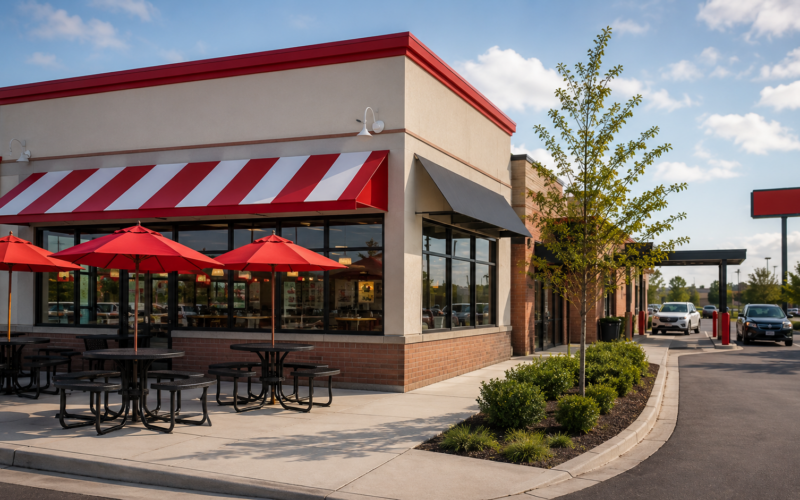
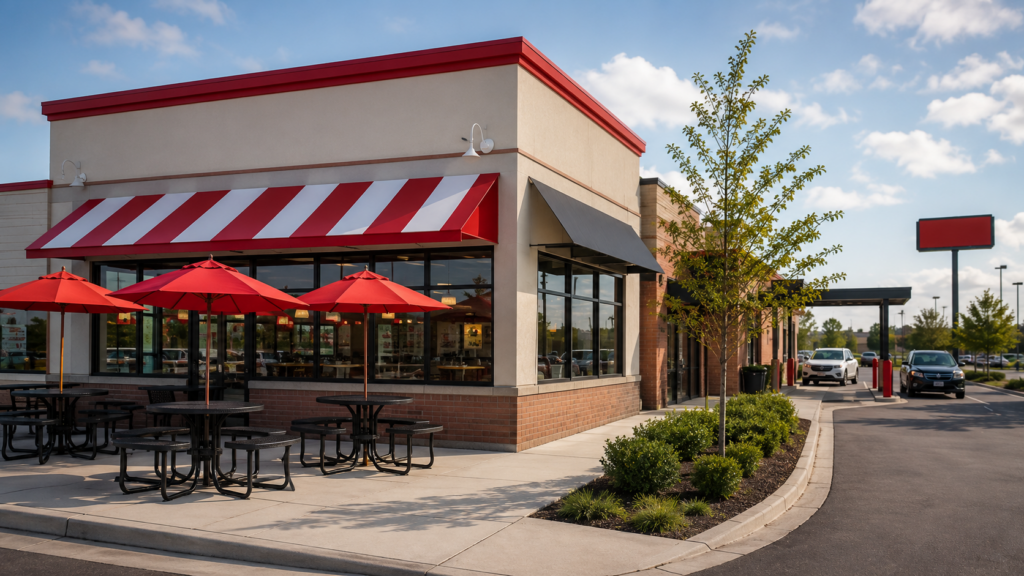
Freddy’s Frozen Custard & Steakburgers has traditionally relied heavily on standalone restaurants with drive-thru lanes. These outlets provide strong visibility, convenient vehicle access and control over the customer experience, but they also require larger sites and significantly more development capital. The company is now pushing more aggressively into in-line restaurants and shopping-centre endcaps to widen the range of viable locations.
An in-line Freddy’s restaurant without a drive-thru can begin at an estimated investment of approximately $854,834 under the current development proposition. A standalone restaurant with a drive-thru begins at roughly $1.59 million and can cost substantially more depending on land, construction, equipment and local conditions. The difference could reduce the entry barrier for qualified franchisees and allow multi-unit operators to preserve capital for additional openings.
Lower development costs matter because restaurant financing has become less forgiving. Construction expenses, borrowing costs, equipment prices, wages and property occupancy costs can make new outlets difficult to justify, even when a brand has respectable average sales. Reducing the initial investment can improve the relationship between annual revenue and capital committed, although smaller formats may also generate lower sales.
Freddy’s franchise data illustrates this trade-off. Standalone franchised restaurants with drive-thru lanes have generated average unit volumes approaching $1.9 million. Endcap units with drive-thru access have produced average volumes of approximately $1.8 million, while in-line restaurants without drive-thru lanes have averaged closer to $1.4 million.
The lower sales figure does not necessarily make the in-line format unattractive. Franchise returns depend on development cost, rent, staffing, food margins, operating expenses and financing, not revenue alone. A smaller restaurant costing hundreds of thousands of dollars less may still provide an appealing return if occupancy costs remain controlled and the location produces steady traffic.
The format also gives Freddy’s Frozen Custard & Steakburgers access to existing retail centres where standalone parcels are unavailable or prohibitively expensive. This could be particularly important in dense urban and suburban trade areas across the Northeast, Northern California and Pacific Northwest. In such locations, a conventional one-acre restaurant site with a drive-thru may be difficult to secure, while an in-line unit can enter an established shopping destination with built-in customer traffic.
Can Freddy’s expand without weakening the drive-thru advantage that supports its sales?
The operational question is whether Freddy’s Frozen Custard & Steakburgers can translate its restaurant experience into smaller locations without losing the convenience that makes standalone outlets productive. Drive-thru demand remains an important part of the United States restaurant market, especially for burgers, fries, beverages and desserts. Removing that channel changes how customers order, collect food and decide whether a location is convenient.
An in-line restaurant may depend more heavily on dine-in traffic, digital ordering, takeaway and delivery. That can work in shopping centres with strong footfall, but it leaves the outlet more exposed to the health of surrounding retailers and the ease of parking. A location with lower construction cost can still disappoint if customers perceive it as inconvenient.
Freddy’s Frozen Custard & Steakburgers must therefore avoid treating in-line development as a simple real estate shortcut. Each site must be evaluated according to traffic patterns, nearby employment, residential density, delivery demand and competition. A restaurant placed into an inexpensive but weak retail centre can become a very economical way to lose money.
Menu execution is another consideration. Freddy’s Frozen Custard & Steakburgers combines cooked-to-order steakburgers with frozen custard, creating a proposition that differs from conventional fast-food operations built primarily around maximum speed. Smaller kitchens must retain enough capacity to manage burger preparation, frying, custard production, beverage service and peak-period orders without damaging service times.
Delivery could increase sales reach, but frozen custard and freshly prepared fries are not products that improve during a long journey in the back of a car. The chain must manage packaging, order sequencing and delivery radius carefully. Digital sales are useful, but technology has yet to persuade a melting dessert to respect traffic congestion.
The strongest format strategy may therefore be a portfolio approach. Standalone drive-thru restaurants can remain the preferred option in markets with suitable real estate, while endcaps and in-line restaurants can fill geographic gaps or enter denser trade areas. Flexibility creates value when formats are matched to markets rather than applied indiscriminately.
What does existing franchisee expansion reveal about the health of the Freddy’s system?
Existing franchisees are expected to play a major role in the 2026 opening programme, with around one-third expanding into additional territories. This matters because experienced operators can often open stores more efficiently than new franchisees. They already understand the supply chain, training systems, technology, marketing calendar and operating standards.
Multi-unit franchisees can also share management resources across several restaurants. Area managers, maintenance teams, trainers and local marketing functions can support multiple outlets, reducing the incremental cost of each new opening. Cluster development may improve advertising efficiency because several nearby restaurants benefit from the same regional campaigns.
However, reinvestment by existing franchisees should not be interpreted as proof that every outlet performs equally well. System averages can conceal considerable differences between top-performing restaurants, immature stores and weaker markets. Prospective franchisees must examine the full franchise disclosure document, speak with current and former operators and test assumptions using local costs.
Freddy’s Frozen Custard & Steakburgers reported 47 openings and 19 terminations during 2025. Gross development was healthy, but the number of terminated locations shows that the system is not immune to closures or franchisee stress. A restaurant chain should be evaluated using net growth and unit economics rather than opening announcements alone.
The 2025 Chapter 11 restructuring of M&M Custard, previously the chain’s largest franchisee, provides an important warning. The operator had expanded into markets that ultimately failed to generate adequate returns and accumulated substantial liabilities. The difficulties were linked to the franchisee rather than a corporate bankruptcy at Freddy’s Frozen Custard & Steakburgers, but the case demonstrates how aggressive multi-unit expansion can strain even an experienced operator.
The lesson for the 2026 programme is straightforward. Territory development schedules must reflect local demand, management capacity and balance-sheet strength. Opening several restaurants quickly can create scale, but it can also magnify mistakes if site selection or market assumptions prove wrong.
Why is Rhône likely to support rapid but capital-light growth at Freddy’s?
Rhône acquired Freddy’s Frozen Custard & Steakburgers after Thompson Street Capital Partners had expanded the chain from roughly 400 restaurants in 2021 to about 580 by the end of 2025. Average unit volumes also improved during that ownership period, strengthening the commercial case for continued development.
The chain’s overwhelmingly franchised structure is likely to appeal to its new private equity owner. At the end of 2025, Freddy’s Frozen Custard & Steakburgers had approximately 542 franchised restaurants and 38 company-operated locations. Franchisees provide most of the capital needed for development, while the franchisor earns initial fees, continuing royalties and other system revenue.
This allows the parent company to grow with lower corporate capital expenditure than a predominantly company-owned restaurant chain. The economic attraction becomes stronger when franchisees fund several units under development agreements. Rhône can therefore pursue geographic growth without purchasing every parcel, constructing every restaurant or employing every restaurant worker directly.
The model still carries indirect financial exposure. Royalty income depends on franchisee sales, and franchisee failures can damage revenue, brand reputation and market coverage. A franchisor may also need to provide operational support, approve transfers or intervene when restaurants encounter financial problems.
Debt used in the acquisition adds another reason to favour dependable fee growth. The transaction reportedly included a $350 million term loan alongside equity capital. Freddy’s Frozen Custard & Steakburgers must therefore generate enough cash to support corporate investment, service financial obligations and maintain the systems required by a growing franchise network.
Rhône’s eventual return may depend on selling the business, recapitalising it or pursuing another strategic transaction after increasing earnings. Reaching and moving beyond 600 restaurants would create a visible milestone, but future buyers will look beyond the sign count. They will examine same-store sales, closure rates, franchisee profitability, debt and the quality of the development pipeline.
How intense is competition in the United States burger and frozen dessert market?
Freddy’s Frozen Custard & Steakburgers competes in a crowded category that includes McDonald’s Corporation, The Wendy’s Company, Restaurant Brands International, Sonic Drive-In, Culver’s, Whataburger, Shake Shack Inc., Five Guys Enterprises and regional burger concepts. It also competes with ice cream and dessert chains for discretionary visits.
The brand’s combination of thin steakburgers, shoestring fries and frozen custard provides differentiation, but several rivals offer overlapping products. Culver’s has a strong butter burger and frozen custard proposition, while Shake Shack Inc. combines premium burgers, shakes and an urban expansion strategy. Local independent restaurants can also compete effectively on quality and community loyalty.
Freddy’s Frozen Custard & Steakburgers generated systemwide sales of approximately $1.04 billion during 2025. That places the chain above many smaller concepts but well below the largest burger systems. Its average unit volume of around $1.9 million for standalone franchised restaurants is respectable and exceeds several established competitors, although it trails the strongest performers in the category.
Expansion into underdeveloped states could produce attractive white-space growth, but competitors are pursuing many of the same markets. Suitable drive-thru sites are scarce, restaurant labour remains expensive and consumers are sensitive to menu pricing. Growing store counts will not protect a chain if customers decide the meal no longer offers sufficient value.
Freddy’s must therefore preserve product quality while controlling labour and food costs. Steakburgers and frozen custard can support a slightly more premium position than basic fast food, but the brand cannot drift too far from family affordability. Restaurant chains often discover that customers enjoy premiumisation most when someone else is paying.
What could prevent Freddy’s from achieving sustainable growth beyond 600 restaurants?
The first risk is development slippage. A target of approximately 60 openings represents gross development, not guaranteed net growth. Construction delays, permitting issues, financing problems or franchisee withdrawals can move planned restaurants into later years.
The second risk is cannibalisation. Freddy’s Frozen Custard & Steakburgers remains underpenetrated nationally, but some established markets already contain dense restaurant clusters. Adding units too close together may increase system sales while reducing sales per restaurant, shifting value from existing franchisees to the franchisor.
The third risk is operational dilution. Sixty openings require trained managers, supply-chain capacity, field support, technology installation and local marketing. Rapid growth can stretch corporate teams and franchisee organisations, particularly when development spans many geographically dispersed states.
Food and labour inflation remain persistent threats. Higher menu prices can protect restaurant margins for a time, but repeated increases may reduce transaction volumes. Lower-cost restaurant formats help with capital expenditure, but they do not solve weak consumer demand or rising operating costs.
Franchisee leverage also requires attention. Operators frequently use debt to fund new restaurants, and expansion commitments may be signed when economic conditions look more favourable than they do at opening. Freddy’s Frozen Custard & Steakburgers must balance development ambition with the long-term financial health of its operators.
The company’s 2026 programme will therefore be judged by more than whether it announces its 600th restaurant. The more meaningful indicators will be net unit growth, opening performance, average sales, closure rates and repeat investment by financially sound franchisees.
What are the key takeaways from the Freddy’s restaurant expansion strategy?
- Freddy’s Frozen Custard & Steakburgers plans approximately 60 gross openings during 2026 as the chain moves beyond 580 locations.
- Existing franchisees are expected to drive much of the expansion, suggesting continued operator confidence but not eliminating financial risk.
- In-line restaurants can begin at around $854,834, materially below the starting investment for a standalone drive-thru restaurant.
- Smaller formats could widen the franchisee pool and unlock denser markets where standalone sites are scarce or expensive.
- In-line locations generate lower average sales than standalone drive-thru restaurants, making capital efficiency and occupancy costs critical.
- Rhône’s ownership creates a strong incentive to expand recurring franchise fees and increase the chain’s eventual enterprise value.
- Freddy’s remains underpenetrated across several United States regions, providing geographic white space for disciplined cluster development.
- The 19 restaurant terminations recorded during 2025 show that gross openings must be assessed alongside closures and net system growth.
- Competition from Culver’s, Shake Shack Inc., McDonald’s Corporation and other burger chains will place continued pressure on value, service and site selection.
- Sustainable expansion will depend on franchisee returns, operating consistency and net unit economics rather than reaching a symbolic restaurant count.
Share this:
Discover more from Business-News-Today.com
Subscribe to get the latest posts sent to your email.