



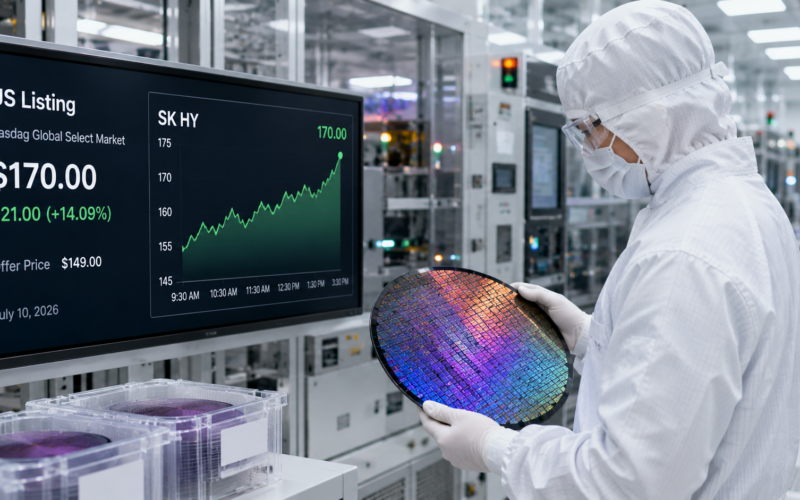
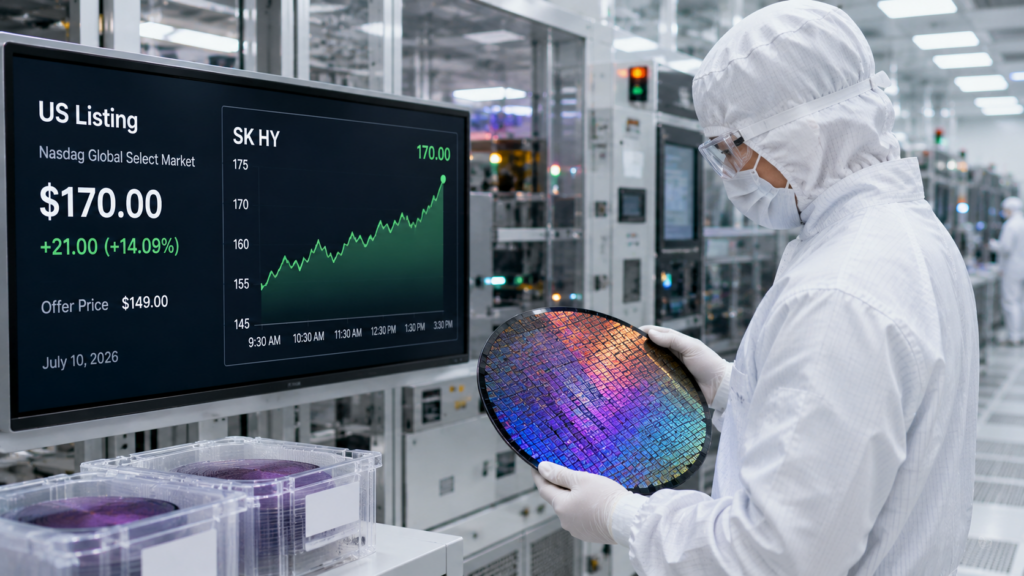
SK hynix Inc. (NASDAQ: SKHYV, KRX: 000660) opened at 170 dollars per American depositary receipt on the Nasdaq Global Select Market on July 10, 2026, trading approximately 14 percent above the 149 dollar offer price set the previous evening, in what ranks as the largest first-time US listing by a foreign company in history and the second-largest US equity share sale on record after the SpaceX debut in June. The Icheon, South Korea-based memory semiconductor manufacturer raised approximately 26.5 billion dollars through the issuance of 177.9 million ADRs, each representing one-tenth of one common share traded in Seoul, and the offering was oversubscribed by more than seven times, with about 5 billion dollars in ADRs allocated to three cornerstone investors including Baillie Gifford, Coatue Management, and Situational Awareness Partners.
The when-issued ticker SKHYV will convert to the permanent ticker SKHY on July 13, 2026 following the standard settlement window. SK Group Chairman Chey Tae-won, Executive Vice Chairman Chey Jae-won, and SK hynix Inc. President and Chief Executive Officer Kwak Noh-Jung marked the occasion at the Nasdaq MarketSite in Times Square, with Kwak framing the moment around the artificial intelligence memory demand thesis and telling Bloomberg in his first-ever English-language interview that memory chip shortages roiling computer, automobile, and device markets will probably persist beyond 2030, with customers signing long-term contracts specifically because they believe the shortage situation will last for longer. The debut arrives at a specific inflection point in the memory cycle, roughly one week after Micron Technology, Inc., Samsung Electronics Co., Ltd., SK hynix Inc., and the broader memory complex each fell more than 20 percent between June 25 and July 3 in what has been characterised as memory’s first bear market of the AI cycle, and SK hynix Inc. trading at approximately 5.8 times forward earnings against Micron Technology, Inc.’s approximately 7 times multiple sets up the specific valuation gap closure thesis that the ADR listing is designed to test.
What does SK Hynix’s $170 opening price on Nasdaq actually change for the AI memory competitive landscape
The listing structurally alters the composition of United States institutional investor exposure to AI memory in a way that changes the peer valuation dynamic across the sector. Prior to July 10, 2026, Micron Technology, Inc. was the only United States-listed pure-play memory semiconductor operator with meaningful liquidity and analyst coverage, and it commanded a valuation premium relative to SK hynix Inc.’s Korean listing despite SK hynix Inc. holding a materially stronger position in high-bandwidth memory. That access-driven premium reflected the reality that United States institutional capital had been constrained from directly holding SK hynix Inc. shares by the operational friction, currency exposure, custody requirements, and analytical coverage limitations of the Seoul listing. The Nasdaq ADR listing removes that friction.
The immediate market response signalled that the demand side of the listing thesis is intact. Book demand at more than seven times available shares confirmed that institutional appetite for direct SK hynix Inc. exposure exists at scale. Baillie Gifford, Coatue Management, and Situational Awareness Partners together taking approximately 5 billion dollars of ADRs demonstrates that specialist growth and technology-focused institutional capital was ready to move on the offering. The 14 percent opening premium above the offer price reflects both continued institutional demand at the trading level and retail interest that had been building through the pre-listing marketing period.
The competitive read-across for Micron Technology, Inc. is more nuanced than the simple pair trade framing suggests. Micron Technology, Inc. shares closed at 991.64 dollars on July 9, 2026, up 247.66 percent year to date, and consensus analyst price targets sit near 1,486 dollars with a forward price-to-earnings ratio of approximately 6 to 7 times. Micron Technology, Inc. delivered Q3 fiscal 2026 revenue of 41.456 billion dollars up 345.7 percent year over year, non-GAAP diluted earnings per share of 25.11 dollars, and GAAP gross margin of 84.6 percent, with guidance for the following quarter at 50.0 billion dollars plus or minus 1.0 billion dollars. That fundamental performance is not being challenged by the SK hynix Inc. listing, but the question of whether new United States capital rotates into SKHY at Micron Technology, Inc.’s expense, or whether new capital flows into both, will define the pair trade over the coming weeks.
Why does CEO Kwak Noh-Jung’s memory crunch beyond 2030 framing recalibrate the durability debate
Kwak Noh-Jung’s statement to Bloomberg that memory-chip shortages will probably persist beyond 2030 is the specific durability signal that has been missing from the memory sector debate through the June and July memory bear market. The concern that had been building through late June 2026 and into early July was that the AI infrastructure capital expenditure cycle might be nearing peak and that memory pricing would compress as capacity additions from SK hynix Inc., Samsung Electronics Co., Ltd., and Micron Technology, Inc. arrive over the coming 18 to 24 months. Kwak Noh-Jung’s framing that customers are signing long-term contracts specifically because they believe the shortage situation will last longer directly counters that cyclical concern by demonstrating that buyer behaviour reflects continued supply constraint expectations.
The mechanistic explanation for extended shortage durability sits in the specific characteristics of high-bandwidth memory manufacturing. Every unit of high-bandwidth memory requires substantially more silicon area than a comparable capacity of standard DRAM because of the vertical stacking architecture and the through-silicon via interconnects that connect the stacked layers. Every generation of high-bandwidth memory further increases the silicon area intensity as bandwidth requirements and capacity per module scale. The net effect is that even as memory manufacturers add wafer capacity, the effective bit output for high-bandwidth memory grows more slowly than raw wafer additions would suggest, and any manufacturing yield issues at leading-edge nodes further compress the effective output.
The demand-side confirmation for the extended shortage thesis is anchored on hyperscaler AI infrastructure spending trajectories that continue to accelerate through 2030 and beyond. Nvidia Corporation’s Chief Executive Officer Jensen Huang has publicly characterised the current cycle as the largest infrastructure expansion in human history, and Nvidia Corporation reported Q1 fiscal 2027 revenue of 81.62 billion dollars up 85.2 percent year over year with Data Center revenue of 75.25 billion dollars. Alphabet Inc. Google, Microsoft Corporation Azure, Amazon.com, Inc. AWS, and Meta Platforms, Inc. together represent the buyer cohort that is signing the long-term contracts Kwak Noh-Jung referenced, and their combined capital expenditure trajectory for AI infrastructure supports memory demand growth that materially exceeds the pace of memory supply capacity additions.
How does the $26.5 billion raise compare to prior mega-listings, and where does the capital land in the fab roadmap
The 26.5 billion dollar raise ranks as the second-largest United States equity share sale on record and the largest ever by a foreign company. Only the SpaceX Nasdaq debut in June 2026 raised more capital in a United States equity listing. The initial SK hynix Inc. filing had targeted a raise of approximately 29 billion dollars, with the final figure adjusted lower during the pricing process to reflect market conditions and demand allocation dynamics. Even at the reduced level, the offering size demonstrates that the memory investment case remains capable of attracting institutional capital at scale despite the recent memory bear market.
The specific deployment of capital targets three primary areas that together support the multi-year manufacturing expansion required to serve the extended shortage thesis. Phase 1 of the Yongin semiconductor cluster in South Korea, part of a broader 390 billion dollar total investment commitment across the coming years, is the anchor greenfield capacity addition. The Cheongju P&T7 advanced packaging plant is the specific facility that supports the through-silicon via and stacking operations required for next-generation high-bandwidth memory production. Extreme ultraviolet lithography equipment procurement, approximately 7.8 billion dollars in commitments through the end of 2027, addresses the specific tool bottleneck that constrains leading-edge memory manufacturing scaling.
The strategic implication of the capital deployment architecture is that SK hynix Inc. is materially increasing its manufacturing capacity commitments precisely when demand visibility from long-term customer contracts is strengthening. That combination of upstream capacity commitment and downstream contracted demand is the specific pattern that supports margin durability through the shortage period. The counterpoint is that if the shortage does not persist as long as management expects, or if capacity additions arrive faster than demand growth supports, the industry would move into oversupply and pricing pressure would compress margins substantially. Managing that risk requires precise timing of capacity ramp against demand delivery, which is where the Yongin phasing decisions and the flexibility to accelerate or delay specific facilities becomes strategically important.
Why is the Micron valuation discount the specific benchmark that the ADR listing is designed to close
SK hynix Inc. currently trades at approximately 5.8 times forward earnings against Micron Technology, Inc.’s approximately 7 times multiple, a discount of roughly 17 to 20 percent that has been substantially wider historically. HSBC research has documented that Micron Technology, Inc. traded at an average 35 percent premium to SK hynix Inc. over the past thirteen years, driven primarily by easier access for United States institutional investors, better analyst coverage, more consistent English-language communication, and the specific benefits of United States equity market inclusion in benchmarks that Micron Technology, Inc. has enjoyed. The ADR listing addresses each of these structural factors directly.
The specific mechanics of the valuation gap closure will play out over multiple quarters rather than in the initial trading week. United States institutional investors typically do not shift portfolio positioning on a single-day event, and the analyst coverage expansion that follows a major ADR listing takes time to build. Sell-side analysts at United States firms including Goldman Sachs, Morgan Stanley, JPMorgan Chase, Citi, and Bank of America will need to initiate or expand coverage on the ADR-listed equity, and their institutional client bases will need to build positions over the coming quarters as analytical thesis clarity improves.
The competitive implication for Micron Technology, Inc. is that the ADR listing removes one of the specific structural advantages Micron Technology, Inc. has enjoyed as the only large United States-listed pure-play memory operator. Chairman Chey Tae-won explicitly signalled that SK hynix Inc. could issue additional United States shares in the future, conditional on maintaining share price stability and demonstrating durable returns. That optionality means the SKHY float can expand over time, which continues to build the specific institutional coverage and liquidity infrastructure that supports valuation multiple expansion. Whether Micron Technology, Inc. defends its historical premium through superior execution, or whether the gap continues to compress toward parity, will define the pair trade dynamic through the remainder of 2026 and into 2027.
How does the HBM market share of roughly 58 percent position SK Hynix against Samsung and Micron through 2030
SK hynix Inc. holds approximately 56 to 60 percent of the global high-bandwidth memory market depending on the specific measurement methodology, according to Counterpoint Research and TrendForce data, with Samsung Electronics Co., Ltd. and Micron Technology, Inc. splitting the remainder roughly evenly at around 21 percent each. The market share position reflects SK hynix Inc.’s early technology leadership in the through-silicon via stacking architecture that defines HBM, its deep integration with Nvidia Corporation as the lead memory qualification partner across HBM2, HBM3, HBM3E, and now HBM4, and its manufacturing execution consistency at leading-edge nodes.
The forward market size trajectory establishes the specific commercial opportunity that SK hynix Inc.’s 58 percent share captures. HBM market size is forecast to expand from approximately 65 billion dollars in 2026 to 120 billion dollars in 2027, ultimately reaching approximately 290 billion dollars by 2030, according to Futurum Equities semiconductor research. If SK hynix Inc. sustains its approximately 58 percent share through 2030, its HBM revenue base at maturity would approach 170 billion dollars per year on the current forecast trajectory. UBS separately forecasts that HBM as a proportion of total DRAM revenue rises from 15 percent in 2026 to 58 percent by 2030, which implies substantial mix shift toward the higher-margin HBM segment across the memory industry.
The competitive dynamic against Samsung Electronics Co., Ltd. and Micron Technology, Inc. through 2030 will be shaped by specific technology transitions and manufacturing execution. Micron Technology, Inc. is shipping HBM4 in high volume for its lead customer platform, and HBM4E is in development with volume production expected in calendar 2027. Samsung Electronics Co., Ltd. has been aggressively investing to close its HBM technology gap and has been publicly framed by industry observers as intensifying competition against SK hynix Inc. in HBM. Whether SK hynix Inc. sustains its lead through the HBM4 and HBM5 generations, or whether Samsung Electronics Co., Ltd. or Micron Technology, Inc. can capture meaningful market share as the market scales, will define the specific commercial trajectory for each of the three operators.
What role does the $4 billion Indiana advanced packaging plant play in the US industrial policy alignment
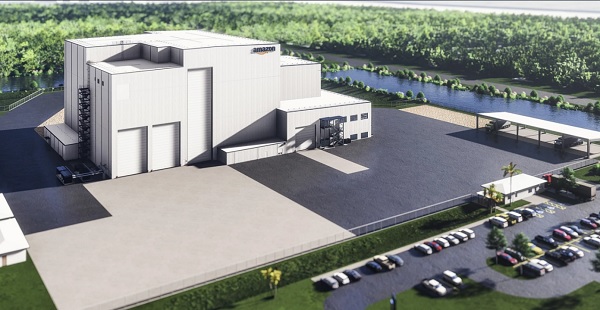
SK hynix Inc. is constructing a 4 billion dollar advanced packaging plant in West Lafayette, Indiana, scheduled for completion in 2028, that will handle the specific through-silicon via bonding and stacking operations required for high-bandwidth memory production. The plant is being supported by up to 458 million dollars in funding from the CHIPS and Science Act enacted in 2022, along with up to 570 million dollars in United States government loans. The facility represents SK hynix Inc.’s first production presence in the United States and aligns the company with the current United States industrial policy priorities around domestic semiconductor manufacturing capacity for critical AI infrastructure components.
The strategic significance of the Indiana facility is broader than the specific packaging economics. Advanced packaging has become one of the most strategically important nodes in the AI semiconductor supply chain because it is where the compute die, the high-bandwidth memory stacks, and the interposer are physically bonded into the final AI accelerator package. Locating advanced packaging capacity within the United States addresses specific supply chain resilience concerns that both the United States government and hyperscaler customers have prioritised, and it positions SK hynix Inc. to serve United States government defense and civilian AI infrastructure procurement mandates that increasingly favour domestically manufactured components.
The additional expansion architecture in the United States extends beyond the Indiana facility. SK hynix Inc. has committed 10 billion dollars to what it calls the AI Company initiative, which supports investments in new product lines and United States operations. The Solidigm NAND flash business near Sacramento, California, which SK hynix Inc. acquired from Intel Corporation, continues to expand its capacity and product portfolio serving hyperscale storage requirements. Together, the Indiana packaging plant, the Sacramento Solidigm operations, and the AI Company initiative build a materially larger United States operational footprint than SK hynix Inc. had entering 2026, and they align the company with the sustained multi-year United States investment agenda in domestic semiconductor manufacturing.
How does the imminent Nasdaq 100 and Philadelphia Semiconductor Index inclusion reshape passive demand for SKHY
The Nasdaq listing makes SK hynix Inc. eligible for inclusion in major United States equity indices including the Nasdaq 100 and the Philadelphia Semiconductor Index, and industry expectation is that Philadelphia Semiconductor Index inclusion could be fast-tracked by late July 2026 following the standard eligibility review processes. Once included in these indices, passive index-tracking funds and exchange-traded funds including Invesco QQQ Trust and iShares Semiconductor ETF would be required to purchase SKHY shares to match benchmark weightings. The estimated aggregate passive index buying pool for SK hynix Inc. across major indices could approach 14 billion dollars, based on the company’s expected index weight and the assets under management of the tracking funds.
The mechanical implications of index inclusion for share price dynamics are substantial. Passive index buying is price-insensitive and must maintain positions in constituents in proportion to their weight, which means the buying pressure builds progressively as index inclusion is announced, occurs at the specific rebalancing event, and continues over time as the underlying index funds themselves grow assets. That structural demand floor reduces the downside risk in SKHY relative to non-index constituents of comparable size, and it provides a specific mechanism for the valuation gap closure thesis to play out over time.
The additional derivative product ecosystem builds around the ADR listing to further amplify trading dynamics. GraniteShares has filed to launch a GraniteShares 2x Long SKHY Daily ETF under the ticker SKUU and a GraniteShares 2x Short SKHY Daily ETF under the ticker SKDD, both expected to begin trading on July 13, 2026 following the SKHYV to SKHY ticker transition. Direxion and ProShares have separately filed for single-stock leveraged ETFs tracking SK hynix Inc. The rapid development of the derivative product ecosystem around SKHY suggests that the equity is expected to attract materially active trading volume, which supports liquidity and price discovery in a way that further narrows the historical valuation gap.
Key takeaways on what the SK Hynix debut signals for AI memory investors and semiconductor supply chain policy
- SK hynix Inc. opened at 170 dollars per ADR on July 10, 2026, up approximately 14 percent from the 149 dollar offer price, raising 26.5 billion dollars in the second-largest United States equity share sale on record after the SpaceX Nasdaq debut in June 2026 and the largest ever by a foreign company.
- The offering was oversubscribed by more than seven times, with three cornerstone investors including Baillie Gifford, Coatue Management, and Situational Awareness Partners taking approximately 5 billion dollars, and the when-issued ticker SKHYV converts to the permanent ticker SKHY on July 13, 2026.
- President and Chief Executive Officer Kwak Noh-Jung told Bloomberg in his first-ever English-language interview that memory chip shortages will probably persist beyond 2030, citing customer willingness to sign long-term contracts as evidence that buyer behaviour reflects extended supply constraint expectations.
- SK hynix Inc. holds approximately 56 to 60 percent of the global high-bandwidth memory market against Samsung Electronics Co., Ltd. and Micron Technology, Inc. at approximately 21 percent each, and the HBM market is forecast to expand from approximately 65 billion dollars in 2026 to 290 billion dollars by 2030.
- The valuation gap closure thesis against Micron Technology, Inc. anchors on SK hynix Inc. trading at approximately 5.8 times forward earnings versus Micron Technology, Inc.’s approximately 7 times multiple, with HSBC research documenting a historical 35 percent Micron Technology, Inc. average premium over thirteen years driven by United States access advantages that the ADR listing addresses.
- Capital deployment targets Phase 1 of the Yongin semiconductor cluster in South Korea, part of a 390 billion dollar total investment commitment, the Cheongju P&T7 advanced packaging plant, and approximately 7.8 billion dollars in extreme ultraviolet lithography equipment procurement through the end of 2027 from ASML Holding N.V.
- The 4 billion dollar West Lafayette, Indiana advanced packaging plant, supported by up to 458 million dollars from the CHIPS and Science Act and up to 570 million dollars in United States government loans, aligns SK hynix Inc. with United States industrial policy priorities for AI semiconductor supply chain resilience.
- Nasdaq 100 and Philadelphia Semiconductor Index eligibility, with potential fast-tracked inclusion by late July 2026, could trigger approximately 14 billion dollars in passive index buying that provides a structural demand floor for SKHY.
- The listing arrives after memory sector stocks including SK hynix Inc., Micron Technology, Inc., Samsung Electronics Co., Ltd., and SanDisk Corporation each fell more than 20 percent between June 25 and July 3, 2026, in what has been characterised as memory’s first bear market of the AI cycle, and the debut is a specific test of investor conviction in the durability of the AI memory demand thesis.
- Execution and cycle risks include the historic memory boom-bust pattern that saw memory manufacturers post negative gross margins several years ago, intensifying HBM competition from Samsung Electronics Co., Ltd., the substantial capital expenditure commitments against uncertain long-term demand visibility, potential dilution from future ADR issuances that Chairman Chey Tae-won signalled remain possible, and geopolitical risks around the Korean peninsula and United States-China semiconductor trade dynamics.
Share this:
Discover more from Business-News-Today.com
Subscribe to get the latest posts sent to your email.